


What Every Homeowner Should Know About Cash Out Refi and Taxes
Understanding cash out refi and taxes is simpler than most homeowners expect — and the news is mostly good.
Quick answers:
- Is the cash from a cash-out refinance taxable? No. The IRS treats it as borrowed money, not income.
- Is the interest tax-deductible? Sometimes — but only if you use the funds to buy, build, or substantially improve your home.
- Does it trigger capital gains tax? No. You’re not selling the property, so no sale means no capital gains event.
- What about personal expenses like debt payoff? Interest on that portion is not deductible (for tax years 2018–2025).
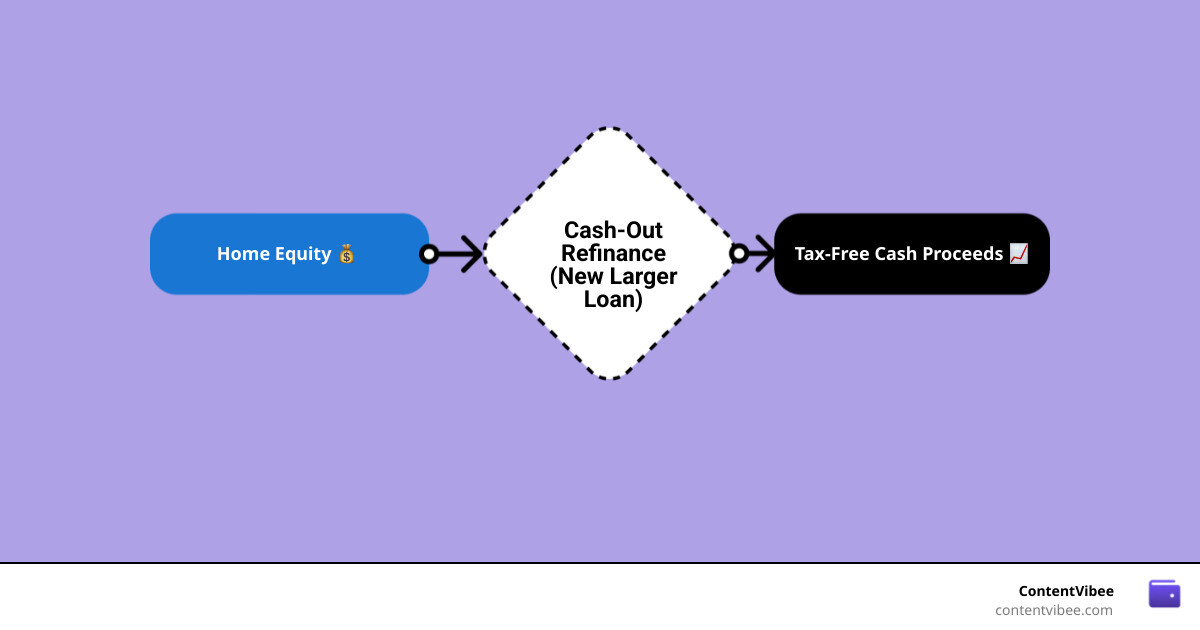
Here’s the simple version: when you do a cash-out refinance, you’re replacing your existing mortgage with a larger loan and pocketing the difference. Because you have to pay that money back, the IRS doesn’t count it as income. Think of it like shifting money from one pocket to another — your home equity goes down, your loan balance goes up, and no tax bill shows up at your door.
That said, how you spend the cash has a big impact on what you can deduct. And with the 2026 tax landscape still operating under the Tax Cuts and Jobs Act (TCJA) rules through 2025, the details matter.
This guide breaks it all down clearly — so you can refinance with confidence and avoid any surprises at tax time.
Understanding Cash Out Refi and Taxes: Is the Cash Taxable?
The short answer is no: cash you receive from a cash-out refinance is generally not taxable.
Why? Because it is loan proceeds. The IRS does not treat borrowed money as income when you have a legal obligation to repay it. A cash-out refi simply swaps your old mortgage for a new, larger one and gives you the difference in cash.
That also means a cash-out refi does not create a capital gains tax event. Capital gains usually come into play when you sell property for more than your tax basis. In a refinance, you still own the home. No sale, no capital gains trigger.
This rule is the same basic idea that applies to other home-equity borrowing, too. Whether you use a cash-out refinance, home equity loan, or HELOC, the proceeds themselves usually are not taxable.
For a deeper industry explainer, see this guide on cash-out refinance tax implications.

Why the IRS Views Cash Out Refi and Taxes as Non-Taxable Debt
The IRS looks at a cash-out refinance as debt, not earnings.
That matters because taxable income usually means money you receive and keep without a matching repayment obligation. Wages, interest income, and business profits fit that description. Refinance proceeds do not.
In plain English:
- You borrowed against home equity
- The loan is secured by your property
- You must repay principal and interest
- Therefore, the cash is not income
This is why people are often relieved to learn that taking $50,000, $80,000, or even more out of their home equity does not by itself create a tax bill.
Where homeowners get tripped up is not the cash itself, but the interest deduction rules. Those rules depend on how the funds are used. If you want to review another plain-language breakdown, this overview of cash-out refinance tax implications is helpful.
When Interest Becomes Tax-Deductible
This is the part that matters most.
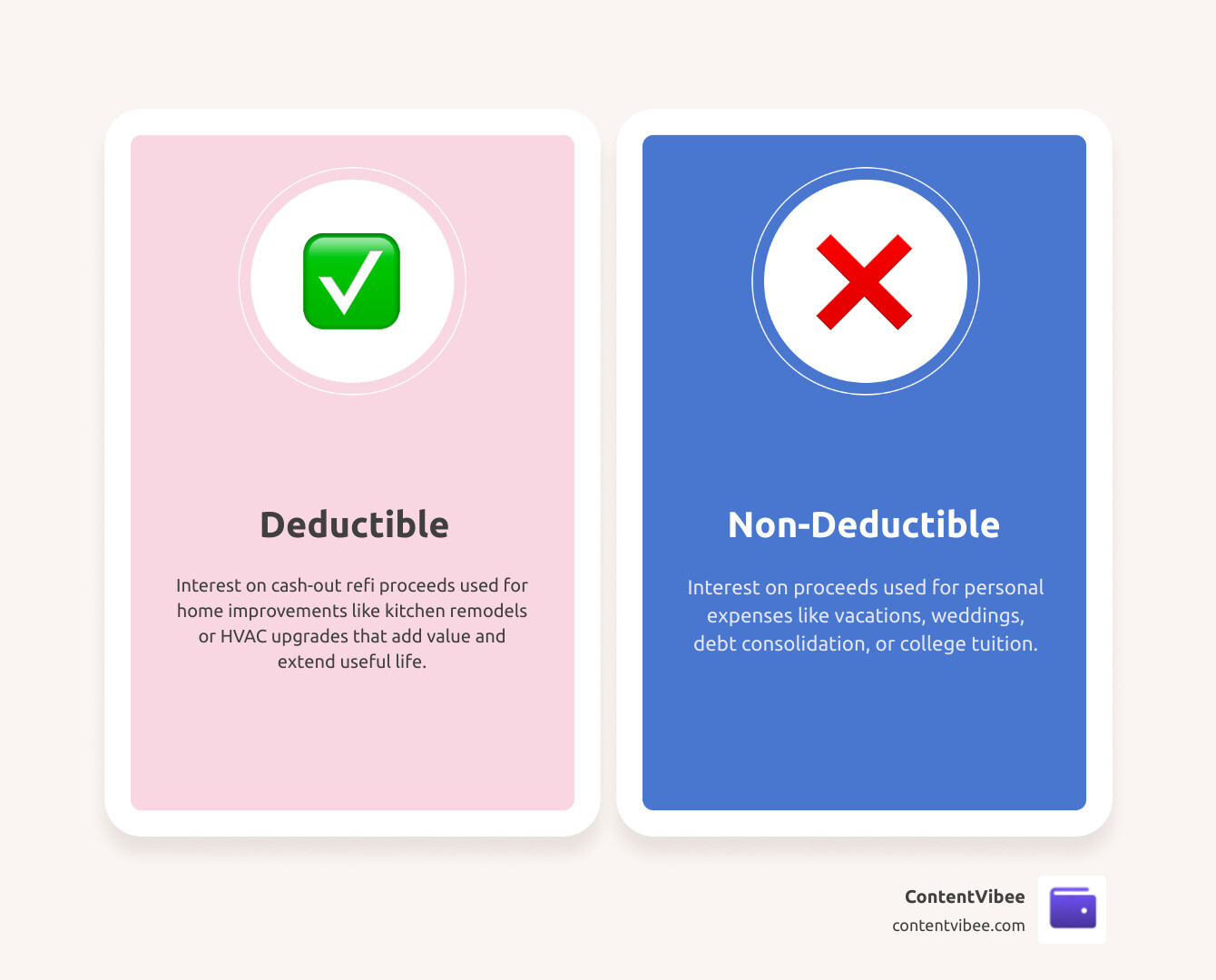
Interest on a cash-out refinance may be deductible if the money is used to buy, build, or substantially improve the home that secures the loan. In other words, the use of proceeds matters.
Generally, a substantial improvement is one that:
- Adds value to the home
- Extends the home’s useful life
- Adapts the home to a new use
Common examples that may qualify include:
- Kitchen remodels
- Bathroom remodels
- Roof replacement
- HVAC replacement
- New windows
- Room additions
- New garage
- Major electrical or plumbing upgrades
- Accessibility improvements
- Built-in security systems
Usually not qualifying on their own:
- Painting one room
- Basic repairs
- Fixing a leak
- Patching siding
- Routine maintenance
- Paying off credit cards
- Taking a vacation
- Covering wedding costs
Here is the simple comparison:
| Usually deductible use of cash-out funds | Usually not deductible use |
|---|---|
| Add a bedroom | Pay off credit cards |
| Replace the roof | Take a vacation |
| Remodel a kitchen | Buy a car |
| Install new HVAC | Pay tuition |
| Add permanent windows | Cover everyday bills |
If you split the money, the interest may be only partially deductible. For example, if you refinance and take $100,000 out, then use $60,000 for a qualifying remodel and $40,000 for personal debt, only the interest tied to the qualifying $60,000 portion may count.
Navigating Mortgage Debt Limits for Cash Out Refi and Taxes
Even if your use qualifies, deduction limits still apply.
For loans originating after December 15, 2017, mortgage interest is generally deductible only on up to:
- $750,000 of qualified mortgage debt for most filers
- $375,000 if married filing separately
For older grandfathered debt, the previous limit may be up to:
- $1 million
- $500,000 if married filing separately
A practical example: if your total qualifying mortgage debt after refinancing is $900,000, not all of the interest may be deductible under the current cap.
Also, you generally need to itemize deductions for mortgage interest to help you on your tax return. If you take the standard deduction, the mortgage interest deduction may not provide an actual tax benefit.
Before refinancing, it helps to understand approval basics and how lenders evaluate your application. Our guide to the pre approval home loan process can help you prepare.
Maximizing Deductions and Avoiding IRS Pitfalls
The biggest tax mistake with a cash-out refinance is assuming all the interest is deductible just because the loan is secured by your home. It is not that simple.
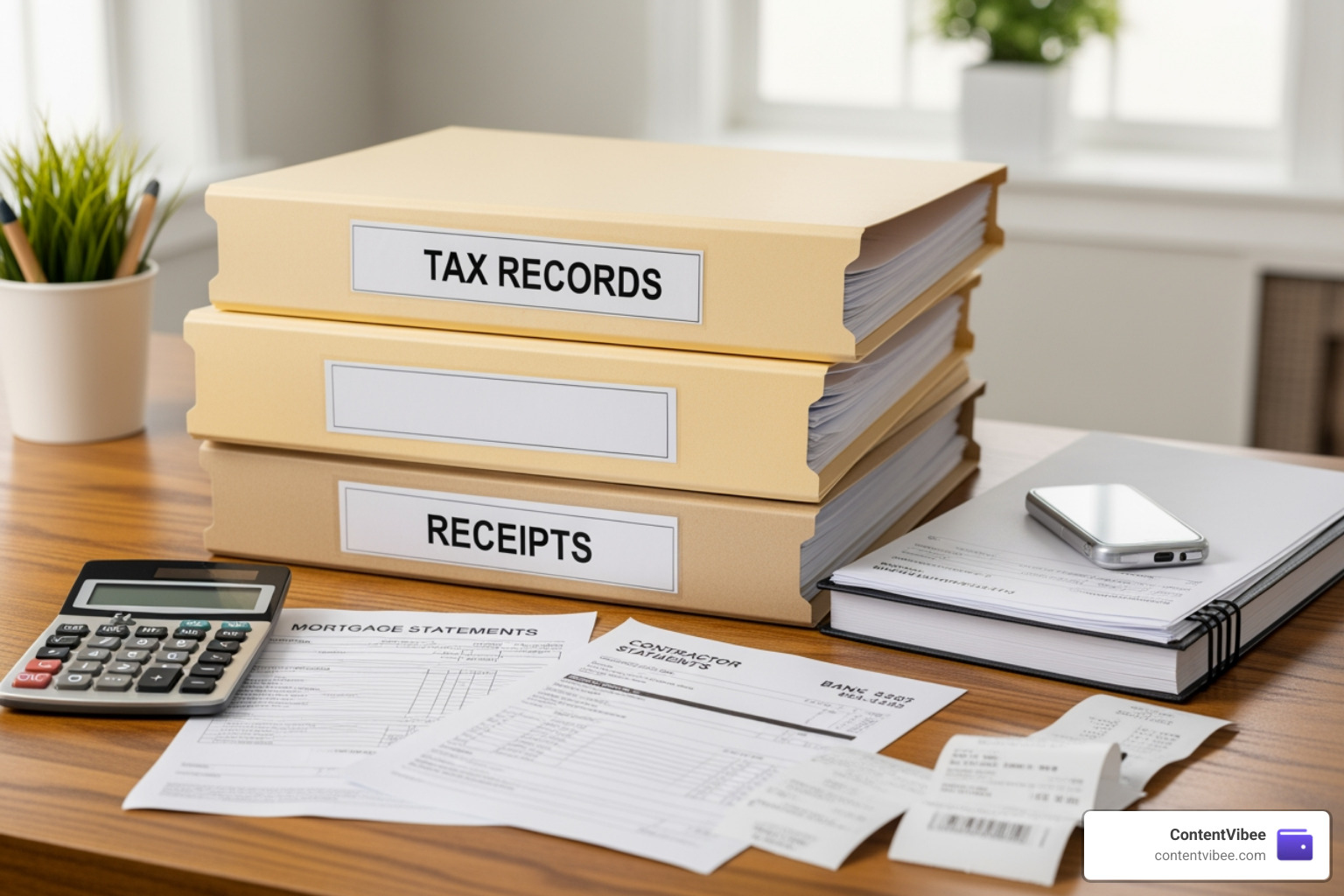
The IRS cares about tracing the use of funds. So if you want the deduction, you need records showing where the money went.
Keep:
- Your Closing Disclosure
- Mortgage statements
- Form 1098
- Contractor invoices
- Receipts for materials
- Proof of payment
- Bank statements showing fund transfers
- Permits and project contracts
- Before-and-after photos for major projects
Good records do two things:
- Support your mortgage interest deduction
- Help document capital improvements that may increase your basis in the home, which can reduce taxable gain when you eventually sell
That second benefit is often overlooked. A qualifying improvement may help now through deductible interest and later by supporting a higher cost basis.
If you are estimating refinance costs in Virginia, see our guide on what are the average closing costs in Virginia.
Capital Improvements vs. Personal Expenses
This is the line we want to keep very clear.
If cash-out funds go toward capital improvements, interest may be deductible. If the funds go toward personal spending, that portion usually is not.
Capital improvement examples:
- Full kitchen renovation
- New roof
- New addition
- New driveway
- Whole-home window replacement
- New fence or deck if it adds value and is permanent
Personal expense examples:
- Debt consolidation
- Medical bills
- Vacations
- Wedding expenses
- Emergency cash cushion
- College tuition
Now, that does not mean personal uses are always bad financially. If rolling high-interest credit card debt into a lower-rate mortgage saves significant interest each year, that may still help your budget. It just may not help your tax deduction.
And remember: improvements can also matter later for sale-related taxes. If you want more context on basis and gain, our article on rental sale capital gains explained covers the broader idea.
Rental Properties and Home Office Nuances
Rental properties follow different tax logic than a primary residence.
With a rental, mortgage interest is often treated as a business expense, and the use of funds still matters for tracing purposes. If cash-out proceeds are used for rental renovations, repairs, or even acquiring another income-producing property, the related interest may be deductible as a business expense if properly documented.
A few key points:
- Refinancing does not restart the property’s depreciation schedule
- Interest deductions often depend on fund tracing
- Mixed-use proceeds should be carefully separated
- Passive activity loss rules may limit how much rental loss you can use in a given year
The commonly cited passive loss allowance is up to $25,000 if adjusted gross income is under $100,000, phasing out up to $150,000.
For self-employed homeowners, a home office can add another wrinkle. If cash-out money is used to build or improve a qualifying home office, part of the interest may support a deduction if the office meets the regular and exclusive use rules. Under the simplified method, the home office deduction is $5 per square foot up to 300 square feet, for a maximum of $1,500.
Important note: employees working from home generally do not get the same federal home office deduction treatment.
For more on investment-property tax topics, see rental property sale what you need to know.
Deducting Points and Closing Costs
Most refinance closing costs are not immediately deductible.
Typical cash-out refinance closing costs run about 2% to 5% of the loan amount. So on a $200,000 refinance, you might pay roughly $4,000 to $10,000.
Here is the usual tax treatment:
- Mortgage points may be deductible over the life of the loan
- Prepaid mortgage interest may be deductible
- Appraisal fees are generally not deductible
- Title insurance is generally not deductible
- Attorney fees are generally not deductible as mortgage interest
- Recording and settlement fees usually are not immediately deductible as itemized mortgage interest
For points, refinances are different from many purchase loans. Instead of deducting all points in the year you refinance, homeowners usually amortize them over the loan term.
Example:
- $2,000 in points on a 15-year refinance
- Annual deduction is about $133.33 per year
That is not exactly thrilling cocktail-party conversation, but it is useful at tax time.
If you want a fuller breakdown of fees, read our guide to average refi closing costs.
Final Take on Cash Out Refi and Taxes
Here is the bottom line on cash out refi and taxes:
- The cash you receive is usually not taxable
- A cash-out refinance does not trigger capital gains tax
- Interest may be deductible only when funds are used to buy, build, or substantially improve the home securing the loan
- Personal uses like debt consolidation or vacations do not make that interest deductible
- Debt limits, itemizing rules, and documentation all matter
- Rental properties and home offices have special rules
If there is one takeaway, it is this: keep excellent records. The tax benefit often depends less on the refinance itself and more on your paper trail after the money lands in your account.
And before signing, make sure the overall deal makes sense beyond taxes alone. Rate, payment, loan term, and closing costs all matter too. If you are comparing offers, start with our pillar guide on average refi closing costs.


