


What You’re Actually Paying a Personal Injury Lawyer (And When)
How much does a personal injury lawyer charge is one of the first questions injured people ask — and the answer is simpler than most expect.
The short answer:
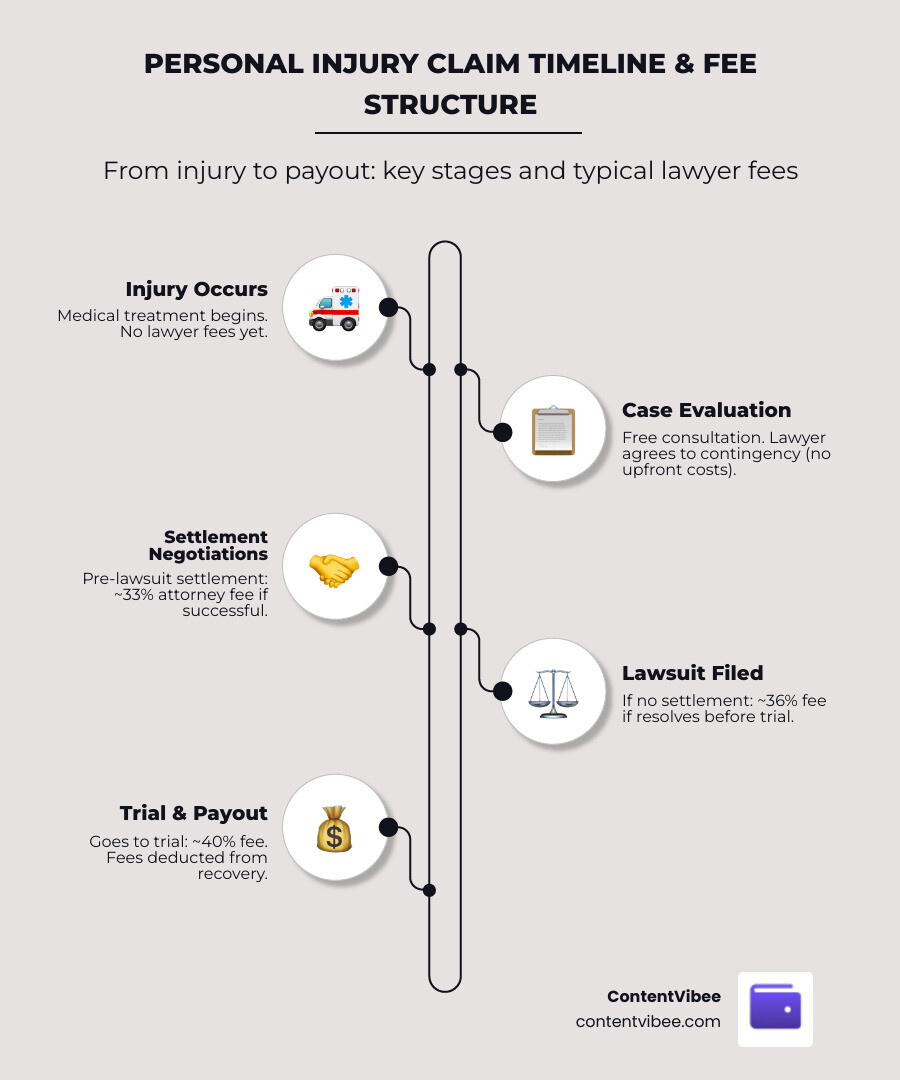
| Case Stage | Typical Lawyer Fee |
|---|---|
| Settles before filing a lawsuit | ~33% of your settlement |
| Lawsuit filed, settles before trial | ~36% of your settlement |
| Goes to trial | ~40% of your settlement |
| Workers’ comp cases | 15–25% (state-regulated) |
| Medical malpractice | 33–40% (plus high case costs) |
Key facts upfront:
- You pay nothing upfront — personal injury lawyers work on contingency
- You owe no attorney fees if you lose
- Fees come out of your settlement, not your pocket
- Additional case expenses (court fees, expert witnesses, etc.) are separate from the percentage
- The American Bar Association confirms the standard range is 33% to 40%
Most people avoid calling a lawyer because they assume it’s too expensive. But the contingency fee model flips that entirely — your lawyer only gets paid when you get paid. That means their financial interest is perfectly aligned with yours.
The U.S. personal injury law market hit $61.7 billion in revenue in 2025, and research consistently shows that people who hire attorneys recover an average of 3.5 times more than those who go it alone — even after paying legal fees.
This guide breaks down exactly how fees work, what comes out of your settlement, and how to make sure you’re keeping as much of your money as possible.
Basic how much does a personal injury lawyer charge vocab:
How Much Does a Personal Injury Lawyer Charge?

When we look at the landscape of legal fees in May 2026, the standard for personal injury remains rooted in the “contingency fee.” According to guidelines often cited by the American Bar Association, the majority of personal injury attorneys will ask for a percentage of the final financial award rather than an hourly rate.
In Virginia and across the U.S., the industry standard typically hovers between 33.3% (one-third) and 40%. This might seem like a hefty slice of the pie, but it’s important to remember what that fee covers. This percentage isn’t just for the lawyer’s time; it’s for their expertise, their staff’s work, and the fact that they are essentially financing your lawsuit.
Common fee structures include:
- Flat Contingency: A set percentage (e.g., 33%) regardless of when the case settles.
- Sliding Scale: The percentage increases as the case progresses through different stages of litigation.
- Capped Fees: Often seen in workers’ compensation or medical malpractice cases where state law limits the maximum percentage.
Understanding these costs is the first step toward a successful claim. For more detailed insights, you can explore our Understanding Personal Injury Costs resource.
Understanding the Contingency Fee Model
The contingency fee model is the “great equalizer” in the American legal system. It allows someone with zero dollars in their bank account to go toe-to-toe with a multi-billion dollar insurance company. Because there are no upfront costs, the lawyer takes on all the financial risk. If they don’t win, they don’t get paid.
This creates a powerful alignment of interests. We like to think of it as performance-based pay. Your attorney has every incentive to maximize your settlement because their paycheck depends on it. They aren’t just your advocate; they are your financial partner in the pursuit of justice. You can find more about these arrangements in our Category/Legal Guides/ section.
Typical Percentages and How Much a Personal Injury Lawyer Charges in 2026
As we navigate 2026, the “one-third rule” is still the most common benchmark. However, many firms use a tiered structure to reflect the amount of work required.
| Case Milestone | Standard Fee Percentage |
|---|---|
| Pre-Litigation Settlement | 33.33% |
| Settlement after Lawsuit Filing | 36% – 38% |
| Trial Verdict | 40% |
| Appeals | 45% |
This tiered approach is fair because filing a lawsuit involves significant additional work—drafting complaints, conducting depositions, and preparing for the courtroom. If your case requires a trial, the lawyer is essentially moving into the courthouse for a week or more, which justifies the 40% rate. To stay updated on these figures, check out Personal Injury Fee Trends for 2026.
Factors That Influence How Much a Personal Injury Lawyer Charges
Not every case is created equal. Several factors can push the percentage up or down:
- Case Complexity: A simple rear-end collision with clear liability might stay at 33%. A complex product liability case involving federal regulations will likely be higher.
- Medical Malpractice: These cases are notoriously expensive and risky. In many jurisdictions, lawyers may charge closer to 40% because they have to advance hundreds of thousands of dollars for expert witnesses.
- Workers’ Compensation: In Virginia, attorney fees for workers’ comp are strictly regulated and usually capped at 20% of the recovery, requiring approval from the Workers’ Compensation Commission.
- Lawyer Experience: A high-profile attorney with a track record of multi-million dollar verdicts may charge a premium, but as we’ll discuss later, their results often justify the cost.
To get a better idea of how these factors play into your specific situation, try our Tools/Settlement Calculators/Car Accident Settlement Calculator/.
Maximizing Your Net Recovery and Final Take-Home

At the end of the day, you don’t care about the “gross” settlement amount nearly as much as the “net” amount—the actual check that goes into your bank account. How much does a personal injury lawyer charge is only one part of the equation. You also have to account for case expenses and medical liens.
To estimate your actual take-home pay, you can use our Calculating Your Final Settlement tool.
Additional Case Expenses and Hidden Costs
Attorney fees and “case costs” are two different things. While the attorney fee covers the lawyer’s labor, case costs cover the out-of-pocket expenses required to build the case. These often include:
- Court Filing Fees: Usually $100 to $500.
- Expert Witnesses: Doctors or accident reconstructionists can charge $2,000 to $10,000+ for testimony.
- Medical Records: Hospitals often charge per page to provide your history.
- Deposition Costs: Paying for court reporters and transcripts.
Most firms “advance” these costs, meaning they pay for them as they go and deduct them from the final settlement. It is vital to ask: “What happens if we lose?” Most reputable firms will waive these costs if there is no recovery, but some contracts might still hold you responsible. For specific slip and fall scenarios, check out our Tools/Settlement Calculators/Slip And Fall Settlement Calculator/.
Gross vs. Net Settlement Calculations
This is where the math gets tricky. There are two ways lawyers calculate their fee:
- The Gross Method: The lawyer takes their 33% from the total settlement before expenses are deducted.
- The Net Method: The lawyer deducts the expenses first, then takes their 33% from the remaining balance.
The Net Method is much more client-friendly and results in more money in your pocket. Always ask your potential lawyer which method they use. Additionally, your lawyer will negotiate your “medical liens”—money you owe to health insurance or hospitals—to ensure they don’t eat up your entire recovery. You can model these scenarios using our Tools/Settlement Calculators/Realistic Settlement Calculator/.
Is Hiring a Lawyer Worth the Cost?
It’s the million-dollar question (sometimes literally). If a lawyer takes 33% to 40%, are you better off handling it yourself?
The data says a resounding no. According to the Insurance Research Council, injured claimants who hire attorneys receive settlements averaging 3.5 times higher than those who represent themselves. Even after the lawyer takes their cut, the victim usually walks away with significantly more money.
Beyond the math, there is the “peace of mind” factor. A lawyer handles the aggressive insurance adjusters, the mountain of paperwork, and the strict legal deadlines. At ContentVibee, we believe your focus should be on healing, not arguing with a claims adjuster over the price of an MRI.
For a personalized look at the value of your claim, visit our Tools/Settlement Calculators/Personal Injury Settlement Calculator/. For other professional guides, see our https://contentvibee.com/category/real-estate/ section.
Frequently Asked Questions About Lawyer Fees
Can you negotiate the lawyer’s contingency fee percentage?
Yes, you can. While 33% to 40% is standard, it isn’t set in stone. If you have a very strong case with clear liability (like a dashcam video of someone running a red light) and high damages, you might negotiate a lower rate. However, the most experienced lawyers rarely discount their fees because their time is in high demand.
What happens if I lose the case—do I owe the lawyer anything?
Under a standard contingency agreement, you owe zero in attorney fees if you lose. As for the case expenses (filing fees, etc.), most firms in 2026 will “write those off” if the case is unsuccessful, but you must confirm this is in your written agreement.
Do fee structures vary by state?
Yes. While the 33-40% range is a national average, some states have specific caps. In Virginia, for example, workers’ compensation fees are strictly controlled by the state. Medical malpractice fees also have specific caps in several states to prevent excessive litigation.
What questions should I ask before signing?
Before you put pen to paper, ask these four critical questions:
- Is your fee calculated on the gross or net settlement?
- Will I be responsible for case expenses if we lose?
- Does the percentage increase if we file a lawsuit?
- Who will be my primary point of contact—you or a paralegal?
The Bottom Line on Lawyer Costs
Hiring a personal injury lawyer in 2026 is an investment in your recovery. While the idea of giving up a third of your settlement is tough, the reality is that a skilled attorney often turns a $10,000 “lowball” offer into a $50,000 settlement.
By understanding how much does a personal injury lawyer charge, you can enter your consultation with confidence, knowing exactly where your money is going and how to maximize your final take-home pay.
For more tools to help you navigate your financial and legal journey, check out our other calculators:
- Tools/Settlement Calculators/Malpractice Settlement Calculator/
- Tools/Settlement Calculators/Structured Settlement Calculator/
- Tools/Settlement Calculators/Birth Injury Settlement Calculator/
- Detailed Reviews Of The Top 10 Family Law Attorneys La/
- Buyers Guide Best Family Law Attorneys Denver/


