


Is whole life insurance a good investment depends heavily on your financial situation — and for most people, the honest answer is: not primarily.
Here’s a quick breakdown to answer the question directly:
| Scenario | Whole Life a Good Fit? |
|---|---|
| You want pure life insurance coverage | No — term life is far cheaper |
| You’ve maxed out your 401(k) and IRA | Possibly — adds tax-deferred savings |
| You have a lifelong dependent (e.g., disabled child) | Yes — provides permanent, guaranteed coverage |
| Your estate exceeds $13.9 million | Yes — helps cover estate taxes |
| You want strong investment growth | No — returns average just 1% to 3.5% annually |
| You want market-linked growth | No — consider index funds or brokerage accounts |
Whole life insurance is a permanent life insurance policy. Unlike term life, it never expires as long as you pay premiums. It also builds a cash value over time — a savings-like component that grows at a guaranteed (but low) rate.
That cash value feature is what makes people call it an “investment.” But the numbers tell a complicated story.
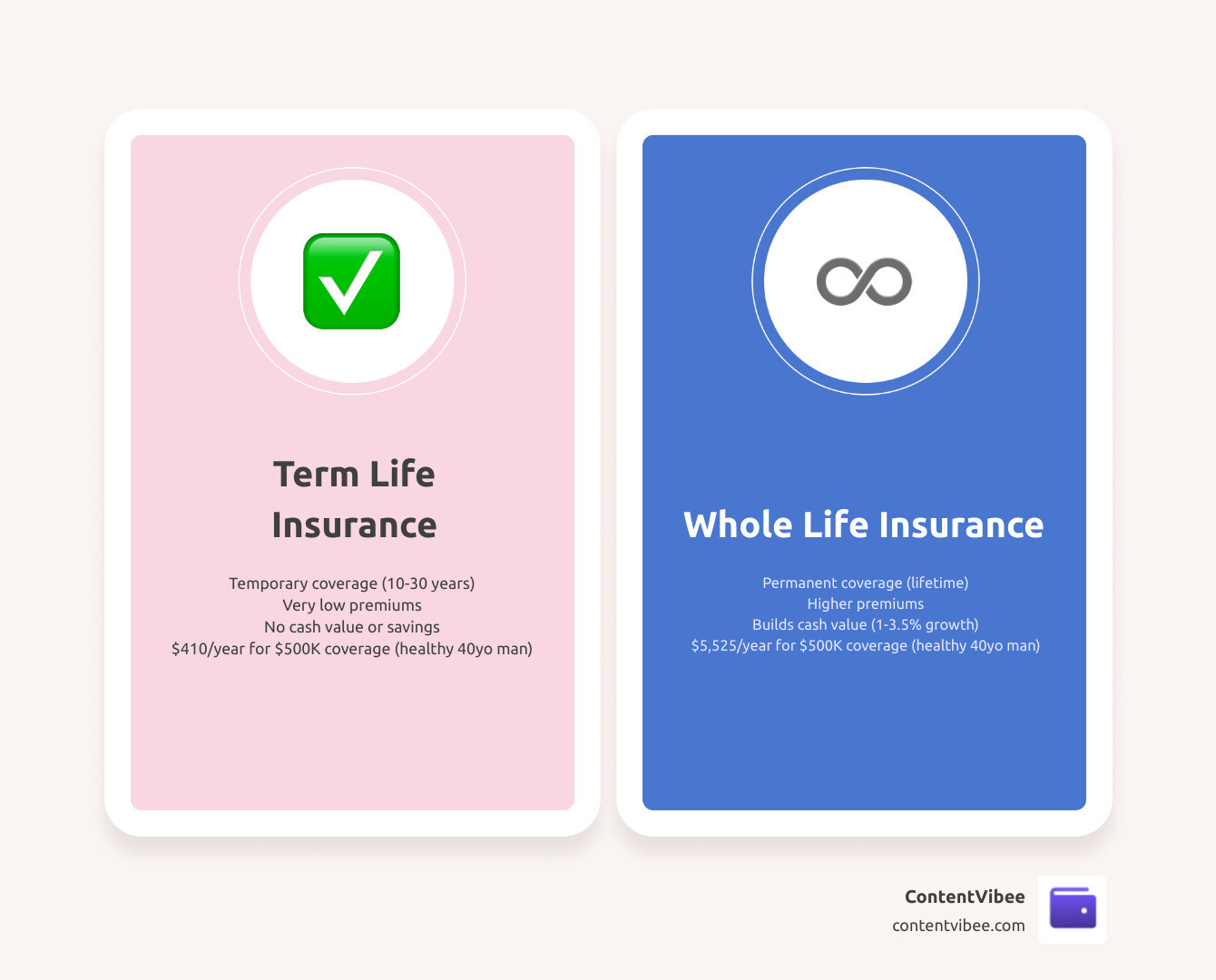
A healthy 40-year-old man pays roughly $5,525 per year for a $500,000 whole life policy. The same coverage via term life? Just $410 per year. That $5,000+ annual gap is either a powerful planning tool or a costly missed opportunity — depending on what you do with it.
The core tension is simple: whole life offers stability and guarantees, while traditional investments offer significantly higher growth potential. Understanding which matters more to your goals is what this guide is all about.
Understanding the Mechanics: Is Whole Life Insurance a Good Investment?
To decide if is whole life insurance a good investment for your family in 2026, we first need to peel back the layers of how these policies actually function. Unlike your standard car insurance or even term life insurance, whole life is a “bundled” financial product.
When we pay a premium for a whole life policy, that money doesn’t just vanish into the insurer’s pocket to cover the risk of us passing away. Instead, the insurance company allocates your premium into three main buckets:
- The Cost of Insurance (COI): This pays for the actual death benefit.
- Administrative Fees and Commissions: These are front-loaded, which is why your policy has almost no value in the first few years.
- The Cash Value Account: This is the “investment” portion.
This cash value grows on a tax-deferred basis, meaning we don’t pay taxes on the interest or dividends as they accumulate. Think of it as a “forced savings” vehicle. For many of us who struggle to consistently move money into a brokerage account, the bill for a life insurance premium acts as a nudge to save.
However, we must also consider the broader umbrella of financial security. In 2026, protecting your wealth isn’t just about growth; it’s about defense. While a whole life policy offers a death benefit, it doesn’t protect you from modern digital threats. For instance, knowing unauthorized bank transaction how to dispute and recover money USA 2026 is just as vital to your net worth as choosing the right insurance. A whole life policy is a fortress for your legacy, but you still need a security system for your daily cash flow.
Evaluating the Cash Value Component: Is Whole Life Insurance a Good Investment for Growth?
If we look at the cash value strictly as a growth engine, it’s a bit like a turtle in a race against hares. It’s slow, steady, and very unlikely to trip, but it won’t be winning any speed trophies.
The average annual rate of return on whole life insurance cash value typically hovers between 1% and 3.5%. When the S&P 500 has historically averaged around 10% (before inflation), a 2% return can feel underwhelming.
Furthermore, the accumulation is incredibly slow at the start. Because of high initial commissions and fees, it often takes 10 to 15 years for the cash value to even equal the total amount of premiums you’ve paid. If you decide to cancel the policy early, you’ll likely face “surrender charges,” which can eat up what little value has accrued.
However, there is a silver lining: Dividends. If you buy a policy from a “mutual” insurance company (an insurer owned by the policyholders rather than shareholders), you may receive annual dividends. While not guaranteed, these dividends can be used to purchase more insurance, reduce your premiums, or simply be added to your cash value to boost that return slightly higher than the guaranteed floor.
Tax-Advantaged Wealth Building: Is Whole Life Insurance a Good Investment for High Net Worth Individuals?
This is where the “investment” argument gets some teeth. For the average person, the high costs of whole life usually outweigh the benefits. But for high-net-worth individuals who have already maxed out their 401(k)s, IRAs, and HSAs, whole life insurance offers a unique tax shelter.
The cash value grows tax-deferred, and we can often access that money tax-free through policy loans. Unlike a bank loan, a policy loan doesn’t require a credit check, and you aren’t technically required to pay it back (though any unpaid balance will be deducted from the death benefit later).
Then there is the issue of Estate Taxes. As of 2025, the federal estate tax exemption sits at $13.9 million, according to the Internal Revenue Service (IRS). If your estate is worth more than that, Uncle Sam is going to want a significant cut when you pass away. Whole life insurance is frequently used to provide heirs with the liquid cash needed to pay those taxes without having to sell off family businesses or real estate.
Even at the state level, this matters. In New York, for example, the estate tax kicks in after just $7.35 million. For a family with a successful business or significant property holdings, is whole life insurance a good investment? In this specific case, yes—it’s a strategic tool for tax mitigation.

Performance Analysis: Cash Value vs. Market Returns
To truly answer is whole life insurance a good investment, we have to look at the “opportunity cost.” This is the money we could have made if we had invested that same premium amount elsewhere.
Let’s look at a concrete comparison based on current 2026 data. Imagine we have $250 a month to put toward our future.
- Option A: Whole Life Insurance. After 2 years, we’ve paid $6,000 in premiums. Our cash value? A measly $950. The rest went to fees and insurance costs.
- Option B: Brokerage Account. We buy a cheap term life policy for $20 a month and invest the remaining $230 in a diversified brokerage account. At a conservative 6% return, after 2 years, we’d have $6,357. That’s a difference of over $5,400 right out of the gate.
The gap only widens over time:
| Years of $250/mo Premium | Whole Life Cash Value | Brokerage Account (6% Return) | The “Cost” of Whole Life |
|---|---|---|---|
| 10 Years | $27,000 | $41,000 | $14,000 |
| 30 Years (10 yrs pay + 20 yrs growth) | $46,000 | $135,000 | $89,000 |
By choosing whole life, you might end up with 293% less wealth than if you had invested in the market. This is why critics often argue that whole life is a poor investment. You are essentially paying a massive premium for the “guarantee” of a low return.
However, we must consider risk tolerance. Some investors are terrified of market volatility. They remember the crashes of the past and want an asset that cannot go down in value. For them, the 1-3.5% return is the price they pay for sleeping soundly at night, knowing their principal is safe.
The Cost of Permanent Protection
We also can’t ignore the sheer price tag. For a healthy 40-year-old man, a $500,000 whole life policy costs about $5,525 annually. A 20-year term policy for the same amount costs about $410.
For a woman of the same age, the whole life premium is roughly $4,968, while the term policy is just $340.
When you choose whole life, you are committing to a high fixed cost for the rest of your life. If your income drops or you hit a financial rough patch, those premiums can become a heavy burden. If you stop paying, the policy could lapse, and you could lose the very protection you were trying to build.
Strategic Scenarios: When Permanent Coverage is Worth the Cost
While the math often favors “buy term and invest the difference,” there are specific “Real World Use Cases” where whole life insurance is not just a good investment—it’s the only logical choice.
1. Lifelong Dependents If you have a child with a disability who will require specialized care long after you are gone, a term policy isn’t enough because it will eventually expire. A whole life policy, often used to fund a Special Needs Trust, ensures that money is available exactly when it’s needed, regardless of when you pass away. This provides a level of financial security that a volatile stock market cannot guarantee.
2. Estate Liquidity As we mentioned earlier, if you have a multi-million dollar estate, your heirs might face a massive tax bill. If your wealth is tied up in “illiquid” assets like a family farm or a private company, your heirs might be forced to sell the asset just to pay the IRS. A whole life policy provides immediate cash (the death benefit) to cover those taxes.
3. Business Succession In a partnership, what happens if one partner dies? The surviving partner might not want to go into business with the deceased partner’s spouse. Many businesses use whole life policies to fund buy-sell agreements. The policy provides the cash for the surviving partner to “buy out” the deceased partner’s share from their heirs.
4. Financial Recovery and Asset Protection In an era of rising digital crime, having a portion of your wealth in a “non-correlated” asset like life insurance can be a safety net. While we should all be aware of identity theft credit report fraud how to fix and protect your score USA, having cash value that is generally protected from creditors in many states adds a layer of “financial recovery” potential that a standard checking account doesn’t offer.

Buy Term and Invest the Difference
For the vast majority of Americans, the “Buy Term and Invest the Difference” (BTID) strategy is the superior wealth-building move.
The logic is simple:
- Buy a term life policy that covers you during your “high responsibility” years (when you have a mortgage and young kids).
- Take the thousands of dollars you would have spent on whole life premiums and put them into index funds or a Roth IRA.
- By the time the term policy expires, your kids are grown, your house is paid off, and your investment account has grown so large that you are “self-insured.” You no longer need life insurance because you have enough cash to leave a legacy.
This strategy offers flexibility. If you have a bad year, you can stop contributing to your brokerage account without losing your insurance. With whole life, you don’t have that luxury.
Frequently Asked Questions
What is the main downside of whole life insurance?
The biggest downsides are the high cost and the low rate of return. Premiums are often 10 to 15 times higher than term life. Additionally, the complexity of the policies can lead to “opportunity cost”—the loss of potential gains you could have seen in a standard brokerage account. Lastly, whole life is illiquid in the early years; if you need your money back in the first 5 years, you’ll likely get almost nothing.
At what age is whole life insurance worth it?
There isn’t a single “perfect” age, but the math changes as you get older. Younger buyers lock in lower premiums, but they also face the longest period of “opportunity cost” compared to market investing. For seniors, whole life is rarely about “investing” and more about estate planning or ensuring there is enough money for final expenses (funeral costs). If you are between 30 and 50 and have maxed out all other tax-advantaged accounts, that is often the “sweet spot” for considering it as a secondary vehicle.
Does whole life insurance always pay out?
Yes, provided the policy is “in force.” This means you must keep up with your premium payments. The death benefit is guaranteed, but there are a few caveats. If you have outstanding policy loans when you die, that amount is subtracted from the payout. Also, if you lied on your application (about smoking, for example), the insurer could contest the claim during the “contestability period” (usually the first two years).
Conclusion
So, is whole life insurance a good investment?
If you are looking for high growth and maximum wealth, the answer is usually no. You’ll likely be much better off buying a term policy and putting your extra cash into a diversified portfolio.
However, if you are a high-net-worth individual looking for a tax shelter, or if you have a specific need for permanent protection—like a child with special needs or a complex business agreement—whole life insurance provides a combination of guarantees and tax perks that no other product can match.
At ContentVibee, we believe in a holistic approach to financial security. Whether you’re deciding on insurance or trying to navigate zelle fraud transaction recovery steps and bank protection options USA 2026, the goal is the same: protecting what you’ve worked so hard to build.
Before making a final decision, we highly recommend speaking with a fee-only fiduciary financial advisor. Unlike an insurance agent who earns a commission on the sale, a fiduciary is legally obligated to act in your best interest. They can help you run the numbers for your specific situation and ensure your insurance choices align with your long-term goals.
For more guides on protecting your digital and financial life, visit our financial security services section. Your future self will thank you for doing the homework today.


