


Zacks Investment Research Subscription Pricing and Value Analysis is one of the most searched topics among self-directed investors trying to decide if a paid stock research tool is actually worth the money.
Here’s a quick breakdown of what Zacks costs in 2026:
| Plan | Monthly Cost | Annual Cost | Best For |
|---|---|---|---|
| Free | $0 | $0 | Basic Zacks Rank lookups |
| Premium | ~$21/mo | $249/year | Screens, reports, Focus List |
| Investor Collection | $59/mo | $495/year | Multiple model portfolios |
| Ultimate | $299/mo | $2,995/year | Full access to 20+ private portfolios |
The short answer: Zacks Premium at $249/year gives you access to the full Zacks Rank system, stock screeners, research reports, and the Earnings ESP filter. Higher tiers add curated model portfolios with strong recent track records — but at a steep price jump.
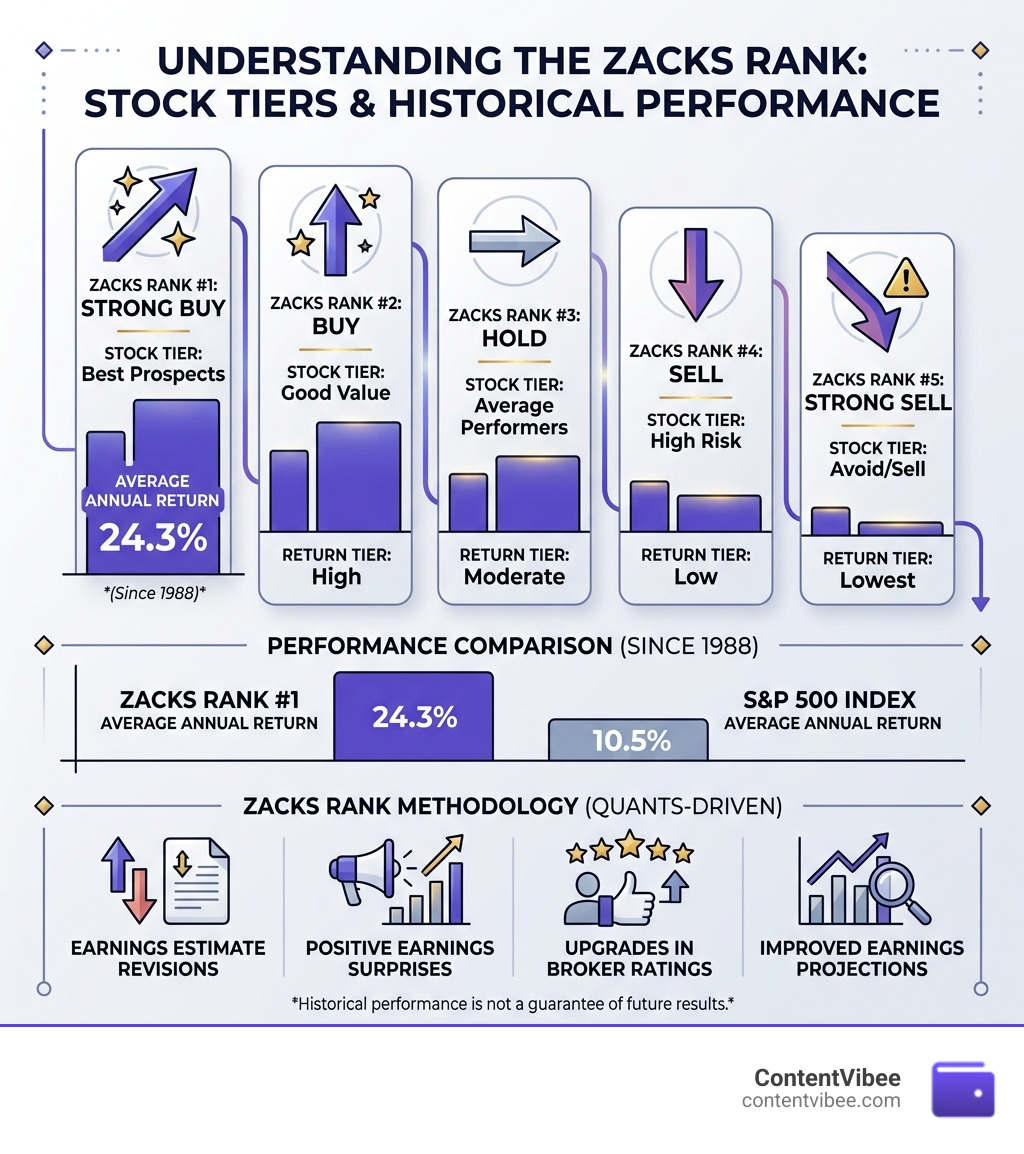
Zacks has been around since 1978, built by MIT-trained researcher Len Zacks on a simple but powerful idea: earnings estimate revisions drive stock prices. That core thesis has powered the Zacks Rank system for over 35 years, and the historical numbers are hard to ignore — #1 Strong Buy stocks have averaged roughly 24.3% annually since 1988, compared to about 10.5% for the S&P 500.
But here’s the real question most investors are asking in 2026: does that edge still hold when EPS data is freely available almost everywhere? And does the subscription price actually justify the value over free alternatives?
That’s exactly what this guide breaks down.
The Zacks Rank Methodology and Performance Track Record
To understand if the Zacks Investment Research Subscription Pricing and Value Analysis makes sense for your wallet, we first have to look under the hood. The entire platform is built on the “Zacks Rank,” a quantitative model that sorts approximately 4,400 stocks into five categories.
Unlike many analysts who rely on “gut feelings” or subjective interviews with CEOs, Zacks is cold, hard, and mathematical. It focuses on four key factors of earnings estimate revisions:
- Agreement: Are most analysts moving their estimates in the same direction?
- Magnitude: How big is the change in the consensus estimate?
- Upside: Is the most recent estimate higher than the consensus?
- Surprise: Does the company have a history of beating expectations?
A core component of this is the Earnings ESP (Expected Surprise Prediction). This tool compares the “Most Accurate Estimate” to the “Zacks Consensus Estimate.” If the most recent estimate is significantly higher than the average, there is a high probability of a positive earnings surprise. In fact, Zacks’ backtests suggest that when a stock has a Zacks Rank #1 and a positive Earnings ESP, it results in a positive surprise 70% of the time.

The performance claims are bold. Since 1988, Zacks #1 Strong Buy stocks have delivered an average annual return of 24.3%. To put that in perspective, the S&P 500 averaged 10.5% over the same period. If you had invested $10,000 in the Zacks #1 list in 1988, it would hypothetically be worth millions today—though we must remember that this assumes monthly rebalancing and zero commission costs, which isn’t always realistic for the average retail trader.
However, even with those caveats, the 35-year track record is a massive data set. It suggests that the system isn’t just a “flash in the pan.” By focusing on analyst revisions, Zacks essentially hitches its wagon to the smartest people in the room—the institutional analysts who spend 80 hours a week dissecting a single sector. When those experts collectively raise their targets, it’s usually a signal that something good is happening. This data-driven approach is also a vital tool for Membership Benefits – Zacks Investment Research (2026), helping users avoid the emotional pitfalls of trading.
Zacks Investment Research Subscription Pricing and Value Analysis for 2026
When we look at the Zacks Investment Research Subscription Pricing and Value Analysis for April 2026, the options range from “completely free” to “the price of a used car.”
For many, the entry point is the 30-day free trial. Zacks often runs promotions where you can access the Investor Collection or Ultimate tiers for just $1 for the first month. This is a great way to “test drive” the private portfolios without committing thousands of dollars upfront. They also offer a 90-day money-back guarantee on the Premium service, which provides a safety net for those worried about buyer’s remorse.
| Tier | Price (2026) | Key Features |
|---|---|---|
| Free | $0 | Basic Rank (1-5), Daily Newsletter |
| Premium | $249/year | Full #1 Rank List, Equity Research Reports, Focus List |
| Investor Collection | $495/year | Everything in Premium + Long-term Investor Portfolios |
| Ultimate | $2,995/year | All Private Portfolios, Trading Alerts, All Service Access |
To see the full list of what’s currently included, you can check the Zacks Premium Stock Research & Recommendations page.
Breaking Down the Zacks Investment Research Subscription Pricing and Value Analysis by Tier
Zacks Premium ($249/year): This is the bread and butter of the service. For about $21 a month, you get the full list of ~220 Strong Buy stocks. In 2026, where market dispersion is high, having a filtered list of “best-in-class” stocks is a huge time-saver. You also get the Focus List, which is a curated selection of 50 stocks for long-term outperformance, and the Earnings ESP Filter to find stocks likely to beat their next quarterly report.
Zacks Investor Collection ($59/month or $495/year): This tier is designed for those who want more “hand-holding.” It includes several niche newsletters like Value Investor, Informed Investor, and Stocks Under $10. If you don’t have time to build your own screens, these model portfolios do the work for you.
Zacks Ultimate ($299/month or $2,995/year): This is the “God Mode” of Zacks. It includes every single private portfolio and trading service they offer. We’re talking about 20+ different strategies, from Blockchain Innovators to Options Trader. It’s a professional-grade tool, but as we’ll discuss, you need a significant amount of capital to make the subscription cost worth it.
Evaluating the Zacks Investment Research Subscription Pricing and Value Analysis for Long-Term ROI
Is it actually worth the price tag? Let’s look at the ROI. As of April 5, 2026, the Zacks Value Investor portfolio has returned +58% over the last three years, beating the S&P 500 (+12%) by a staggering 46%. Similarly, the Zacks Top 10 portfolio returned +31% in the same period, beating the market by 19%.
If you are managing a $100,000 portfolio, a $249 annual fee for Premium represents only 0.25% of your assets. If the Zacks Rank helps you gain even an extra 1% in annual returns, the service has paid for itself four times over. However, if you’re only investing $1,000, the $249 fee is a 25% “tax” on your capital—at that point, you’re better off sticking to the free version or low-cost index funds.
For the Ultimate tier at nearly $3,000 a year, the math changes. To justify that cost, you likely need a portfolio of at least $500,000. This tier is for serious, active traders who are looking for specific, high-conviction alerts across multiple sectors.
Is Zacks Premium Worth the Cost for Self-Directed Investors?
The world of 2026 is full of data. You can find EPS estimates on Google, Yahoo Finance, or your brokerage app for free. So why pay for the Zacks Investment Research Subscription Pricing and Value Analysis?
The value isn’t just in the data; it’s in the distillation of that data. Every day, over 20 stocks are added or removed from the #1 Rank list. For a self-directed investor, trying to track 500,000 earnings estimates across thousands of companies manually is impossible. Zacks does the heavy lifting, providing a systematic, quantitative screen that removes emotion from the equation.

The Pros of Zacks Premium:
- Objectivity: The system doesn’t care about “hype” or “story.” It only cares about numbers.
- The #1 Rank List: A manageable list of ~220 stocks that have historically outperformed.
- Earnings ESP: A legitimate edge for traders who play the “earnings season” game.
- Research Reports: Deep-dive PDF reports on over 1,000 stocks that provide more context than a simple chart.
The Cons of Zacks Premium:
- Interface: Let’s be honest—the Zacks website can feel like a time capsule from 2005. It’s clunky and can be overwhelming for beginners.
- Information Overload: If you aren’t careful, the constant stream of alerts and #1 rank changes can lead to “over-trading,” which eats into your profits via taxes and fees.
- Trustpilot Scores: Zacks has a 1.6/5 rating on Trustpilot. Most complaints center on the difficulty of canceling subscriptions and the aggressive marketing emails.
In today’s efficient markets, some argue the “Zacks edge” has dulled because everyone has access to the same information. However, in 2026, we’ve seen high market dispersion where specific sectors (like memory/storage or energy) move wildly based on earnings upgrades. In this environment, a tool that highlights where the upgrades are happening is arguably more valuable than ever.
For a deeper dive into whether the price matches the performance, you can read our analysis on Is Zacks Investment Research Worth the Price Tag?.
Frequently Asked Questions about Zacks Investment Research Subscription Pricing and Value Analysis
What is the difference between Zacks Premium and Zacks Ultimate in 2026?
Zacks Premium is a “do-it-yourself” toolkit. It gives you the screens, the lists, and the research reports, but you have to decide which stocks to buy. Zacks Ultimate is a “follow-me” service. It gives you access to the actual buy and sell alerts from all of Zacks’ private portfolios. If you want to see exactly what the pros are trading in real-time, Ultimate is the choice; if you just want data to support your own picks, Premium is sufficient.
Can I access the Zacks Rank for free without a subscription?
Yes! This is one of the “best-kept secrets” of the site. You can type any ticker symbol into the Zacks search bar, and the 1-5 Rank will be visible on the quote page for free. However, you won’t be able to see the full list of all #1 Rank stocks at once, nor will you be able to use the advanced screening tools to filter them by sector or valuation.
Is the Zacks Rank system still effective in today’s efficient markets?
While markets are faster today, the underlying psychology of analyst revisions hasn’t changed. Analysts tend to be conservative. When they start revising estimates upward, they often do so in small increments over several months. This creates a “momentum” effect that the Zacks Rank is designed to capture. While it’s not a crystal ball, the 2026 data shows that the system still effectively identifies stocks with positive price momentum.
Conclusion
At ContentVibee, we believe that the best investment you can make is in your own financial education and security. The Zacks Investment Research Subscription Pricing and Value Analysis reveals a service that is powerful but requires a specific type of investor to be truly “worth it.”
If you are a quantitative-minded investor who values data over narratives, Zacks Premium at $249/year is one of the more reasonably priced tools in the industry. It provides a proven framework for verifying analyst revisions and protecting your capital from the volatility of “hype-driven” stocks. However, if you are looking for a modern, sleek interface or have a very small portfolio, the cost and the clunky website might be a deterrent.
Zacks is a tool, not a magic wand. It works best when combined with your own due diligence and a solid understanding of market fundamentals. Whether you choose the free version or spring for the Ultimate tier, staying informed is your best defense against market uncertainty.
Explore more financial security and investment research categories