


A rental property sale is one of the most financially complex transactions a real estate investor will ever make. Unlike selling a primary residence, there’s no simple exclusion to shelter your gains. Instead, you’re navigating capital gains tax, depreciation recapture, tenant obligations, and a closing process that can easily go sideways if you’re not prepared.
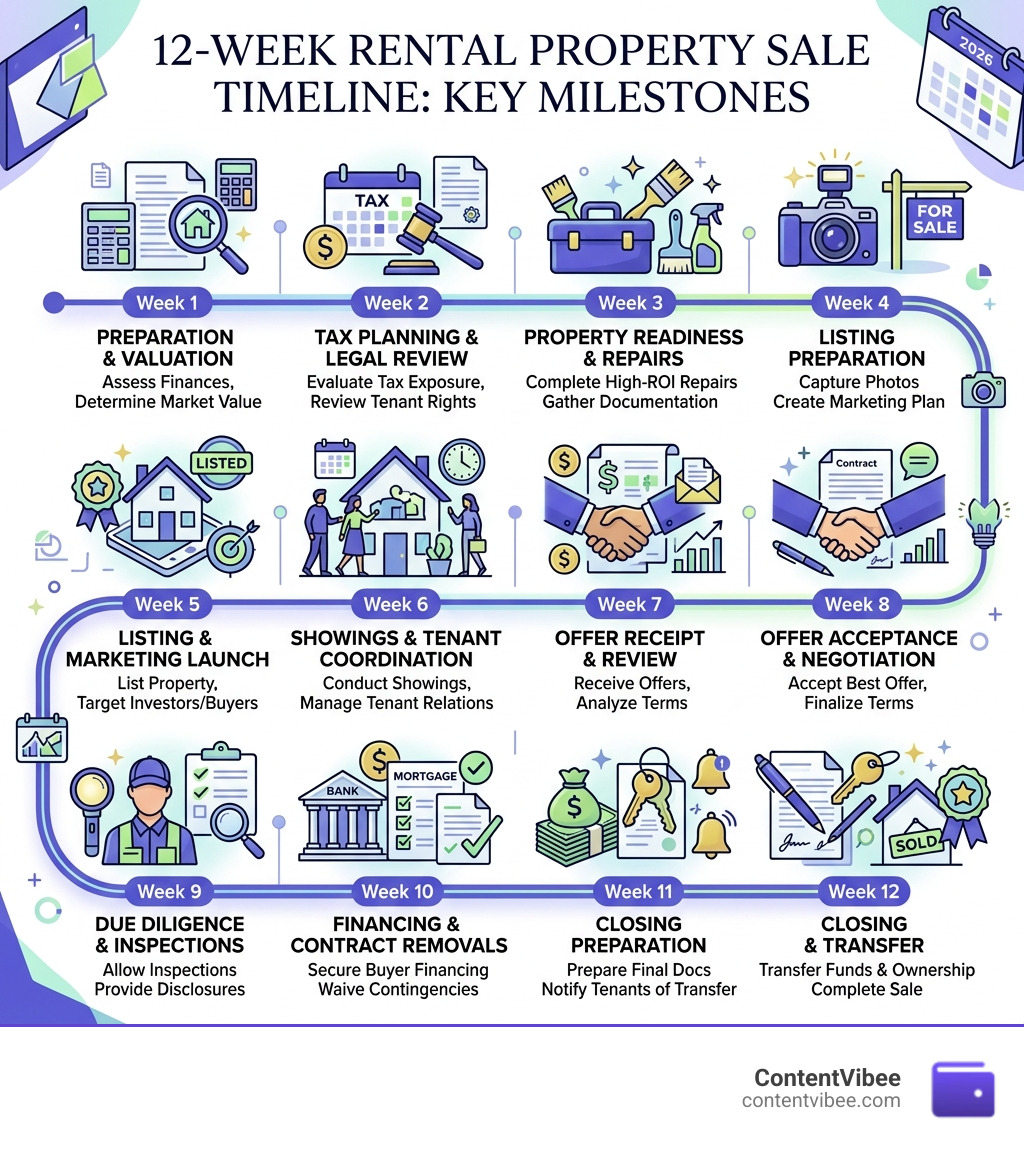
Here’s a quick overview of the key steps involved:
- Assess your tax exposure – Calculate your adjusted cost base (or adjusted basis), estimate capital gains, and factor in depreciation recapture
- Decide on occupancy – Determine whether to sell with tenants in place or wait for a vacant property
- Review tenant rights and lease obligations – Check local laws for notice periods, showings, and deposit transfers
- Prepare the property – Gather documentation, make high-ROI repairs, and complete required disclosures
- List and market strategically – Target the right buyer (investor vs. owner-occupant) with the right pricing approach
- Explore tax deferral options – A 1031 exchange or installment sale could significantly reduce your tax bill
- Close and transfer ownership – Handle lease assignments, security deposits, tenant notifications, and tax reporting
The stakes are high. The total tax bill on a profitable rental sale can easily reach 25% to 35% of your gain when you add up capital gains tax, depreciation recapture, and state income tax. Many investors are caught off guard – not by the sale itself, but by a tax bill that’s far larger than expected.
This guide walks you through every stage of the process, from pre-sale planning to post-closing tax filing, so you can keep more of what you’ve earned.
Financial Security and Fraud Prevention in a Rental Property Sale
When we handle a rental property sale, we aren’t just moving bricks and mortar; we are moving massive amounts of capital. In April 2026, the digital landscape for real estate is more sophisticated than ever, but so are the risks. Criminals often target high-value transactions like these because the payouts are enormous.

Protecting your equity means more than just finding a buyer; it means securing your digital footprint. From the moment you list to the final wire transfer, your financial data is at risk. It is vital to understand how to prevent tax fraud and identity theft during a rental property sale to ensure your hard-earned profit doesn’t end up in a scammer’s offshore account. Furthermore, we must recognize why selling investment property requires digital financial security—it’s not just about the house; it’s about the sensitive tax and banking information attached to it.
Preventing Wire Transfer Fraud and Identity Theft during a Rental Property Sale
Wire transfer fraud is perhaps the most devastating threat during a rental property sale. Scammers often intercept emails between you and your escrow officer, providing “updated” wiring instructions that lead to their own accounts. To prevent unauthorized transactions, we always recommend verifying wiring instructions via a known phone number—never via email links.
Verification scams are also on the rise. You might receive a text or email that looks like it’s from your bank or title company asking you to “verify your identity” by clicking a link. This is a classic phishing attempt to steal your credentials. If you find yourself a wire transfer fraud victim what to do and recovery options USA 2026, every second counts. You must contact your bank immediately to initiate a “kill chain” and report the incident to the FBI’s Internet Crime Complaint Center (IC3).
Disputing Unauthorized Financial Actions during Closing
The closing period is a whirlwind of activity, making it easy to miss small, unauthorized financial actions. Whether it’s an incorrect fee on the Closing Disclosure or a suspicious charge on your credit report triggered by the sale process, you must be vigilant.
If you notice discrepancies, the dispute process should begin immediately with your financial institution. Bank protection laws in the USA provide some recourse, but proactive credit monitoring is your best defense. If your personal information is leaked during the transaction, knowing identity theft credit report fraud how to fix and protect your score USA is essential for maintaining your ability to reinvest in future properties.
Navigating Tax Implications: Capital Gains and Recapture
The IRS is essentially your silent partner in any rental property sale, and they expect their cut. Understanding the difference between capital gains and depreciation recapture is the difference between a successful exit and a financial headache.

Calculating Adjusted Cost Base for a Rental Property Sale
To determine your tax liability, we first need to find your “adjusted basis” (or Adjusted Cost Base in Canada). This isn’t just what you paid for the house. You start with the purchase price, add closing costs from the original buy, and add capital improvements—think a new roof or a kitchen remodel, not just a fresh coat of paint.
From that total, you must subtract the accumulated depreciation you claimed (or were allowed to claim) over the years. This final number is your adjusted basis. When you subtract this from your net sale price, you get your total taxable gain. If you’ve been targeted by scams recently, be sure to look into unauthorized bank transaction how to dispute and recover money USA 2026 to ensure your records are clean before filing.
Handling Terminal Loss and UCC in 2026
If the market has been unkind and you sell your property for less than its Undepreciated Capital Cost (UCC), you might be looking at a terminal loss. Unlike a capital loss, which has limited deductibility, a terminal loss can often be used to offset other forms of income, providing a silver lining in a tough sale.
Conversely, if you sell for more than the UCC but less than the original cost, you’ll face “depreciation recapture.” This is taxed as ordinary income, often at a higher rate (up to 25% in the US) than standard capital gains. If you’ve encountered issues with digital payment platforms during your sale, check out Zelle fraud transaction recovery steps and bank protection options USA to safeguard your liquid proceeds.
Strategic Preparation: Selling with Tenants vs. Vacant
One of the biggest debates in a rental property sale is whether to keep the tenants or show an empty house. There are pros and cons to each, and the right choice depends on your target buyer.
| Feature | Selling with Tenants | Selling Vacant |
|---|---|---|
| Buyer Pool | Mainly Investors | Investors & Owner-Occupants |
| Income | Rent continues until closing | No income during listing |
| Staging | Limited by tenant’s belongings | Full control over professional staging |
| Showings | Requires 24-48 hour notice | Easy, on-demand access |
| Sale Price | Often 5-15% lower | Typically higher (Owner-occupant premium) |
Managing Tenant Rights and Local Laws in a Rental Property Sale
Tenant rights are paramount. In many jurisdictions, such as British Columbia or certain US states like California, you cannot simply evict a tenant because you want to sell. The lease usually “runs with the land,” meaning the new owner inherits the tenant.
You must provide proper notice for showings—usually 24 to 48 hours in writing. If the buyer intends to move in, specific notice periods apply (often 60 to 90 days). We often suggest a “cash-for-keys” agreement, where you pay the tenant to vacate early, which can be a win-win that allows you to stage the home and sell to an owner-occupant for a higher price. Always prioritize protecting your financial data when selling a tenant-occupied property to ensure lease agreements and payment histories are shared securely.
Documentation and Disclosures for Investor Buyers
If you are selling to another investor, your “marketing” isn’t just photos; it’s data. You’ll need:
- Rent Rolls: A history of payments and current lease terms.
- Maintenance Logs: Proof that the property has been cared for.
- Estoppel Certificates: Documents signed by tenants confirming the terms of their lease.
- Utility Bills: To show operating expenses.
Handling these documents requires secure document handling for real estate investment services to prevent sensitive tenant information from being leaked.
Maximizing Net Proceeds and Tax Deferral Strategies
Our goal at ContentVibee is to help you keep more of your money. The most powerful tool in the US investor’s arsenal is the 1031 exchange.
Using a 1031 Exchange to Defer Taxes on a Rental Property Sale
A 1031 exchange allows you to sell your rental property and reinvest the proceeds into a “like-kind” property while deferring all capital gains and depreciation recapture taxes. To pull this off, you must follow strict IRS rules:
- Use a Qualified Intermediary (QI): You cannot touch the money from the sale.
- 45-Day Identification: You have 45 days from the sale to identify potential replacement properties.
- 180-Day Closing: You must close on the new property within 180 days.
Missing these deadlines results in a fully taxable sale. It is also vital to know how to safely manage a 1031 exchange to avoid financial fraud, as the high dollar amounts involved attract sophisticated scammers. If you do fall victim to a title or escrow scam, learning how to recover money from real estate escrow scams is your only path to financial recovery.
Primary Residence Conversion and Section 121 Exclusions
If you once lived in the rental property, you might qualify for the Section 121 exclusion, which allows you to exclude up to $250,000 ($500,000 for married couples) of gain. However, if it has been a rental for a long time, the IRS applies “non-qualified use” rules, meaning you can only exclude the portion of the gain that occurred while you lived there. Furthermore, you can never exclude depreciation recapture—that must be paid regardless. For more on protecting your wealth during these transitions, explore our Category/Financial Security/ section.
Frequently Asked Questions about Rental Property Sales
How does selling a rental property in Canada differ from the US?
In Canada, there is no 1031 exchange. Instead, 50% of your capital gain is taxable and added to your income for the year. You report this on Schedule 3 and Form T776 according to Canada Revenue Agency guidelines. While the US has the Section 121 exclusion, Canada has the Principal Residence Exemption (PRE), which is very robust but strictly applies to homes you “ordinarily inhabit.” If you are dealing with cross-border transactions, knowing how to dispute unauthorized transactions during international property sales is a must.
What are the most common mistakes to avoid when selling?
The biggest mistake is underestimating depreciation recapture. Many sellers calculate their capital gains but forget the IRS “takes back” the tax breaks they gave you over the years. Other common pitfalls include poor record-keeping (losing receipts for improvements) and ignoring local tenant laws, which can lead to costly lawsuits or delayed closings.
Should I sell to an investor or an owner-occupant?
If your property needs work and has a long-term tenant, an investor might be the best fit. They care about the cap rate and cash flow. However, if the home is in a desirable neighborhood and can be delivered vacant, owner-occupants typically pay a 5% to 15% premium because they are buying a home, not just an income stream.
Conclusion
At ContentVibee, we believe that a rental property sale should be a crowning achievement of your investment journey, not a source of stress. By focusing on profit maximization and aggressive tax minimization strategies, we help you transition your wealth into its next phase securely. Whether you are using a 1031 exchange to level up your portfolio or cashing out for retirement, digital financial security is the foundation of every successful deal. For more insights, check out our Category/Real Estate/ page for the latest in market trends and recovery strategies.


