


Rental sale capital gains are the profits you make when you sell a rental property — and yes, the IRS wants a cut.
Unlike selling your primary home, there’s no automatic exclusion when you sell a rental. That means your entire profit could be taxable. Here’s the quick breakdown:
How rental sale capital gains work:
| Factor | What It Means |
|---|---|
| Held less than 1 year | Taxed as ordinary income (10%–37%) |
| Held more than 1 year | Taxed at long-term rates (0%–20%) |
| Depreciation claimed | Recaptured at up to 25% ordinary income rate |
| High earner (200k+/250k+) | Extra 3.8% Net Investment Income Tax applies |
| Primary residence exclusion | Only applies if you lived there 2 of the last 5 years |
The difference between a good tax strategy and a bad one can be tens of thousands of dollars.
Consider this: on a $400,000 gain, a single filer could owe $60,000 at the 15% long-term rate — or $140,000 at a 35% short-term rate. That’s an $80,000 swing based largely on how long you held the property.
And that’s before depreciation recapture enters the picture.
Many rental property owners are caught off guard when they sell. They see a big profit number and assume they’ll keep most of it. Then the tax bill arrives.
This guide covers everything — how gains are calculated, how to reduce what you owe, what forms to file, and when to call a tax professional.
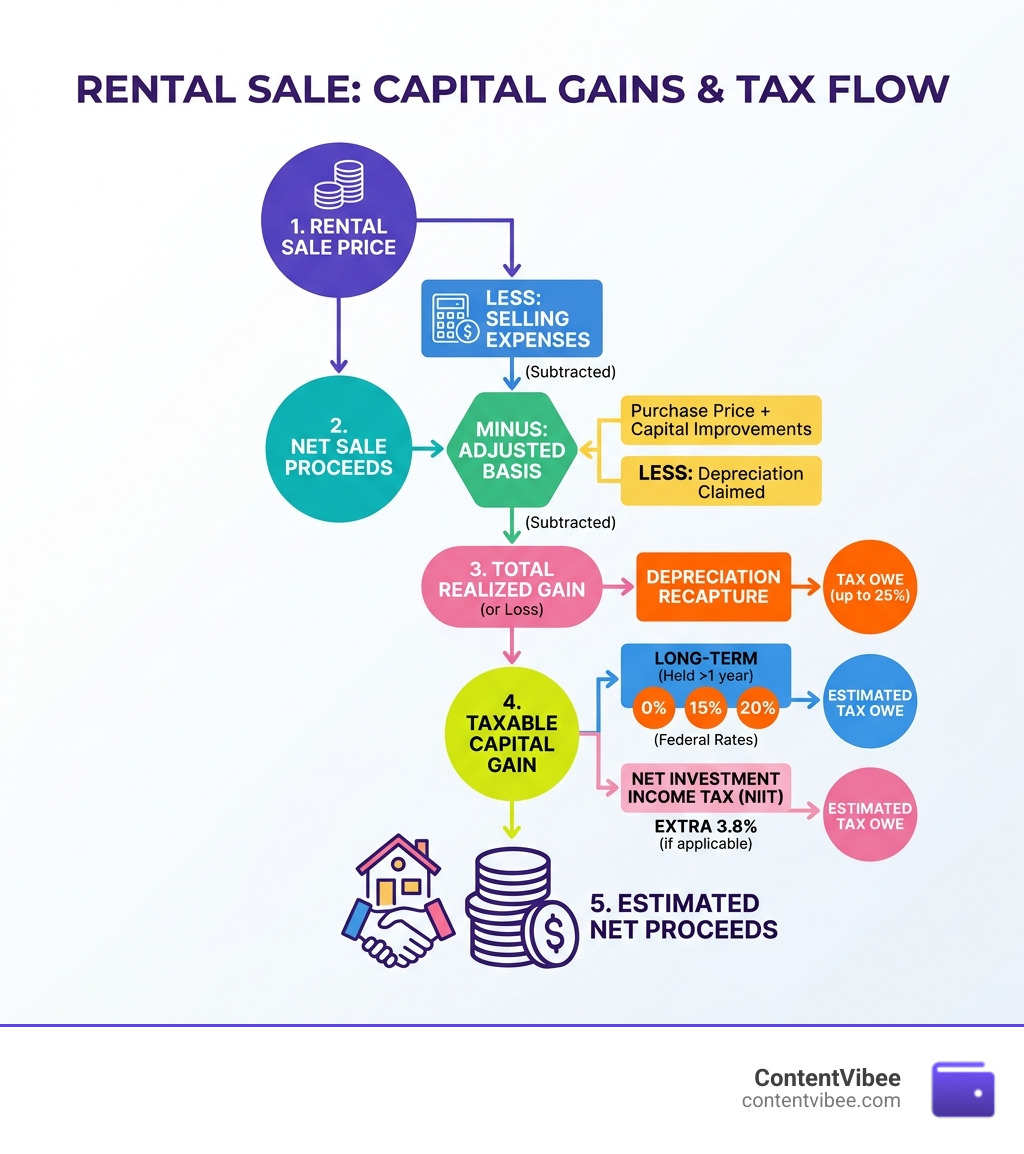
Understanding the Basics of Capital Gains on Rental Property
When we talk about rental sale capital gains, we are essentially looking at the “profit” realized from the sale of a real estate asset used for business or income-producing purposes. In the eyes of the IRS, your rental property is an investment, not just a house. This distinction is vital because it changes how every dollar of profit is treated compared to the sale of your personal “main home.”
The primary factor determining your tax rate is the holding period. If you flip a rental property in under a year, the IRS views that profit as ordinary income. If you hold it for at least 366 days, you move into the much friendlier neighborhood of long-term capital gains.
Short-Term vs. Long-Term Holding Periods
The “one-year rule” is the golden line in the sand for real estate investors.
- Short-Term Capital Gains: If you sell a property you’ve owned for one year or less, your gain is taxed at the same rate as your salary. For 2025-2026, these ordinary income rates range from 10% to 37%. For a single filer making a decent living, this often means losing a third of your profit to the government.
- Long-Term Capital Gains: By holding the property for more than a year, you qualify for the 0%, 15%, or 20% rates.
As of April 2026, we are looking at 2025 tax data for current filings. For single filers, you could pay 0% if your taxable income is under $48,350. Most investors fall into the 15% bracket (income up to $533,400), while high-flyers earning above that pay 20%. Understanding Why Selling Investment Property Capital Gains Tax/ is so significant helps us realize that timing isn’t just about the market—it’s about the tax calendar.
Net Investment Income Tax (NIIT) for High Earners
If you’re a high-income earner, there’s an extra “guest” at the tax party: the Net Investment Income Tax (NIIT). This is a 3.8% surtax that applies to your rental sale capital gains if your Modified Adjusted Gross Income (MAGI) exceeds certain thresholds.
- Single filers: $200,000
- Married filing jointly: $250,000
This surtax was designed to help fund the Affordable Care Act, and it effectively bumps your 15% capital gains rate to 18.8%, or your 20% rate to 23.8%. When we look at How To Prevent a Tax Hit When Selling a Rental Property, managing this threshold is often a top priority.
Calculating Your Rental Sale Capital Gains
Calculating your gain isn’t as simple as “Sale Price minus Purchase Price.” The IRS uses a concept called the Adjusted Basis. Think of the basis as your “tax-free” portion of the sale—it’s the money you’ve already invested and paid taxes on.
Calculating Your Rental Sale Capital Gains Basis
Your journey starts with the Cost Basis, which is usually what you paid for the property. But wait, there’s more! You can add certain closing costs to this number, such as title insurance, legal fees, and recording fees.
To find your Adjusted Basis, we use this formula:
- Original Purchase Price
- + Capital Improvements (New roof, central air, a kitchen remodel)
- – Depreciation (The annual tax deductions you took while renting it out)
- = Adjusted Basis
Every dollar you spent on a permanent improvement increases your basis, which in turn lowers your taxable gain. This is why we always tell our clients to keep every single receipt for renovations. If you’re wondering Can You Really Buy Investment Property/ without a plan for tracking these costs, the answer is yes, but you’ll pay for it at the closing table!
The Role of Deductible Selling Costs
When you finally sell, you don’t get to keep the “sticker price.” You have to pay the people who helped you sell it. Fortunately, the IRS allows you to subtract these costs from the sales price before calculating your gain. These include:
- Real estate agent commissions (often the largest expense)
- Advertising and marketing costs
- Legal and escrow fees
- Home staging and cleaning for the sale
By accurately tracking these, you ensure you aren’t paying taxes on money that went straight into your Realtor’s pocket.

Depreciation Recapture and Its Impact on Your Tax Bill
This is the part of rental sale capital gains that makes even seasoned investors sweat. While you owned the property, the IRS allowed you to “depreciate” the building (not the land) over 27.5 years. This gave you a nice annual deduction of roughly 3.6% of the building’s value.
The catch? When you sell, the IRS wants that money back.
How Depreciation Recapture Works
Depreciation recapture is taxed at a flat rate of up to 25%. It doesn’t matter if your long-term capital gains rate is 15%; the portion of your profit that represents the depreciation you claimed (or could have claimed) is taxed at this higher ordinary income rate.
According to Publication 527 (2025), Residential Rental Property | Internal Revenue Service, this applies to any depreciation allowed or allowable after May 6, 1997. “Allowable” is a scary word—it means even if you forgot to take the deduction on your taxes over the years, the IRS will still tax you as if you did!
Avoiding Common Calculation Mistakes
One of the biggest blunders we see is failing to separate land value from building value. You cannot depreciate land because, theoretically, land doesn’t wear out or get old. If you bought a property for $500,000 and the land is worth $100,000, you can only depreciate the $400,000 building.
If you don’t correctly separate these values, your depreciation recapture calculations will be wrong, potentially leading to an audit. In niche investments, such as Why Mobile Home Investment Roi And Financing Risk/, these calculations can get even more complex due to the shorter lifespan of the structures.
Strategies to Minimize or Defer Rental Sale Capital Gains
We don’t just want to help you calculate your taxes; we want to help you keep more of your hard-earned money. There are several powerful “loopholes” (entirely legal ones!) provided by the tax code.
Utilizing the 1031 Exchange for Tax Deferral
The 1031 Exchange, named after Section 1031 of the Internal Revenue Code, is the holy grail for real estate investors. It allows you to sell a rental property and reinvest the proceeds into a “like-kind” property while deferring all capital gains and depreciation recapture taxes.
However, the rules are strict:
- 45-Day Identification: You have exactly 45 days from the sale of your property to identify up to three potential replacement properties.
- 180-Day Closing: You must close on the new property within 180 days.
- Qualified Intermediary: You cannot touch the money. A third party must hold the funds between the sale and the purchase.
As noted in the IRS Sales, trades, exchanges | Internal Revenue Service, failing to meet these deadlines by even one day will trigger the full tax bill. For those who want the benefits of real estate without being a landlord, some look into Why Real Estate Investment Trust High Dividend/ stocks, though these do not qualify for 1031 exchanges.
Tax-Loss Harvesting and Timing the Sale
If you have a massive gain from a rental sale, you can offset it by selling other investments—like stocks or underperforming properties—at a loss. This is called tax-loss harvesting.
- The $3,000 Rule: If your losses exceed your gains, you can use up to $3,000 of that excess loss to offset your ordinary income (like your salary). Any remaining loss can be “carried forward” to future years.
- Timing: If you know you’re retiring next year and your income will drop significantly, waiting to sell your rental property could move you from a 20% capital gains bracket down to 15% or even 0%.
Reporting the Sale: IRS Forms and Compliance
Reporting your rental sale capital gains is a multi-form process. You can’t just write a number on your 1040 and call it a day.
Reporting Rental Sale Capital Gains on Form 4797
Form 4797 is where the “business” side of the sale happens. This is used to report the sale of business property and to calculate the dreaded depreciation recapture. From there, the “capital” portion of the gain flows to Schedule D and Form 8949.
It is essential to categorize the assets correctly. If the property was used for a trade or business, Form 4797 is your primary tool. If it was held strictly for investment (like vacant land), you might use Form 8949 instead.
Special Considerations for Inherited or Foreign Property
If you inherited a rental property, you likely received a Step-up in Basis. This means your “cost basis” is the fair market value of the home on the day the previous owner passed away, not what they originally paid for it. This can wipe out decades of capital gains taxes.
For foreign properties, things get spicy. As a US citizen, you are taxed on your worldwide income. If you sell a villa in Portugal, you must report that gain to the IRS. However, you can often claim a Foreign Tax Credit (Form 1116) for any taxes you paid to the foreign government, preventing you from being taxed twice on the same dollar.

Frequently Asked Questions about Rental Property Sales
Can I avoid capital gains by moving into my rental?
Yes, but it’s not a “get out of jail free” card. To qualify for the Section 121 exclusion ($250,000 for singles / $500,000 for couples), you must live in the home as your primary residence for at least two of the five years before the sale.
However, the IRS won’t let you exclude the portion of the gain that occurred while it was a rental (this is called “nonqualified use”). You also still have to pay depreciation recapture on any depreciation taken after 1997. It reduces the bill, but it doesn’t eliminate it.
What happens if I sell my rental property at a loss?
Unlike a personal home (where losses are not deductible), a loss on a rental property sale is a business loss. You can generally use this loss to offset other income. However, “Passive Activity Loss” rules might limit how much you can deduct in a single year if you aren’t considered a “real estate professional” by the IRS.
How do state taxes impact my total gain?
Federal taxes are only half the battle. Most states tax capital gains as ordinary income. In a high-tax state like California, you could be looking at an additional 1% to 13.3% tax on your gain. California also does not recognize 1031 exchanges in the same way the federal government does if you are moving your investment out of state—they may “track” the gain and tax you later.
Conclusion
Navigating rental sale capital gains is one of the most complex tasks a real estate investor will face. Between calculating the adjusted basis, surviving depreciation recapture, and meeting 1031 exchange deadlines, there are countless opportunities for expensive errors.
At ContentVibee, we believe that profit maximization isn’t just about finding the right property—it’s about keeping the profit you’ve already made. By understanding these rules and planning your exit strategy years in advance, you can significantly minimize your tax burden and boost your long-term returns.
Because the tax code is constantly evolving (especially as we look toward the 2026 tax year), we always recommend consulting with a qualified tax professional or CPA before you sign a listing agreement. For more info about real estate investment strategies, stay tuned to our latest guides. Your financial recovery and growth depend on the moves you make today!


