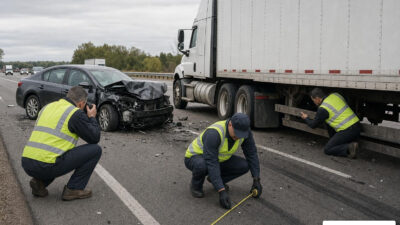


Why a Houston Truck Accident Claim Needs Fast, Focused Action
A truck accident lawyer Houston Texas can help protect your claim after a crash involving an 18-wheeler, delivery truck, tanker, or other commercial vehicle. The right attorney should understand federal trucking rules, act quickly to preserve electronic evidence, and explain costs clearly – often through a contingency-fee agreement with no upfront legal fee.
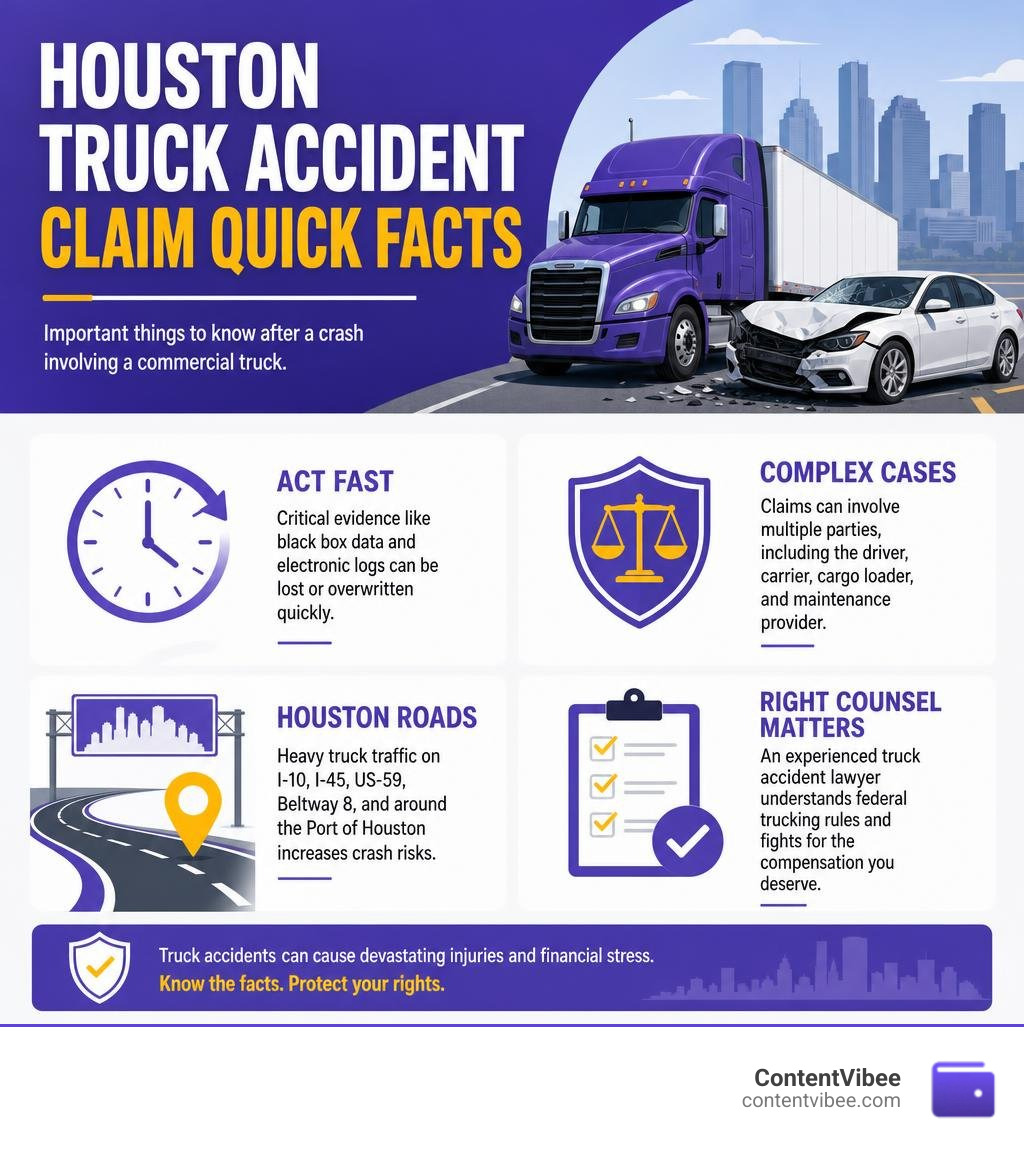
Houston-area roads carry constant freight traffic, especially near I-10, I-45, US-59, Beltway 8, and the Port of Houston. Harris County records more than 6,100 truck crashes in a typical year. When a vehicle that may weigh up to 80,000 pounds collides with a passenger car, the physical and financial consequences can be severe.
Commercial truck cases are not ordinary car accident claims. They can involve the driver, trucking carrier, cargo loader, maintenance provider, and insurers with large policies. Critical records, including black box data and electronic driving logs, may also disappear or be overwritten unless they are preserved quickly.
Immediate Steps After a Houston Commercial Vehicle Crash
The moments following a collision with a commercial motor vehicle are often overwhelming, chaotic, and dangerous. However, taking proactive steps right away protects both your personal physical safety and your future legal rights.
When an 18-wheeler or heavy freight truck crashes into a passenger car on a busy highway like I-10 or Beltway 8, immediate action helps build an unassailable foundation for your compensation claim.

Here is what you should do immediately following a commercial vehicle crash in Texas:
- Ensure Crash Scene Safety and Call 911: Move your vehicle to the shoulder if possible to avoid secondary collisions, or remain inside with your hazard lights on if it is unsafe to move. Call 911 right away so dispatchers can send emergency medical personnel and law enforcement officers.
- Obtain an Official Police Crash Report: Always insist that police respond to the scene. The responding officers will complete a official Texas Peace Officer’s Crash Report (CR-3). This document records critical details, including driver identification, insurance details, weather conditions, initial fault observations, and citations issued.
- Undergo Immediate Medical Evaluation: Never decline emergency medical assessment at the scene or delay seeing a physician. Some catastrophic injuries, such as traumatic brain injuries or internal bleeding, may not display immediate symptoms due to adrenaline. A prompt medical report links your injuries directly to the truck collision.
- Gather Photographic and Video Evidence: If you are physically able to do so safely, take extensive photos and videos of all involved vehicles, tire skid marks, road debris, traffic signals, weather conditions, and visible bodily injuries.
- Collect Witness and Driver Details: Exchange contact and insurance details with the truck driver, but limit your conversation strictly to essential facts. Capture the driver’s Commercial Driver’s License (CDL) number, the motor carrier’s name, US DOT number, and license plate numbers. Obtain phone numbers and names from any independent eyewitnesses on the scene.
Navigating Insurance Adjusters with a Truck Accident Lawyer Houston Texas
Shortly after a major collision, representatives from the trucking company’s insurance provider will likely contact you. Commercial insurers deploy rapid-response defense teams to accident scenes within hours to protect their financial interests. Their primary goal is to minimize corporate payout liabilities.
Insurance adjusters often sound friendly and deeply concerned, but their strategy typically involves getting you to make recorded statements that can be used later to reduce or deny your claim. They may attempt to get you to admit partial fault or understate the severity of your pain.
They also frequently offer rapid, initial lowball settlements while you are still in the hospital or off work. These early cash offers rarely cover long-term rehabilitation, lost future earning potential, or non-economic suffering.
When you retain a truck accident lawyer Houston Texas, your legal team steps between you and the insurance company. Your attorney manages all communications, handles settlement negotiations, accurately evaluates your total lifetime damages, and prevents you from making statements that could harm your case.
Legal Costs and the Two-Year Statute of Limitations
A common concern for crash victims is the financial cost of hiring skilled trial attorneys. Fortunately, reputable commercial vehicle attorneys handle cases on a contingency fee basis.
Under a contingency fee agreement:
- You pay zero upfront costs or out-of-pocket expenses to start your case.
- Your legal team pays for expert witnesses, accident reconstruction, filing fees, and evidence collection.
- Attorney fees are paid only as an agreed-upon percentage of the financial compensation recovered through a settlement or trial verdict.
- If your legal team does not win your case, you owe no attorney fees.
Time is of the essence when filing a lawsuit in Texas. Under Texas Civil Practice and Remedies Code Section 16.003, the statute of limitations for filing a personal injury or wrongful death lawsuit is strictly two years from the exact date of the crash.
Failing to file your lawsuit before this two-year window expires generally bars you from seeking financial compensation in court. Furthermore, critical digital evidence like driver logs and black box records can be legally overwritten in as little as 30 days if a legal preservation demand is not submitted immediately.
If you want to understand how general personal injury claims operate alongside specialized truck litigation, reviewing our complete guide to hiring a Houston Personal Injury Attorney offers valuable foundational insights.
Why Commercial Truck Wrecks Are More Complex Than Car Accidents
Comparing a commercial truck wreck to a standard passenger car collision is like comparing apples to bowling balls. The physics, governing legal statutes, electronic data streams, and corporate defense structures make commercial freight litigation vastly more complex.

A fully loaded semi-truck can weigh up to 80,000 pounds, whereas an average passenger motor vehicle weighs around 3,000 to 4,000 pounds. This dramatic weight disparity creates immense kinetic energy during a crash.
At highway speeds of 65 mph, a fully loaded 18-wheeler requires approximately 525 feet-nearly the length of two football fields-to come to a complete stop after the driver applies the brakes. In contrast, a passenger car stops in roughly 300 feet.
Commercial collisions also involve multiple corporate entities rather than just two drivers. A single crash can involve:
- The commercial truck driver
- The motor carrier or freight fleet owner
- The cargo shipping or loading company
- Third-party vehicle maintenance contractors
- Freight brokers and truck component manufacturers
Commercial carriers maintain deep corporate pockets and multi-layered umbrella insurance policies worth millions of dollars. Consequently, they deploy aggressive corporate legal teams to fight liability at every turn.
Common Causes and Catastrophic Injuries on Houston Highways
Houston’s sprawling infrastructure, combined with heavy regional industrial activity, leads to high volumes of commercial traffic on major thoroughfares. Corridors like I-10, I-45, US-59, and Beltway 8 see heavy truck traffic every day.
Common causes of commercial truck crashes in the Houston metro area include:
- Driver Fatigue: Long hours on the road can cause reduced reaction times or falling asleep at the wheel.
- Distracted Driving: Using cell phones, navigating GPS systems, or eating while operating a heavy vehicle.
- Jackknife Collisions: Occur when a truck’s drive wheels lock up during sudden braking, causing the trailer to swing outward at a 90-degree angle and sweep across multiple traffic lanes.
- Underride Crashes: Devastating accidents where a smaller passenger vehicle slides beneath the side or rear of a commercial trailer due to missing or defective underride guards.
- Improper Cargo Loading: Unbalanced or unsecured freight that shifts during transport, causing vehicle instability or rollovers.
- Mechanical Maintenance Failures: Neglecting routine brake maintenance, driving on worn tires, or steering box failures.
Given the extreme physical forces involved, victims of big rig crashes frequently suffer life-altering, catastrophic injuries, including:
- Traumatic Brain Injuries (TBIs) and severe concussions
- Spinal cord damage resulting in partial or total paralysis
- Compound bone fractures and limb amputations
- Severe burn injuries and permanent facial disfigurement
- Internal organ lacerations and internal bleeding
For drivers involved in specialized commercial transportation crashes, such as those near regional industrial fields, our comprehensive Oilfield Injury Lawyer Texas Detailed Guide explains the specific safety regulations governing industrial haulers.
Role of Federal Regulations and Electronic Evidence
Unlike everyday passenger vehicle operators, commercial motor carriers and truck drivers must strictly follow the Federal Motor Carrier Safety Regulations (FMCSRs) enforced by the Federal Motor Carrier Safety Administration.
Key federal regulations include:
- Hours of Service (HOS) Limits: Commercial truckers are strictly limited to driving a maximum of 11 hours within a 14-hour on-duty window after completing 10 consecutive hours off duty.
- Mandatory Drug & Alcohol Testing: Trucking companies must randomly test at least 50% of their active commercial driver workforce for illegal drugs and alcohol each year, along with mandatory post-accident testing.
- Driver Qualification Records: Carriers must maintain extensive files containing driver medical certifications, driving record checks, and background background verification.
Commercial trucks carry sophisticated electronic onboard computers that record crucial crash data:
The vehicle’s Engine Control Module (ECM), commonly known as the “black box,” records critical pre-crash metrics including travel speed, seatbelt usage, clutch application, engine RPM, and the exact second brakes were applied. Modern trucks are also equipped with Electronic Logging Devices (ELDs) that digitally track driving hours.
Because commercial fleets are permitted under federal guidelines to overwrite electronic logging data after set periods (sometimes as short as 30 days), your legal team must immediately issue a formal spoliation of evidence letter. This binding legal notice commands the carrier to preserve all physical truck parts, ECM data downloads, ELD records, dashcam footage, and maintenance files.
To learn more about how law firms preserve digital evidence following major fleet accidents, consult our Truck Accident Law Firm Guide 2026.
Proving Liability and Recovering Damages Under Texas Law
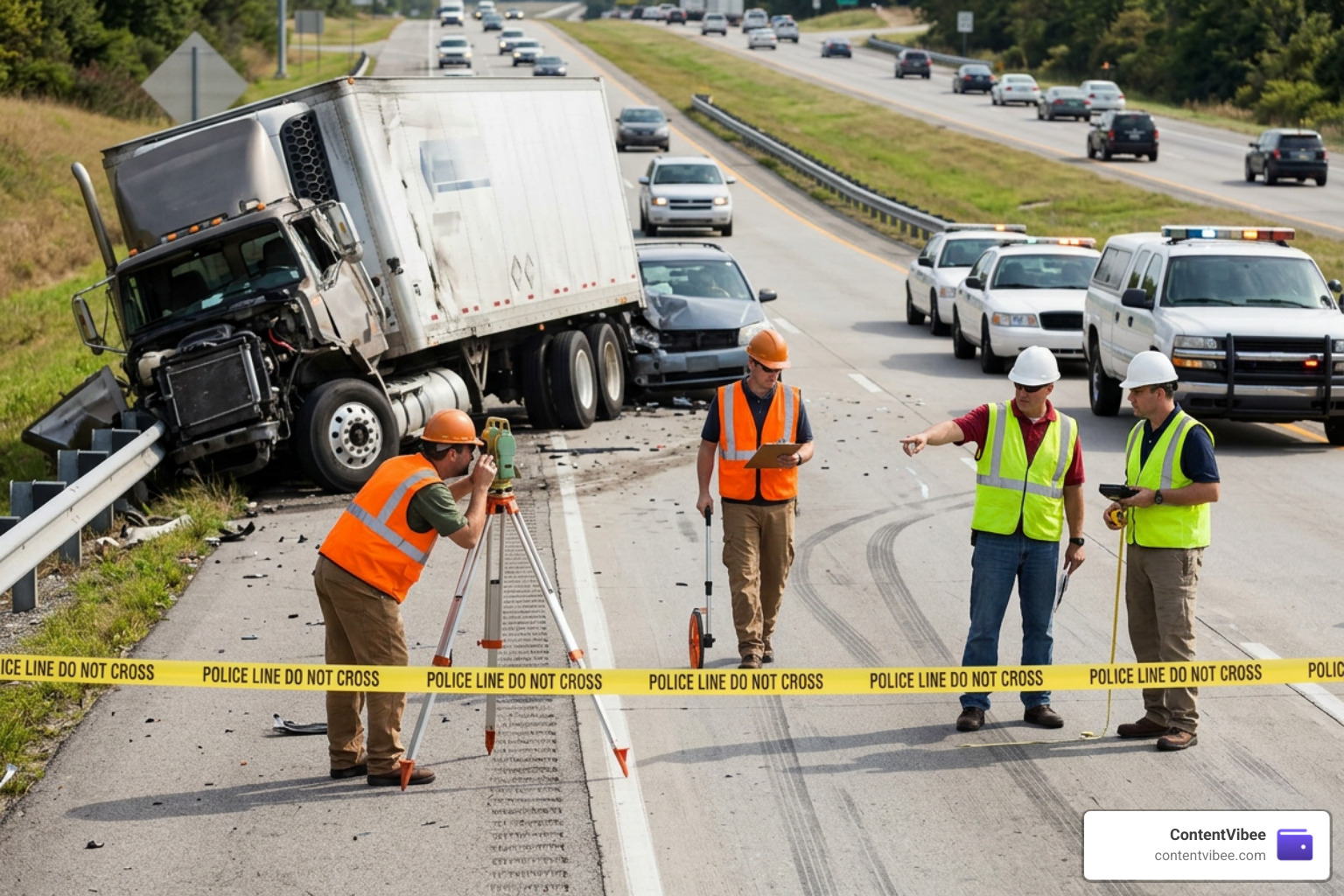
Establishing fault after an 18-wheeler wreck requires showing that a party failed to exercise reasonable care under the circumstances. In Texas, proving liability involves establishing four legal elements: duty of care, breach of duty, causation, and measurable legal damages.
Under the legal doctrine of respondeat superior (vicarious liability), motor carriers are generally held liable for negligent actions committed by their employee drivers while acting within the scope of their employment.
Furthermore, carriers can be held directly liable for their own corporate negligence, such as:
- Negligent Hiring: Failing to check a driver’s history of traffic violations or license suspensions.
- Negligent Entrustment: Allowing an unfit, exhausted, or unqualified driver to operate an 80,000-pound rig.
- Negligent Maintenance: Ignoring required fleet brake, tire, and lighting repairs to lower operating costs.
Third parties can also share legal fault. For instance, if cargo was improperly stacked by an independent loading firm causing the truck to tip over on an overpass, or if a brake system manufacturer produced a defective component, those parties can be named as co-defendants in your lawsuit.
Gathering Key Evidence to Establish Negligence
Building a strong case against commercial carriers requires gathering and analyzing many types of physical, digital, and documentary evidence.

Your legal team will gather and analyze critical evidentiary sources, such as:
- Accident Reconstruction Reports: Utilizing forensic engineers to examine skid marks, vehicle crush damage, and impact angles to reconstruct the precise mechanics of the collision.
- Driver Qualification Files (DQFs): Reviewing driver hiring applications, medical examiner certificates, annual driving records, and prior crash history.
- Maintenance & Repair Manifests: Inspecting inspection logs, brake adjustment records, and tire service receipts to locate unaddressed mechanical defects.
- Traffic Camera and Telematics Footage: Requesting municipal traffic camera video from Houston intersections and retrieving fleet dashcam recordings.
- Dispatch Communication Records: Examining text messages, cellular data, and QUALCOMM communications between dispatchers and drivers to detect pressure to violate federal driving limits.
If you want to review step-by-step strategies for gathering expert witness testimony in personal injury lawsuits, check out our resource on the Best Personal Injury Attorney Houston Guide 2026.
Recoverable Compensation and Comparative Negligence Rules
Victims of commercial vehicle collisions in Texas are legally entitled to pursue financial compensation for both economic and non-economic losses resulting from their injuries.
| Damage Category | Type of Loss | Examples Included |
|---|---|---|
| Economic Damages | Direct, measurable financial costs | Emergency ER care, surgery, physical therapy, prescription medication, lost wages, diminished future earning capacity, property damage |
| Non-Economic Damages | Intangible physical and emotional impacts | Physical pain and suffering, mental anguish, emotional distress, loss of enjoyment of life, physical impairment, permanent disfigurement |
| Punitive (Exemplary) Damages | Penalty damages awarded for gross negligence | Awarded under Texas Civil Practice & Remedies Code § 41.003 when a carrier acts with deliberate disregard for human safety |
Texas applies a modified comparative negligence rule (also known as the 51% bar rule). Under Texas law:
- You can recover financial compensation as long as your share of responsibility for the crash is 50% or less.
- Your final financial recovery is reduced in proportion to your percentage of assigned fault. For example, if a jury awards $1,000,000 in total damages but finds you 10% at fault for speeding, your final financial award is reduced by 10% to $900,000.
- If you are found to be 51% or more responsible for the collision, you are legally barred from recovering any financial compensation from the other driver or trucking company.
How to Choose the Right Truck Accident Lawyer Houston Texas

Selecting the right attorney to handle your commercial truck collision case is one of the most important decisions you will make for your physical and financial recovery. Not all personal injury attorneys have the resources, technical expertise, or trial experience necessary to handle commercial vehicle claims.
When evaluating potential law firms, prioritize those that specialize in 18-wheeler litigation and have a track record of handling high-value commercial policy claims.
To find top legal representation in 2026, explore our detailed comparative analysis of the Best Truck Accident Attorneys for 2026.
Key Qualities of a Truck Accident Lawyer Houston Texas
When choosing a truck accident lawyer Houston Texas, look for these essential qualifications during your initial consultation:
- Substantial Commercial Vehicle Experience: Choose a law firm that regularly handles 18-wheeler and commercial transport crashes rather than one that primarily handles standard car accidents.
- Proven Courtroom & Trial Readiness: Insurance companies know which attorneys settle early for low amounts and which ones regularly go to trial. Strong trial experience gives you essential leverage during settlement negotiations.
- Access to Expert Witness Networks: A successful case often depends on calling top expert witnesses, including forensic accident reconstructionists, trucking industry safety consultants, human factors engineers, and medical life-care planners.
- Rapid Evidence-Preservation Capabilities: Look for a firm with the resources to quickly send formal spoliation letters and dispatch independent investigators to the crash scene within 24 hours.
- Transparent Communication and No Upfront Fees: Your attorney should clearly explain fee structures, provide regular updates on your case status, and operate on a true contingency fee basis with zero hidden costs.
Frequently Asked Questions About Houston Truck Accidents
Who can be held legally responsible for my truck crash in Texas?
Multiple entities can share legal liability for a single commercial vehicle crash in Texas:
- The Truck Driver: For reckless driving, speeding, distracted driving, driving while exhausted, or operating under the influence.
- The Motor Carrier / Trucking Company: For vicarious liability, negligent hiring, poor fleet maintenance, or pushing drivers to violate hours-of-service limits.
- Cargo Loaders and Shippers: For improperly securing, overfilling, or unevenly balancing trailer freight.
- Maintenance and Repair Contractors: For failing to identify or fix critical mechanical faults, such as worn brakes or steering system issues.
- Vehicle and Parts Manufacturers: For design or manufacturing defects in truck components, including tires, hitch assemblies, or underride guards.
Can I recover financial compensation if I was partially at fault?
Yes. Under Texas’s modified comparative fault law, you can recover financial compensation as long as your percentage of responsibility for the crash is 50% or less.
However, your total financial award will be reduced by your percentage of fault. If you are found 20% responsible for a collision and your total calculated damages equal $500,000, you will receive $400,000. If you are found 51% or more at fault, you cannot recover any compensation under Texas law.
How long does a commercial truck accident lawsuit take to resolve?
The timeline for resolving a commercial truck accident claim varies based on case complexity, injury severity, and liability disputes:
- Simple, Clear-Cut Claims: Cases with clear liability, moderate injuries, and cooperative insurers may settle in 6 to 12 months.
- Complex or High-Value Claims: Cases involving catastrophic injuries, multiple liable parties, or contested black box evidence typically take 12 to 24 months to navigate formal discovery, expert depositions, and settlement negotiations.
- Cases That Go to Trial: If a fair settlement cannot be reached and your case proceeds to a court trial, the legal process can take 2 years or longer to achieve a final resolution.
Conclusion
A serious collision with an 18-wheeler or commercial vehicle can change your life in an instant. Managing painful bodily injuries, mounting medical bills, lost income, and aggressive corporate insurance adjusters creates immense physical, emotional, and financial strain.
Partnering with an experienced truck accident lawyer Houston Texas levels the playing field against major trucking carriers and corporate defense teams. By taking swift action to secure vital electronic black box data, document regulatory violations, build clear fault evidence, and navigate complex Texas comparative negligence laws, dedicated legal counsel helps ensure your rights remain protected.
If you or a loved one has been injured in a commercial vehicle collision, do not wait to seek help. Taking prompt action ensures critical digital evidence is preserved before it disappears, keeps your claim well within Texas statutory deadlines, and puts you on the path toward full financial recovery.
For step-by-step guidance on locating qualified legal representation in your area, consult our nationwide guide to Truck Accident Lawyers Near Me Guide today.