


Why Commercial Truck Crash Claims Differ From Standard Auto Accidents
When passenger cars collide, the resulting personal injury claims are usually straightforward: two drivers, two standard personal auto insurance policies, and local traffic laws. Commercial truck accidents operate under an entirely different legal framework.
Due to the sheer size and weight of an 80,000-pound semi-truck, the physical forces involved in a collision often lead to catastrophic injuries, including traumatic brain injuries, spinal cord damage, paralysis, or wrongful death.
Beyond the physical impact, commercial trucking is governed by a heavy web of federal regulations, state statutes, and complex corporate supply chains. Unlike standard car accidents, commercial claims involve massive corporate insurance policies, multiple potentially liable entities, and sensitive electronic data systems that can be legally destroyed or overwritten if not immediately secured.
If you are navigating the aftermath of a major crash, understanding these unique differences is vital to protecting your legal rights. For a broader overview of serious injury representation, check out our in-depth guide to serious truck accident lawyer strategies.
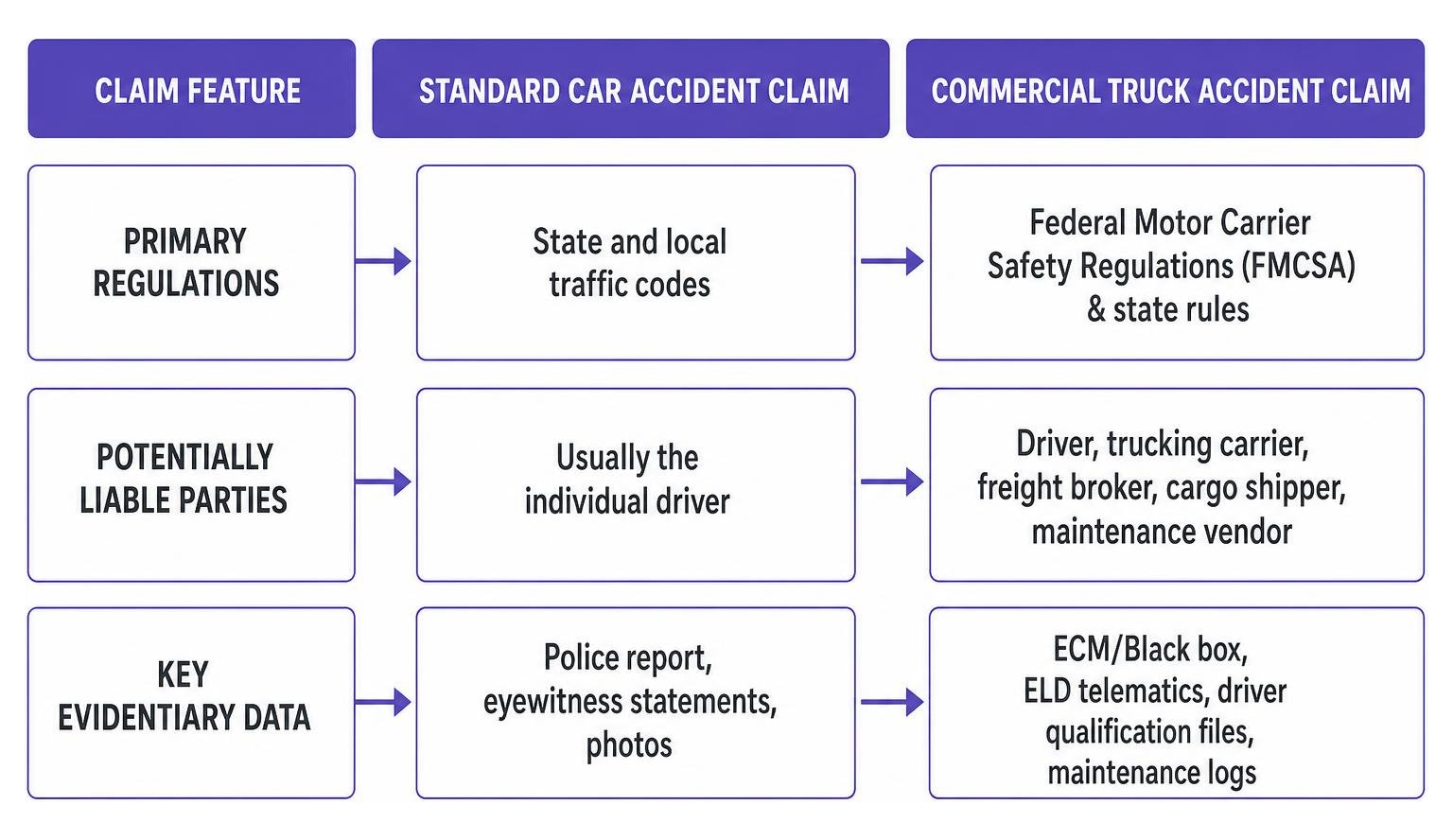
| Claim Feature | Standard Car Accident Claim | Commercial Truck Accident Claim |
|---|---|---|
| Primary Regulations | State and local traffic codes | Federal Motor Carrier Safety Regulations (FMCSA) & state rules |
| Potentially Liable Parties | Usually the individual driver | Driver, trucking carrier, freight broker, cargo shipper, maintenance vendor |
| Key Evidentiary Data | Police report, eyewitness statements, photos | ECM/Black box, ELD telematics, driver qualification files, maintenance logs |
| Insurance Coverage | Typical personal auto limits ($25k–$100k) | Commercial fleet policies (often $1M to tens of millions) |
| Defense Strategy | Insurance adjuster review | Immediate rapid-response defense teams dispatched to crash scene |
Common Causes of Catastrophic Commercial Vehicle Crashes
Understanding why a crash occurred is the first step in proving corporate negligence. In commercial trucking, accidents are rarely “just bad luck”—they are frequently the predictable outcome of regulatory non-compliance or systemic cost-cutting by motor carriers.
- Hours-of-Service (HOS) Violations & Driver Fatigue: Truck drivers are bound by federal limits on how many consecutive hours they can operate a commercial motor vehicle. When carriers pressure drivers to hit tight delivery deadlines, fatigue sets in, severely impairing reaction time and judgment.
- Logbook Fraud and Falsification: While Electronic Logging Devices (ELDs) have made log tampering harder, some carriers and drivers still manipulate data, bypass log rules, or force drivers to operate off-the-clock.
- Mechanical Failure and Lack of Maintenance: Commercial vehicles require routine inspections and preventive maintenance. Worn brakes, bald tires, failed steering mechanisms, and broken lighting systems directly cause loss-of-control collisions.
- Improper Cargo Loading and Weight Imbalance: Overloaded trucks take significantly longer to stop. Unsecured or unevenly distributed cargo can shift during transit, causing severe trailer swaying or tipping. In specialized accidents like jackknifes, cargo shifting is often a primary factor—you can read more about this in our article on the jackknife dilemma why you need a jackknife truck accident lawyer.
- Speeding and Inattentive Driving: Heavy trucks require up to two football fields of distance to come to a complete stop at highway speeds. Tailgating, excessive speeding, or distracted driving via mobile apps dramatically elevates crash severity.
Finding the Best Lawyer for Trucking Accident Litigation

Finding the right lawyer for trucking accident cases is not about picking the biggest billboard on the highway. Commercial trucking litigation requires specialized technical knowledge, significant financial capital, and aggressive trial preparation. A general personal injury lawyer who primarily handles rear-end passenger car crashes will likely be overwhelmed by corporate defense tactics, complex insurance layers, and federal regulations.
When evaluating potential legal representation, look for attorneys who focus their practice specifically on commercial motor vehicle collisions. Top-tier attorneys frequently hold professional designations, author industry training treatises, or maintain commercial driving credentials themselves.
Key Qualifications to Demand in a Lawyer for Trucking Accident Claims
- Board Certification in Truck Accident Law: Fewer than 1% of licensed lawyers nationwide hold specialized Board Certification in Truck Accident Law from accredited organizations like the National Board of Trial Advocacy (NBTA). Board certification requires rigorous testing, verified trial experience, peer review by judges and fellow lawyers, and demonstrated mastery of federal motor carrier safety regulations.
- Class-A Commercial Driver’s License (CDL): Some elite truck accident attorneys hold personal Class-A CDLs. Having hands-on operational experience driving semi-trucks gives an attorney an invaluable advantage when deposing defense experts, examining vehicle dynamics, and identifying driver operational errors.
- Proven Trial Track Record: Commercial insurers track which lawyers actually take cases to court and which ones settle quickly for lower amounts. Look for verified multi-million-dollar verdicts and settlements in catastrophic injury and wrongful death truck crash claims.
Questions to Ask When Interviewing a Lawyer for Trucking Accident Cases
During your initial consultation, ask these key questions to evaluate an attorney’s qualifications:
- What percentage of your law practice is dedicated specifically to commercial truck accident litigation?
- Are any lawyers in your firm board-certified in Truck Accident Law by the NBTA?
- How quickly can your team send a rapid-response investigation team to preserve the truck’s black box and physical evidence?
- What is your track record taking commercial trucking claims to a jury verdict versus settling?
- Will your firm advance all litigation costs (including expert accident reconstructionists and medical specialists) without upfront charges to me?
- Can you explain how federal motor carrier safety rules apply to my specific crash?
For a deeper dive into choosing specialized counsel across different regional markets, explore our guide on best truck accident attorneys for 2026.
Trial Experience versus Fast Settlement Mills
High-volume “settlement mill” law firms operate on speed and turnover. They take on hundreds of personal injury cases, attempt quick initial settlements with insurance adjusters, and rarely step foot in a courtroom. In commercial truck accident litigation, hiring a settlement mill can cost you hundreds of thousands—or millions—of dollars in lost recovery.
Trucking defense companies and their insurers quickly recognize settlement mills. Knowing the lawyer avoids trial, the insurer will make low settlement offers that fail to cover long-term medical care, lost earning capacity, or permanent disability.
Conversely, trial-ready attorneys build every case from day one as if it is going to a jury. They retain accident reconstruction engineers, life-care planners, and forensic economists. When defense insurers know an attorney has the financial backing, evidence, and courtroom mastery to secure a massive jury verdict, they are forced to make fair settlement offers.
Uncovering Multi-Party Liability and Federal Regulatory Violations
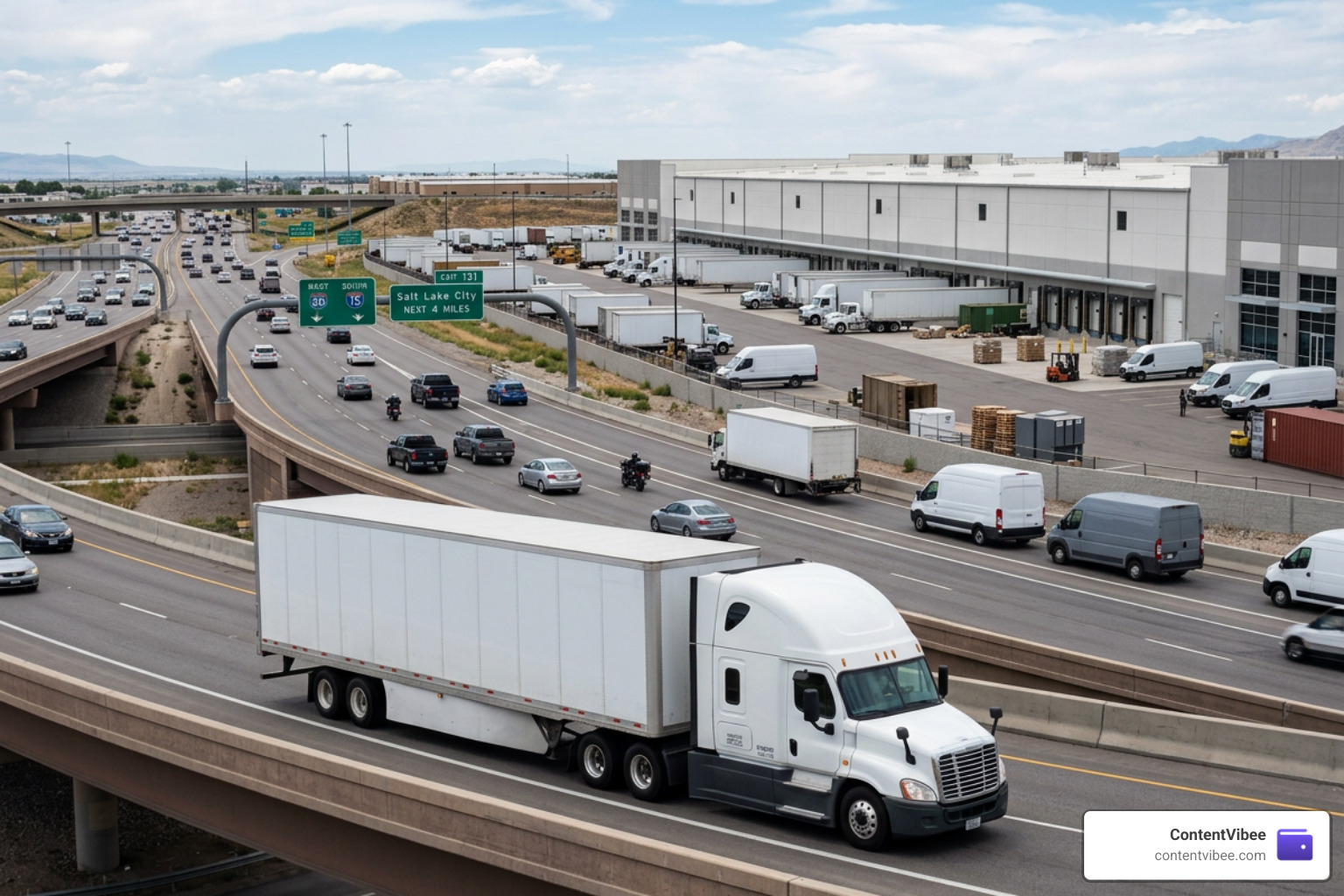
In a typical auto accident, liability starts and ends with the drivers involved. In a commercial trucking crash, the driver may only be the visible link in a much longer chain of corporate negligence. A skilled lawyer for trucking accident claims investigates the complete logistics ecosystem to hold every responsible party accountable.
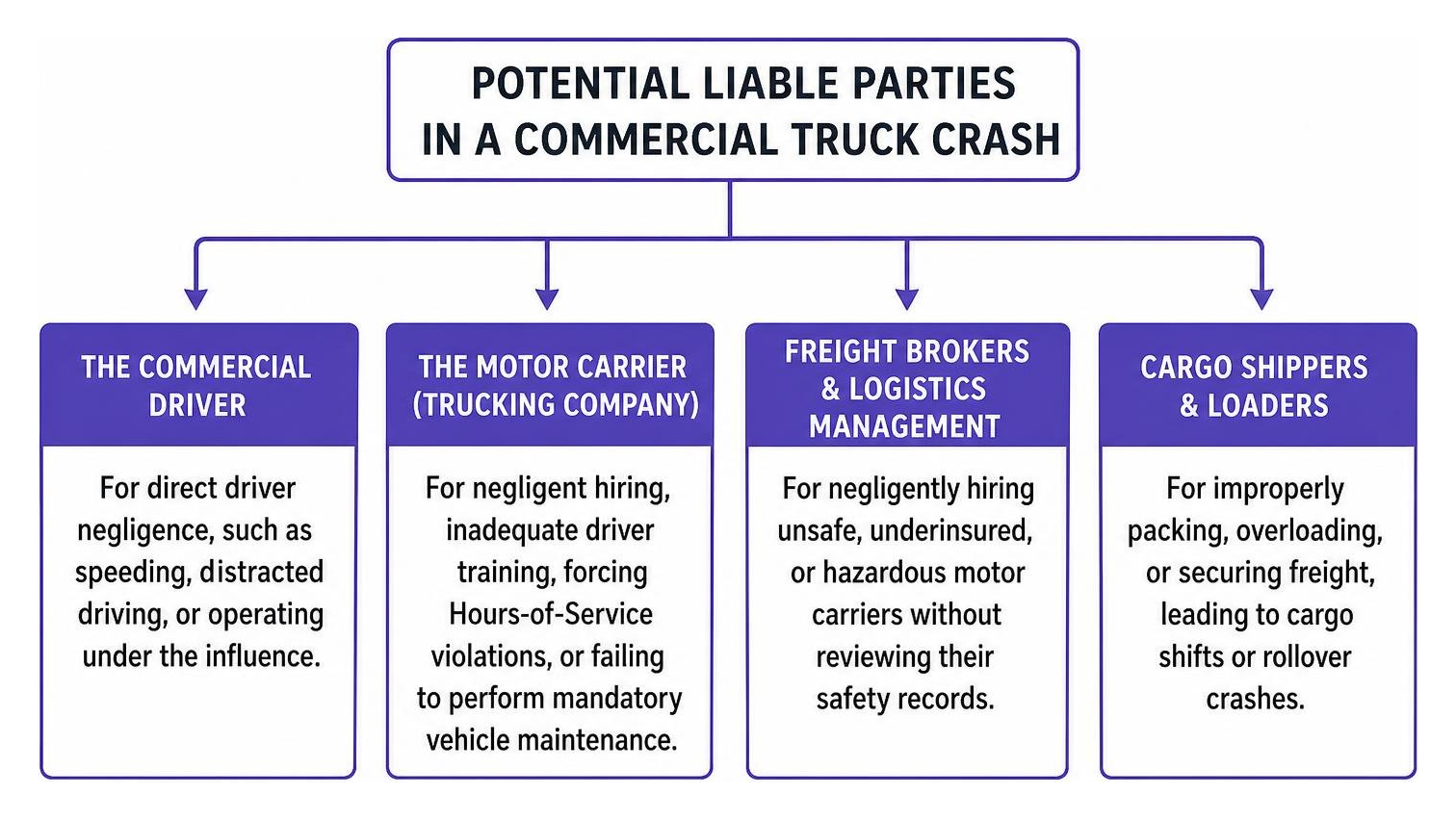
Potentially liable parties include:
- The Commercial Driver: For direct driver negligence, such as speeding, distracted driving, or operating under the influence.
- The Motor Carrier (Trucking Company): For negligent hiring, inadequate driver training, forcing Hours-of-Service violations, or failing to perform mandatory vehicle maintenance.
- Freight Brokers and Logistics Management: For negligently hiring unsafe, underinsured, or hazardous motor carriers without reviewing their safety records.
- Cargo Shippers and Loaders: For improperly packing, overloading, or securing freight, leading to cargo shifts or rollover crashes.
- Maintenance and Repair Vendors: For negligent mechanical repairs, faulty brake servicing, or missed safety inspections.
- Vehicle & Component Manufacturers: For defective truck components, such as faulty tires, failing air brakes, or malfunctioning collision mitigation systems.
To learn more about navigating claims against large fleets, read our summary on a comprehensive guide to commercial truck accident attorney representation.
Holding Freight Brokers and Cargo Shippers Accountable
For years, freight brokers—the logistics middlemen who match shippers with truck carriers—claimed immunity when an unsafe carrier they hired caused a fatal crash. However, recent legal precedents and landmark appellate rulings have established that freight brokers can be held legally accountable for negligent selection.
If a freight broker hires a trucking company with a history of safety violations, poor vehicle maintenance, or lack of insurance simply to save money on shipping rates, that broker can be held directly liable for resulting injuries. Uncovering these middle-mile logistics connections opens additional commercial insurance coverage to ensure full financial recovery for victims.
FMCSA Regulations and Carrier Duty of Care
The Federal Motor Carrier Safety Administration (FMCSA) sets strict regulatory standards for commercial motor carriers operating across state lines. Key FMCSA rules that frequently play a central role in truck crash cases include:
- Driver Qualification Files (49 CFR Part 391): Trucking companies must maintain comprehensive qualification files for every driver, including background checks, driving records, medical examiner certificates, and drug test results.
- Hours-of-Service Rules (49 CFR Part 395): Limits driving time to prevent fatigue, enforcing strict rest break requirements and mandatory daily and weekly off-duty periods.
- Inspection, Repair, and Maintenance (49 CFR Part 396): Requires regular safety inspections, systematic vehicle repair, and detailed maintenance logbooks for every commercial motor vehicle in a fleet.
Evidence Preservation and Tech Tools in Commercial Vehicle Claims
Commercial trucks are complex modern computing platforms equipped with sophisticated digital recording technology. When a crash occurs, this electronic evidence provides an objective, second-by-second timeline of what happened before, during, and after impact.
Critical digital evidence includes:
- Electronic Control Module (ECM) / Black Box: Records crucial collision metrics such as travel speed, engine RPM, throttle position, brake application, and seatbelt usage immediately prior to impact.
- Electronic Logging Devices (ELDs): Tracks exact driving hours, rest breaks, geographic location, and operational status to detect driver fatigue and HOS violations.
- Telematics & GPS Fleet Software: Provides real-time tracking of vehicle location, hard-braking events, sudden cornering, and route history.
- In-Cab Dashcams & Mobile App Data: Captures forward-facing and interior cab video footage, revealing driver distraction, drowsiness, or cell phone usage behind the wheel.
Rapid Response Defense Tactics and Spoliation Letters
Within hours of a catastrophic collision, commercial motor carriers and their insurance companies dispatch specialized “rapid-response” defense teams to the scene. These teams include defense attorneys, claims adjusters, and accident reconstructionists whose sole job is to gather evidence to protect the corporate entity and minimize company liability.
Worse yet, crucial electronic data can be overwritten or destroyed during routine truck operations if action is not taken immediately. ECM black box data is frequently erased as the truck is moved or repaired, and ELD logs are legally required to be retained by carriers for only six months under FMCSA rules unless a legal hold is issued.
To stop the destruction of evidence, your lawyer for trucking accident claims must immediately draft and serve a formal Spoliation Letter. This legal preservation order explicitly instructs the motor carrier, insurer, and third parties to preserve all physical evidence, ECM downloads, ELD records, maintenance logs, and driver personnel files. If a carrier destroys evidence after receiving a spoliation letter, courts can issue severe sanctions or instruct the jury to presume the destroyed evidence proved the carrier’s fault.
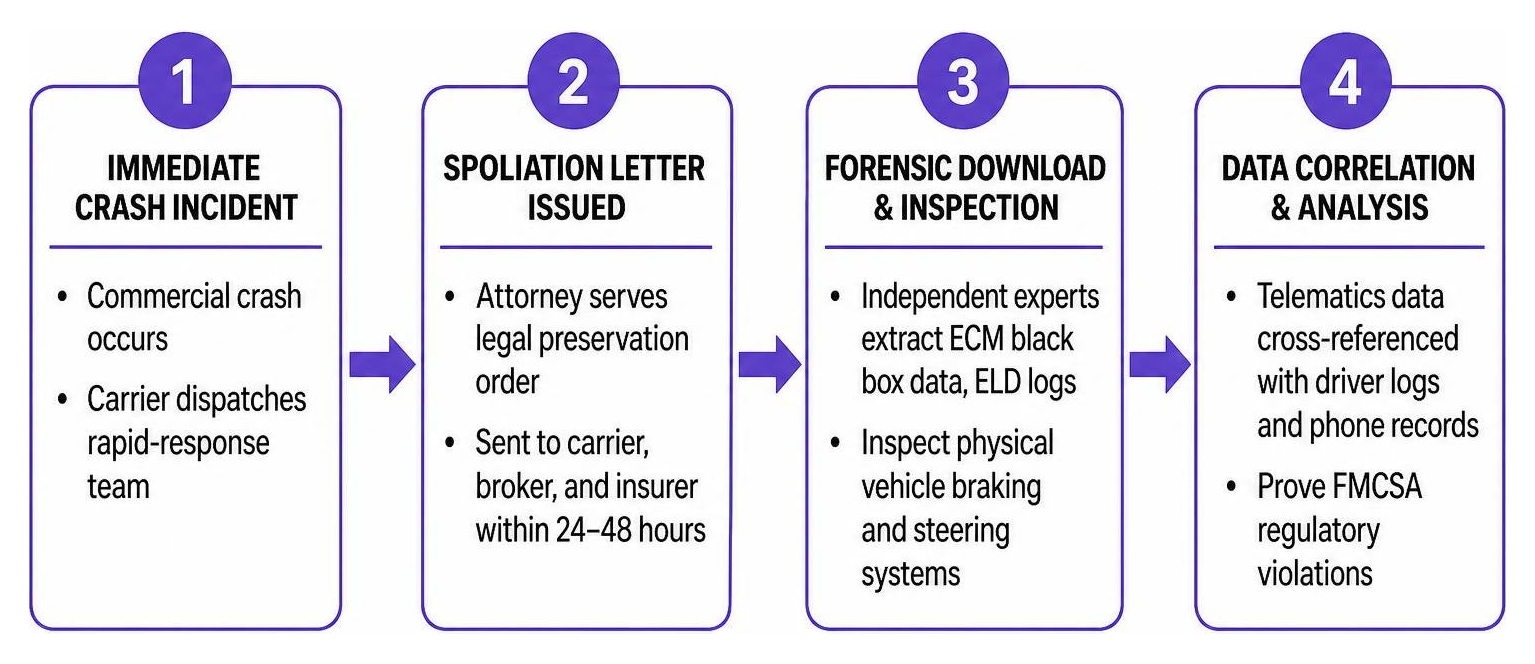
- Immediate Crash Incident: Commercial crash occurs; carrier dispatches rapid-response team.
- Spoliation Letter Issued: Attorney serves legal preservation order to carrier, broker, and insurer within 24–48 hours.
- Forensic Download & Inspection: Independent experts extract ECM black box data, ELD logs, and inspect physical vehicle braking and steering systems.
- Data Correlation & Analysis: Telematics data is cross-referenced with driver logs and phone records to prove FMCSA regulatory violations.
Telematics, ELDs, and Onboard Technology Data
By combining telematics data with mobile app logs and ELD records, expert accident reconstruction engineers can build precise step-by-step visual models of the crash.
For example, telematics may prove that a driver had been operating for 14 straight hours without required rest breaks, while ECM data reveals that no brakes were applied until 0.5 seconds before hitting stopped traffic. This combination provides clear proof of gross negligence and fatigue.
Compensation, Fee Structures, and Legal Process Expectations
Victims of severe commercial truck accidents face long medical recoveries, loss of income, and intense emotional trauma. Securing full financial justice requires calculating both immediate out-of-pocket losses and lifelong medical and personal impacts.
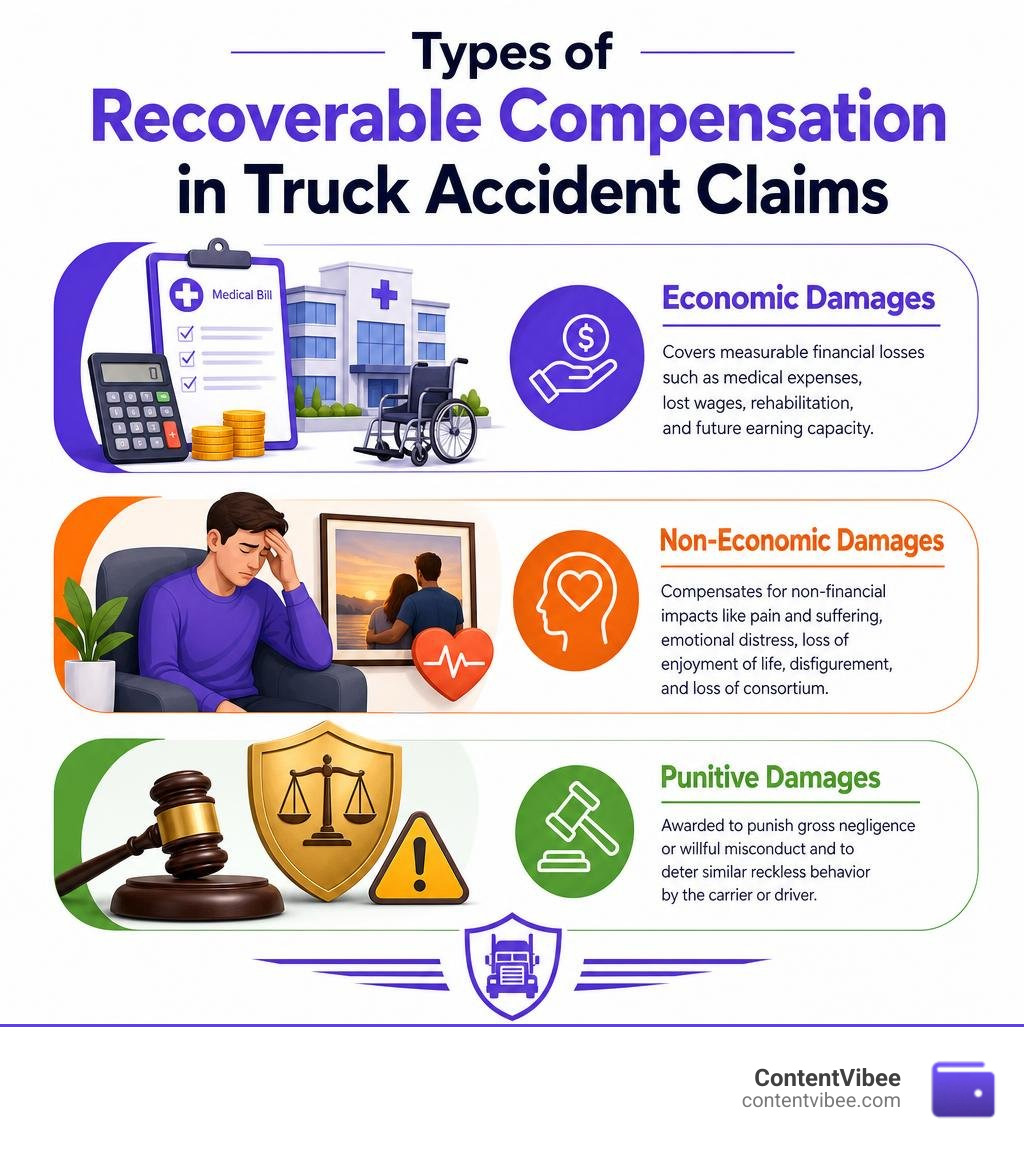
Recoverable compensation in a commercial trucking claim typically includes:
- Economic Damages: Past and future medical treatment, emergency surgeries, physical rehabilitation, home modifications, prescription medications, lost wages, and loss of future earning capacity.
- Non-Economic Damages: Physical pain and suffering, emotional distress, loss of enjoyment of life, physical disfigurement, and loss of consortium (impact on spousal relationships).
- Punitive Damages: Awarded in cases where the motor carrier or driver demonstrated gross negligence or willful misconduct—such as knowingly operating with destroyed brakes or hiring a driver with multiple DUI convictions.
To estimate potential claim values, read our breakdown on ultimate guide to truck accident settlement amounts.
Understanding Contingency Fee Agreements
Reputable commercial truck accident attorneys represent clients on a contingency fee basis. This arrangement makes high-caliber legal representation accessible to anyone, regardless of financial background:
- Zero Upfront Costs: You pay no upfront retainers, hourly rates, or out-of-pocket expenses.
- Firm Advances All Case Expenses: The law firm pays for court filing fees, accident reconstruction experts, medical testimony, and trial exhibits.
- No Fee Unless You Win: The attorney only receives payment—calculated as an agreed-upon percentage of the final settlement or court verdict—if they successfully secure financial recovery for you.
Step-by-Step Timeline From Free Consultation to Trial
Understanding the stages of a commercial trucking legal claim helps remove fear of the unknown:
- Free Initial Consultation: Reviewing crash details, insurance coverage, and immediate legal needs.
- Investigation & Evidence Preservation: Issuing spoliation letters, interviewing witnesses, securing black box data, and downloading ELD logs.
- Medical Treatment & Life-Care Planning: Documenting all physical injuries and working with medical experts to outline lifelong care requirements.
- Filing the Lawsuit & Discovery Phase: Exchanging legal documents, taking formal depositions of the driver, safety directors, and logistics brokers.
- Mediation & Settlement Negotiations: Formal settlement conferences where both sides attempt to resolve the claim fairly.
- Jury Trial: Presenting expert testimony, visual evidence, and witness statements in court if the insurance carrier refuses to pay full value.
For an end-to-end perspective on working with legal teams, explore our resource on truck accident law firm complete guide.
Frequently Asked Questions About Commercial Truck Accidents
How soon should I contact an attorney after a truck crash?
You should contact a specialized lawyer for trucking accident claims immediately—ideally within 24 to 48 hours. Motor carriers send rapid-response investigation teams to the scene right away, and vital digital black box data can be overwritten in a matter of days if formal preservation demands are not served.
Who can be sued besides the truck driver after a crash?
Beyond the driver, claims can be brought against the motor carrier (trucking company), freight brokers, cargo shippers, vehicle manufacturers, repair vendors, and third-party logistics firms depending on who contributed to the unsafe vehicle or operational conditions.
How does black box data help prove negligence in a trucking case?
Black box (ECM) data provides objective physical evidence of vehicle speed, engine performance, hard-braking events, steering input, and seatbelt usage right before the crash. This data helps counter false driver statements and proves whether safety violations occurred.
Conclusion
Securing legal representation after a commercial vehicle crash is about more than just obtaining financial compensation—it is about restoring stability to your life and holding reckless corporate entities accountable. When motor carriers cut corners on driver safety, skip vehicle maintenance, or force exhausted drivers onto public highways, aggressive litigation forces systematic changes that make roads safer for everyone.
At ContentVibee, we are committed to helping crash victims and their families navigate complex financial and legal choices with confidence. By choosing a dedicated, trial-ready lawyer for trucking accident claims, you ensure your rights are protected against powerful insurance companies every step of the way. Explore our full library of educational resources to take your next step toward justice and recovery.


