


Understanding Your Semi Truck Accident Settlement Value
When evaluating a semi truck accident settlement, generic formulas fail because commercial crashes involve complex layers of loss. Unlike standard automobile accidents, collisions involving fully loaded 80,000-pound commercial rigs generate immense physical impact. Determining case value requires an exhaustive accounting of immediate economic losses, future healthcare needs, and long-term disruptions to your life.
Calculating a claim’s worth requires pairing clear evidence of liability with a precise calculation of past and future damages. Crucially, access to higher insurance policy limits does not mean an insurance provider will willingly pay them. Securing full valuation depends on utilizing technical evidence—such as electronic logging devices (ELDs) and engine control modules—to prove gross negligence or regulatory violations.
Economic vs. Non-Economic Damages in a Semi Truck Accident Settlement
Financial recovery in personal injury claims falls into two distinct categories: economic and non-economic damages. Economic damages represent concrete financial losses backed by documentation like receipts, invoices, and pay stubs. Non-Economic damages reflect the intangible, human losses that result from physical trauma.
- Economic Damages: Include emergency transport, hospital stays, surgical interventions, physical therapy, specialized medical equipment, home modifications, lost wages, and loss of future earning capacity.
- Non-Economic Damages: Include physical pain and suffering, acute emotional distress, permanent physical disfigurement, loss of consortium, loss of enjoyment of life, and post-traumatic stress disorder (PTSD).
| Damage Category | Included Compensation Types | Documentation & Proof Required |
|---|---|---|
| Economic | Past & future medical bills, lost wages, vocational rehabilitation, property damage | Medical invoices, expert life-care plans, tax returns, wage statements |
| Non-Economic | Pain & suffering, emotional distress, physical impairment, loss of life quality | Daily pain journals, psychological evaluations, expert testimony |
How FMCSA Violations and Driver Negligence Impact Case Worth
The Federal Motor Carrier Safety Administration (FMCSA) enforces strict safety regulations governing commercial motor carriers. Establishing that a driver or trucking company violated federal safety standards significantly increases a claim’s settlement value by proving clear fault.
Key evidence that can expose regulatory non-compliance includes:
- Driver Logbooks & Hours of Service (HOS): Proving a driver exceeded daily driving limits to meet tight delivery schedules demonstrates driver fatigue and operational recklessness.
- Black Box (ECM) Downloads: Electronic Control Modules capture critical pre-crash data, including vehicle speed, braking history, throttle position, and steering inputs.
- Maintenance Logs: Carrier records may reveal deferred brake inspections, worn tires, or ignored mechanical defects.
- Cell Phone Records: Subpoenaed mobile carrier logs can establish illegal distracted driving at the moment of impact.
To understand how these evidence-gathering phases fit into the broader legal timeline, read our detailed guide on How a Truck Accident Injury Lawsuit Works From Claim to Settlement.
Average Settlement Amounts and Injury Severity

While dataset averages offer baseline context, injury severity remains the primary driver of final payout amounts. Minor soft-tissue claims may resolve near median values, but severe physical injuries regularly result in multi-million dollar payouts due to lifelong care requirements.
Dataset metrics across settled claims reveal an average payout of $103,654.08 and a median settlement of $30,000.00. However, jury awards and mediated settlements in catastrophic cases stretch significantly higher. For example, national datasets indicate that 12% of rear-end truck accident verdicts exceed $1 million.
How Injury Types Influence Payout Expectations
The nature of the injury dictates both the immediate medical costs and the lifetime financial compensation required:
- Traumatic Brain Injury (TBI): Ranging from mild concussions to severe cognitive impairment, TBI claims resolve across wide spectrums. Payouts can range from $1 million for moderate impairment up to $50 million or more for catastrophic, life-altering brain damage requiring round-the-clock care.
- Spinal Cord Damage & Cervical Fusion: Injuries requiring invasive surgical stabilization—such as single or multi-level spinal fusions—frequently command settlement values between $1 million and $3.5 million. Cases causing permanent paralysis or quadriplegia often push settlements higher.
- Amputations: Traumatic limb loss or medically required amputations involve extensive prosthetic replacement costs, long-term physical therapy, and severe disfigurement, often resulting in eight-figure recoveries.
- Wrongful Death Claims: Payouts for fatal collisions generally start around $500,000 and frequently exceed $5 million to compensate surviving family members for lost financial support, funeral expenses, and profound loss of companionship.
Estimating Average Semi Truck Accident Settlement Ranges
While every collision presents unique facts, industry benchmarks illustrate general settlement expectations based on injury severity:
- Minor Soft-Tissue Injuries: $15,000 – $50,000
- Moderate Injuries (Non-Surgical Fractures, Sprains): $50,000 – $200,000
- Serious Injuries (Single Surgeries, Moderate TBI, Disc Herniations): $250,000 – $750,000
- Catastrophic Injuries (Spinal Fusion, Severe TBI, Amputation): $1,000,000 – $5,000,000+
- Wrongful Death: $500,000 – $5,000,000+
Commercial Insurance Policy Limits and Liability Rules

Understanding commercial insurance structures is critical when pursuing a semi truck accident settlement. Federal law mandates that freight companies carry substantial financial liability limits, far exceeding standard consumer auto policies:
- Non-Hazardous Freight (>10,000 lbs): Minimum $750,000 liability policy required by the FMCSA.
- Oil & Petroleum Transporters: Minimum $1,000,000 liability policy limit.
- Hazardous Materials Carriers: Minimum $5,000,000 liability policy limit.
Beyond primary liability policies, large trucking enterprises often maintain excess umbrella coverage and secondary fleet policies. Furthermore, legal doctrines like respondeat superior (vicarious liability) allow victims to hold parent companies directly responsible for the negligent acts of their drivers during business operations.
Countering Low Initial Settlement Offers from Insurance Carriers
Insurance claims adjusters frequently attempt early contact with crash victims to extend lowball settlement offers before the full scope of medical injuries becomes clear. For instance, insurers may open negotiations at modest figures—such as $20,000—hoping an injured party will accept quick cash and execute a full liability release.
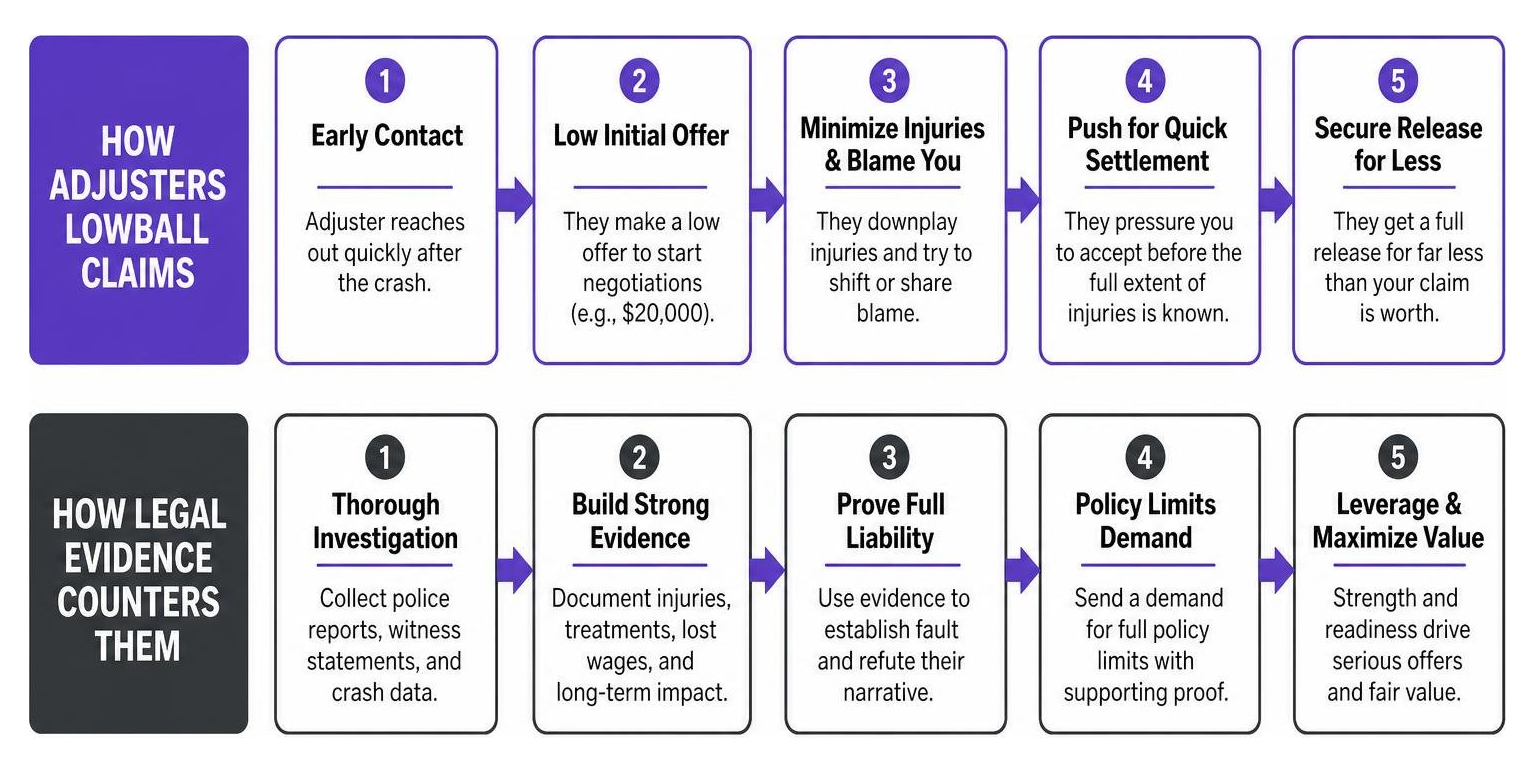
Commercial insurers push back aggressively in high-stakes claims. When victims face lowball offers, thorough case preparation and formal policy limit demands can alter negotiation dynamics. When an insurer faces potential bad-faith exposure for rejecting a reasonable policy-limits demand, aggressive legal strategy can drive initial low offers up substantially. For insights on navigating insurer pressure tactics, see our guide on How to Handle a Truck Accident Injury Claim Without Getting Steamrolled.
How State Laws Affect Settlement Payouts
Geographic location heavily dictates final settlement calculations due to regional statutory rules. State frameworks govern how comparative fault is calculated, how quickly claims must be brought, and whether non-economic damages are capped.
Key legal doctrines that impact claim valuation include:
- Modified Comparative Fault (50% Bar Rule): In jurisdictions operating under a strict 50% fault threshold, an injured motorist found 51% or more responsible for a collision is legally barred from recovering any financial compensation. If deemed 20% at fault, their total financial award is reduced by 20%.
- Pure Comparative Fault: In states enforcing pure comparative fault (such as Kentucky under KRS 411.182), an injured driver can recover damages even if they were 90% responsible for the crash, though recovery is reduced proportionately.
- No-Fault PIP Rules: Certain states require victims to exhaust personal injury protection (PIP) limits through their own auto insurance before stepping outside the no-fault system to file suit against a commercial trucking firm.
To review the foundational requirements for preparing your documentation, read Everything You Need to Know About Filing a Semi Truck Accident Claim.
Key Statutory Provisions Impacting Claim Valuation
Recent legislative shifts across various states directly impact how claims move through the civil courts:
- Statutes of Limitations: Personal injury filing deadlines vary by state. For instance, Florida shortened its personal injury statute of limitations from four years down to two years for actions accruing after March 24, 2023. Missing a state’s statutory deadline permanently bars recovery.
- Caps on Non-Economic Damages: While states like Kentucky impose zero caps on pain and suffering compensation, other states cap non-economic recoveries in personal injury or wrongful death matters, which can limit recovery in clear-cut catastrophic claims.
The Timeline of a Truck Accident Claim
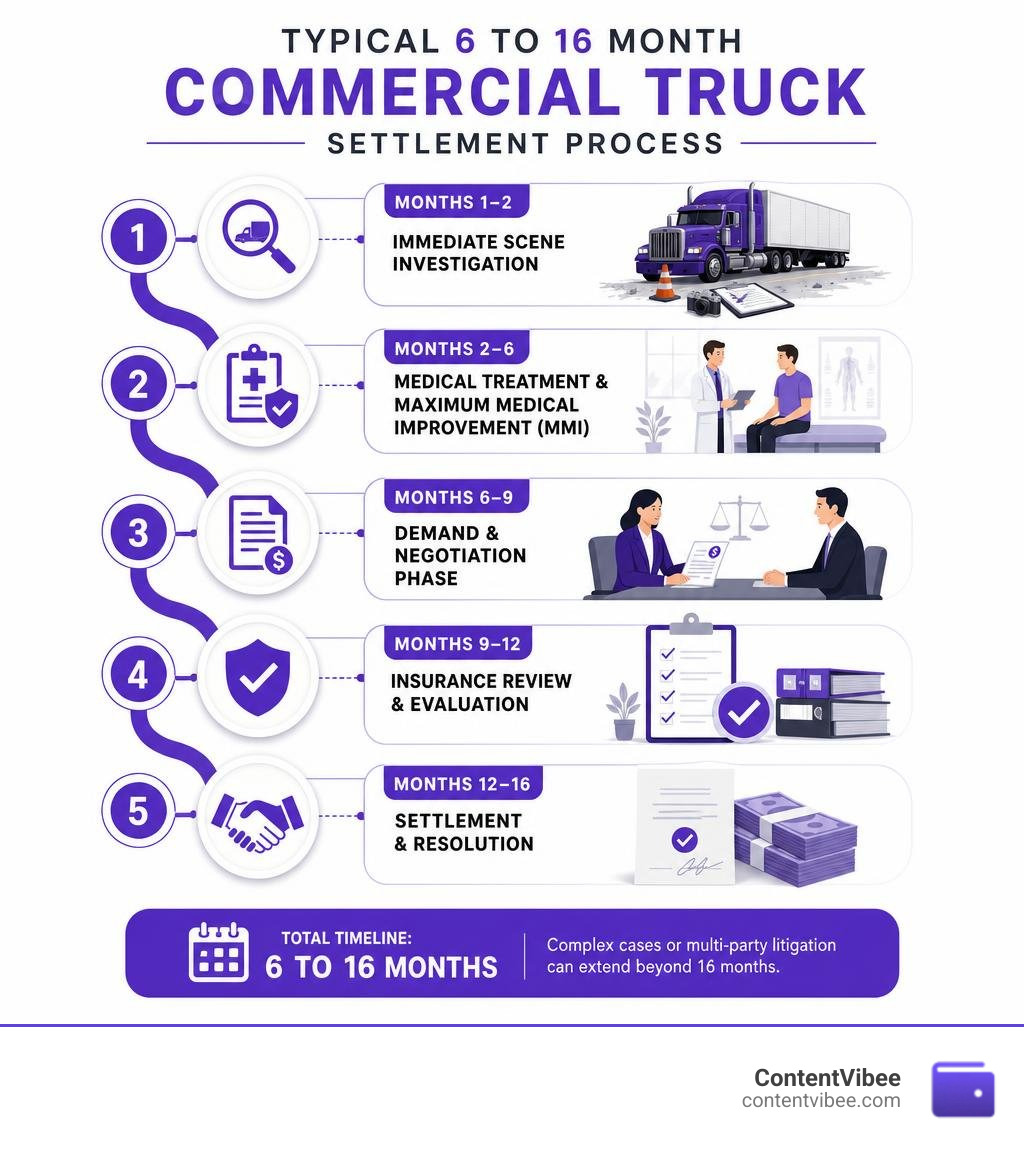
Resolving a commercial vehicle claim generally takes between 6 to 16 months, though complex catastrophic cases or multi-party litigation can extend past two years.
- Immediate Scene Investigation (Months 1–2): Evidence collection begins instantly. Spoliation letters are sent to freeze electronic logbooks, black box data, cell phone records, and vehicle maintenance history.
- Medical Treatment & Maximum Medical Improvement (Months 2–6): Full claim valuation cannot occur until the injured party reaches Maximum Medical Improvement (MMI), allowing experts to project lifetime care costs accurately.
- Demand & Negotiation Phase (Months 6–9): A formal settlement demand packet detailing liability proof and economic losses is presented to the trucking company’s insurance carriers.
- Litigation, Mediation, & Trial (Months 9–16+): If the insurer refuses a fair settlement demand, a lawsuit is filed. Cases enter formal discovery, court-ordered mediation, or proceed directly to trial.
Frequently Asked Questions About Truck Accident Claims
What is the average settlement for a semi truck accident?
Empirical data across settled cases shows an average settlement of $103,654.08, while the median payout rests at $30,000.00. However, these statistical averages combine minor injury payouts with severe, multi-million dollar catastrophic crash claims.
How long does it take to receive a truck accident settlement check?
Most commercial vehicle claims resolve within 6 to 16 months. Once a formal settlement agreement and release are signed by all parties, settlement funds are typically disbursed via trust accounts within 30 to 60 days, after outstanding medical liens are resolved.
Can I sue the trucking company directly instead of just the driver?
Yes. Under the legal principle of respondeat superior, motor carriers are legally liable for negligent driving committed by employees operating within the scope of their employment. Additionally, trucking companies can be sued directly for negligent hiring, improper vehicle maintenance, or forcing drivers to exceed federal hours-of-service limits.
Conclusion
Securing full compensation from a commercial insurer requires proving liability, documenting lifetime financial impact, and leveraging technical evidence like ELD logs and black box data. Commercial carriers and their insurance teams move quickly to protect their interests after a crash. Knowing your legal rights and understanding how case value is determined empowers you to pursue the full settlement you deserve.
For step-by-step guidance on selecting legal representation for complex commercial vehicle claims, read our guide on how to Find an 18-Wheeler Injury Lawyer.


