

Why the Cost of Selling Shares Eats More of Your Returns Than You Think
The cost of selling shares is rarely just one number — it’s a stack of fees, taxes, and charges that most investors never see coming.
Quick answer: What does it cost to sell shares?
| Cost Type | Typical Amount |
|---|---|
| Online stock/ETF commission | $0 at most major brokers |
| Regulatory fees (SEC + FINRA TAF) | ~$0.01–$0.03 per $1,000 sold |
| Options contract fee | $0.65 per contract |
| Broker-assisted trade surcharge | $25 per trade |
| Mutual fund short-term redemption fee | $49.95 (if held under 60 days) |
| Secondary market bond fee | $1 per bond ($10 min / $250 max) |
| Capital gains tax | 0%–37% depending on holding period and income |
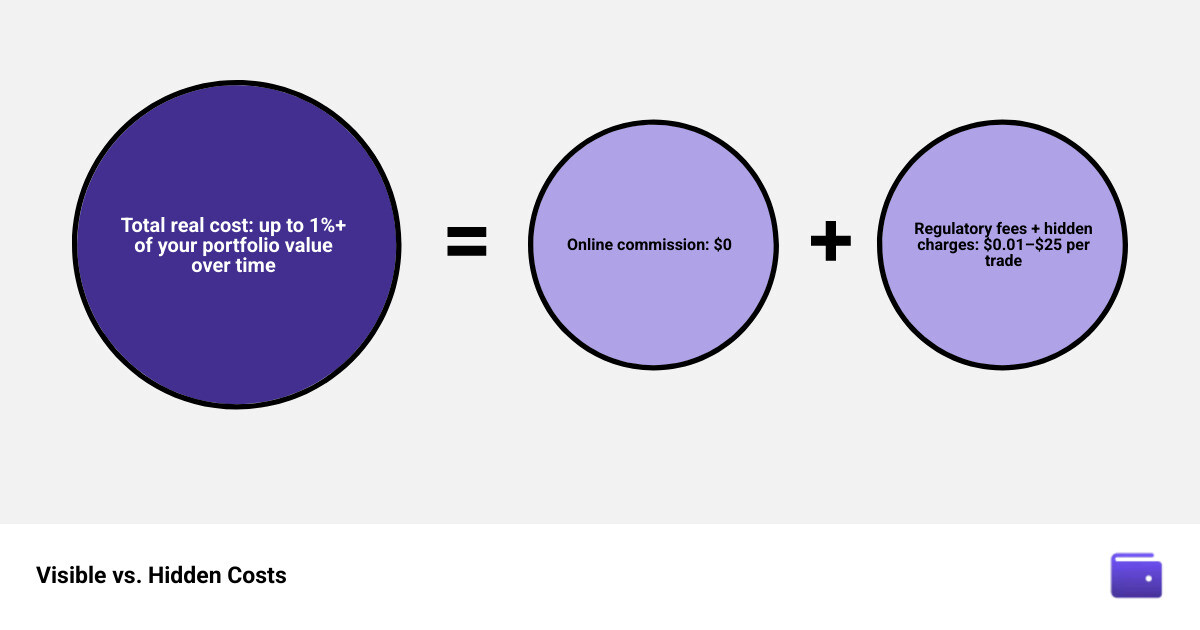
Most people see “$0 commission” and assume selling shares is free. It isn’t.
Even on a simple online stock sale, you’ll still pay small mandatory regulatory fees. Sell a mutual fund too early, use a broker over the phone, or hold international securities, and those costs climb fast.
And that’s before taxes even enter the picture.
Here’s the part that really stings: a fee difference of just 1% per year on a $100,000 portfolio earning 4% annually can quietly drain $28,000 from your returns over 20 years. That’s not a rounding error — that’s a car, a down payment, or years of retirement income.
This guide breaks down every layer of cost you’ll face when selling shares — from the obvious to the deeply hidden — so you can keep more of what you’ve earned.
Understanding the True Cost of Selling Shares
When we talk about the cost of selling shares, we often focus on the “sticker price.” In May 2026, most of us are accustomed to seeing a big fat zero next to the commission line on our trading screens. However, the reality of the financial industry is that businesses don’t work for free. To understand the true cost, we have to look behind the curtain of the “commission-free” era.
Many modern brokerages have shifted their revenue models. Instead of charging you a flat fee to click the “sell” button, they might make money through payment for order flow (PFOF)—where they receive small payments for routing your trade to specific market makers—or through margin interest and securities lending. For more on how these models work, see the guide on Fees and Commissions | FINRA.org.
To help investors navigate this, the SEC requires firms to provide a Form CRS (Client Relationship Summary). This document is your best friend; it summarizes the principal fees and costs you’ll incur. Before you liquidate a position, understand why brokerage firm investment fees and account structures matter so you can spot where your money might be leaking out.

Commission vs. Brokerage Fees: What’s the Difference?
It’s easy to use these terms interchangeably, but they represent different things. A trade commission is specifically the fee charged for the execution of a trade—the “toll” you pay to enter or exit a position. On the other hand, brokerage fees is a broader umbrella term. This includes account maintenance fees, wire transfer fees, and wealth management fees if you have a professional managing your portfolio.
For example, while a discount broker might charge $0 in commission, a full-service broker might charge a percentage-based fee (often 1% to 2% of managed assets) that covers both trading and advice. If you aren’t careful, you might find yourself paying more than you realize at certain full-service firms compared to a self-directed online account.
The Hidden Regulatory Cost of Selling Shares
Even when your broker’s commission is zero, Uncle Sam and the regulators still want their tiny slice. These are often called “pass-through” charges because the broker collects them from you to pay the government.
- SEC Section 31 Fee: This is a fee assessed by the SEC on national securities exchanges to cover the costs of supervising the markets. It is usually a tiny fraction of the total principal sold (often $0.01 to $0.03 per $1,000).
- FINRA Trading Activity Fee (TAF): This fee helps FINRA fund its regulatory activities. For equity sales, this is currently around $0.000195 per share, though it is capped at $9.79 per trade.
- Options Regulatory Fee (ORF): If you are selling options, this fee is charged by the Options Clearing Corporation (OCC) and varies depending on the exchange where the trade is executed.
While these fees are usually just pennies, they appear on every sell order confirmation. If you’re a high-volume trader, these “invisible” costs can add up over a year.
How Asset Types Influence Your Transaction Expenses
Not all securities are created equal when it comes to the cost of selling shares. Selling 100 shares of a blue-chip stock is a very different financial transaction than offloading a complex bond or a mutual fund.

Mutual Fund Redemption Fees and Penalties
Mutual funds have their own unique set of rules. While many are “No Transaction Fee” (NTF) funds, that doesn’t mean you can jump in and out of them without consequence. Many brokers impose a short-term redemption fee—often around $49.95—if you sell shares held for less than 60 days. This is designed to discourage market timing and protect long-term shareholders from the costs of frequent trading.
Additionally, you should be aware of 12b-1 fees, which are ongoing marketing and distribution fees ranging from 0.25% to 1% of the fund’s value. When selling, you might also encounter “deferred sales loads” depending on the share class you own. To avoid surprises, always review advisory and management fees in the fund’s prospectus.
Calculating the Total Cost of Selling Shares in 2026
If you are selling bonds in the secondary market, the pricing is different. Online trades typically cost about $1.00 per bond, but brokers often act as a “principal.” This means they might buy the bond from you at a lower price (a markdown) and sell it to someone else at a higher price, rather than charging a transparent commission.
Furthermore, the way you place the trade matters. In our digital age, doing things the “old fashioned way” costs more:
- Online Trades: Usually $0 for stocks/ETFs.
- Automated Phone Trades: Can incur a $5 surcharge.
- Broker-Assisted Trades: Often come with a $25 to $32.95 service charge per transaction.
By simply using your broker’s mobile app instead of calling a representative, you can save enough to buy a nice lunch.
Beyond the Trade: Ongoing and International Expenses
If you’re branching out into international markets, the cost of selling shares gets significantly more complex.
ADR Custody Fees and Foreign Transaction Taxes
American Depositary Receipts (ADRs) allow you to trade foreign stocks on U.S. exchanges, but they come with “ADR custody fees.” These are pass-through fees charged by the bank that holds the actual foreign shares, typically ranging from $0.01 to $0.05 per share.
Furthermore, some countries (like France, Italy, or Spain) impose a Financial Transaction Tax (FTT). Even if you are a Californian selling these shares through a U.S. broker, you may still be liable for these foreign taxes. Add in a currency exchange markup (which can be up to 1% for smaller trades), and your international “bargain” might be more expensive than you thought. For more on how these add up, check out our guide on totting up the costs of buying and selling shares.
Comparing Full-Service, Discount, and Robo-Advisor Costs
Choosing the right platform is half the battle.
- Full-Service Brokers: They provide high-touch advice but typically charge 1% to 2% of your managed assets.
- Robo-Advisors: These automated platforms have fees that are much lower, usually between 0.20% and 0.30% annually.
- Discount Brokers: Ideal for the DIY investor, offering $0 commissions and low-cost passive ETFs with operating expense ratios (OER) as low as 0.05%.
The Long-Term Impact of a 1% Fee on Your Portfolio
We cannot stress this enough: small percentages matter. As we mentioned in the intro, a 1% fee on a $100,000 investment earning 4% can reduce your total return by $28,000 over 20 years.
When you sell shares, you are often realizing the “net” of these years of fees. Understanding the difference between marginal and effective rates is crucial for seeing how these costs interact with your taxes to determine what actually ends up in your bank account.
Tax Implications and Realized Gains
Selling your shares is a “taxable event” unless the shares are in a tax-advantaged account like a Roth IRA. The IRS doesn’t care about your “unrealized gains” (the profit on paper), but the moment you sell, those gains become “realized,” and the taxman comes knocking.
Your cost basis is what you originally paid for the shares, including commissions. Your taxable gain is the sale price minus that cost basis. If you hold the shares for more than one year, you qualify for long-term capital gains rates (0%, 15%, or 20%). If you sell in under a year, you are taxed at your ordinary income rate, which can be as high as 37%.
Strategies like tax-loss harvesting—selling losing positions to offset your gains—can significantly lower your bill. For a deeper dive, read about the tax implications of selling stock and how selling investment property triggers capital gains.
State-Specific Tax Burdens: The California Example
For our readers in California, the cost of selling shares is unfortunately higher than in most other states. California treats capital gains as ordinary income, regardless of how long you held the asset.
With a maximum state tax rate of 13.3%, plus the federal long-term rate of 20% and the 3.8% Net Investment Income Tax (NIIT) for high earners, a Californian could see a total effective tax rate of over 37% on their “long-term” gains. This makes understanding state capital gains tax rates an absolute necessity for anyone living in the Golden State.
Frequently Asked Questions about Selling Shares
Does zero-commission trading mean selling is entirely free?
No. While the trade execution fee might be $0, you still pay regulatory fees (SEC/FINRA), the bid-ask spread (the difference between what buyers pay and sellers receive), and potential taxes. Brokers also make money indirectly through payment for order flow.
How much extra does a broker-assisted trade cost?
At major firms like Fidelity or Schwab, calling a representative to place a trade for you typically adds a service charge of $25 to $32.95. It is always more cost-effective to use the online platform or mobile app.
What are ADR custody fees and who pays them?
ADR custody fees are charges for the storage and record-keeping of foreign shares. They are usually deducted from any dividends paid out by the foreign company, or they are charged as a separate line item on your monthly statement. The investor (you) pays them.
Conclusion
At Smart Money & Tech Tips for Americans, we believe that the best way to grow your wealth is to stop it from leaking out through unnecessary expenses. The cost of selling shares involves much more than just a click of a button; it requires a strategic understanding of commissions, regulatory fees, and the heavy hand of taxes, especially in high-tax states like California.
By choosing low-cost platforms, holding assets for the long term, and being mindful of “hidden” regulatory charges, you can ensure your portfolio has the longevity it needs to support your future. For more tips on keeping your expenses low, dive into our guide on why brokerage firm investment fees and account structures matter.


