


Tax Brackets Impact on Investment Income and Capital Gains Strategy determines how much of your investment profits you actually keep — and most self-directed investors are leaving real money on the table by ignoring it.
Here’s a quick breakdown of how it works:
| Income Type | Tax Treatment | Key Rate Range |
|---|---|---|
| Short-term capital gains (held ≤1 year) | Taxed as ordinary income | 10% – 37% |
| Long-term capital gains (held >1 year) | Preferential rates | 0%, 15%, or 20% |
| Qualified dividends | Same as long-term capital gains | 0%, 15%, or 20% |
| Interest income | Taxed as ordinary income | 10% – 37% |
| Net Investment Income Tax (NIIT) | Surtax on top of above | +3.8% above MAGI thresholds |
The single biggest factor: whether you hold an asset for more or less than one year can be the difference between paying 37% and paying nothing.
For 2025, the 0% long-term capital gains rate applies if your taxable income stays at or below $48,350 (single) or $96,700 (married filing jointly). For 2026, those thresholds rise slightly due to inflation indexing — giving investors a wider window to realize gains tax-free.
But the rates themselves are only part of the story. How your investment income layers on top of your ordinary income — a concept called capital gains stacking — can quietly push you into higher brackets, trigger Medicare premium surcharges, increase the taxable portion of your Social Security benefits, and even phase out valuable deductions.
More than 70% of the tax benefit from lower capital gains rates flows to taxpayers earning over $1 million per year. That’s not because those strategies are only for the ultra-wealthy — it’s because most investors simply don’t plan around them.
This guide changes that.
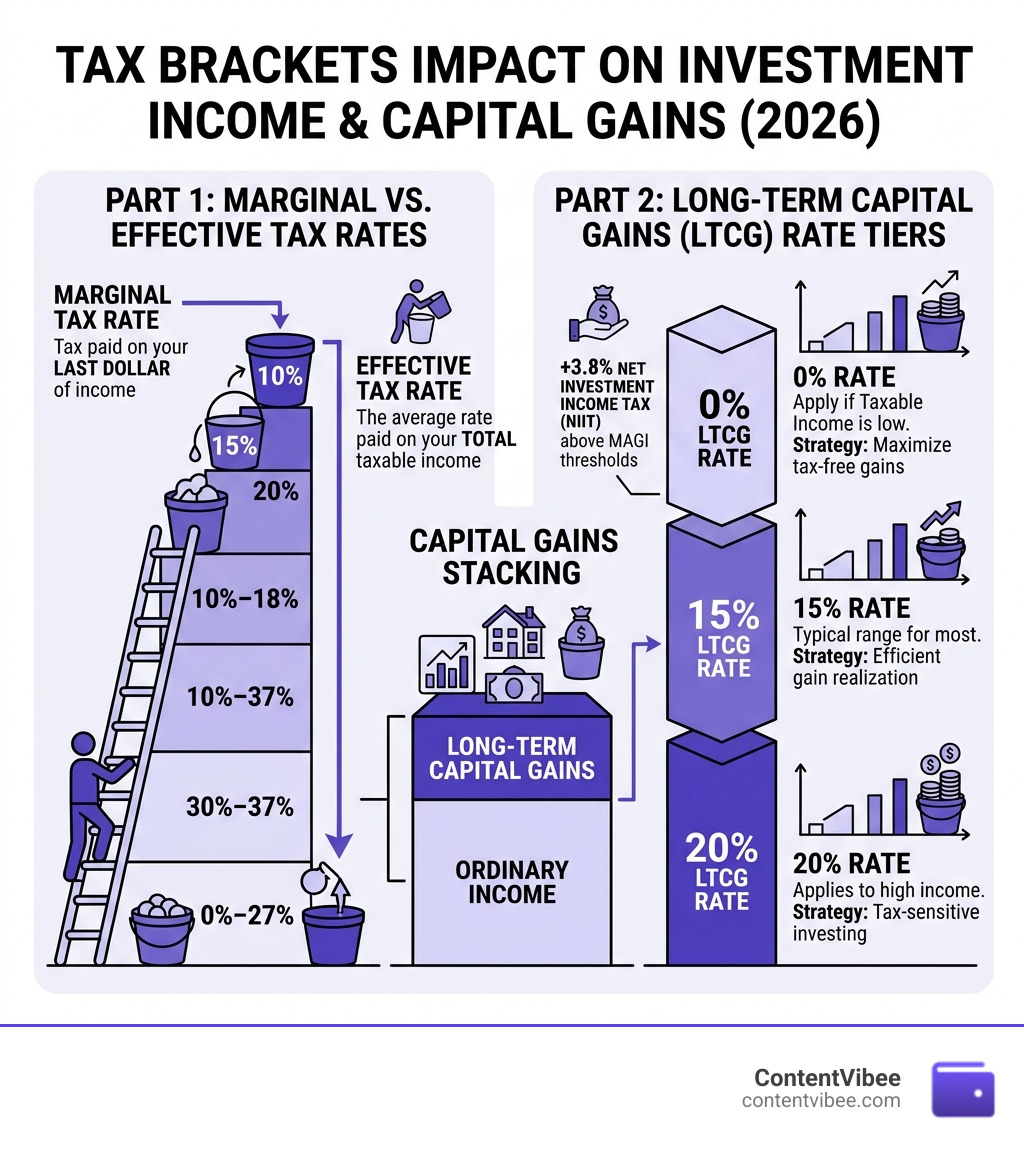
As we navigate the tax landscape we must first master the “tax ladder.” The U.S. federal income tax system is progressive, meaning your income is taxed in tiers, not at one flat rate. Think of it like filling up buckets: your first few thousand dollars fall into the 10% bucket, the next chunk into the 12% bucket, and so on, up to the 37% top tier.
Marginal Tax Rate is the percentage of tax applied to your last dollar of income. If you are in the 24% bracket, only the money within that specific range is taxed at 24%.
Effective Tax Rate, on the other hand, is the actual percentage of your total income that goes to the IRS. Because you utilize lower buckets first and benefit from the standard deduction (which has risen significantly by 2026 to account for inflation), your effective rate is almost always lower than your marginal rate.
“bracket creep” is a real concern. This happens when inflation-adjusted cost-of-living raises push you into a higher marginal bracket even if your purchasing power hasn’t increased. By understanding where you sit on the ladder, we can better manage the Tax Brackets Impact on Investment Income and Capital Gains Strategy to ensure your hard-earned growth isn’t eaten away by avoidable “tax drag.”
Tax Brackets Impact on Investment Income and Capital Gains Strategy
The interplay between your day job (ordinary income) and your portfolio (investment income) is where the real strategy begins. the IRS has adjusted thresholds upward, offering a unique window for tax-efficient rebalancing.
| Filing Status | 0% LT Capital Gains Rate (2025) | 0% LT Capital Gains Rate (2026 Proj.) |
|---|---|---|
| Single | Up to $48,350 | Up to ~$49,450 |
| Married Filing Jointly | Up to $96,700 | Up to ~$98,900 |
| Head of Household | Up to $64,750 | Up to ~$66,350 |
Note: Taxable income is calculated AFTER your standard deduction.
To make the most of these rates, we recommend using tools like the proprietary Zacks Rank system. By identifying stocks with high upward potential, we can time our exits when they hit “Long-Term” status (the 366-day rule) to lock in those 0% or 15% rates instead of paying ordinary income rates up to 37%.
If you are participating in a Florida Retirement System plan, it is vital to understand how these distributions layer into your overall tax picture. You can learn more about this in our guide: What You Need to Know About FRS Investment Plan.
Strategic Asset Sales for Tax Brackets Impact on Investment Income and Capital Gains Strategy
The secret to “tax-free rebalancing” lies in the 0% bracket. If your taxable income is low enough—perhaps during a gap year, early retirement, or a year with heavy business deductions—you can sell appreciated assets, pay $0 in federal tax, and immediately buy them back. This resets your cost basis to the current market price, shielding future gains from the taxman.
Qualified dividends also receive this preferential treatment. By focusing on high-quality dividend-paying stocks, we can create a stream of income that is taxed far more favorably than interest from a high-yield savings account or a traditional bond.
Minimizing Bracket Creep with Tax Brackets Impact on Investment Income and Capital Gains Strategy
Timing is everything. If you are close to the edge of a higher bracket, realizing a large capital gain in December could be a mistake. By splitting the sale between December and January, we can spread the income across two tax years, potentially keeping more of it in the 15% long-term bracket rather than letting it “stack” into the 20% tier.
For those managing withdrawals from employer-sponsored plans, the order of operations matters. We dive deeper into this in our article: Why FRS Investment Plan Withdrawal Rules and Tax.

Navigating the ‘Bump Zone’ and Capital Gains Stacking
This is where many investors get “ghosted” by taxes they didn’t see coming. Capital gains stacking means that long-term capital gains are added on top of your ordinary income to determine their tax rate.
Imagine a married couple with $90,000 in ordinary taxable income and $10,000 in long-term capital gains.
- The $90,000 fills up the lower ordinary brackets.
- The $10,000 in gains “stacks” on top. Since the 0% threshold for joint filers is roughly $98,900, the first $8,900 of their gains is taxed at 0%.
- The remaining $1,100 of gains is taxed at 15%.
The Bump Zone Trap: If this couple earns just $1 more in ordinary income, it doesn’t just cost them 12 cents in ordinary tax. It can push $1 of their capital gains from the 0% bracket into the 15% bracket. This creates an effective marginal rate of 27% (12% ordinary + 15% capital gain) on that single dollar!
This stacking effect also impacts:
- Social Security Taxation: Higher income can make up to 85% of your benefits taxable.
- Medicare Part B Premiums: Crossing MAGI thresholds triggers IRMAA surcharges, which are essentially a “stealth tax” on retirees that can cost thousands per year.
- Identity Theft Tax Fraud Recovery: If you’ve been a victim of irs tax refund scam how to claim loss and prevent identity theft USA, your reported income might be inflated, making it even more critical to dispute unauthorized transactions to protect your tax bracket.
Pro-Level Tactics for Tax Recovery and NIIT Protection
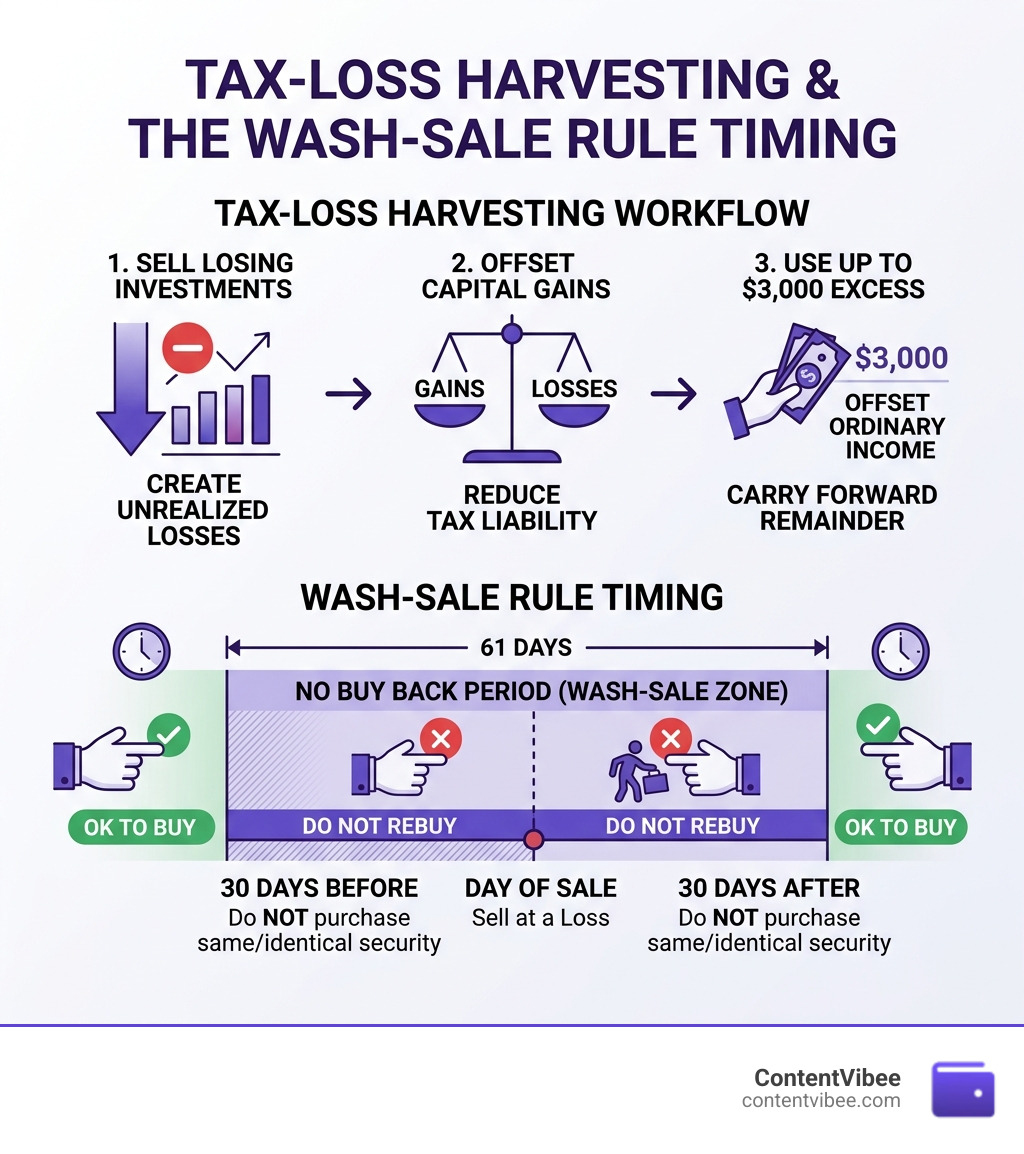
When the market gets volatile, we don’t just see red—we see opportunity. Tax-loss harvesting allows us to sell losing positions to offset our gains. If your losses exceed your gains, we can use up to $3,000 of that “excess” to wipe out ordinary income, with the rest carrying forward indefinitely.
The Net Investment Income Tax (NIIT)
For high earners, the 3.8% NIIT surtax is a major hurdle. It applies to the lesser of your net investment income or the amount by which your Modified Adjusted Gross Income (MAGI) exceeds:
- $200,000 (Single/Head of Household)
- $250,000 (Married Filing Jointly)
Unlike federal brackets, these thresholds are not indexed for inflation. This means every year, more investors are hit by this tax. To protect yourself, we recommend:
- Asset Location: Keep high-growth, high-turnover assets in tax-advantaged accounts (like a Roth IRA) and keep tax-efficient ETFs in taxable accounts.
- Municipal Bonds: Interest from “munis” is generally exempt from federal tax and NIIT, making them highly attractive for those in the 32%+ brackets.
- Roth Conversions: In lower-income years, converting a Traditional IRA to a Roth can lower future RMDs, preventing “bracket spikes” in your 70s.
If you are dealing with a wire transfer fraud victim recovery options USA situation, documenting these losses correctly is vital, as they may provide a “silver lining” deduction that lowers your MAGI and shields you from the NIIT.
State Tax Variations and Legislative Sunsets
Federal taxes are only half the battle. Your residency plays a massive role in your Tax Brackets Impact on Investment Income and Capital Gains Strategy.
Some states, like Florida, Texas, Nevada, and Wyoming, have no state income tax, meaning you only pay the federal rates. Others are not so kind. California taxes capital gains as ordinary income with rates as high as 13.3%, while New York can hit you with 10.9%. Washington state has also introduced a 7% tax on long-term capital gains exceeding $278,000.
The 2026 Cliff: Many provisions of the Tax Cuts and Jobs Act (TCJA) are scheduled to sunset at the end of 2025. This means that in 2026, we could see a return to higher individual rates and lower standard deductions. Navigating this requires proactive planning. We suggest reviewing Topic no. 409, Capital gains and losses | Internal Revenue Service to stay updated on official basis and reporting rules.
If you are planning a large asset sale, timing your move to a low-tax state before the sale can save you six figures. Just be sure to establish “true residency” to avoid a residency audit from your former home state.
Frequently Asked Questions about Capital Gains Strategy
Can realizing capital gains push me into a higher ordinary income tax bracket?
No, realizing long-term capital gains will not push your ordinary income (like your salary) into a higher bracket. However, the reverse is true: your ordinary income can push your capital gains into a higher bracket (the 15% or 20% tiers) because of the stacking effect. Short-term gains, however, are taxed exactly like salary, so they can push you into a higher ordinary bracket.
How do I qualify for the 0% long-term capital gains rate?
To pay 0% in federal capital gains tax, your total taxable income (ordinary income + capital gains – deductions) must be below the threshold for your filing status. we estimate this to be roughly $49,450 for individuals and $98,900 for married couples. If you’re a student or early retiree, this is your golden ticket to tax-free wealth building.
What is the Net Investment Income Tax (NIIT) threshold ?
The threshold remains $200,000 for single filers and $250,000 for married couples filing jointly. Because this isn’t adjusted for inflation, it is a “stealth tax” that catches more people every year. If you find yourself over this limit, consider unauthorized bank transaction how to dispute and recover money USA strategies if fraud has impacted your accounts, as ensuring your reported income is accurate is the first step in NIIT protection.
Conclusion
Maximizing your after-tax ROI is just as important as picking the right stocks. By mastering the Tax Brackets Impact on Investment Income and Capital Gains Strategy, we can ensure that more of our portfolio’s growth stays in our pockets rather than being lost to the “stacking” effect or the 3.8% NIIT.
Whether you’re using the Zacks Rank to time your entries or harvesting losses to offset a big win, proactive planning is the key to long-term wealth. Don’t let tax season be a surprise—make it a strategic victory.
For more information on protecting your assets from fraud or exploring financial recovery, visit our categories page: More financial recovery and protection options


