


A Compound Interest Calculator for Retirement Investment Growth Strategy is a tool that shows you exactly how your money grows over time — by earning returns not just on what you invest, but on every dollar of growth you’ve already accumulated.
Here’s what you need to know right away:
- Start early — $500/month at 7% from age 25 grows to $1.2 million by 65; waiting until 35 cuts that to $566,000
- Use the right rate — 6–8% is a realistic long-term assumption for diversified portfolios; the S&P 500 has averaged ~10% since 1926
- Contribute consistently — regular monthly contributions dramatically outperform sporadic investing
- Protect tax efficiency — tax-advantaged accounts like 401(k)s and Roth IRAs can add over $130,000 to your final balance compared to taxable accounts
Compound Interest Calculator
Discover the true power of compound interest. Calculate how your initial investments and monthly contributions will grow over time into a massive nest egg.
*Calculations assume monthly compounding and end-of-month contributions. These are estimates and do not account for taxes, inflation, or investment fees.
The Power of Compound Interest: Building Long-Term Wealth
If there is one mathematical concept that has the power to change your financial life forever, it is compound interest. Albert Einstein famously called it the “Eighth Wonder of the World,” stating that those who understand it, earn it; and those who don’t, pay it. Our free Compound Interest Calculator is designed to help you visualize this phenomenon, making it easier to plan for retirement, save for a home, or achieve financial independence.
Understanding the Investment Strategy
Many popular financial personalities, such as Dave Ramsey, advocate for a straightforward, highly disciplined approach to investing. The strategy is built on a few core tenets:
- Get out of debt first: Before investing heavily, clear high-interest consumer debt (credit cards, personal loans). Interest working against you is mathematically destructive.
- Build an emergency fund: Ensure you have 3 to 6 months of expenses saved in a liquid account to prevent derailing your investments during life’s unexpected emergencies.
- Invest consistently: The secret to massive wealth isn’t timing the market perfectly; it’s “time in the market.” Contributing a set percentage of your income (often recommended at 15%) every single month ensures you are always buying assets, a strategy known as Dollar-Cost Averaging.
- Use Growth Stock Mutual Funds or Index Funds: For long-term growth, spreading your risk across hundreds of solid companies via mutual funds or S&P 500 index funds provides steady, reliable growth over decades.
The 10% to 12% Return Debate
When using a compound interest calculator, one of the most critical inputs is the “Estimated Annual Interest Rate.” You may notice that certain financial advisors famously use a 12% annual return in their examples. But is this realistic?
Historically, since its inception in 1926 through to recent years, the S&P 500 index has returned an average of roughly 10% to 10.5% annually before inflation. If you look at specific 30-year bull market periods, or specific aggressive growth mutual funds, you can find averages closer to 12%.
However, it is crucial to remember that the market is volatile. You will have years where your portfolio drops by 20%, and years where it surges by 30%. Because of this, many conservative planners recommend using an estimated return of 8% to 10% when running retirement projections. This builds a margin of safety into your financial plan. Feel free to adjust the interest rate field in our calculator to see best-case and worst-case scenarios.
How to Use This Compound Interest Calculator
To get the most accurate projection of your financial future, follow these steps:
- Initial Investment: Enter the amount of money you currently have sitting in your brokerage account, IRA, or 401(k). If you are just starting out, it’s perfectly fine to leave this at $0.
- Monthly Contribution: This is the engine of your wealth. Enter the amount you plan to deposit into your investments every single month. Consistency here is far more important than a massive initial deposit.
- Length of Time: How many years until you plan to touch this money? If you are 30 years old and plan to retire at 65, you would enter 35 years. Compound interest reveals its true magic in the later decades.
- Estimated Annual Interest Rate: Enter your expected rate of return. We default to 10%, but you can adjust this based on your risk tolerance and asset allocation.
Visualizing Your Wealth: Principal vs. Interest
When you click “Calculate,” pay special attention to the progress bar and the legend below your Total Investment Value. You will notice two numbers:
Total Contributions (Principal): This is the actual hard cash that came out of your paycheck. This is the sum of your initial investment plus every monthly deposit you made.
Total Interest Earned: This is the “free money.” It is the wealth generated purely by your money making more money. If you leave your investments alone for 20 or 30 years, you will inevitably see that your Total Interest Earned vastly eclipses your actual contributions. This is the moment your money starts working harder than you do.
Why You Should Start Today
The biggest enemy of wealth building is procrastination. Because compound interest is an exponential function based on time, waiting just five years to start investing can cut your final retirement nest egg in half. You do not need to be wealthy to start investing; you just need to be consistent. Play with the calculator above, find a monthly contribution that fits your budget, and start building your financial legacy today.
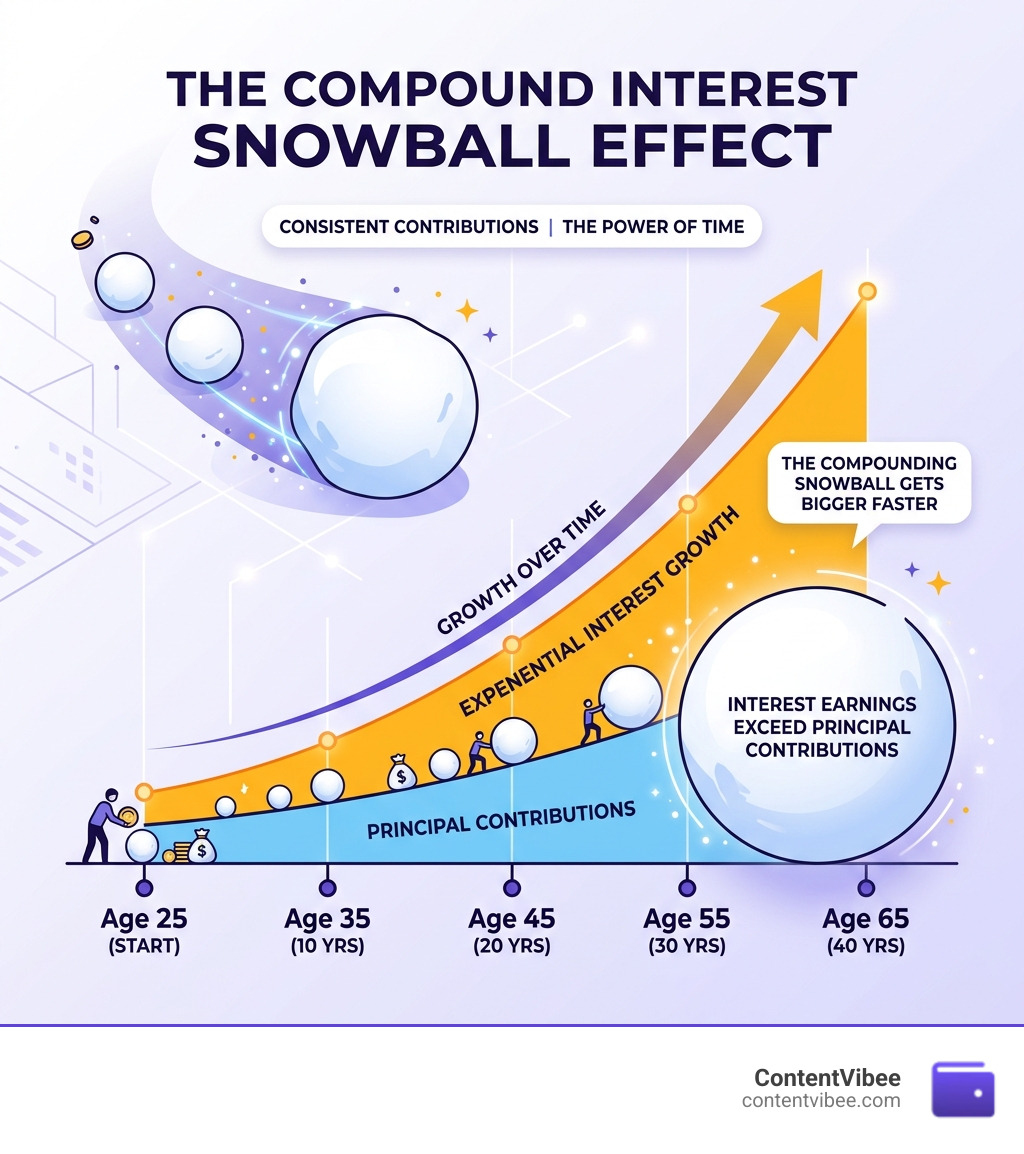
Albert Einstein is widely credited with calling compound interest "the eighth wonder of the world" — and the math backs that up. A single $10,000 investment at 7% annual return doesn't just become $17,000 or $20,000 after 30 years. It becomes $76,123 — with $66,123 of that coming purely from compounding, not from money you ever added.
That's the snowball effect. And it's why when you start and how you structure your retirement investments matters far more than most people realize.
This guide walks you through four simple, actionable steps to make compounding work as hard as possible for your retirement — and how to use a calculator to map it all out with real numbers.
The Mechanics of a Compound Interest Calculator for Retirement Investment Growth Strategy
To master your financial future, we first need to look under the hood of how wealth is actually built. Most people think of saving as a linear process: you put money in, and it sits there. But a Compound Interest Calculator for Retirement Investment Growth Strategy reveals a much more exciting reality.
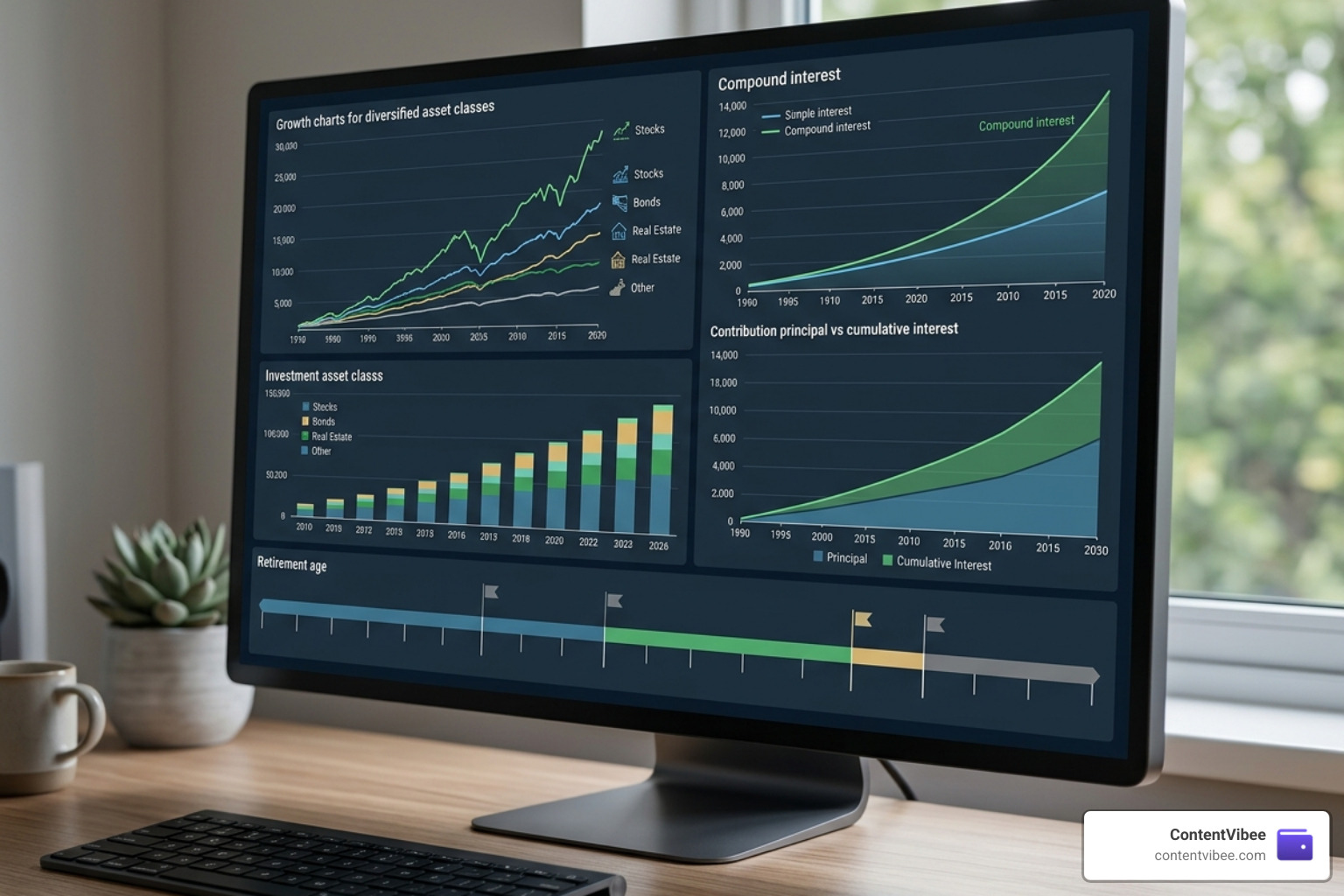
The basic formula for compound interest is A = P(1 + r/n)^(nt). While that looks like high school algebra nightmares, it simply means your ending amount (A) is determined by your starting principal (P), your interest rate (r), the number of times it compounds per year (n), and the total time in years (t).
In retirement, time is your greatest multiplier. One of the most useful mental shortcuts we use is the Rule of 72. If you want to know how long it takes for your money to double, simply divide 72 by your expected annual return. At a 7% return, your money doubles roughly every 10.3 years. At 10%, it doubles every 7.2 years. This is the heartbeat of long-term wealth accumulation.
Why You Need a Compound Interest Calculator for Retirement Investment Growth Strategy
Visualizing growth is the difference between a "wish" and a "plan." If your goal is a $1 million target by age 65, a calculator tells you exactly what the "price" of that goal is today. For example, if you are 35 years old and starting from zero, you might need to contribute about $880 a month at a 7% return to hit that million-dollar mark.
Using a Compound Interest Calculator - Investment Growth Tool allows us to move beyond guesswork. It helps us understand the future value of our current sacrifices. We also have to consider the types of assets we choose. There is a significant difference in how wealth builds when understanding traditional vs alternative investments. While a savings account might offer safety, its measly 0.5% to 1% return often fails to keep up with inflation, whereas a diversified stock portfolio historically offers the 7-10% returns necessary to fuel the compounding engine.
Advanced Inputs for Your Compound Interest Calculator for Retirement Investment Growth Strategy
As of April 2026, the financial markets continue to reward those with a granular plan. To get the most accurate results, we shouldn't just look at a flat "7% return." Advanced calculators allow for a variance range. This means you can see what happens if the market underperforms (perhaps 4%) or overperforms (perhaps 10%).
Other key inputs include:
- Contribution Frequency: Adding $500 once a month is often better than adding $6,000 once a year because those monthly "chunks" start compounding immediately.
- Annual Step-ups: This is a game-changer. If you increase your monthly contribution by just 3% every year as your salary grows, you can add hundreds of thousands of dollars to your final nest egg without feeling a massive pinch in your lifestyle.
- Compounding Frequency: While most stocks and mutual funds are calculated annually, many high-yield savings accounts compound daily. A good Compound Interest Calculator for Retirement Investment Growth Strategy lets you toggle these settings to see the subtle but real differences in growth.
Step 1: Harness the "Eighth Wonder" by Starting Early
The most expensive mistake any investor can make isn't picking the wrong stock—it's waiting until "next year" to start.

Consider the "Cost of Delay." If you start at age 25 with $500 monthly contributions at a 7% return, you’ll have roughly $1.2 million by age 65. If you wait until age 35 to start that exact same $500 monthly contribution, you end up with only $566,000. Even though you only missed 10 years of contributions ($60,000 total), you lost out on over $630,000 in growth. You essentially paid over half a million dollars for a 10-year delay.
This is why we emphasize the time-value of money. Historical data shows that the S&P 500 has averaged approximately 10% annual compounded returns since 1926. Even after adjusting for inflation, that leaves a "real" return of about 7%.
Benefits of an Early Start:
- Lower Monthly Requirement: You can save much less per month to reach the same goal.
- Risk Tolerance: You have decades to recover from market downturns.
- The "Free Money" Phase: In the later years of a 40-year investment horizon, your interest earned per year will eventually exceed your total annual salary.
For more interactive modeling, you can use the Compound Interest Calculator | Investor.gov to see how your specific age impacts your trajectory.
Step 2: Amplify Returns with Consistent Contributions and Asset Selection
While a lump sum is great, most of us build wealth through consistent monthly contributions. This strategy is known as dollar-cost averaging. By investing a fixed amount every month, you naturally buy more shares when prices are low and fewer shares when prices are high.
According to research, $10,000 invested at 7% grows to $76,123 in 30 years. However, if you add just $200 a month to that initial $10,000, your total jumps to $293,382. The consistency of the contribution acts as the fuel for the compounding fire.
| Strategy | Initial Investment | Monthly Contribution | Years | Total at 7% |
|---|---|---|---|---|
| Lump Sum Only | $10,000 | $0 | 30 | $76,123 |
| Consistent Saver | $10,000 | $200 | 30 | $293,382 |
| Aggressive Saver | $10,000 | $500 | 30 | $607,438 |
When selecting assets, we must be mindful of our tax situation. This involves understanding marginal vs effective rates to ensure we aren't losing too much of our growth to the IRS. For long-term retirement growth, a stock-heavy portfolio is generally recommended for those with 20+ years until retirement, as the higher returns of equities are necessary to maximize the compounding effect.
Don't forget to reinvest your dividends! A portfolio that automatically reinvests dividends can grow to be nearly double the size of one where dividends are taken as cash over a 30-year period. You can visualize this using the Investment Growth Calculator — Free Compound Interest & Returns Estimator.
Step 3: Optimize for Compounding Frequency and Inflation
Compounding frequency refers to how often the interest is calculated and added back to your balance.
- Annual: Once a year.
- Monthly: 12 times a year.
- Daily: 365 times a year.
Does it matter? Yes, but perhaps less than you think. For example, $10,000 at 5% for 10 years grows to $16,288.95 with annual compounding. With daily compounding, it grows to $16,486.64. While an extra $200 is nice, the interest rate and time are far more powerful levers than the frequency. You can test these nuances yourself on the Compound Interest Calculator - NerdWallet.
However, the real "silent killer" of retirement is inflation. If your Compound Interest Calculator for Retirement Investment Growth Strategy shows you'll have $1 million in 30 years, you must realize that $1 million in 2056 won't buy what $1 million buys in April 2026. With an average inflation rate of 3%, your purchasing power is essentially cut in half every 24 years.
To combat this, we always recommend looking at "real" rates of return. If you expect 10% from the market and 3% inflation, use 7% in your calculator to see what your wealth will look like in "today's dollars." This helps avoid the shock of reaching your goal only to find out prices have tripled.
Step 4: Protect Your Nest Egg from Tax Drag and Financial Fraud
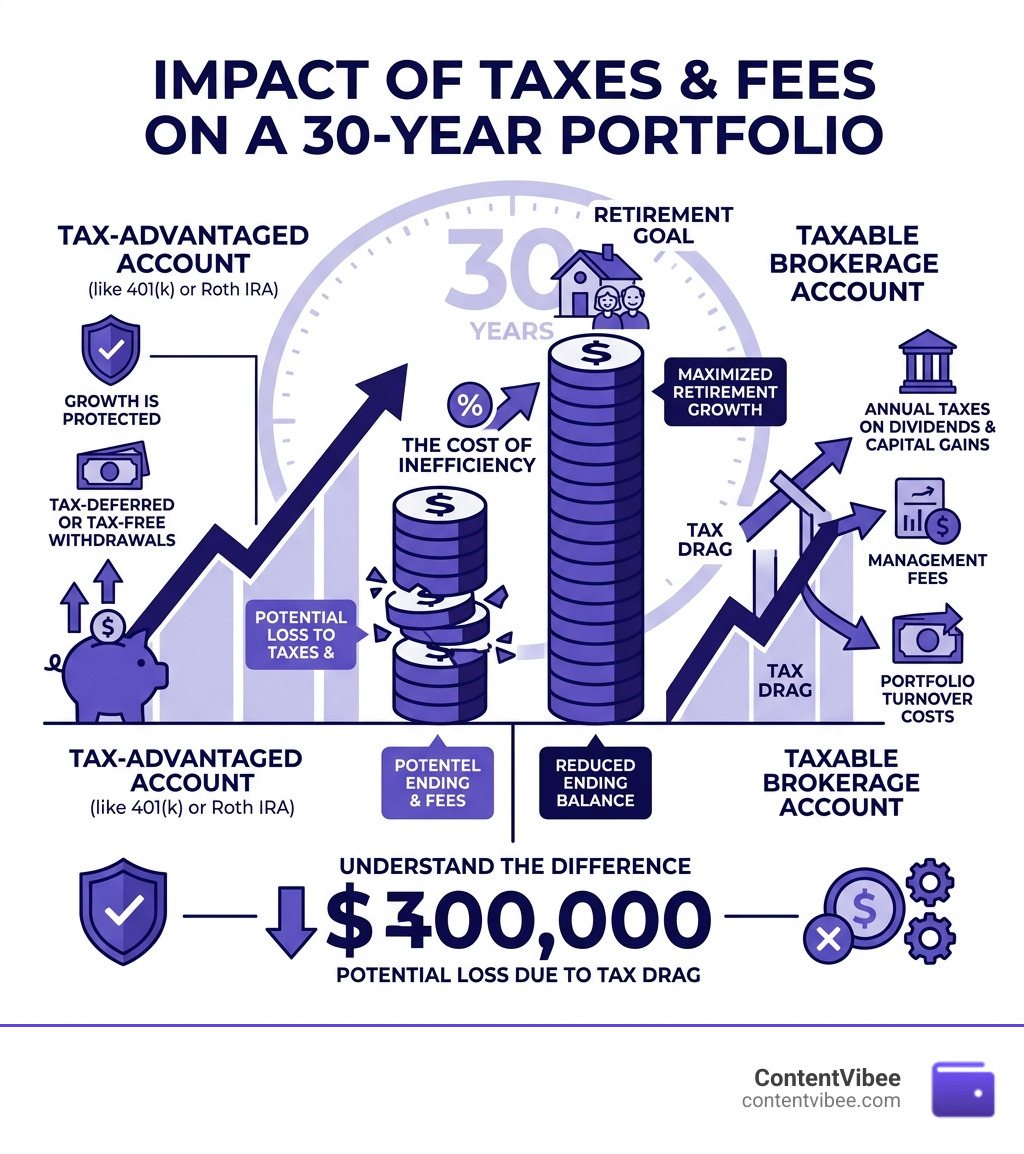
You can have the best investment strategy in the world, but if you're losing 25% of your growth to taxes and fees every year, your "snowball" will melt before it reaches the bottom of the hill.
Tax-advantaged accounts like 401(k)s and Roth IRAs are essential. In a taxable brokerage account, you might pay taxes on dividends and capital gains every year. This "tax drag" can reduce your final balance by over 20%. For instance, $500 a month at 7% over 30 years in a tax-advantaged account grows to $607,438, while the same investment in a taxable account might only yield $475,000. That's a $132,438 difference just based on where the money is "parked."
If you work in the public sector, understand specific plans, such as the FRS investment plan withdrawal rules and tax implications, to avoid unnecessary penalties. You should also check out the Compound interest calculator | Manulife John Hancock Retirement for retirement-specific projections.
Unauthorized Bank Transaction Recovery and Retirement Security
As we move into 2026, digital security is a pillar of retirement planning. All the compounding in the world won't help if a fraudster empties your account.
If you face an unauthorized bank transaction how to dispute and recover money USA 2026, time is of the essence. Under federal law (Regulation E), you generally have 60 days from your statement date to report unauthorized electronic transfers to limit your liability.
- Notify your bank immediately to freeze the account.
- File a formal dispute in writing.
- Monitor for wire transfer fraud recovery options if the theft involved larger sums.
- Update all account verification methods, moving away from SMS-based 2FA to hardware keys or authenticator apps.
Identity Theft Credit Report Fraud and Retirement Protection
Your credit score and identity are financial assets. Identity theft credit report fraud how to fix and protect your score USA is a process that requires diligence. If your Social Security Number is misused, it can lead to fraudulent loans that tank your credit, making it harder to manage your retirement assets or downsize your home later.
We recommend:
- Freezing your credit reports at Equifax, Experian, and TransUnion.
- Using credit monitoring tools to get real-time alerts.
- Seeking legal compensation angles if a data breach at a major institution led to your loss.
To understand how these factors affect your overall financial picture, you might need to dive into what you need to know about FRS investment plan details or other state-specific retirement systems.
Frequently Asked Questions about Retirement Compounding
What is a realistic annual rate of return for 2026?
While the S&P 500 has a long-term average of 10-11%, most financial planners suggest using a conservative 6% to 8% for your long-term retirement projections. This accounts for a mix of stocks and bonds and provides a "safety buffer" for years when the market is flat or down.
How does the Rule of 72 help with retirement planning?
It provides a quick reality check. If you have $100,000 at age 40 and you want it to grow to $400,000 by age 60, you need it to double twice in 20 years. That means you need a doubling time of 10 years. According to the Rule of 72 (72 / 10), you need to average a 7.2% annual return to reach that goal without adding another penny.
Does compounding frequency significantly change my final balance?
Not as much as the interest rate or the time horizon. For a $10,000 investment over 30 years at 8%, the difference between annual compounding ($100,627) and daily compounding ($110,232) is about $9,600. While significant, it pales in comparison to the difference an extra 1% in annual return would make, which would push the total to over $130,000.
Conclusion
Building a secure retirement isn't about "getting lucky" in the stock market; it's about a disciplined Compound Interest Calculator for Retirement Investment Growth Strategy. By starting early, contributing consistently, and protecting your gains from taxes and fraud, you allow the math of the universe to do the heavy lifting for you.
At ContentVibee, we believe that self-directed investors are best served by clear data and proprietary insights. Whether you are using the Zacks Rank to pick high-performing stocks or simply setting up your first Roth IRA, the goal is the same: making your money work harder than you do.
Ready to dive deeper into your retirement journey? Explore our financial planning categories to find more guides on wealth protection, credit security, and investment growth. The best time to start was ten years ago; the second best time is today, April 2026.


