


FRS Investment Plan Withdrawal Rules and Tax Penalty Analysis is something every Florida public employee — especially first responders — needs to understand before touching their retirement account.
Here’s a quick overview of the key rules:
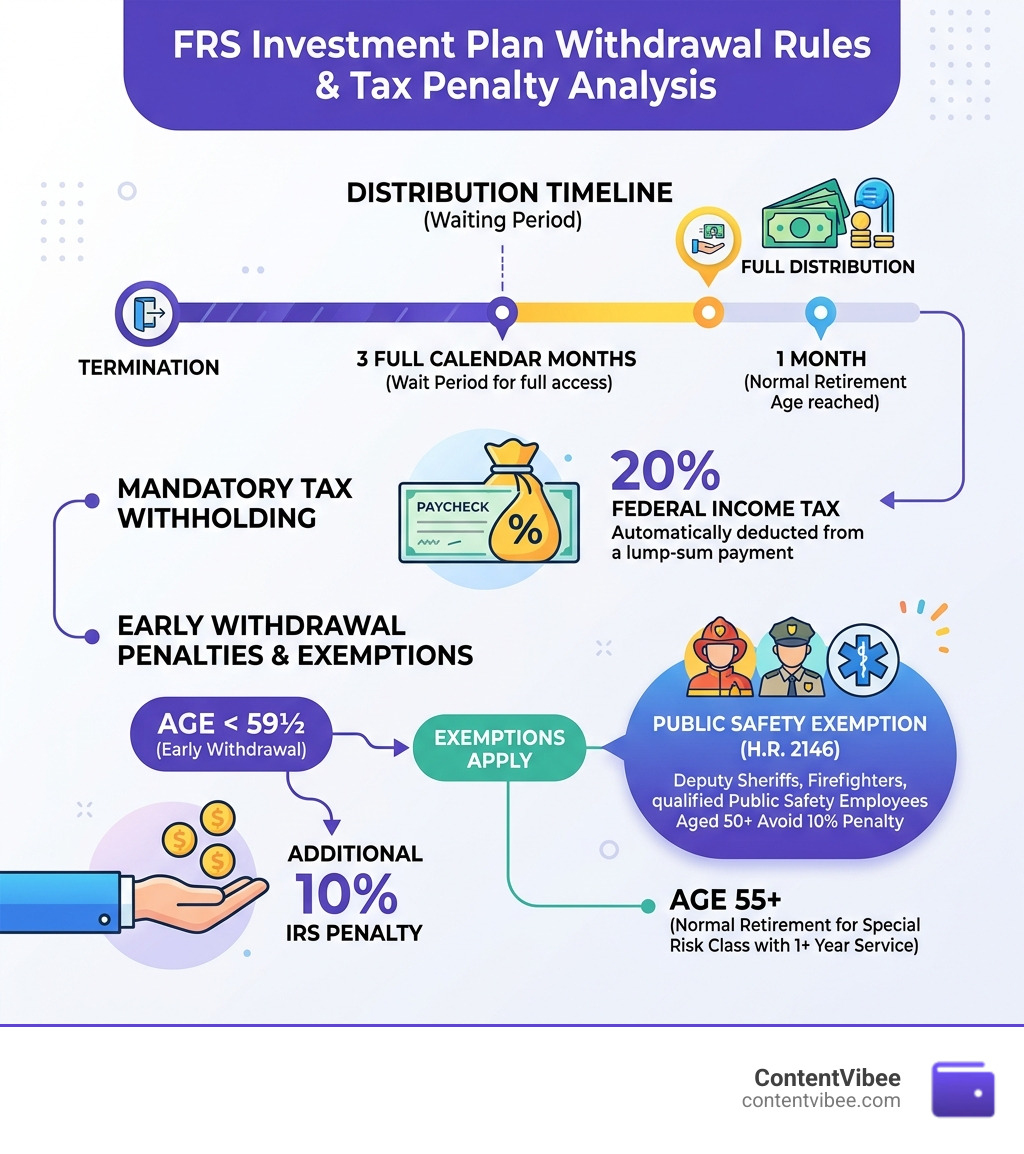
- Waiting period: You must be off all FRS payrolls for 3 full calendar months before taking a distribution (1 month if you’ve reached normal retirement)
- Mandatory withholding: 20% federal tax is withheld on any taxable lump-sum payout
- Early withdrawal penalty: An extra 10% IRS penalty applies if you’re under age 59½ — unless an exemption applies
- Public safety exemption: Deputy sheriffs, firefighters, and other qualifying public safety employees aged 50+ can avoid the 10% penalty entirely under the 2015 Defending Public Safety Employees’ Retirement Act (H.R. 2146)
- Special Risk Class: Members who retire at age 55+ with at least 1 year of service meet normal retirement criteria and have faster distribution access
- De minimis rule: Vested balances of $1,000 or less are automatically distributed after 6 months — no retirement status triggered
- RMDs: Required Minimum Distributions begin in the calendar year you turn 73 (or the year you terminate, whichever is later)
- Retirement status: Taking any distribution — even a rollover — officially marks you as “retired” under FRS rules, triggering reemployment restrictions
Many Florida first responders are still unaware of how much these rules can work in their favor — or cost them dearly if ignored.
A $30,000 early cashout can shrink to roughly $21,000 after withholding and penalties. That same balance, left invested for 20 years at a 7% annual return, could grow to over $116,000.
The decisions you make at termination can shape your financial future for decades.
FRS Investment Plan Withdrawal Rules and Tax Penalty Analysis
Navigating the Florida Retirement System (FRS) can feel like trekking through the Everglades without a map. But when it comes to the Investment Plan, the stakes are high. Unlike the Pension Plan, which provides a fixed monthly check, the Investment Plan is a defined contribution plan. This means your retirement security depends on your account balance, investment performance, and—crucially—how much the IRS takes when you leave.
A comprehensive FRS Investment Plan Withdrawal Rules and Tax Penalty Analysis reveals that the federal government generally views retirement accounts as “hands-off” until you reach age 59½. If you take money out before then, the IRS typically slaps on a 10% early withdrawal penalty in addition to standard income taxes. However, for those of us in Florida’s public sector, there are powerful legal shields like H.R. 2146 that can protect your hard-earned savings.

FRS Investment Plan Withdrawal Rules and Tax Penalty Analysis for Special Risk Class Members
If you are in the Special Risk Class—which includes law enforcement, firefighters, and correctional officers—the rules are slightly more flexible because of the physical demands of your job. In the FRS, “Normal Retirement” for Special Risk members is generally defined as age 55 with at least one year of service, or 25 years of service at any age (if hired before July 1, 2011).
For those who meet these criteria, the FRS allows a “fast-track” distribution. Instead of waiting the standard three months, you can access up to 10% of your account balance after being off the payroll for just one full calendar month. The remaining 90% becomes available after three full calendar months. This can be a lifesaver for bridging the gap between your last paycheck and your first retirement distribution. You can find more details on these specifics in our guide on What You Need to Know About FRS Investment Plan.
Public Safety Employee Early Withdrawal: How to Claim 10% Penalty Exemptions Under H.R. 2146
One of the most significant victories for first responders was the “Defending Public Safety Employees’ Retirement Act” (H.R. 2146), which became effective at the end of 2015. Before this law, many deputy sheriffs and firefighters were hit with the 10% penalty if they retired and accessed their Investment Plan or DROP funds before age 59½.
As of April 2026, the law is clear: if you are a “qualified public safety employee” and you separate from service in or after the year you turn age 50, you are exempt from the 10% early withdrawal penalty on distributions from governmental defined contribution plans like the FRS Investment Plan.
To claim this, you typically use IRS Form 5329 when filing your taxes. This exemption is a massive benefit, but there is a catch: if you roll your FRS funds into a private IRA, you might lose this “Age 50” protection, as IRAs usually follow the stricter age 59½ rule. This is why many experts suggest keeping your funds within the FRS or a 457(b) plan if you need early access. For more on managing these assets, check out our Category Investments section.
Distribution Timelines and the Three-Calendar-Month Rule
Timing is everything. You can’t just quit on a Friday and expect a check on Monday. The FRS enforces a strict “off-payroll” requirement. To be eligible for a distribution, you must terminate all employment with every FRS-participating employer.
The standard rule is that you must wait three full calendar months from your termination date before you can receive a payout. For example, if you retire on January 15, you must remain off all FRS payrolls for February, March, and April. You would then be eligible for your distribution on May 1.

During this time, your employer must report your termination to the Division of Retirement. If you return to work for any FRS employer in any capacity (even as a temp or independent contractor) during these first few months, your retirement could be voided. There is one small exception: the “De Minimis” rule. If your vested account balance is $1,000 or less, the FRS will automatically distribute the funds to you after six months of termination. Interestingly, these tiny automatic payouts do not trigger “retired” status, meaning they won’t mess up your ability to go back to work later. You can read more about these timelines in this article on Retiring from the FRS Investment Plan: Timeline, and Steps.
FRS Investment Plan Withdrawal Rules and Tax Penalty Analysis: Avoiding Reemployment Benefit Suspensions
Taking a distribution from the Investment Plan is a bell that cannot be un-rung. The moment you take a payout—whether it’s a $100 cashout or a full rollover to an IRA—the FRS considers you “retired.” This triggers the reemployment blackout period.
For the first six calendar months after your retirement, you generally cannot work for an FRS-participating employer. If you do, you may be required to repay your entire distribution. From months seven through twelve, there are still limitations on how many hours you can work or how much you can earn. For those looking for more general financial advice on navigating post-career income, our Category Finance page has plenty of resources.
Unauthorized Distribution Recovery: How to Fix Invalid FRS Payouts and Protect Retirement Status
What happens if you take a payout but realize you weren’t actually eligible? Perhaps your employer hadn’t officially processed your paperwork, or you accidentally returned to a part-time FRS role too soon. This creates an “invalid distribution.”
In 2026, the FRS typically allows a 90-day window to repay the invalid distribution. If you don’t return the funds within this timeframe, the Division of Retirement will declare your retirement void. This can lead to a mess of tax penalties and the loss of your “retired” status, which could impact your future health insurance subsidies. If you find yourself in this situation, it is vital to contact the MyFRS Financial Guidance Line immediately. For common troubleshooting, the FRS Investment Plan FAQ is a great place to start.
Tax Implications: Withholding, Penalties, and RMDs
When you take a lump-sum distribution, the FRS is legally required to withhold 20% for federal income taxes. It’s important to remember that this 20% is just a “down payment” to the IRS. If your actual tax bracket is higher (which it often is when you add a large lump sum to your yearly income), you might owe even more come April.
| Distribution Type | Mandatory Withholding | 10% Early Penalty | Tax Treatment |
|---|---|---|---|
| Lump-Sum Cashout | 20% | Yes (unless exempt) | Ordinary Income |
| Direct Rollover | 0% | No | Tax-Deferred |
| Partial Payout | 20% on cash portion | Yes (on cash portion) | Ordinary Income |
Beyond the immediate taxes, you also have to worry about Required Minimum Distributions (RMDs). As of 2026, the IRS requires you to start taking money out of your account by April 1 of the year after you turn 73, or the year you retire, whichever is later. If you fail to take your RMD, the penalty used to be a staggering 50%, though recent laws have softened this. Still, it’s a tax trap you want to avoid. You can find more on payout structures at the official Benefit Distribution Payouts – MyFRS page.
Mandatory Federal Withholding: How to Dispute and Recover Overpaid Taxes
If you take a direct payment and the 20% is withheld, you can still “undo” the tax hit if you act quickly. Under the 60-day rule, you can roll that money into an IRA or another qualified plan. However—and this is the tricky part—you must roll over the full amount of the distribution, including the 20% that was withheld. This means you have to use your own personal savings to replace that 20% until you get it back as a tax refund the following year.
For our international members or those living abroad, withholding rules can vary. You may need to submit Form W-8BEN to ensure you aren’t being over-taxed based on international treaties. For more on protecting your assets from unexpected costs, visit our Category Insurance section.
Strategic Rollovers and Protecting Your Retirement Status
Many people are tempted to roll their FRS Investment Plan balance into a retail IRA for more investment choices. While this offers flexibility, it comes with risks. As we mentioned earlier, the biggest risk for first responders is the loss of the H.R. 2146 penalty exemption. Once money is in a standard IRA, you generally cannot touch it penalty-free until 59½, whereas the FRS allows public safety workers access at age 50.
Additionally, the FRS Investment Plan has incredibly low institutional fees that most retail IRAs can’t match. If you want more control without leaving the plan, you can use the Self-Directed Brokerage Account (SDBA), which allows you to invest in thousands of different stocks and ETFs while keeping your money under the FRS umbrella. To help decide if a rollover is right for you, read Should You Keep Money in the FRS Investment Plan After Retiring?.
Health Insurance Subsidy (HIS) Eligibility and Claiming Your Benefit
The Health Insurance Subsidy (HIS) is a monthly payment to help retirees cover the cost of health insurance. the benefit is calculated as $7.50 per month for every year of service you have, with a minimum of $30 and a maximum of $225 per month.
To qualify for the HIS as an Investment Plan member, you must meet the Pension Plan’s normal retirement criteria (e.g., age 62 with 8 years of service for regular class, or age 55 for special risk). You also have to provide proof of health insurance coverage. This is a “use it or lose it” benefit—you must apply for it using Form HIS-IP. For more on how to grow your supplemental retirement income, see our article on Why Life Insurance Investment Cash Value Growth matters.
Frequently Asked Questions about FRS Withdrawals
What happens to my FRS Investment Plan if I die before taking a distribution?
If you pass away before taking your money, your vested account balance goes to your designated beneficiaries. If you haven’t named anyone, the FRS follows a specific hierarchy: your spouse, then your children, then your parents, and finally your estate. It is vital to keep your beneficiary designations updated on MyFRS.com to avoid legal headaches for your loved ones.
Can I take a hardship withdrawal from the FRS Investment Plan while still employed?
Generally, no. The FRS Investment Plan is a 401(a) plan, which is much stricter than a private 401(k). You cannot take loans or hardship withdrawals while you are still actively employed by an FRS agency. You must officially terminate your employment to access the funds.
How do I initiate my FRS Investment Plan payout ?
The process is mostly digital now. You can log into MyFRS.com or call the Financial Guidance Line at 1-866-446-9377. You will need your PIN to authenticate. Once your employer has reported your termination, you can request your termination kit and set up your direct deposit.
Conclusion
Understanding the FRS Investment Plan Withdrawal Rules and Tax Penalty Analysis is the difference between a comfortable retirement and a costly financial mistake. Whether you are a deputy sheriff looking to retire at 50 or a regular class member planning for 65, the rules regarding the three-month wait, the 20% withholding, and the reemployment restrictions are non-negotiable.
At ContentVibee, we believe in empowering you with the right information. For those looking to take their financial strategy even further, we recommend looking into tools like Zacks Investment Research. Their proprietary Zacks Rank system is a fantastic way for self-directed investors to predict stock performance and balance costs against value. Just like navigating the FRS, having a proven system for your investments can help ensure your long-term financial security.
Ready to dive deeper into your financial future? Explore More info about money and credit services on our site today.