Brokerage firm investment fees and account management charges are the costs you pay to buy, sell, and hold investments — and they vary widely across brokers, account types, and investment products.
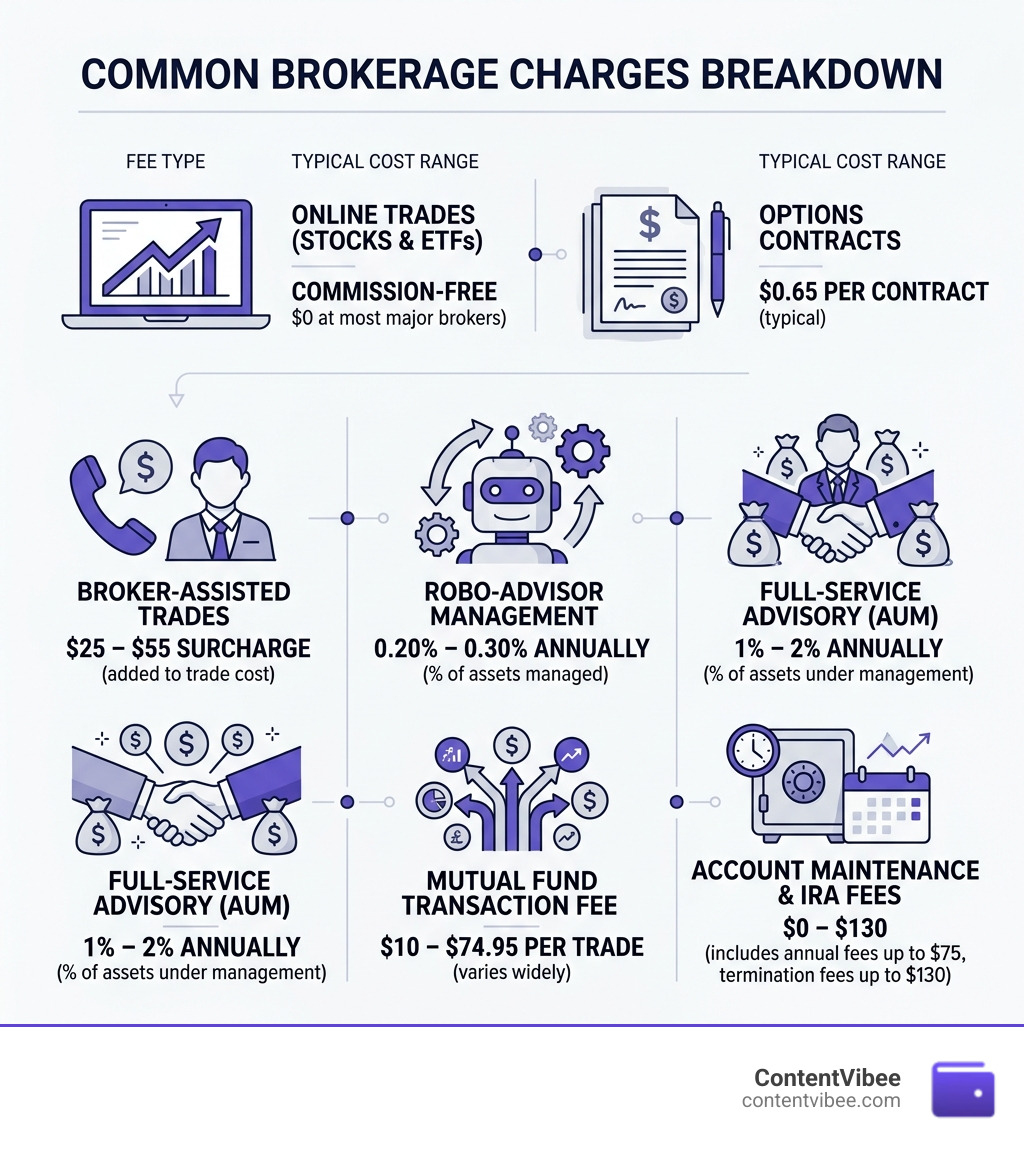
Here’s a quick breakdown of what you’ll typically encounter:
| Fee Type | Typical Cost |
|---|---|
| Online stock/ETF trades | $0 at most major brokers |
| Options contracts | $0.65 per contract |
| Broker-assisted trades | $25-$55 surcharge added |
| Full-service advisory (AUM) | 1% to 2% annually |
| Robo-advisor management | 0.20% to 0.30% annually |
| Mutual fund transaction fee | $10 to $74.95 per trade |
| Annual account maintenance | $0 to $75/year |
| Wire transfer (outgoing) | $15 to $25 |
| IRA termination fee | Up to $130 |
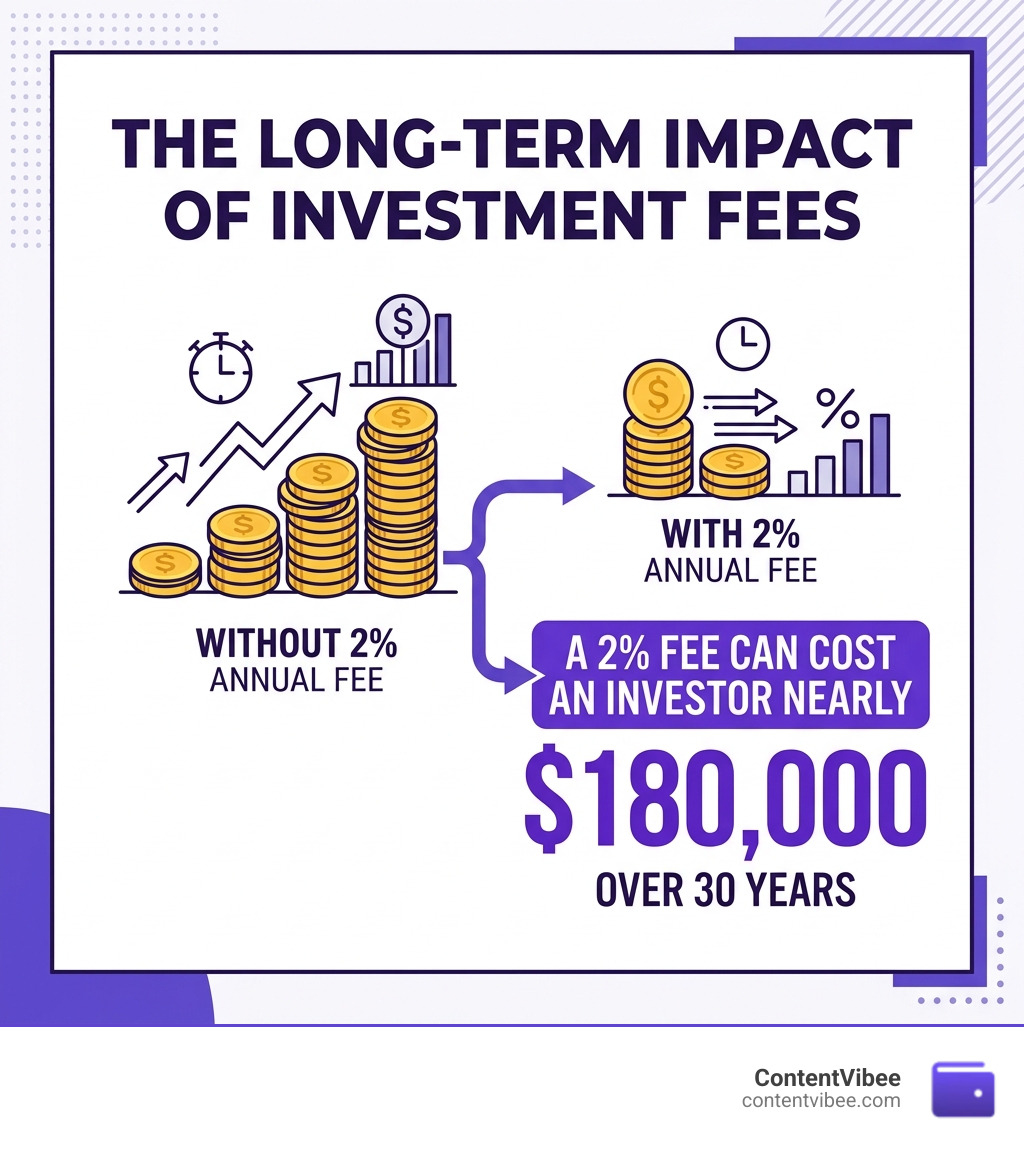
These costs might look small on paper. But they compound over time in a serious way.
Investing $500 per month for 30 years at a 7% return? A 2% annual fee could cost you over $178,000 compared to a near-zero-fee approach. That’s real money left on the table.
The good news: understanding exactly what you’re paying — and why — puts you back in control.
Breaking Down Brokerage Firm Investment Fees and Account Management Charges
When we open a brokerage account, we often focus on the excitement of the first trade. However, the “fine print” of Brokerage Firm Investment Fees and Account Management Charges can quietly erode our capital. the industry has largely moved toward “commission-free” models for basic trades, but firms still need to keep the lights on. They do this through a variety of service-based and administrative charges. According to the Financial Industry Regulatory Authority (FINRA), even small fees can add up over time.
Account maintenance fees are the most common “zombie” fees. While many discount brokers have abolished them, some firms still charge between $25 and $75 annually just to keep your account open. Often, these are waivable if you maintain a certain balance – for example, some major brokers waive the $25 annual fee if you opt into electronic delivery for all statements and disclosures.
Inactivity fees are another trap. If you don’t place a trade for six months or a year, some platforms might ding you $50 to $200. Furthermore, while many firms now offer $0 minimum deposit requirements, specialized accounts or managed portfolios often require a “buy-in.” For instance, some automated platforms require a $5,000 minimum, while more hands-on advisory services might require $500,000 or more. Understanding advisory fees is crucial because these asset-based costs cover much more than just trades – they include professional guidance and portfolio rebalancing.

Understanding Brokerage Firm Investment Fees and Account Management Charges for Options
If you’ve moved beyond simple stock buying into derivatives, the fee structure changes. While stock trades might be “free,” options almost always carry a contract fee. The industry standard remains approximately $0.65 per contract.
For active traders, these costs can sometimes be negotiated. Some firms offer volume discounts, dropping the price to $0.50 or even $0.45 per contract if you execute more than 30 trades per month. You also need to be aware of:
- Exercise and Assignment Fees: Some brokers charge a flat fee, often $20-$25, if your options are exercised or if you are assigned shares.
- Buy-to-Close Waivers: Many brokers now offer $0 fees to close out low-value options, such as contracts worth $0.05 or less, to help you clean up your portfolio without extra cost.
If you prefer a hands-off approach to complex strategies, compare the annual management fee, tax-loss harvesting features, and rebalancing policies before choosing an account type.
Impact of Brokerage Firm Investment Fees and Account Management Charges on Retirement
Retirement accounts like IRAs often come with their own unique set of “exit” fees. If you decide to move your money to a different firm, you might be hit with an IRA termination fee, which can run as high as $130.
Beyond termination, 401(k) administration fees are often “hidden” within the plan’s expense ratios. These cover the record-keeping and legal compliance of the plan. Even a 1% difference in these fees can significantly delay your retirement date. For investors working with high-touch advisory relationships, it is important to review whether the annual percentage of assets under management is justified by the planning, tax guidance, and ongoing support provided.
Trading Commissions and Mutual Fund Transaction Costs
The headline “$0 Commission” is the great lure of modern investing. However, this usually only applies to U.S. exchange-listed stocks and ETFs traded online. If you pick up the phone to have a human execute the trade for you, expect a “broker-assisted” surcharge of $25 to $55.
No-Transaction-Fee (NTF) vs. Transaction-Fee Funds
Mutual funds are a different beast. Many brokers offer a list of “No-Transaction-Fee” (NTF) funds. While you don’t pay a commission to buy these, the broker is often getting paid by the fund company via 12B-1 fees, which are marketing and distribution fees.
If you step outside that list, you might pay a transaction fee ranging from $10 to $74.95 per trade. Additionally, watch out for the short-term redemption fee. If you sell an NTF fund too quickly, usually within 60 to 90 days, the broker may charge a penalty – often around $49.95 – to discourage rapid trading. Reviewing a mutual fund’s expense ratio, sales load, and turnover rate is one of the best ways to understand its true long-term cost, since high internal expenses can be more damaging than a one-time trade fee.
Fixed Income and Bond Trading Costs
Trading bonds is rarely “free.” In the secondary market, brokers usually charge a markup when you buy or a markdown when you sell. This is often baked into the price you see, but some firms charge a flat $1 per bond with a minimum, such as $10, and a maximum, such as $250.
U.S. Treasuries are often the cheapest fixed-income product to trade, with many firms offering $0 commissions for online auction bids. However, CDs often require minimum investments of $1,000 to $5,000. Understanding markup policies, yield differences, and call features can help you build a laddered portfolio without losing too much of your return to transaction costs.
Advisory Models: Robo-Advisors vs. Full-Service Management
How much help do you need? This is the biggest driver of Brokerage Firm Investment Fees and Account Management Charges.
- Robo-Advisors: These use algorithms to manage your money. They typically charge 0.20% to 0.30% of your assets annually. They are useful for automatic rebalancing and, in some cases, tax-loss harvesting.
- Full-Service Brokers: These provide a dedicated human advisor. Fees generally start at 1% of AUM and can go higher for smaller accounts. As your wealth grows, these fees often “tier down” – for example, you might pay 0.80% once your assets exceed $500,000.
When deciding between these models, compare the total value you receive. A self-directed investor may prefer lower account costs and independent research tools, while someone with more complex planning needs may be comfortable paying more for personalized guidance.

Specialized Product Costs
If you trade futures, forex, or foreign stocks, the standard fee schedule goes out the window.
- Futures: Often cost $1.50 to $2.25 per contract, plus exchange fees.
- Forex: Usually “commission-free,” but the broker takes a spread, which is the difference between the buy and sell price, and that cost can be significant.
- Foreign Stocks: Trading on international exchanges often incurs a $50 surcharge plus local taxes, such as the French Financial Transaction Tax.
For specialized products, always compare not just published commissions but also spreads, currency conversion charges, exchange fees, and custody costs. In these markets, the cost of a poorly priced trade can easily exceed the headline commission.
Hidden Service Charges and Protecting Against Financial Loss
Beyond the trades, there are administrative “gotchas.” Wire transfers usually cost $15 to $25 for outgoing funds. If you hold American Depositary Receipts (ADRs), the banks that issue them can pass through “custody fees” ranging from $0.01 to $0.05 per share.
the rise of digital fraud makes it essential to understand your recovery options. If you experience a wire transfer fraud victim what to do and recovery options USA scenario, knowing how to dispute and recover money in the USA is vital. Most major brokers offer a “Satisfaction Guarantee” where they may refund commissions if you are unhappy, but recovering funds from a fraudulent wire transfer requires immediate action and coordination with the bank’s fraud department.
Unauthorized Brokerage Transactions: How to Dispute and Recover Money in
If you notice unauthorized bank transaction how to dispute and recover money USA activity or trading in your brokerage account, the clock is ticking. Under U.S. regulations, you must report these errors quickly to limit your liability.
- Identity Theft Recovery: If your SSN is misused to open fraudulent accounts, you need to initiate identity theft credit report fraud how to fix and protect your score USA steps immediately.
- Regulatory Fees: You will often see “SEC Section 31” or “FINRA TAF” fees on your statements. These are tiny, usually pennies per trade, and are used by the government to fund the supervision of the markets. While they aren’t fraud recovery fees, they support the infrastructure that helps protect investors and market integrity.
Strategies to Minimize Fees and Maximize Long-Term Returns
We want to keep as much of our money as possible. Here is our checklist for minimizing Brokerage Firm Investment Fees and Account Management Charges:
- Go Digital: Opt for electronic statements to avoid “paper statement fees” (often $2-$5 per month).
- Use Household Balancing: Many firms allow you to link accounts (spouse, children, IRA) to reach higher asset tiers. This can waive wire fees or lower your advisory percentage.
- Watch the Expense Ratio: A low-cost index fund’s average expense ratio is often 0.07%, while the industry average is 0.44%. On a $100,000 portfolio, that’s a savings of $370 every single year.
- Avoid “Penny Stock” Surcharges: Many brokers charge extra for stocks priced under $1.00 or for OTC (Over-the-Counter) trades.
Frequently Asked Questions about Brokerage Fees
What is the typical fee for a broker-assisted trade?
Imost firms charge a flat $25 service fee on top of the standard commission for any trade placed over the phone with a live representative. If you place the trade yourself online but call with a question, you generally won’t be charged this fee.
How can I avoid annual account maintenance charges?
The easiest way is to choose a discount broker that has $0 maintenance fees. If you are with a firm that charges them, maintaining a balance over a certain threshold (often $10,000 to $50,000) or signing up for e-delivery of documents usually waives the cost.
Do $0 commission trades have hidden catches?
While the trade itself is $0, brokers often make money through “Payment for Order Flow” (sending your trade to specific market makers) or by keeping the interest earned on your uninvested cash. Always check the “sweep rate” on your cash—if it’s 0.01% while high-yield accounts are 4%, that’s a hidden cost.
Conclusion
At ContentVibee, we believe that transparency is the first step toward wealth. The “perfect” broker isn’t necessarily the one with the lowest fees, but the one that provides the most value for the price you pay. Whether you are a self-directed investor using proprietary research or someone who prefers a full-service advisor, knowing the breakdown of Brokerage Firm Investment Fees and Account Management Charges ensures that your hard-earned gains stay in your pocket.
Don’t let hidden costs derail your 30-year plan. Review your statements, ask about fee waivers, and take control of your financial security today.