


Credit Union Investment Services Fees and Financial Advisory Cost is one of the most important — and most overlooked — topics for anyone investing through a credit union
Here’s a quick breakdown of what you can typically expect to pay:
| Fee Type | Typical Range | Example |
|---|---|---|
| AUM fee (guided/robo) | 0.25% – 0.50% per year | $25–$50/year on $10,000 |
| AUM fee (human advisor) | 0.50% – 2.0% per year | $500–$2,000/year on $100,000 |
| Self-directed online trades | $0 – $14.95 per trade | Varies by credit union |
| Full-service stock trades | $40 – $300+ per trade | Tiered by trade size |
| IRA annual maintenance | $0 – $50 per year | Often waived above $100K |
| IRA termination fee | $95 typical | Charged on account closure |
| ETF expense ratios | ~0.17% average | Charged by fund, not advisor |
| Account transfer fee | $50 – $150 | Charged by prior custodian |
Most people join a credit union expecting lower costs. And often, that’s true — but only if you know where to look.
Credit unions typically don’t manage investments directly. Instead, they partner with third-party firms like national broker-dealers to deliver investment services. You can verify these partnerships through the FINRA BrokerCheck tool. This layered model means fees can come from multiple sources at once — the advisor, the platform, the fund, and sometimes the custodian.
Understanding each layer is the difference between a smart investment strategy and one quietly eroded by costs you didn’t know existed.
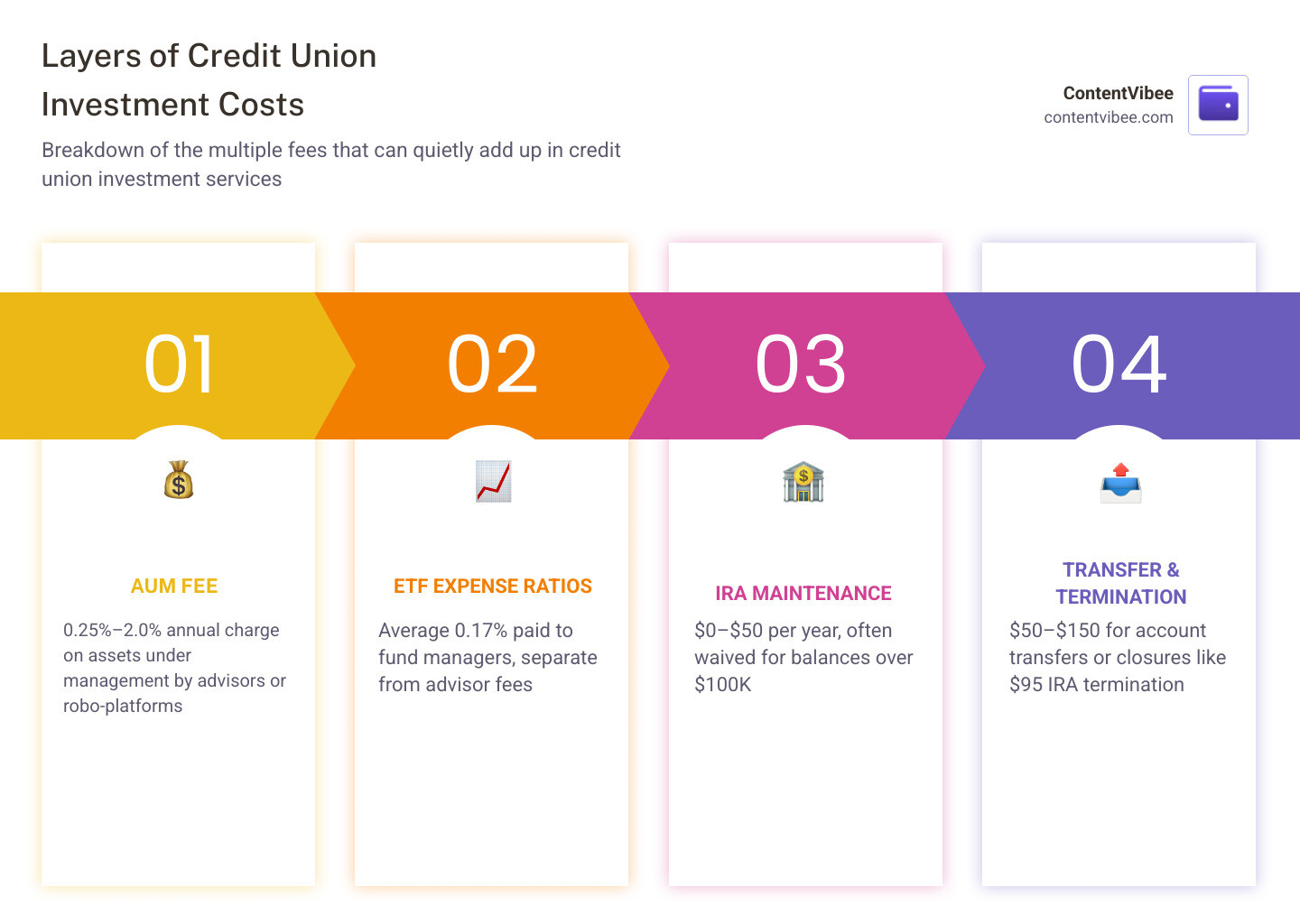
Common Fee Structures in Credit Union Investment Services
When we look at how credit unions charge for their expertise, the most common model we see is the Assets Under Management (AUM) fee. In this setup, you aren’t paying for every single phone call or email; instead, the credit union’s investment partner takes a small percentage of your total account balance each year.
The industry median for a human financial advisor is roughly 1% of assets managed. However, this is often a sliding scale. If you have $50,000, you might pay closer to 1.25% or 1.50%. If you are lucky enough to have $5 million, that rate might drop to 0.70% or lower. It’s always worth asking if there are tiers—because as your wealth grows, your percentage should generally shrink.
For those who prefer a more “hands-off” or digital-first approach, many credit unions now offer guided investing or robo-advisory services. These are significantly cheaper, often ranging from 0.25% to 0.50%. While you lose the face-to-face coffee meetings, you gain a massive advantage in cost-efficiency. If you want to dive deeper into how these strategies fit into a larger portfolio, check out our category: investments for more insights.
Understanding Credit Union Investment Services Fees and Financial Advisory Cost for Guided Portfolios
Guided portfolios are the “middle ground” of the investing world. They use algorithms to rebalance your accounts, ensuring you stay within your risk tolerance without a human having to manually click “sell” or “buy” every time the market moves.
As of April 2026, we’ve observed that many leading credit unions have settled on a 0.25% annual management fee for these digital services. To put that in perspective, a $10,000 balance would cost you just $25 a year in management fees. This is highly competitive with major independent robo-advisors. If you’re comparing these to other platforms, understanding digital investment fees can give you a great benchmark for what “low cost” really looks like in the private sector.
Commission-Based vs. Fee-Only Models
This is where things get a bit “old school.” Some credit union programs still operate on a commission basis. This means the advisor (or the firm they work for) gets paid when you buy or sell a specific product, like a mutual fund with a “front-end load” (an upfront sales charge).
However, many credit unions are moving toward a more transparent salaried or fee-based model. For example, some institutions charge a flat 0.50% annual fee for equities and mutual funds but only 0.25% for cash and fixed-income securities. This is often preferred because it reduces the incentive for an advisor to “churn” your account (trade excessively just to generate commissions).
When reviewing your credit union’s fee schedule, look specifically for “Transaction Fees” versus “Advisory Fees.” If you see a $59 charge every time you buy a stock, you are in a commission-based environment. If you see a quarterly deduction of 0.25%, you are likely in an advisory-based one.
Comparing Credit Union Investment Services Fees and Financial Advisory Cost
Comparing a credit union to broad online brokerage industry pricing reveals some important differences. While credit unions are known for “people helping people,” their investment arms are businesses that need to cover the costs of their third-party partnerships.
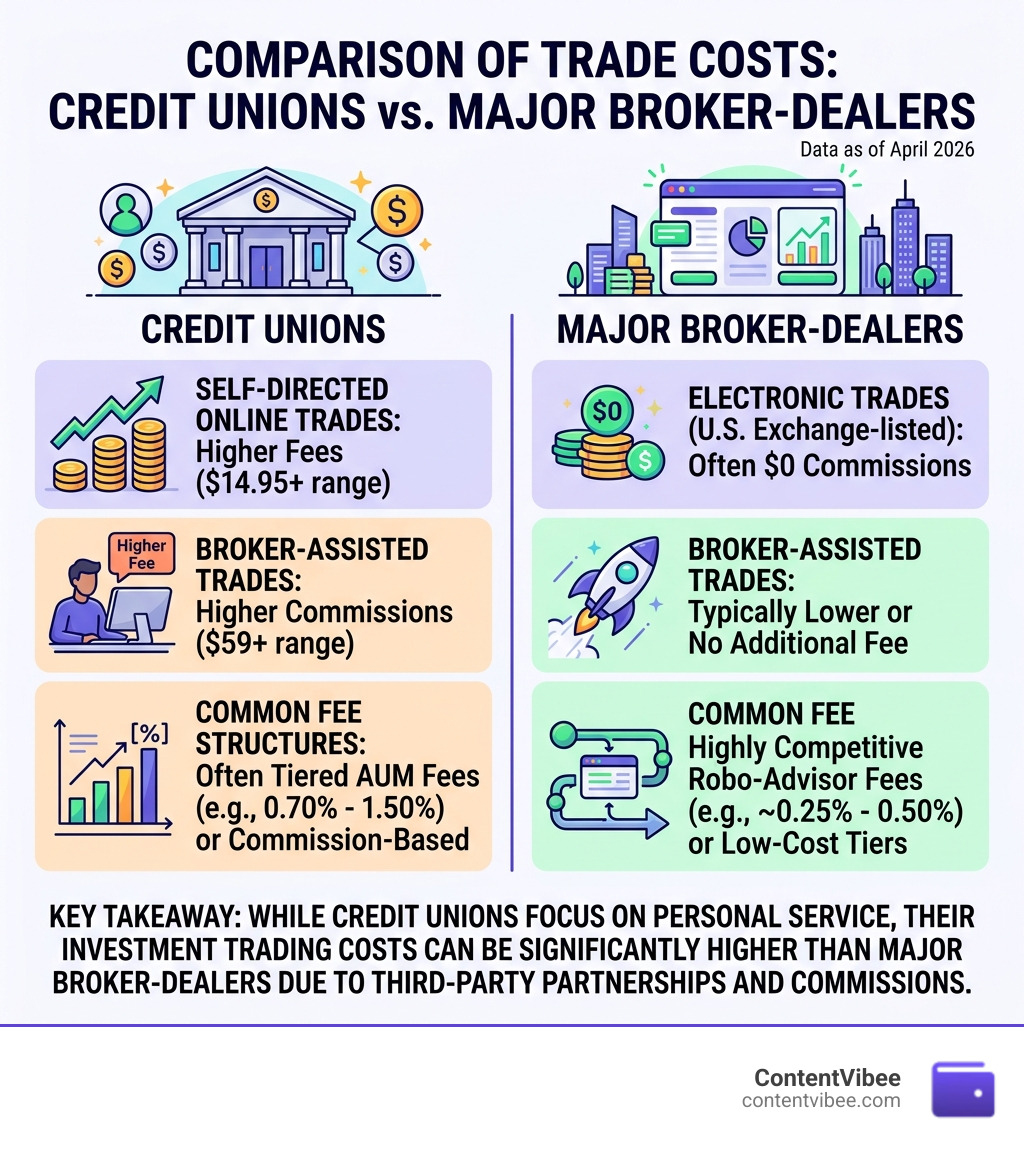
As the table in our intro suggests, electronic trades for U.S. exchange-listed securities are often $0 at large online brokerage platforms. However, at a credit union, you might still see fees ranging from $14.95 for self-directed online trades to over $59 for full-service trades.
If you are curious about why some firms charge what they do, exploring advisory fee structures can help you understand the “premium” services that justify higher costs.
Broker-Assisted vs. Self-Directed Trading Costs
There is a “convenience tax” in credit union investing. If you log into your portal and execute a trade yourself, the cost is usually minimal. But if you pick up the phone and ask a broker to do it for you, expect a surcharge.
A common industry standard is a $25 broker-assisted fee on top of the standard commission. For example, if your credit union charges $15 for an online trade, that same trade might cost $40 if you do it over the phone. This is meant to discourage simple trades from taking up an advisor’s time, which is better spent on complex financial planning.
Household Balance Discounts and Fee Waivers
One of the best ways we’ve found to lower your Credit Union Investment Services Fees and Financial Advisory Cost is through “householding.” This is the practice of linking all accounts in your home-your IRA, your spouse’s brokerage account, and perhaps even a trust-to reach a higher total balance.
Many credit unions offer significant perks once you cross certain thresholds, such as $100,000 or $250,000:
- IRA Maintenance Fee Waivers: Often $40-$50 per year, waived if your balance is high enough.
- Lower AUM Tiers: Moving from a 1.25% fee to 1.00%.
- Free Financial Plans: Comprehensive planning that might normally cost $2,500 to $3,000 may be offered for free to high-balance members.
Hidden Costs: Retirement Accounts and Termination Fees

Retirement accounts like IRAs are the bread and butter of credit union investing, but they come with their own unique “fine print.” While a standard brokerage account might be free to keep open, an IRA often carries an annual maintenance fee of $20 to $50. This covers the extra IRS reporting and administrative work required for tax-advantaged accounts.
The real “gotcha,” however, is the termination fee. If you decide to move your money to another firm, many credit unions (via their partners) will charge a “Transfer Out” or “Account Termination” fee, typically around $95. This is a one-time parting gift that you should factor into your long-term plans. For a broader look at what other firms charge, you might find it useful to read about investment platform fees.
Impact of ETF Expense Ratios on Credit Union Investment Services Fees and Financial Advisory Cost
When you look at your statement and see a 0.50% management fee, you might think, “Okay, that’s not bad.” But there is a second, invisible layer of cost: the Expense Ratio.
Most guided portfolios at credit unions are built using Exchange-Traded Funds (ETFs). These funds are managed by major asset management companies, and they charge their own internal fee, a typical diversified portfolio might have an average expense ratio of 0.17%.
- Advisory Fee (0.50%) + ETF Expense (0.17%) = Total Cost of 0.67%
While 0.67% is still much lower than the 1% to 2% charged by many traditional wealth managers, it’s important to realize that the advisor fee isn’t the only thing leaving your pocket.
Custodial and Administrative Surcharges
Because credit unions aren’t usually “custodians” (the firms that actually hold the securities), they use third-party clearing firms. These third-party custodians have their own list of “nuisance fees” that can add up:
- Paper Statement Fees: $2 to $5 per month. (Go green and save!)
- Confirmation Fees: Small charges for every trade confirmation mailed to you.
- Non-Publicly Traded Security Fees: If you hold unique assets, you could pay $250 per position annually.
- Wire Transfer Fees: $25 to $35 for moving money out quickly.
Protecting Your Wealth: Conflicts of Interest and Security
We have to talk about the elephant in the room: referral fees. When a credit union employee suggests you talk to an “on-site investment professional,” that credit union is often receiving a referral fee or a share of the revenue from the investment firm.
This creates a potential conflict of interest. Is the recommendation happening because it’s the best thing for your wallet, or because it helps the credit union’s bottom line? Most reputable credit unions are transparent about this in their “Form ADV” or disclosure brochures, but it’s something we always recommend our readers verify. For more on how to vet financial services, see our category: investments resources.
Fraud Prevention and Recovery in Credit Union Accounts
digital security is just as important as investment returns. If you experience an unauthorized bank transaction and need to recover money in the USA, the rules for investment accounts are slightly different than for your checking account.
While your credit union deposits are protected by the NCUA (up to $250,000), your investments are not. Instead, they are typically protected by the SIPC (Securities Investor Protection Corporation).
- SIPC Protection: Covers you if the brokerage firm fails (up to $500,000).
- Market Loss: SIPC does not cover you if your stocks go down in value.
- Fraud Recovery: If a hacker steals your identity and drains your brokerage account, recovery options often depend on the specific security guarantees of the partner brokerage firm.
If you’ve been a victim of identity theft, knowing how to fix and protect your score is the first step in financial recovery.
Due Diligence and Advisor Transparency
How do you know if your advisor is “one of the good ones”? We always suggest using FINRA BrokerCheck. This free tool allows you to see an advisor’s entire history, including any past disputes, regulatory actions, or employment changes.
Additionally, ask for the Form ADV. This is a document that investment advisors must file with the SEC. It lists their fee structure, any conflicts of interest, and their “fiduciary duty”-which is a legal requirement to put your interests ahead of their own. If an advisor is hesitant to provide this, it’s a major red flag.
Frequently Asked Questions about Credit Union Investment Fees
What is the minimum investment for credit union guided investing?
Minimums have dropped significantly over the years. many credit union “Guided Investing” programs allow you to start with as little as $200. However, some full-service advisory programs at larger credit unions may still require a $3,500 minimum or even $25,000 to work with a dedicated human advisor. Subsequent investments can often be as low as $25.
Are credit union investment accounts NCUA insured?
No. This is the most common misconception. While your savings and checking accounts are insured by the National Credit Union Administration (NCUA), investment products—like stocks, bonds, and mutual funds—are not insured. They can lose value. They are, however, usually covered by SIPC insurance, which protects against the failure of the brokerage firm itself.
How do wrap fees work at credit unions?
A “wrap fee” is a bundled pricing model. Instead of paying a separate commission for every trade, you pay one single annual fee (like 1.00%) that “wraps” together the advisory services, the cost of trades, and the administrative fees. This is very popular because it makes your costs predictable, regardless of how often you trade.
Conclusion
Navigating Credit Union Investment Services Fees and Financial Advisory Cost doesn’t have to be a headache. By understanding that you are often paying a “layered” fee—comprising the advisor’s cut, the fund’s expense ratio, and the custodian’s administrative charges—you can make a much more informed decision.
Credit unions remain a fantastic choice for many investors due to their community focus and often lower-than-average digital fees. However, always remember to check the background of your advisor, opt for electronic statements to avoid “nuisance fees,” and look for household discounts to keep more of your money working for you.
For more tips on managing your wealth and staying secure in a digital world, explore our category: finance section. At ContentVibee, we are dedicated to helping you protect what you’ve built and grow what you have.


