


Two Social Security Checks, One Household: What Every Couple Needs to Know
Can both spouses collect Social Security at the same time? Yes — and most couples are leaving money on the table by not planning this carefully.
Here’s the quick answer:
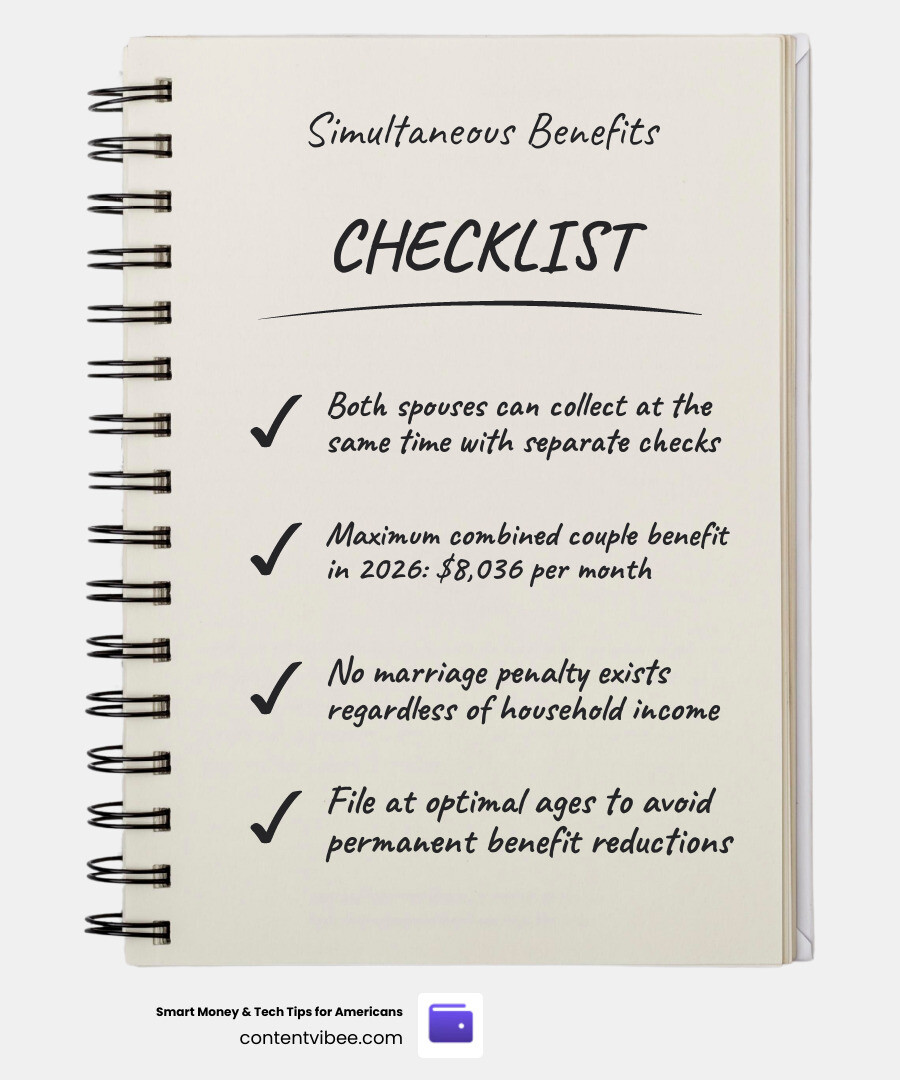
- Yes, both spouses can receive Social Security benefits simultaneously.
- Each spouse gets their own check based on their own work record — or up to 50% of their partner’s benefit, whichever is higher.
- There is no marriage penalty and no cap on the household total.
- The maximum combined benefit for a married couple in 2026 is $8,036 per month (based on 2025 figures).
- When and how you each file determines whether you maximize or permanently reduce that combined income.
The rules sound simple. But the details — deemed filing, spousal benefit percentages, survivor protections — can get complex fast. A poorly timed filing decision can cost a couple tens of thousands of dollars over a retirement that could last 20 to 30 years.
Since 1939, Social Security has offered spousal benefits to support households where one partner earned significantly less — or nothing at all. As of December 2023, more than 1.7 million people were collecting benefits based on a retired spouse’s earnings record. The rules have changed significantly since then, especially after the 2015 Bipartisan Budget Act closed several popular strategies.
This guide breaks down exactly how both spouses can collect Social Security at the same time, how to coordinate your filing ages, and how to protect the surviving spouse’s income for the long haul.
Can Both Spouses Collect Social Security at the Same Time?
When we sit down with couples in California to discuss their retirement, the most common concern is whether getting married “shrunk” their Social Security potential. We are happy to report that the Social Security Administration (SSA) is surprisingly romantic — or at least, it doesn’t punish you for saying “I do.”
Each spouse is viewed as an individual worker. If you have both worked and paid into the system, you are both entitled to your own retirement benefits based on your respective earnings histories. This is known as “dual entitlement.”
When we ask can both spouses collect social security at the same time, the answer is a resounding yes. You will receive two separate checks, deposited into your accounts independently. There is no “household cap” that forces you to split a single pot of money. In fact, for high-earning couples in 2026, the maximum monthly benefit can reach $8,036 ($4,018 per individual, based on 2025 maximums).
Eligibility Requirements for Simultaneous Benefits
To ensure you both get those checks, you need to meet a few basic criteria:
- Work Credits: Each spouse generally needs 40 “credits” to qualify for their own retirement benefit. This usually equates to about 10 years of work.
- Age: You must both be at least 62 years old to begin collecting. However, as we’ll discuss later, “can” doesn’t always mean “should” when it comes to age 62.
- Marriage Duration: If you are claiming a spousal benefit (meaning a benefit based on your partner’s work record rather than your own), you must generally have been married for at least one continuous year.
- Primary Earner Status: For one spouse to collect a spousal benefit, the other spouse must already be receiving their own retirement or disability benefits.
If you’re unsure where you stand, we recommend checking the Do You Qualify for Social Security Spouse’s Benefits? | Social Security Matters | SSA page for the latest eligibility nuances.
The Myth of the Marriage Penalty
In income taxes, “marriage penalties” are a real headache. But Social Security is different. Because benefits are based on individual work records, your marriage does not reduce the amount you earned through your own career.
If Spouse A is entitled to $2,000 a month and Spouse B is entitled to $2,000 a month, the household receives $4,000. The SSA doesn’t look at the $4,000 and say, “That’s too much for one house; let’s cut it.” This lack of a penalty allows couples to maximize their lifetime income by strategically choosing when each person starts their “individual” clock.
Understanding Spousal Benefits and the Deemed Filing Rule

What happens if one spouse stayed home to raise children or had a significantly lower-paying career? This is where the spousal benefit comes into play.
A spousal benefit allows a husband or wife to receive up to 50% of their partner’s “Primary Insurance Amount” (PIA) — which is the amount the partner receives at their Full Retirement Age (FRA).
For a deep dive into the mechanics, check out our guide on What is a Social Security Spousal Benefit?.
The most important thing to understand is that the SSA doesn’t just “give” you two full benefits. If you are eligible for both your own retirement benefit and a spousal benefit, they pay your own benefit first. If the spousal benefit is higher, they add a “top-off” amount to make up the difference. You effectively get the higher of the two amounts, but not both combined.
How Deemed Filing Affects When Both Spouses Collect Social Security at the Same Time
In the “old days” (before 2015), couples used a strategy called a “restricted application.” One spouse could file for just spousal benefits while letting their own retirement benefit grow by 8% every year.
The 2015 Bipartisan Budget Act largely ended this. Now, we have “deemed filing.” This rule states that when you apply for one benefit, you are “deemed” to have applied for all benefits for which you are eligible.
According to the Filing Rules for Retirement and Spouses Benefits | SSA, the SSA will automatically calculate both your own benefit and any potential spousal benefit and pay you the highest total. This prevents people from “double-dipping” or gaming the system to delay their own benefits while collecting on a spouse’s record.
Exceptions to Deemed Filing Rules
While deemed filing is the standard, there are a few “golden” exceptions:
- Disability: If you receive Social Security Disability Insurance (SSDI), deemed filing rules may not apply in the same way.
- Caring for a Child: If you are caring for a child who is under age 16 or disabled and entitled to benefits, you may be able to collect spousal benefits without being forced to file for your own retirement.
- Survivor Benefits: Deemed filing does not apply to survivor benefits. If your spouse passes away, you can choose to take a survivor benefit and let your own retirement benefit grow, or vice versa. This is a critical strategy for widows and widowers.
Strategic Timing: Maximizing Your Combined Monthly Payments
Timing is everything. If you both claim at 62, you might get checks sooner, but those checks will be up to 30% smaller for the rest of your lives. On the flip side, waiting until age 70 can boost your monthly payment significantly.
| Claiming Age | Benefit Percentage (Own Record) | Spousal Benefit Percentage |
|---|---|---|
| 62 | ~70% | 32.5% |
| Full Retirement Age (67) | 100% | 50% |
| 70 | 124% – 132% | 50% (No increase past FRA) |
As you can see, the spousal benefit maxes out at your Full Retirement Age. Delaying a spousal claim past age 67 won’t get you more money, but delaying your own claim will. We suggest using the Social Security Spousal Benefit Calculator to see how these numbers look for your specific situation.
Coordination Strategies for When Both Spouses Collect Social Security at the Same Time
We often recommend a “split strategy” for couples with unequal earnings.
- The Lower Earner Claims Early: If the household needs cash, the spouse with the smaller work record might claim at 62 or 67.
- The Higher Earner Delays: The spouse with the larger record waits until age 70. This maximizes the 8% annual “Delayed Retirement Credits.”
Why do this? Because when the higher earner waits until 70, they lock in a benefit that is roughly 132% of their base amount. This doesn’t just help while they are alive; it also sets the floor for the survivor benefit. If the higher earner passes away first, the surviving spouse will step into that larger check.
Impact of Claiming Age on Spousal Percentages
If you decide to collect a spousal benefit before your own Full Retirement Age, be prepared for a haircut. At age 62, a spouse only receives about 32.5% of the worker’s benefit. To get the full 50%, you must wait until your FRA.
It’s also worth noting that Cost-of-Living Adjustments (COLA) apply to both checks. So, if inflation causes a 3% bump, both spouses see their checks increase, helping the household keep up with the rising price of avocado toast here in California.
Special Circumstances: Survivor and Divorced Spouse Benefits
Life is messy. Sometimes “together” doesn’t last forever, and sometimes it’s cut short by tragedy. Social Security has rules for these scenarios that are surprisingly generous.
Survivor Benefit Protections for Couples
When one spouse passes away, the household income typically drops because one of the two checks disappears. However, the survivor is entitled to 100% of the deceased spouse’s benefit (if the survivor has reached their own FRA).
If Spouse A was getting $3,000 and Spouse B was getting $1,500, Spouse B will stop receiving $1,500 and start receiving $3,000. This is why we emphasize that the higher earner should wait as long as possible to file — they are essentially buying a life insurance policy for their partner through the SSA.
Don’t forget the $255 lump-sum death payment. It’s not much (it hasn’t changed since the 1950s), but it’s a small bit of help during a difficult time.
Rules for Divorced Spouses and Ex-Partners
You might be surprised to learn that you can collect on an ex-spouse’s record even if they have remarried. To qualify:
- The marriage must have lasted at least 10 years.
- You must be currently unmarried.
- You must be at least 62.
- Your ex-spouse must be eligible for benefits (even if they haven’t claimed them yet, provided you’ve been divorced for at least two years).
The best part? Claiming on an ex’s record does not reduce their benefit or the benefit of their current spouse. It’s a “ghost” claim that the SSA handles privately. For more details, see Do You Qualify for Social Security Spouse’s Benefits? | Social Security Matters | SSA.
Frequently Asked Questions about Spousal Social Security
Can I collect both my own retirement benefit and a spousal benefit?
Technically, yes, but not in the way most people hope. You don’t get $1,000 from your work and $1,000 from your spouse for a total of $2,000.
As the SSA clarifies in Can I collect Social Security spouse’s benefits and my own retirement benefits? | SSA, they pay your own benefit first. If your spousal benefit is higher, they add a “top-off” to reach that higher amount. You effectively receive the higher of the two, but the “source” of the money is split between your record and your spouse’s.
Does one spouse’s decision to claim early reduce the other’s benefit?
If your spouse claims their own retirement benefit at 62, it does not reduce your own retirement benefit. Your checks are independent.
However, it does reduce the amount they can leave you as a survivor benefit later. It also means you can start collecting a spousal benefit on their record sooner (since they must be filed for you to claim spousal), but that spousal benefit will be reduced if you are also under your Full Retirement Age.
Can a spouse delay their own benefit while collecting a spousal benefit?
For most people retiring in 2026, the answer is no. The “restricted application” loophole has expired for almost everyone. Under the “deemed filing” rules found in the Filing Rules for Retirement and Spouses Benefits | SSA, you are forced to take the highest benefit available to you immediately upon filing. You can no longer “hide” your own benefit to let it grow while snacking on a spousal check.
Conclusion
At Smart Money & Tech Tips for Americans, we believe that understanding the “math” of marriage is the key to a stress-free retirement. Can both spouses collect social security at the same time? Absolutely. But doing it without a plan is like driving through Los Angeles without GPS — you’ll eventually get there, but you’ll waste a lot of time and resources along the way.
By coordinating your filing dates, understanding the “top-off” nature of spousal benefits, and protecting the survivor benefit, you can secure your household’s financial future. We encourage you to use our Social Security Spousal Benefit Calculator to run your own scenarios and find your “sweet spot” for filing.
Retirement is a team sport. Make sure you and your spouse are playing with the same playbook!