


Why Your Financial Planning Fee Based Structure Could Cost You Thousands
Understanding financial planning fee based compensation is one of the most important steps you can take before hiring an advisor — especially if you’re in or near retirement.
Quick answer: What is a fee-based financial advisor?
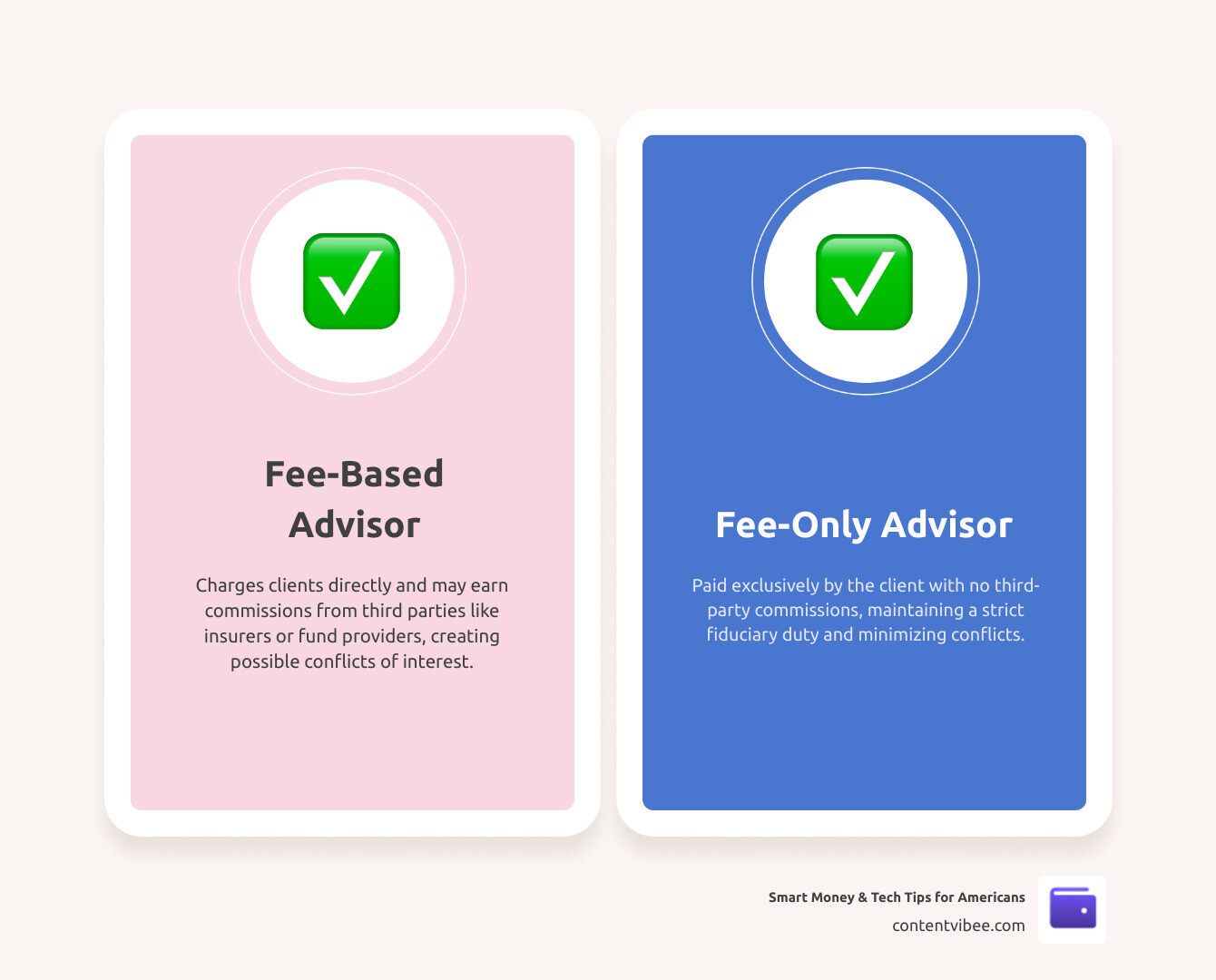
A fee-based advisor charges clients directly and may also earn commissions or payments from third parties (like insurance companies or mutual fund providers) for recommending certain products. This is different from a fee-only advisor, who is paid exclusively by the client.
Here’s a fast comparison to know before reading further:
| Feature | Fee-Based Advisor | Fee-Only Advisor |
|---|---|---|
| Charges client directly | Yes | Yes |
| Earns third-party commissions | Yes (possible) | Never |
| Fiduciary duty | Sometimes | Always |
| Potential conflicts of interest | Higher | Lower |
| Common fee types | AUM, flat, commission | AUM, flat, hourly |
The stakes are real. On a $400,000 portfolio over 20 years, a 1% AUM model can cost over $139,000 in fees — compared to roughly $14,700 under an advice-only flat-fee model. That gap doesn’t just affect what you pay. It affects what’s left for your retirement, your income strategy, and your spouse’s survivor benefits.
And yet fewer than 2% of the roughly 285,000 financial professionals in the U.S. are true fee-only fiduciary advisors. Most people are working with someone who has at least some financial incentive tied to what they recommend.
This guide will help you read a fee schedule clearly, understand what you’re actually paying for, and ask the right questions before signing anything.
Decoding the Financial Planning Fee Based Model vs. Fee-Only

If the wording on an advisor’s website feels designed by a lawyer having a bad day, you’re not alone.
The biggest difference between fee-based and fee-only comes down to who pays the advisor and whether outside compensation is allowed.
A fee-only planner gets paid only by the client. A fee-based advisor may charge you directly and still receive commissions from products they recommend. That does not automatically make the advice bad, but it does create incentives you should understand.
If you want a broader overview of how these charges fit into the industry, see our guide to wealth management fees.
What is a Financial Planning Fee Based Advisor?
A financial planning fee based advisor usually works under a mixed compensation model. They may charge:
- A percentage of assets under management
- A flat planning fee
- An hourly fee
- Commissions from insurance or investment products
This often happens when an advisor is dual-registered, meaning they can act as an investment advisor in one situation and as a broker or insurance agent in another. In practice, that can mean they recommend a mutual fund with a sales load, an annuity with a commission, or an insurance policy that pays them.
That is why disclosure matters. Clients should expect clear written explanations of:
- Whether commissions are possible
- Which products pay compensation
- Whether the advisor receives referral fees or revenue sharing
- When the advisor is acting as a fiduciary and when they are not
For more context on account-level charges that can appear alongside advisor compensation, read this breakdown of brokerage firm investment fees and account costs.
The Fee-Only Fiduciary Standard
Fee-only means the advisor is compensated solely by the client, not by product providers. That can include:
- AUM fees
- Flat project fees
- Hourly planning fees
- Ongoing retainers or subscriptions
The key benefit is conflict minimization. If no product company is paying the advisor, there is less risk that recommendations are being nudged by a commission grid.
In the U.S., fee-only advisors commonly operate as registered investment advisors and are generally held to a fiduciary standard when giving advice. Professional groups such as NAPFA explain fee-only advising here, and directories like Fee Only Network can help people verify advisors who follow this model.
That said, do not stop at a marketing label. We should still verify the advisor’s Form ADV, compensation disclosures, and credentials.
The Real Cost of Advice: AUM, Flat Fees, and Hourly Rates

A fee schedule is not just about what you pay this year. It is about what the pricing model does over time.
As of 2026, common advisor fee structures include:
- AUM fee: 62% of advisors use this model, with an average fee of 1.05%
- Flat fee: average around $2,554
- Hourly fee: average around $268
- Annual retainer: average around $4,484
- Subscription fee: average around $215 per month
If you are comparing structures, our AUM fee calculator guide can help you translate percentages into real dollars. For a behind-the-scenes look at costs that can also affect firms and clients, see why investment manager software fees matter.
Comparing Financial Planning Fee Based Costs to Advice-Only
AUM sounds harmless because 1% looks small. Unfortunately, percentages are sneaky.
A 1% fee on a $2 million portfolio is $20,000 per year. If your portfolio grows, the fee rises automatically even if the amount of work does not.
Here is the basic tradeoff:
| Fee Model | How It Works | Good Fit | Main Drawback |
|---|---|---|---|
| AUM | Percentage of assets each year | Ongoing portfolio management | Gets more expensive as assets grow |
| Flat fee | Fixed dollar amount | People who want predictable costs | Large upfront bill possible |
| Hourly | Pay for time used | Specific planning projects | Costs can feel less predictable |
| Subscription | Monthly fee | Younger accumulators, ongoing advice | Service depth varies by firm |
Research cited above shows how large the long-term difference can be:
| Scenario | AUM Model | Advice-Only Flat Fee |
|---|---|---|
| $400,000 portfolio over 20 years | $139,314 in fees | $14,707 in fees |
| 30-year projection | Lower ending value | More than $174,000 higher portfolio value |
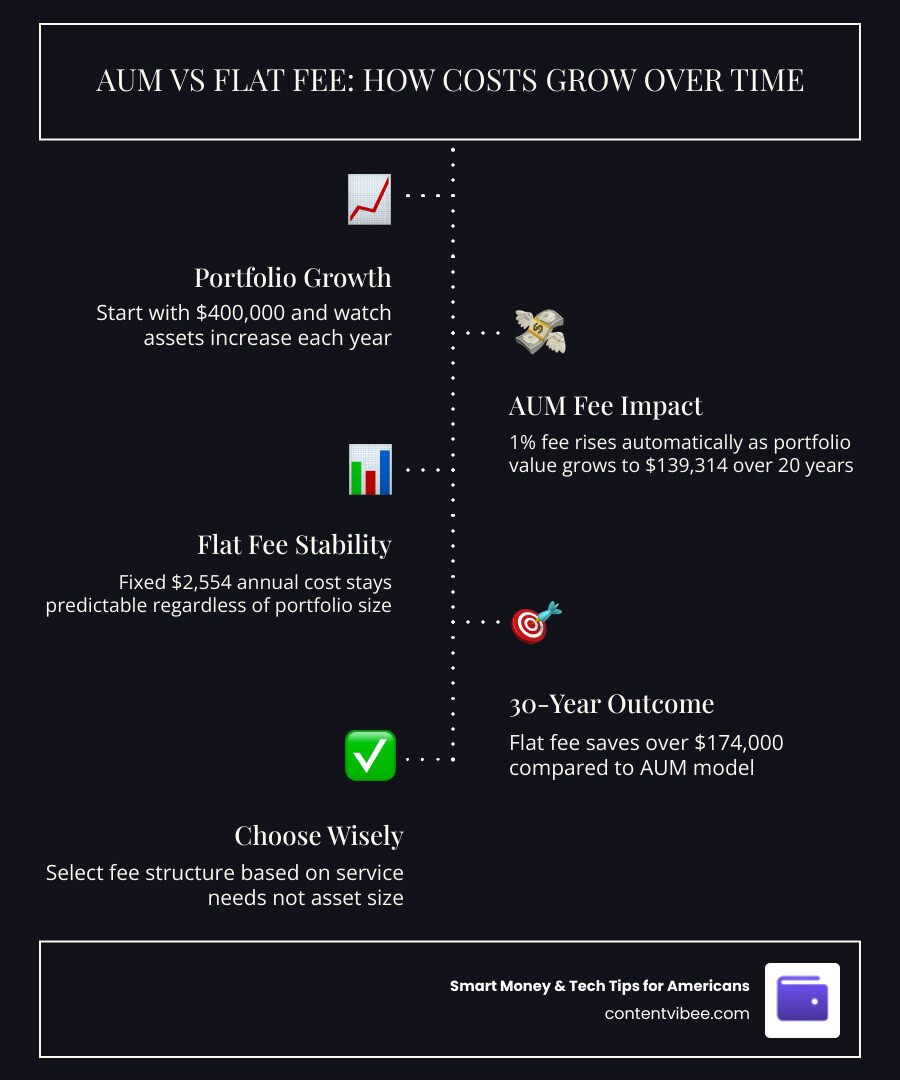
This is one reason many investors choose fee-only or advice-only planning. They want costs tied to complexity and service, not just account size.
Understanding Digital Advice and Robo-Alternatives
Not everyone needs a full-service planner. Digital advice platforms can be a lower-cost option for basic investment management.
Robo-advisors often charge around 0.25% to 0.50% annually, which is below the roughly 1% traditional advisor benchmark. Some hybrid models combine digital management with limited access to human advisors.
These can work well if you want:
- Automated portfolio management
- Lower investment minimums
- Basic retirement planning tools
- Lower ongoing costs
But they may fall short if you need deeper tax strategy, Social Security timing, estate coordination, or retirement income planning. For more, see our guide to Wealthfront investment fees and why robo-advisor fee comparison matters.
Spotting Red Flags and Conflicts of Interest
Some fee schedules are transparent. Others are like onions: lots of layers, and eventually somebody cries.
Common red flags include:
- Vague language such as “we may receive compensation from affiliates”
- Product recommendations tied to commissions
- Revenue sharing with fund companies
- Referral fees paid to solicitors
- Extra custodial or platform charges not explained upfront
- High-cost insurance products wrapped inside a “plan”
Even firms associated with banks, brokerages, or credit unions can involve overlapping charges, so it helps to understand credit union investment services fees.
Transparency and Disclosure Requirements
Clients should expect candor, not a scavenger hunt.
Ask for and review the advisor’s Form ADV, especially the sections covering fees, conflicts, disciplinary history, and compensation. A transparent advisor should clearly explain:
- What you pay them
- What you pay third parties
- Whether they receive any non-cash compensation
- Whether they use proprietary products
- Whether there are custodial fees, fund expense ratios, or transaction charges
- Whether “soft dollar” arrangements exist, where research or services are received from vendors in exchange for business
The best advisors explain total cost of ownership, not just their headline fee.
How to Evaluate and Choose the Right Planner
The right advisor is not always the cheapest one. The goal is value, clarity, and alignment.
We suggest looking at five things:
Compensation model
Is the advisor fee-only or fee-based? If fee-based, what outside compensation is possible?Planning scope
Do you need investment management only, or a full plan covering retirement, taxes, Social Security, insurance, and estate issues?Credentials
Look for relevant qualifications and verify registration status. A credential is not magic dust, but it helps.Communication style
If they explain fees like a waffle iron manual, keep looking.Service model
Some firms offer modular planning, project work, retainers, or ongoing asset management. Match the structure to your actual needs.
For examples of fee-only service menus and pricing approaches, you can review a sample fee schedule here and this fee-only planning overview. For mainstream educational comparisons, NerdWallet’s fee-only vs fee-based guide is also useful.
Questions to Ask Your Financial Planning Fee Based Professional
Before hiring anyone, ask these directly:
- How exactly do you make money?
- Are you fee-only, or can you receive commissions?
- Are you acting as a fiduciary at all times?
- Can I see your Form ADV?
- What is included in the planning fee?
- What costs are separate from your fee?
- Do you receive referral fees, revenue sharing, or insurance compensation?
- What is the total annual cost in dollars, not just percentages?
- How often will my fee increase?
- If my portfolio doubles, does your workload double too?
That last one gets awkward fast, which is precisely why it is a good question.
Frequently Asked Questions about Advisor Fees
Is a 1% AUM fee considered normal in 2026?
Yes. Around 1% remains a common benchmark, and the average AUM fee cited in the research is 1.05%. Normal, however, does not automatically mean cost-effective. On larger portfolios, a flat-fee or hourly model may be much cheaper.
Are financial planning fees tax-deductible for individuals?
Generally, no. For most individual taxpayers in the U.S., financial advisor fees are not tax-deductible. That makes fee awareness even more important, because you are typically paying with after-tax dollars.
How do I verify if an advisor is truly fee-only?
Use several checks, not one:
- Ask if they receive any commissions, referral fees, or third-party payments
- Read their Form ADV
- Verify registration and disclosures
- Check fee-only directories such as Fee Only Network
- Review educational material from NAPFA
If the answer is “mostly fee-only” or “fee-based but fiduciary,” that is not the same thing.
Conclusion
Reading a fee schedule should not require a decoder ring.
The real lesson is simple: the way an advisor gets paid shapes the incentives behind the advice. A financial planning fee based model can work, but it may include conflicts that are reduced under a fee-only structure. And over time, the difference between percentage fees and flat-dollar pricing can become enormous.
At Smart Money & Tech Tips for Americans, we believe Americans make better decisions when costs are explained in plain English and dollars, not buried in percentages and footnotes. If you want to keep learning how advisory costs affect long-term wealth, start with our guide to asset management vs investment management.
The best fee schedule is not the fanciest one. It is the one you can understand, predict, and live with for years without crying.


