


When a Big Truck Hits You, the Clock Starts Immediately
A big truck lawyer is a personal injury attorney who specializes in crashes involving commercial vehicles — 18-wheelers, tractor-trailers, semi-trucks, and other large rigs. If you’ve just been in a truck accident and need quick guidance, here’s what matters most:
Quick answers for truck accident victims:
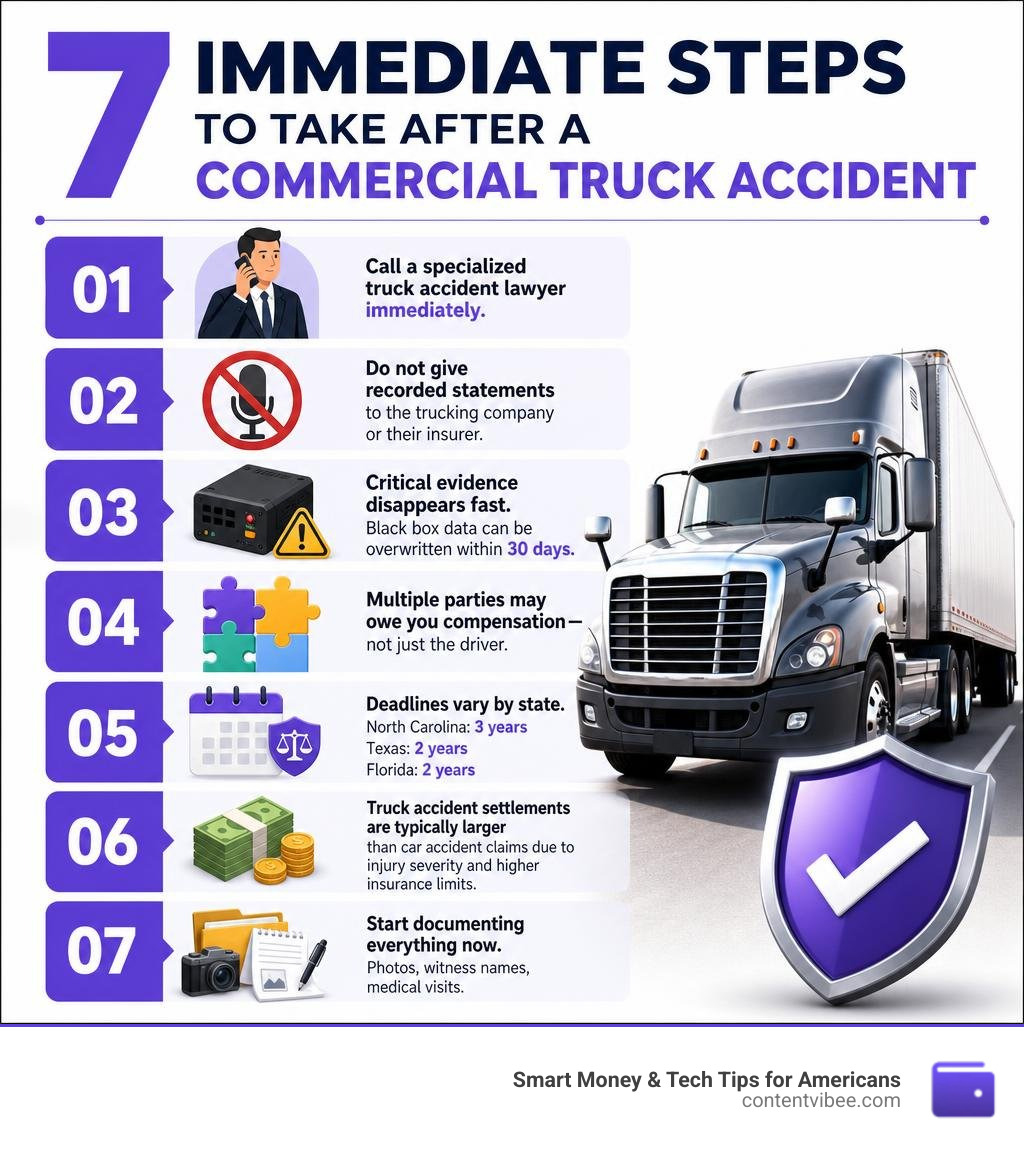
- Call a specialized truck accident lawyer immediately — not a general personal injury attorney
- Do not give recorded statements to the trucking company or their insurer
- Critical evidence disappears fast — black box data can be overwritten within 30 days
- Multiple parties may owe you compensation — not just the driver
- Deadlines vary by state — North Carolina gives you 3 years; Texas gives you 2 years; Florida gives you 2 years
- Truck accident settlements are typically larger than car accident claims due to injury severity and higher insurance limits
- Start documenting everything now — photos, witness names, medical visits
The stakes in a truck accident are not comparable to a typical fender-bender. A fully loaded commercial tractor-trailer can weigh up to 80,000 pounds — that’s 20 to 30 times heavier than the average passenger car. The injuries are often catastrophic. The legal process is far more complex. And the trucking company’s legal team is very likely already working against you before you’ve even left the hospital.
That’s not a scare tactic. It’s the reality of how these cases work.
This guide gives you 7 practical tips you’ll wish you had known from the start — whether you’re dealing with a crash right now or want to be prepared if one ever happens.
Why You Need a Specialized Big Truck Lawyer
When you are involved in a standard passenger car collision, you usually deal with two drivers and their respective insurance companies. But when a commercial vehicle is involved, the entire playing field shifts. This is not a scenario where a general personal injury lawyer can easily step in and get you the results you deserve. You need a specialized big truck lawyer who understands the highly technical nature of commercial transport.
Trucking companies do not play nice. From the absolute second a crash is reported, their corporate risk management teams and insurance adjusters are deployed to the scene to gather evidence, shape the narrative, and find ways to limit their financial exposure. If you do not have a specialized advocate on your side immediately, you are starting this fight at a massive disadvantage.
To learn more about the unique benefits of specialized legal representation, check out these x reasons to choose a truck accident lawyer. For an example of how specialized certification elevates an attorney’s capability, you can learn about Board Certified Truck Accident Attorney Joseph V. Camerlengo, whose credentials demonstrate the rigorous standards required to handle these complex legal battles.
The Difference Between Car Accidents and Semi-Truck Crashes
The sheer physical reality of a commercial vehicle collision alters the entire legal and medical landscape. While the average passenger vehicle weighs between 3,000 and 4,500 pounds, a fully loaded commercial semi-truck can tip the scales at 80,000 pounds and stretch up to 80 feet long.
When these two forces collide, the laws of physics are brutally unforgiving. The crash dynamics mean that passenger vehicle occupants absorb nearly all of the kinetic energy, resulting in devastating, life-altering injuries.
Beyond physics, the commercial insurance limits are vastly different. While a standard car insurance policy might cap out at $30,000 or $50,000, commercial motor carriers are required by federal law to carry liability coverage starting at $750,000, with many policies extending to $5 million or more. Because there is so much money on the line, insurance companies will fight tooth and nail to deny or minimize your claim. You can read more about this dynamic in our guide on choosing a semi truck accident lawyer.
How a Big Truck Lawyer Navigates Federal Regulations
Commercial trucking is governed by a massive, complex web of federal rules established by the Federal Motor Carrier Safety Administration (FMCSA). These regulations dictate:
- How many hours a driver can be on the road without taking a break (Hours of Service rules)
- Strict drug and alcohol testing protocols before and after collisions
- Detailed vehicle maintenance and inspection schedules
- Mandatory training and licensing requirements for drivers
A generalist attorney might look at a crash and simply argue that the truck driver was negligent for speeding. However, an experienced big truck lawyer will dig deeper into the FMCSA compliance history. They will analyze Electronic Logging Device (ELD) data to see if the driver falsified logs to meet a tight corporate deadline. They will audit the fleet’s maintenance records to see if the truck was operating with faulty brakes.
This level of detail requires deep industry knowledge. To see how top-tier legal minds approach these regulations, you can learn about Board Certified Truck Accident Attorney Joseph A. Fried, who has spent decades using federal compliance standards to hold negligent trucking companies accountable.
7 Critical Tips for Handling a Commercial Truck Accident Claim
If you or a loved one has been injured in a commercial vehicle wreck, the steps you take in the hours, days, and weeks following the crash will directly dictate your ability to recover compensation.
To help you protect your rights, we have compiled the seven most critical tips that can make or break your case. For a deeper dive into choosing the right legal representative, read our advice on choosing a truck accident lawyer wisely. If your accident occurred on the west coast, you can also learn about California Truck Accident Lawyers who understand the state-specific regulations governing major shipping corridors.
Tip 1: Act Fast to Preserve Electronic Evidence
Modern commercial trucks are essentially rolling computers. They are equipped with Electronic Control Modules (ECMs)—commonly referred to as “black boxes”—as well as ELDs, GPS tracking systems, and onboard cabin cameras. This technology records invaluable data, including:
- The truck’s speed immediately prior to impact
- Whether and when the brakes were applied
- Steering angles and sudden acceleration/deceleration patterns
- How long the driver had been behind the wheel without a break
The catch? This data does not last forever. Trucking companies are legally permitted to overwrite or purge black box data and electronic logs in the ordinary course of business, sometimes in as little as 30 days. Onboard camera footage can be deleted in a matter of days.
To stop this from happening, your attorney must immediately send a formal “spoliation letter” (a legal hold notice) to the trucking company, demanding that all electronic, mechanical, and physical evidence be preserved. For a complete breakdown of how this evidence is secured, check out our Truck Wreck Attorney Ultimate Guide.
Tip 2: Identify All Potentially Liable Parties
In a standard car accident, the driver who hit you is almost always the only person you sue. In a commercial truck accident, the driver is often just the tip of the iceberg. Multiple corporate entities may share liability for your injuries, including:
- The Trucking Company (Carrier): They are responsible for hiring, training, and monitoring their drivers. If they pushed a driver to ignore safety limits, they are liable.
- The Cargo Loading Company: If cargo was improperly loaded or secured, causing a shift in weight that led to a rollover or jackknife accident, the loading facility can be held responsible.
- The Maintenance Provider: If a third-party mechanic failed to repair a known brake defect, they share the blame.
- The Parts Manufacturer: If a tire blowout or steering failure was caused by a manufacturing defect, a product liability claim can be pursued.
- The Freight Broker: In some cases, the broker who hired an unsafe trucking company can be held liable for negligent hiring.
Uncovering this chain of liability requires a comprehensive investigation. If you are dealing with an accident in Southern California, you can learn about Los Angeles truck accident attorneys who specialize in untangling these multi-party corporate webs.
Tip 3: Understand the True Value of Your Injuries
Because commercial trucks are so massive, the physical injuries they cause are often catastrophic. We are not just talking about minor whiplash. We are talking about:
- Traumatic Brain Injuries (TBIs) that alter cognitive function permanently
- Spinal cord damage resulting in partial or complete paralysis
- Polytrauma, crushed limbs, and amputations
- Severe burns from fuel fires or hazardous chemical cargo
These injuries require a lifetime of care. When calculating the value of your claim, you cannot just look at your current medical bills. You must account for future surgeries, ongoing physical therapy, home modifications, specialized medical equipment, lost earning capacity, and profound pain and suffering.
To understand how lawyers calculate these long-term costs, refer to our Truck Accident Law Firm Guide 2026.
Tip 4: Hire a Big Truck Lawyer with Trial Experience
Many personal injury attorneys prefer to settle cases quickly out of court. While a settlement is often the preferred outcome, the only way to get a commercial insurer to offer a fair payout is to show them that you are ready, willing, and able to take them to trial.
A trial-ready lawyer will build your case from day one as if it is heading to a courtroom. They will hire accident reconstruction experts, medical specialists, and life care planners to present an airtight case to a jury. When insurance companies see that your attorney has a track record of winning multi-million dollar verdicts, their willingness to offer a fair settlement increases dramatically.
To learn more about this trial-first philosophy, you can learn about Virginia Catastrophic Injury Lawyer Robert E. Byrne, Jr., who focuses heavily on trial-ready commercial vehicle litigation. For more practical advice on finding the right advocate, read our best truck accident lawyer tips.
Tip 5: Never Give a Recorded Statement to Insurers
Shortly after your accident, you will likely receive a phone call from a friendly insurance adjuster representing the trucking company. They might express sympathy, ask how you are feeling, and request a quick recorded statement to “help speed up your claim.”
Do not do it.
These adjusters are highly trained professionals whose job is to protect their company’s bottom line. They will use open-ended questions to get you to downplay your injuries or admit to a portion of fault. Because some serious injuries (like brain trauma or internal bleeding) take days to fully manifest, you might tell them you “feel fine” only to discover a week later that you require spinal surgery. They will use your recorded statement to destroy your credibility.
Let your big truck lawyer handle all communications. If you want to know more about how to protect yourself from these insurance tactics, check out what to expect from Truck Accident Lawyers.
Tip 6: Keep Track of the Statute of Limitations
Every state has a strict legal deadline—known as the statute of limitations—for filing a personal injury lawsuit. If you miss this deadline, you lose your right to seek compensation forever.
- North Carolina: 3 years from the date of the accident
- Texas: 2 years from the date of the accident
- California: 2 years from the date of the accident
- Florida: 2 years from the date of the accident
While two or three years might seem like a long time, building a complex truck accident case takes months of intensive work. Gathering maintenance logs, hiring experts, and negotiating with corporate insurers cannot be rushed. To ensure you do not miss your window of opportunity, consult our Truck Accident Lawyers Near Me Guide.
Tip 7: Document Everything from Day One
The success of your claim hinges entirely on the quality of your evidence. While your attorney will handle the heavy legal lifting, you can help protect your case by preserving as much documentation as possible from the very beginning:
- At the Scene: If you are physically able, take photos of the vehicle damage from multiple angles, the positions of the cars, skid marks, road conditions, and any relevant traffic signs. Collect names and contact info of witnesses.
- Medical Records: Keep a meticulous file of every doctor’s visit, prescription, physical therapy session, and medical bill.
- Daily Journal: Write down how your injuries affect your daily life. Note your pain levels, sleep quality, and the activities you can no longer perform. This serves as powerful evidence of your non-economic damages (pain and suffering).
For a step-by-step checklist on how to build an unassailable record of your claim, read our Truck Accident Law Firm Complete Guide.
Proving Negligence and Calculating Damages
To win a truck accident claim, your legal team must prove that the truck driver or trucking company acted negligently and that their negligence directly caused your injuries.
| Feature | Passenger Car Claims | Commercial Truck Claims |
|---|---|---|
| Average Vehicle Weight | 3,000 to 4,500 lbs | Up to 80,000 lbs |
| Primary Governing Law | State Traffic Laws | State Traffic Laws + Federal FMCSA Regulations |
| Typical Insurance Limits | $30,000 – $100,000 | $750,000 – $5,000,000+ |
| Potential Liable Parties | Driver only | Driver, Carrier, Cargo Loader, Manufacturer, Broker |
| Evidence Complexity | Police report, basic photos | Black box data, ELD logs, maintenance audits, dashcams |
Once negligence is established, your attorney will calculate your total damages. These are split into two primary categories:
- Economic Damages: These are the quantifiable financial losses you have suffered, such as medical bills, future medical care costs, lost wages, and loss of earning capacity.
- Non-Economic Damages: These are the intangible, subjective losses that do not come with a receipt, such as physical pain, emotional distress, loss of enjoyment of life, and loss of companionship.
To learn more about how top firms evaluate these damages, consult our Buyers Guide for Best Truck Accident Law Firms. If your accident occurred in the Southwest, you can also learn about El Paso Truck Accident Lawyers who have deep experience navigating Texas transport liability laws.
Frequently Asked Questions About Truck Accident Claims
Navigating the aftermath of a commercial vehicle wreck can feel overwhelming. Here are the answers to some of the most common questions victims ask us:
How much is a typical truck accident settlement worth?
There is no single “average” settlement. Because commercial truck accidents often cause catastrophic injuries, their settlement values are typically much higher than standard car accident claims. The final payout depends heavily on:
- The severity and permanence of your injuries
- The total cost of your past and future medical treatment
- The amount of insurance coverage available (commercial policies often have multi-million dollar limits)
- The clarity of fault (proving the trucking company was 100% negligent)
To see how top attorneys maximize these values, read our guide on best truck accident lawyers top questions answered.
Can I still recover compensation if I was partially at fault?
Yes, but it depends entirely on the laws of the state where the accident occurred.
- California follows a pure comparative negligence system. This means you can recover compensation even if you were 99% at fault for the crash, though your final settlement will be reduced by your percentage of fault.
- Texas and many other states use a modified comparative fault system (often a 51% bar). Under these rules, you can only recover damages if your share of the blame is 50% or less. If you are found to be 51% or more at fault, you get nothing.
To understand how comparative negligence might affect your specific case, you can learn about Big Truck Chuck and his team’s approach to proving liability in complex, multi-vehicle scenarios.
How long does a truck accident lawsuit take to resolve?
Because of the complexity of the evidence and the amount of money involved, truck accident cases rarely wrap up overnight. A typical claim can take anywhere from 12 to 24 months to resolve, and sometimes longer if it goes to trial.
The timeline is dictated by:
- Your Recovery: Your attorney should not settle your case until you have reached Maximum Medical Improvement (MMI). This ensures all future medical costs are fully accounted for.
- The Investigation: Gathering black box data, auditing logs, and reconstructing the crash scene takes time.
- Litigation: If the insurance company refuses to offer a fair settlement, filing a lawsuit and going through the formal discovery phase adds months to the process.
To learn more about the timelines and regional considerations of these lawsuits, you can learn about Los Angeles Truck Accident Lawyers who routinely handle high-stakes commercial cases.
Conclusion
At Smart Money & Tech Tips for Americans, we know that a commercial truck accident can throw your entire life—and your financial stability—into complete chaos in a fraction of a second. The physical, emotional, and financial toll is immense. But you do not have to navigate this incredibly stressful journey alone.
By hiring a specialized big truck lawyer, you are leveling the playing field against massive trucking corporations and their aggressive insurance defense teams. An experienced attorney will preserve the digital evidence, identify all liable parties, and fight tirelessly to secure the maximum compensation you need to rebuild your life.
If you or a loved one is ready to take the next step toward financial and physical recovery, we highly encourage you to Contact a Truck Accident Law Firm today to schedule a free, no-obligation case evaluation. Protect your rights, secure your evidence, and let the experts handle the fight while you focus on healing.


