


Why Every Pre-Retiree Needs a Social Security Calculator
A social security calculator is one of the most powerful — and most underused — tools available to Americans planning for retirement.
Here’s a quick answer to what you came here for:
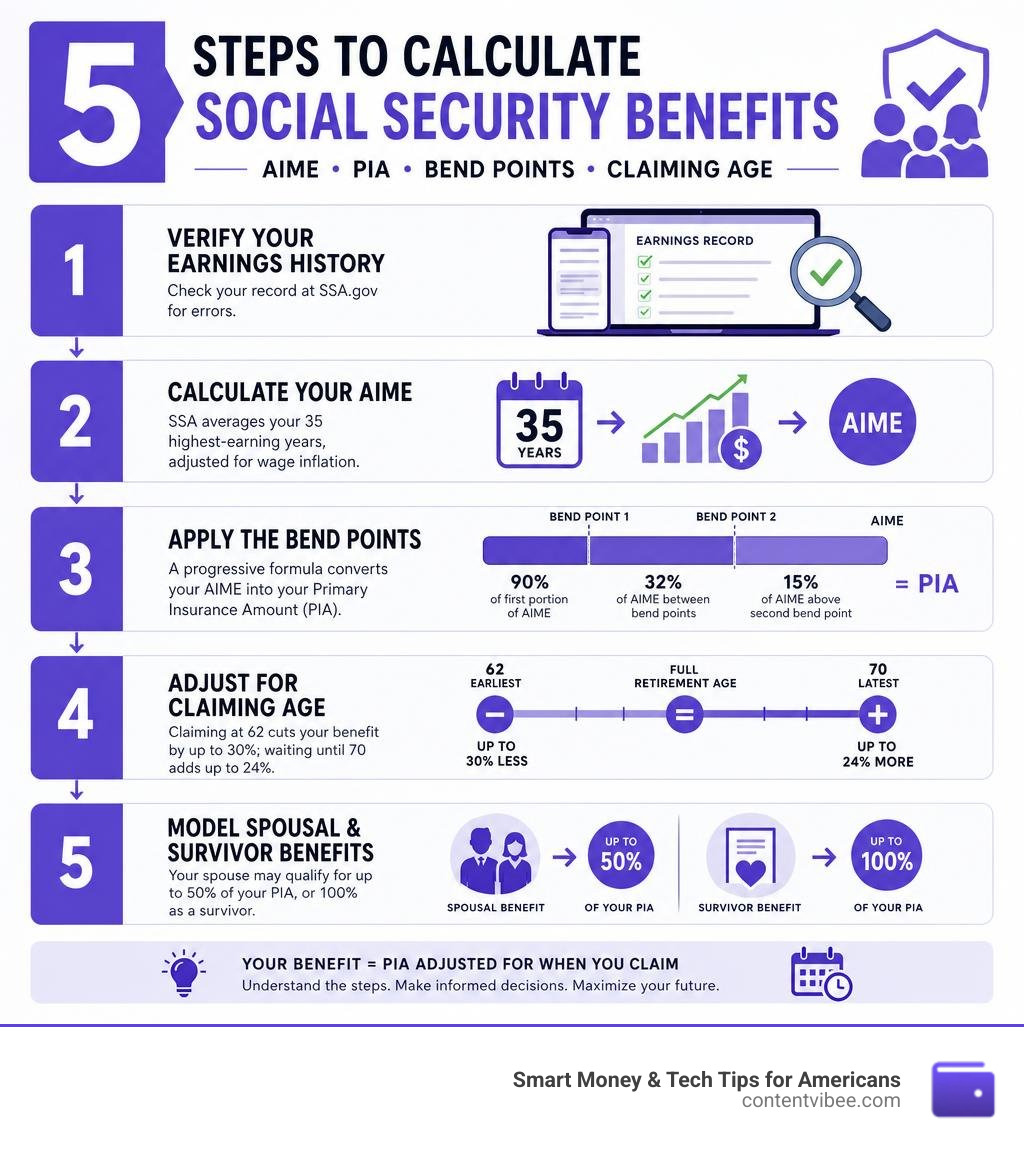
How to calculate your Social Security benefit (5 steps):
- Verify your earnings history — check your record at SSA.gov for errors
- Calculate your AIME — SSA averages your 35 highest-earning years, adjusted for wage inflation
- Apply the bend points — a progressive formula converts your AIME into your Primary Insurance Amount (PIA)
- Adjust for claiming age — claiming at 62 cuts your benefit by up to 30%; waiting until 70 adds up to 24%
- Model spousal and survivor benefits — your spouse may qualify for up to 50% of your PIA, or 100% as a survivor
That’s the core of it. But the details matter a lot — especially for married couples.
Consider this: among adults 65 and older, 39% of men and 44% of women rely on Social Security for more than half of their retirement income. Getting the timing wrong — or missing an error in your earnings record — can cost you tens of thousands of dollars over a lifetime.
In 2026, the average monthly benefit is $2,071, but the maximum at age 70 reaches $5,251. The gap between those numbers largely comes down to strategy.
This guide walks you through every step — from reading your earnings record to coordinating benefits with your spouse — so you don’t leave a single dollar on the table.
Demystifying the Social Security Calculator: How It Estimates Your Benefits
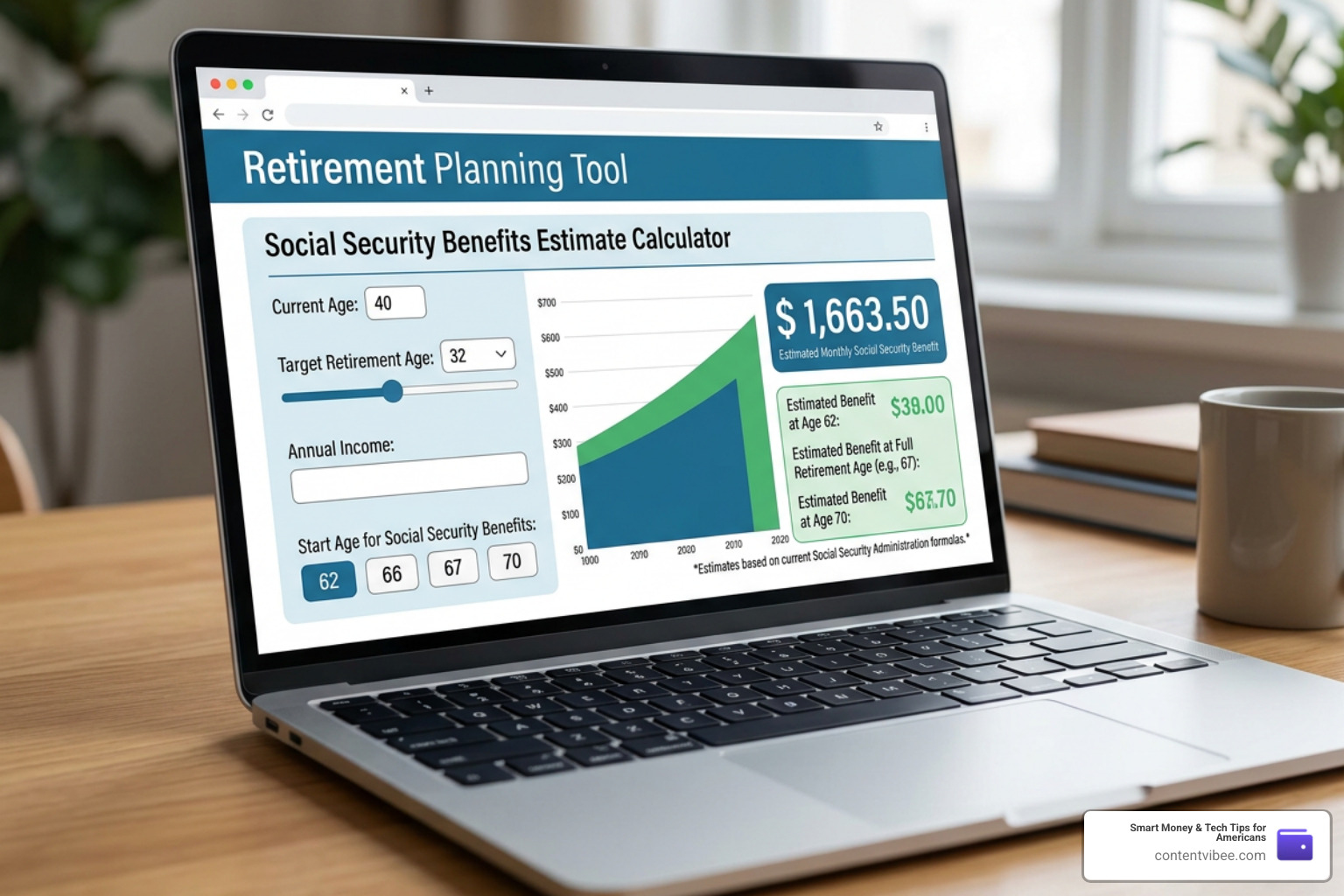
When you search for a social security calculator, you will quickly realize that not all estimation tools are built the same. The Social Security Administration (SSA) and various financial platforms offer different tiers of calculators depending on how deep you want to dive into the math.
Understanding the differences between these tools can help you choose the right one for your planning phase:
- The Quick Calculator: This tool provides a fast, bare-bones estimate. It does not access your actual earnings record. Instead, it asks for your date of birth, current year’s earnings, and a planned retirement age to build a rough projection. It is a great starting point if you are young or just want a quick ballpark figure, but it shouldn’t be used for final retirement modeling. You can try the official government version via the Quick Calculator.
- The Online Calculator: A step up in accuracy, this version requires you to manually enter your covered earnings for each year of your working life. It doesn’t link directly to the SSA database for privacy reasons, but if you have a copy of your Social Security Statement, you can plug in your actual numbers to get a highly reliable estimate.
- The Detailed Calculator: This is a powerful, downloadable software application designed for complex financial planning. It can compute almost any type of benefit, including those impacted by unique pension structures or disability. You can find more about this advanced tool on the Benefit Calculators – Estimate Your Benefit page.
- Your “my Social Security” Account: This is the gold standard. By creating a personal account on the official SSA portal, the system automatically links directly to your verified tax records. It does the math for you based on real-time data and lets you toggle between different claiming ages effortlessly.
If you are looking for a straightforward, user-friendly tool to begin mapping out your retirement without getting bogged down in governmental jargon, we recommend exploring the Best Free Social Security Calculator Options Your No Cost Retirement Roadmap/ to see how various free tools compare.
How to Calculate Your Social Security Benefit in 5 Simple Steps
The actual math behind your monthly check might seem like a closely guarded government secret, but it is actually a highly structured, logical process. It relies on your 35 highest-earning years, wage indexing, and a formula that converts those earnings into your Primary Insurance Amount (PIA).
Let’s break down this complex system into five manageable steps so you can see exactly how the gears turn.
Step 1: Verify Your Earnings History and Wage Indexing
Your future benefit is built entirely on your historical earnings. The SSA tracks how much you pay in Social Security payroll taxes each year. However, a dollar earned in 1990 had vastly different purchasing power than a dollar earned in 2026.
To make the math fair, the SSA uses the National Average Wage Index (AWI) to adjust your historical earnings for inflation up to the year you turn 60. Earnings after age 60 are recorded in raw, unindexed dollars.
To ensure your future check is accurate, you must verify that your earnings record has no missing years or incorrect amounts. An error here can permanently reduce your monthly payout by $50 to $200 for life. You can learn exactly how to check your statement by reading our guide on how to Estimate Your Monthly Retirement Benefits In 5 Easy Steps/.
Step 2: Calculate Your Average Indexed Monthly Earnings (AIME)
Once your lifetime earnings are indexed for wage inflation, the SSA identifies your 35 highest-earning years. If you worked fewer than 35 years in jobs where you paid Social Security taxes, the system will plug in $0 for those empty years, which can drag down your average significantly.
To find your Average Indexed Monthly Earnings (AIME):
- Select your 35 highest-earning, indexed years.
- Add those 35 annual earnings figures together.
- Divide the total by 420 (the number of months in 35 years).
- Round down to the next lower dollar amount.
This final number is your AIME, the foundation of your monthly retirement benefit.
Step 3: Apply the 2026 Bend Points to Find Your Primary Insurance Amount (PIA)
The SSA formula is progressive, meaning it is designed to replace a higher percentage of lower-income earnings than higher-income earnings. To do this, the system runs your AIME through three separate brackets, which are divided by thresholds called bend points.
Your bend points lock in during the year you turn 62, regardless of when you actually claim your benefits. For those reaching eligibility in 2026, the bend points are $1,286 and $7,749.
Here is how the 2026 progressive formula calculates your Primary Insurance Amount (PIA), which is your benefit at Full Retirement Age (FRA):
- 90% of the first $1,286 of your AIME.
- 32% of your AIME between $1,286 and $7,749.
- 15% of your AIME that exceeds $7,749 (up to the 2026 maximum taxable wage base of $184,500).
Let’s look at how this formula applies to different lifetime earning levels in 2026:
| Average Lifetime Earnings Level | Estimated AIME | PIA Calculation Breakdown (Using 2026 Bend Points) | Total Monthly PIA at FRA |
|---|---|---|---|
| Modest Earner | $3,000 | (90% of $1,286) + (32% of $1,714) | $1,705.88 |
| Mid-Career Professional | $6,000 | (90% of $1,286) + (32% of $4,714) | $2,665.88 |
| High Earner | $10,000 | (90% of $1,286) + (32% of $6,463) + (15% of $2,251) | $3,563.21 |
Step 4: Adjust Your Benefit Based on Your Claiming Age
Your PIA is the exact amount you will receive if you claim your benefit at your Full Retirement Age (FRA). For anyone born in 1960 or later, your FRA is 67.
However, you can choose to claim your benefit as early as age 62 or as late as age 70. Your choice will permanently adjust your monthly benefit:
- Claiming Early (Age 62 to FRA): Your benefit is reduced by 5/9 of 1% for each of the first 36 months before your FRA, and an additional 5/12 of 1% for each month beyond that. If your FRA is 67 and you claim at 62, you face a permanent 30% reduction in your monthly check.
- Delaying Benefits (FRA to Age 70): For every year you delay claiming past your FRA, you earn 8% in delayed retirement credits. Delaying from age 67 to age 70 results in a permanent 24% increase in your monthly payout.
Choosing when to claim is a balance of health, financial need, and longevity. The break-even age for delaying benefits is typically between age 78 and 82. To run your own scenarios, check out our How Much Social Security Will I Get Calculator/.
Step 5: Use a Social Security Calculator to Model Spousal and Survivor Benefits
Your retirement planning doesn’t happen in a vacuum, especially if you are married. The SSA offers spousal, survivor, and even divorced-spouse benefits that can drastically alter your household claiming strategy:
- Spousal Benefits: A spouse can claim up to 50% of the higher earner’s PIA once the higher earner has filed for their own retirement benefit. If the spouse has their own work record, the SSA will pay the higher of the two benefits, not both. Learn more about coordinating this by reading our guide to Calculate Spouse Retirement Benefits/.
- Survivor Benefits: If you outlive your spouse, you can step into their shoes and receive 100% of their monthly benefit, including any delayed retirement credits they earned. For high-earning couples, having the higher earner delay claiming until age 70 is often a highly effective strategy to maximize the survivor benefit for the remaining spouse. Check out the details at Calculate Survivor Retirement Benefits/.
- Divorced-Spouse Benefits: If you were married for at least 10 years, are currently unmarried, and are at least age 62, you can claim benefits based on your ex-spouse’s work history without affecting their current benefit or their new spouse’s benefits.
To map out these joint strategies, we recommend using a specialized tool like our Tools/Finance Calculator/Social Security Spousal Benefit Calculator/.
Maximizing Your Lifetime Benefits: Strategies, Taxes, and Future Reforms
Maximizing your retirement income is about more than just picking a claiming age; it is about protecting your benefits from taxes and understanding the broader economic landscape.
First, let’s talk about Uncle Sam. Many retirees are surprised to learn that their Social Security benefits may be subject to federal income tax. The IRS determines this using your combined income (also known as provisional income), which is calculated as:
$$\text{Combined Income} = \text{Adjusted Gross Income (AGI)} + \text{Nontaxable Interest} + 50\% \text{ of your Social Security Benefit}$$
If your combined income crosses certain thresholds, a portion of your benefits becomes taxable:
- Single Filers: Combined income between $25,000 and $34,000 may require taxes on up to 50% of benefits. Above $34,000, up to 85% of benefits may be taxable.
- Married Filing Jointly: Combined income between $32,000 and $44,000 may require taxes on up to 50% of benefits. Above $44,000, up to 85% of benefits may be taxable.
To manage this tax burden, some retirees implement strategic Roth IRA conversions in the years leading up to retirement to lower their future taxable income.
Additionally, as a geography note for our readers: California does not tax Social Security benefits at the state level. If you reside in California, you only need to plan for federal taxes on your benefits.
Another critical consideration is the long-term solvency of the Social Security program. Current projections indicate that the OASI Trust Fund reserves could be depleted by 2033 to 2034. If Congress does not act before then, incoming payroll taxes would still cover roughly 77% of scheduled benefits, resulting in an automatic benefit cut of about 23%.
While this sounds alarming, history suggests that Congress will likely implement reforms to shore up the trust fund. Potential changes could include raising the payroll tax cap, indexing the retirement age to life expectancy, or adjusting future cost-of-living adjustments (COLAs).
For married couples looking to build a resilient retirement plan in the face of these potential policy changes, we suggest reading Do The Math Top Social Security Calculators For Married Couples/.
How Reliable is an Online Social Security Calculator Compared to an Official SSA Estimate?
While third-party calculators are highly convenient, they are only as good as the data you input. An official estimate from your personal my Social Security account is always the most reliable because it pulls directly from your actual, tax-verified earnings record.
However, third-party calculators are excellent for running “what-if” scenarios, such as modeling early retirement or estimating spousal benefits. If you have a pension from a job where you did not pay Social Security taxes (such as certain government or civil service positions), standard calculators may overestimate your benefits. In these cases, you must use specialized tools that account for the Windfall Elimination Provision (WEP) or Government Pension Offset (GPO), which you can access directly on the Benefits Planner: Retirement | Online Benefits Calculator | SSA page.
For a quick, high-level estimate that doesn’t require logging into a government portal, the Social Security Calculator: Estimate Your Benefits – AARP is another highly reputable option.
Frequently Asked Questions
Can I work while collecting Social Security benefits?
Yes, you can work and collect benefits simultaneously. However, if you are under your Full Retirement Age (FRA) and earn more than the annual limit ($23,400 in 2026), the SSA will temporarily withhold $1 in benefits for every $2 you earn above the limit.
Once you reach your FRA, there is no earnings limit, and the SSA will permanently recalculate your monthly benefit upward to credit you for the amount that was withheld.
Are Social Security benefits taxable?
Yes, depending on your combined income. Up to 85% of your federal benefits can be taxed if your combined income exceeds $34,000 (single) or $44,000 (married filing jointly). Fortunately, California is one of the many states that does not tax Social Security benefits at the state level.
What is the maximum Social Security benefit in 2026?
In 2026, the maximum monthly benefit at Full Retirement Age is approximately $4,152. If you delay claiming until age 70, the maximum benefit reaches $5,251. To qualify for this maximum, you must earn at or above the maximum taxable wage base ($184,500 in 2026) for at least 35 years of your working career.
Conclusion
Calculating your future retirement income doesn’t have to be overwhelming. By utilizing an online social security calculator and verifying your earnings record, you can take control of your financial future.
Whether you choose to claim early at 62, wait for your Full Retirement Age at 67, or maximize your benefits at age 70, making an informed decision is key to a secure retirement. We at Smart Money & Tech Tips for Americans are here to help you navigate these complex choices with practical, straightforward guidance.
To take the next step in your financial planning journey, try our interactive How Much Social Security Will I Get Calculator/ today!


