


How Much Can You Really Save With Fidelity’s Fee Structure?
Fidelity trading fees savings are among the most significant in the retail brokerage industry — and for investors nearing retirement, every dollar saved on fees is a dollar that keeps compounding. Here’s a quick snapshot of what Fidelity actually costs (and doesn’t cost):
| Fee Type | Fidelity Cost |
|---|---|
| Online U.S. stocks & ETFs | $0 per trade |
| Options | $0 + $0.65 per contract |
| Bonds (secondary market) | $1 per bond online |
| U.S. Treasuries (online) | $0 |
| Fidelity index funds (ZERO funds) | 0.00% expense ratio |
| Account service / maintenance fee | $0 |
| IRA account minimum | $0 |
| Uninvested cash yield (SPAXX, as of June 17, 2026) | 3.29% 7-day yield |
| Fidelity Go (under $25,000) | $0 advisory fee |
| Fidelity Go (over $25,000) | 0.35% per year |
The short answer: Fidelity is one of the lowest-cost brokers available to U.S. investors, with $0 commissions on most common trades, no account minimums, and a suite of zero-expense-ratio index funds you won’t find at most competitors.
But the full picture is a little more nuanced. Margin rates, broker-assisted trades, foreign stock transactions, and certain mutual fund fees can add up if you’re not paying attention.
This guide breaks down every major fee category at Fidelity, compares them to competitors like Schwab, Vanguard, and E*Trade, and shows you exactly where the real savings opportunities are — especially if you’re in the final stretch before retirement and want to make sure you’re not quietly bleeding money to fees you didn’t know existed.
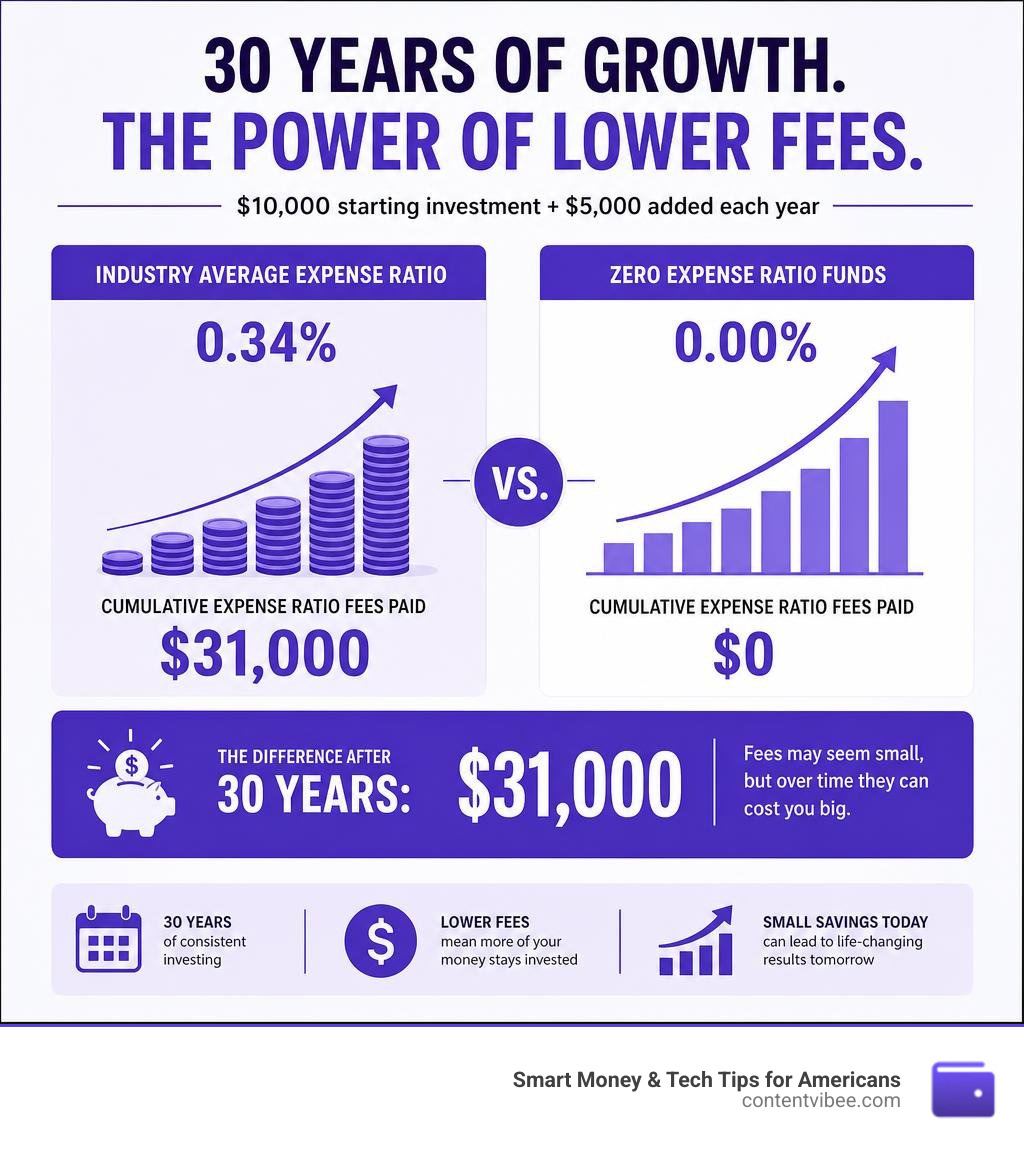
Consider this: an investor starting with $10,000 and adding $5,000 per year for 30 years could pay nearly $31,000 in cumulative expense ratio fees at the industry average rate of 0.34% — versus zero with Fidelity’s ZERO index funds. That’s not a small difference.
Fidelity Commission Rates and Core Trading Costs
When we look at the cost of managing an investment portfolio, the most visible expenses are the direct costs to buy and sell securities. Fortunately, the era of paying $10 or $15 every time you click “buy” is long gone.
To get a comprehensive look at how these charges are structured across all asset classes, the official Fidelity Brokerage and Commission Fee Schedule outlines every cost in detail. For retail investors, this structure provides some of the strongest cost-saving opportunities in the industry, which we also explore in our Fidelity Cost Transparency Review.
Zero-Commission Stocks and ETFs
If you are trading online, your commission rate for U.S. stocks and exchange-traded funds (ETFs) is exactly $0. Whether you buy one share or 10,000 shares, you will not pay a commission.
Furthermore, Fidelity supports fractional share trading for more than 7,000 U.S. stocks and ETFs. With a minimum transaction value of just $1, you can build a diversified portfolio even with a small amount of capital. This makes it incredibly easy to execute dollar-cost averaging strategies without commissions eating into your principal. To understand how to structure your portfolio without losing money to friction costs, check out our guide on How to Buy and Sell Stocks Without Losing Your Shirt to Fees.
Options Contract Fees and Buy-to-Close Rules
For options traders, the commission to place an online trade is $0, but you will pay a contract fee of $0.65 per contract.
However, Fidelity has a customer-friendly rule that can save active traders a significant amount of money: buy-to-close orders for options priced at $0.65 or less are completely free (meaning $0 commission and $0 contract fee). If you are writing options to generate income and regularly buy them back to close out positions as they lose value, this rule keeps a lot of cash in your pocket. For a deeper dive into how multi-leg orders and index options are priced, see our detailed breakdown of Fidelity Options Fees Explained and Demystified.
Fixed Income and Bond Markups
If you want to add fixed income to your portfolio, Fidelity offers incredibly competitive pricing.
- U.S. Treasuries: $0 commission for online trades (both new issues and secondary market).
- Secondary Market Bonds: Fidelity charges a markup of $1.00 per bond (with a $1,000 face value) for online secondary bond trades.
This pricing translates to a potential average savings of $15 per bond compared to traditional brokers who charge higher markups or flat ticket fees. For complete details on fixed-income pricing, you can reference Fidelity’s Trading Commissions and Margin Rates page.
Mutual Fund Transaction Fees
Fidelity offers thousands of mutual funds with no transaction fees (NTFs). Specifically, you can trade any Fidelity-branded mutual fund for $0. However, if you purchase a non-Fidelity transaction-fee fund, you may face a flat fee of $49.95 for online purchases.
Additionally, be aware of short-term trading fees. If you buy a no-transaction-fee (NTF) fund and sell it within 60 days, Fidelity may charge a short-term redemption fee of $49.95 to discourage rapid trading. We break down these exact scenarios in our article Fidelity Mutual Fund Trade Fee When Is Free Not Actually Free.
Maximizing Your Fidelity Trading Fees Savings

To truly maximize your Fidelity trading fees savings, you have to look beyond the $0 stock commissions. The real magic happens when you optimize your cash holdings and long-term fund selections. Fidelity’s pricing model is built to reward long-term, self-directed investors. You can read more about their philosophy on their page covering Straightforward and Transparent Pricing. However, it is always wise to ask: Is Fidelity Actually Free or Are You the Product? Understanding how they make money (such as through order flow and margin interest) helps you avoid their higher-cost services.
How Zero-Expense Funds Boost Your Fidelity Trading Fees Savings
One of the most unique offerings at Fidelity is their lineup of ZERO index mutual funds (like FNILX and FZROX). These are the industry’s first mutual funds with a 0.00% expense ratio offered directly to retail investors.
Most index funds at other brokerages carry expense ratios between 0.03% and 0.09%, and active funds can easily charge 0.50% or more. By utilizing Fidelity’s zero-expense funds, you keep 100% of your market returns. Over a 20- or 30-year investing horizon, this lack of drag from management fees can save you tens of thousands of dollars. If you are preparing to rebalance your portfolio, make sure you do it efficiently by reading about Selling Your Shares Without Losing Your Shirt to Fees.
Comparing Core Position Yields to Increase Your Fidelity Trading Fees Savings
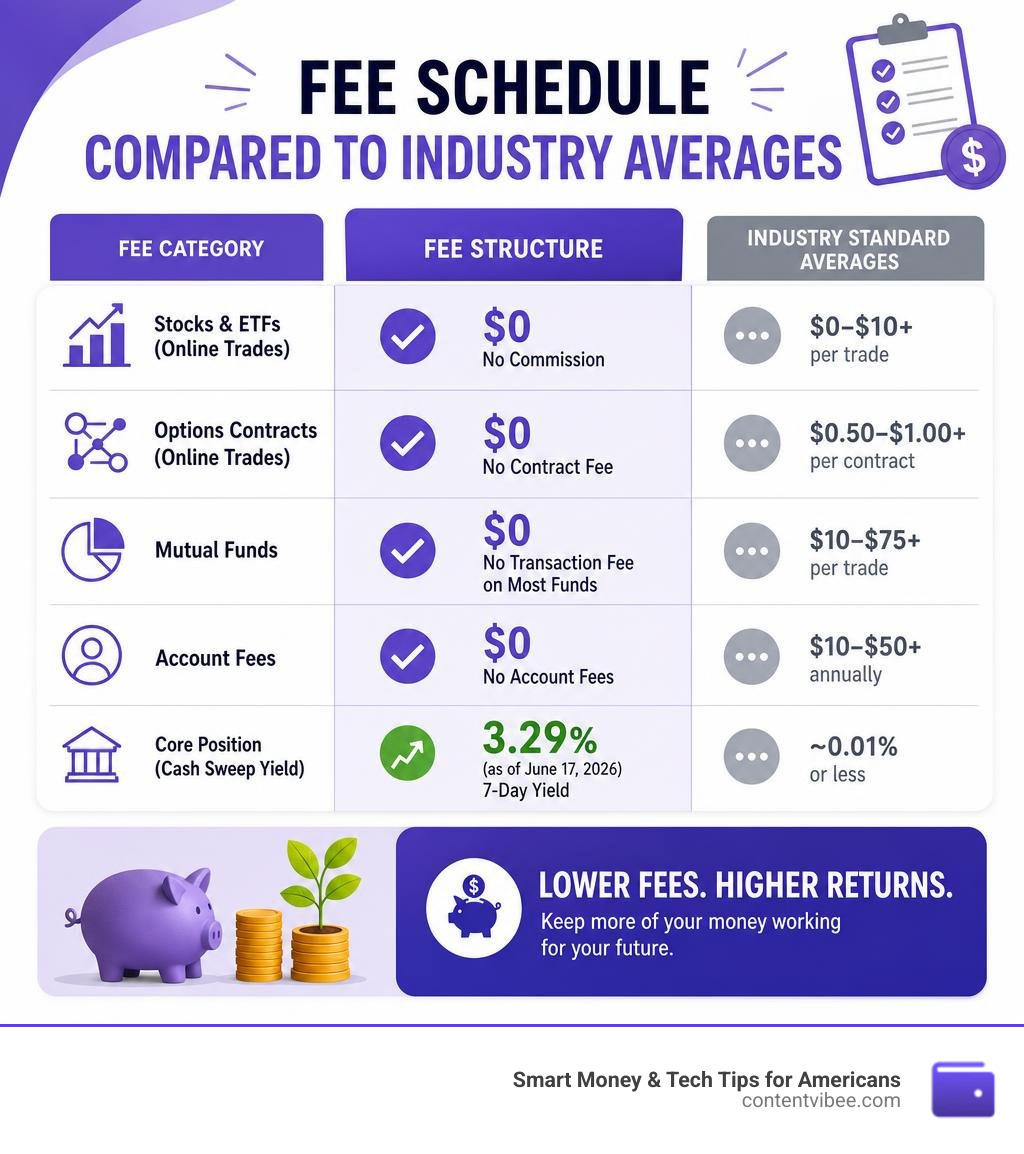
Most brokerages sweep your uninvested cash into a bank product that pays a microscopic interest rate (often as low as 0.01%). If you have $20,000 sitting in cash waiting for a market correction, you are losing purchasing power daily.
Fidelity does things differently. When you open a retail brokerage account, your default “core position” (where uninvested cash sits) is automatically set to a money market fund, such as the Fidelity Government Money Market Fund (SPAXX).
- As of June 17, 2026, SPAXX offers a highly competitive 3.29% 7-day yield.
- There are no account fees or subscription fees required to earn this yield.
- To put this in perspective, holding $10,000 in uninvested cash at Fidelity yields roughly $329 a year, compared to just $1 a year at a broker paying a 0.01% sweep rate.
You can learn more about how cash settlements and core positions work on the Trading FAQs: About Your Trading Account page.
Understanding Margin Rates and Hidden Account Fees
While retail trading is largely free of commissions, there are still areas where fees can sneak up on you if you are not careful.
To help you avoid unexpected charges, we recommend reviewing our guide on how to Don’t Get Caught Off Guard by Stock Selling Fees.
Tiered Margin Rates and Interest Calculations
If you trade on margin, you are borrowing money from the broker to buy securities. Fidelity uses a tiered pricing structure where your interest rate decreases as your debit balance increases.
Fidelity’s base margin rate (effective December 12, 2025) is 10.575%. The final rate you pay is determined by adding or subtracting a premium based on your balance tier:
| Debit Balance Tier | Margin Rate (as of June 2026) |
|---|---|
| $0 – $24,999.99 | 11.825% |
| $25,000 – $49,999.99 | 11.325% |
| $50,000 – $99,999.99 | 10.575% (Base Rate) |
| $100,000 – $499,999.99 | 9.575% |
| $500,000 – $999,999.99 | 8.250% |
| $1,000,000+ | 7.500% |
While Fidelity’s rates for smaller balances are in line with the industry, their rates for larger balances (7.50% for $1M+) are highly competitive. You can compare these rates directly against other major platforms by visiting the Compare Online Brokers page.
Hidden Fees: Wires, Transfers, and Foreign Trading
Fidelity stands out by charging $0 for many common administrative tasks that other brokers use to nickel-and-dime clients:
- Account Transfers (ACATS): $0 to transfer your account out of Fidelity (compared to $50 or $75 at many competitors).
- Bank Wires: $0 for outgoing bank wires (Schwab, for example, charges up to $25).
- Annual/Inactivity Fees: $0.
- Paper Statements: $0.
However, you must be careful with international and foreign trading. If you trade stocks directly on foreign exchanges (in local currencies), Fidelity charges country-specific taxes, currency exchange fees (which can run up to 3% of the principal), and transaction fees. To protect yourself from these international friction costs, read our analysis on how to Don’t Get Short Changed by Hidden Commission in Stock Market Trades.
Robo-Advisory and Wealth Management Costs
If you prefer a hands-off approach to investing, you might consider Fidelity Go, their robo-advisory service.
- Balances under $25,000: $0 advisory fee.
- Balances of $25,000 and above: 0.35% advisory fee per year.
For personalized wealth management services, fees range from 0.50% to 1.50% depending on your assets under management. You can compare these advisory options in our comprehensive guide to Fidelity Robo Advisor Fees and our companion piece on Fidelity Advisor Directed Fees.
Frequently Asked Questions About Fidelity Fees
Are there any annual account maintenance or inactivity fees?
No. Fidelity does not charge any annual account maintenance, service, or inactivity fees. There are also no minimum balance requirements to open or maintain a standard retail brokerage account or an IRA. Even if you decide to close an IRA, Fidelity charges $0 for the closeout process.
How much does it cost to execute a broker-assisted trade?
If you place a trade online, it is free. However, if you need to place a trade over the phone, the costs go up:
- FAST Automated Telephone Service: $12.95 per trade.
- Representative-Assisted Trade: $32.95 per trade.
Because of these steep surcharges, we highly recommend executing your trades online or through the mobile app. For more details on these fees, see our breakdown of the Broker Assisted Trade Fee Fidelity.
What are the fees for trading international stocks?
For U.S. residents trading international stocks, there are two primary routes:
- American Depositary Receipts (ADRs): These trade on U.S. exchanges and are subject to standard $0 online commissions (though foreign banks may charge small custody fees).
- Direct International Trading: Trading directly on foreign exchanges in 25 different countries and 16 local currencies is subject to currency conversion fees (up to 3%) and local transaction taxes.
Conclusion
At Smart Money & Tech Tips for Americans, we believe that smart financial planning starts with minimizing unnecessary costs. By taking advantage of Fidelity trading fees savings—such as their $0 stock commissions, zero-expense-ratio index funds, and automatic 3.29% yield on uninvested cash—you can build a highly cost-efficient portfolio that maximizes your long-term wealth.
To see how these savings compare to other brokers on a per-transaction basis, check out our companion piece on the Fidelity Fee Per Trade. Keep your fees low, keep your cash yielding, and let compounding do the heavy lifting for your future!


