


The Social Security Windfall Elimination Provision Has Been Repealed — Here’s What It Means for You
The Social Security windfall elimination provision was a rule that reduced monthly Social Security benefits for millions of workers who also received a pension from a job that didn’t pay into Social Security — but as of January 2024, it no longer applies.
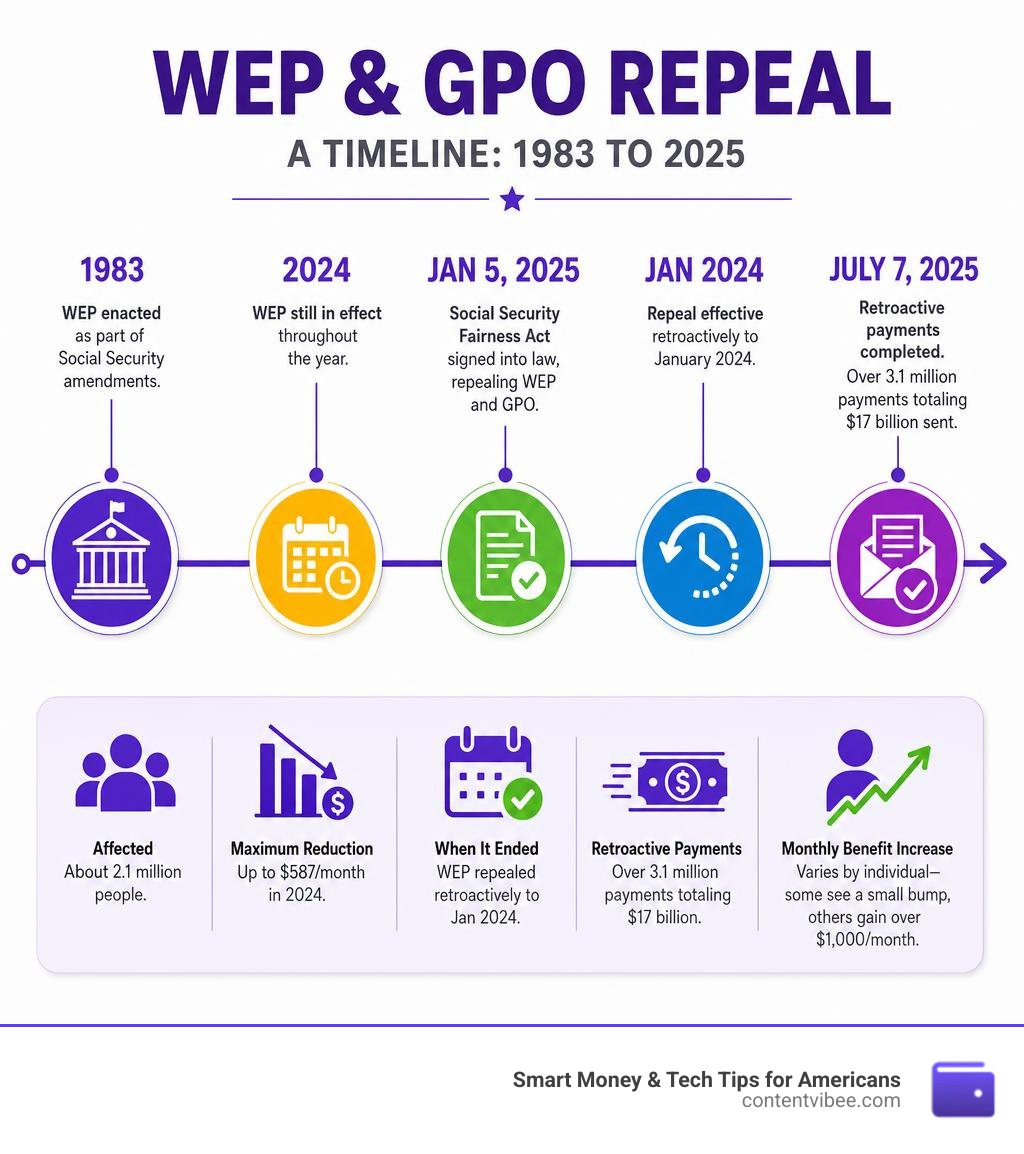
Quick Answer: Key Facts About the WEP Repeal
- What it was: A formula that cut Social Security benefits for workers with non-covered pensions (teachers, firefighters, police officers, federal CSRS employees, and others)
- Maximum reduction: Up to $587/month in 2024
- Who was affected: About 2.1 million people — roughly 3% of all Social Security recipients
- When it ended: The Social Security Fairness Act was signed on January 5, 2025, eliminating WEP retroactively to January 2024
- Retroactive payments: Over 3.1 million payments totaling $17 billion were sent out by July 7, 2025
- Monthly benefit increase: Varies by individual — some see a small bump, others gain over $1,000/month
If you or your spouse worked in a public-sector job — or any job that didn’t withhold Social Security taxes — this repeal could mean real money back in your pocket.
But many people still don’t know if they qualify, how much they’ll receive, or what steps (if any) they need to take. This guide breaks it all down clearly.
What Was the Social Security windfall elimination provision?
For over four decades, public servants and certain other workers faced a frustrating surprise when they retired: their hard-earned Social Security benefits were significantly smaller than they expected. The culprit was the Social Security windfall elimination provision (WEP).
To understand why this rule existed, we have to look back to the Social Security Amendments of 1983. During a time of broader Social Security reforms, Congress created the WEP to solve what it saw as a “double-dipping” problem.
Normally, Social Security uses a progressive formula designed to help low-wage workers by replacing a higher percentage of their average lifetime earnings. However, the system could not easily distinguish between a true low-wage worker and a worker who spent most of their career in a high-paying job where they didn’t pay Social Security taxes (known as “non-covered” employment).
Without the WEP, a worker with a substantial “non-covered” pension from a public-sector career—and only a few years of side work in “covered” Social Security employment—would appear to the system as a low-wage earner. This would trigger the highly generous, progressive formula, resulting in an unintended “windfall.”
To prevent this, the WEP modified the standard benefit formula, slashing the monthly payouts of those who qualified for both a non-covered pension and Social Security. For more details on the policy background, you can read the official Program Explainer: Windfall Elimination Provision.
How the Social Security windfall elimination provision Worked
To calculate your standard retirement benefit, the Social Security Administration (SSA) determines your Average Indexed Monthly Earnings (AIME) and applies a three-tier formula to find your Primary Insurance Amount (PIA). Under standard rules, the formula multiplies the first tier of your average earnings by 90%, the second by 32%, and the third by 15%.
The Social Security windfall elimination provision worked by drastically reducing that first 90% factor. For workers affected by the WEP, that first multiplier could be slashed to as low as 40%.
How much your benefit was reduced depended on your “Years of Coverage” (YOCs)—the number of years you had “substantial earnings” in a job where you paid Social Security taxes.
- 30 or more years of coverage: You were completely exempt from the WEP, keeping your full 90% factor.
- 21 to 29 years of coverage: The factor scaled down gradually from 85% to 45%.
- 20 or fewer years of coverage: You received the minimum 40% factor, resulting in the maximum possible benefit reduction.
However, the law included a “WEP guarantee.” This safety net ensured that the reduction to your Social Security benefit could never exceed half of your monthly non-covered pension amount.
| Feature | Standard Benefit Formula | WEP Benefit Formula (20 or Fewer YOCs) |
|---|---|---|
| First Earnings Tier Multiplier | 90% | 40% |
| Second Earnings Tier Multiplier | 32% | 32% |
| Third Earnings Tier Multiplier | 15% | 15% |
| Maximum Impact | No reduction | Capped at 50% of non-covered pension or annual limit |
Who Was Affected by the Social Security windfall elimination provision?
The WEP primarily targeted dedicated public-sector employees. In California, this heavily impacted our local communities, including:
- Teachers and School Employees: Educators enrolled in the California State Teachers’ Retirement System (CalSTRS) who did not pay into Social Security through their school districts.
- First Responders: Firefighters and police officers who rely on local government pensions.
- Government Workers: Public employees enrolled in the California Public Employees’ Retirement System (CalPERS) whose specific agency opted out of Social Security.
- Federal Employees: Those hired before January 1, 1984, who remained under the Civil Service Retirement System (CSRS).
- International Workers: Individuals receiving foreign pensions from countries where they worked but did not pay U.S. Social Security taxes.
According to data from the Congressional Research Service, roughly 2.1 million people—about 3% of all Social Security recipients—were actively affected by the WEP. For these public servants, the maximum monthly reduction in 2024 was a staggering $587, creating a major dent in their retirement security.
WEP vs. GPO: Understanding the Key Differences
It is common to hear the WEP mentioned in the same breath as the Government Pension Offset (GPO). While both rules penalize those with non-covered public pensions, they target entirely different types of benefits.
- The WEP only applied to your own retirement or disability benefits earned through your own work history.
- The GPO applies to spousal or survivor benefits.
If you receive a non-covered pension and try to claim a spousal or survivor benefit based on your spouse’s Social Security record, the GPO historically reduced your spousal benefit by two-thirds of your government pension amount. In many cases, this completely wiped out the spousal benefit.
To learn more about how survivor rules operate, see our guide on What You Need To Know About Spousal Survivor Benefits.

The Social Security Fairness Act: The Historic Repeal of WEP and GPO
For decades, advocates, labor unions, and public-sector workers argued that the WEP and GPO unfairly penalized those who dedicated their lives to public service. In late 2024, those efforts finally crossed the finish line.
Congress passed the historic Social Security Fairness Act (H.R. 82), and it was officially signed into law on January 5, 2025. This landmark legislation completely eliminated both the WEP and the GPO.
This means that public servants, including our hard-working California teachers and first responders, finally receive their full, unreduced Social Security benefits alongside their state and local pensions. For more background on this legislative victory, you can read the announcement that the Social Security Fairness Act signed into law.
Timeline of the Repeal and Retroactive Payments
The implementation of the Social Security Fairness Act has been remarkably swift. Here is the timeline of how the repeal played out:
- January 2024 (Retroactive Effective Date): The law made the repeal retroactive to benefits payable starting January 2024.
- February 2025 (Benefit Adjustments Begin): The SSA began adjusting monthly benefit payments to reflect the new, unreduced rates.
- April 2025 (New Monthly Amounts): Most affected beneficiaries began receiving their updated, higher monthly payments.
- July 7, 2025 (Retroactive Payments Completed): In an incredible administrative feat, the SSA completed sending out more than 3.1 million retroactive lump-sum payments, totaling $17 billion, to eligible beneficiaries.
What You Need to Do Now to Claim Your Benefits
If you were already receiving Social Security benefits that were being reduced by the WEP or GPO, your benefits should have adjusted automatically, and you should have received your retroactive lump-sum payment in mid-2025.
However, if you have not yet retired, or if you previously chose not to apply for Social Security because the WEP or GPO would have reduced your benefits to almost nothing, we highly recommend taking action immediately:
- Check Your online Account: Create or log into your “my Social Security” account at the official SSA website to verify that your mailing address and direct deposit details are completely up to date.
- File a New Application: If you are eligible for retirement or spousal benefits but never applied, you should submit an application as soon as possible.
- Estimate Your New Benefits: To see how much you stand to receive without the WEP reduction, use our How Much Social Security Will I Get Calculator.

How to Avoid Scams Related to the WEP Repeal
With billions of dollars in retroactive payments flowing to retirees, scammers have unfortunately seized the opportunity to target vulnerable seniors. We want to make sure you protect your hard-earned money. Keep these rules in mind:
- The SSA will never charge a fee to adjust your benefits or process your retroactive payments.
- Hang up on unsolicited calls from anyone claiming they can “expedite” your WEP refund or increase your monthly payout for a fee.
- Do not share personal financial details or your Social Security number over the phone or via email in response to unexpected messages.
- Report any suspicious activity directly to the SSA Office of the Inspector General.
Frequently Asked Questions about the WEP Repeal
We know you still might have questions about how these changes impact your specific situation. Here are answers to the most common questions we hear.
Will my state pension change because of the WEP repeal?
No. If you are a retired California teacher receiving a CalSTRS pension, or a public employee receiving a CalPERS pension, your state pension remains completely untouched. The repeal of the WEP and GPO only increases your federal Social Security benefits; it has no impact on your state retirement system’s payouts.
How far back do the retroactive WEP payments go?
The Social Security Fairness Act specified that the repeal is retroactive to benefits payable starting January 2024. Therefore, your retroactive lump-sum payment covers the difference between your old, reduced benefit and your new, full benefit for the months between January 2024 and the date your monthly payment was officially adjusted in early 2025.
Do I need to apply to get my WEP reduction removed?
If you were already actively receiving Social Security benefits, you did not need to apply. The SSA processed these adjustments automatically. However, if you are newly eligible or previously delayed filing for retirement, spousal, or survivor benefits, you must submit a standard application to begin receiving your payments.
Conclusion
At Smart Money & Tech Tips for Americans, we believe that understanding your retirement benefits is the key to financial peace of mind. The repeal of the Social Security windfall elimination provision represents a historic victory for millions of public servants who can finally enjoy the full retirement security they earned.
As you plan your next financial steps, we invite you to explore our A Comprehensive Guide To Social Security Benefits and read our analysis on the Best Age To Collect Ss to ensure you are maximizing your monthly retirement income.


