


Why Every Disabled Veteran Needs to Know About the Disabled Veteran Social Security Calculator
Using a disabled veteran Social Security calculator is one of the smartest moves you can make if you’re trying to figure out how much money you’re actually entitled to each month.
Here’s the quick answer many veterans are looking for:
Can disabled veterans receive both VA disability and SSDI?
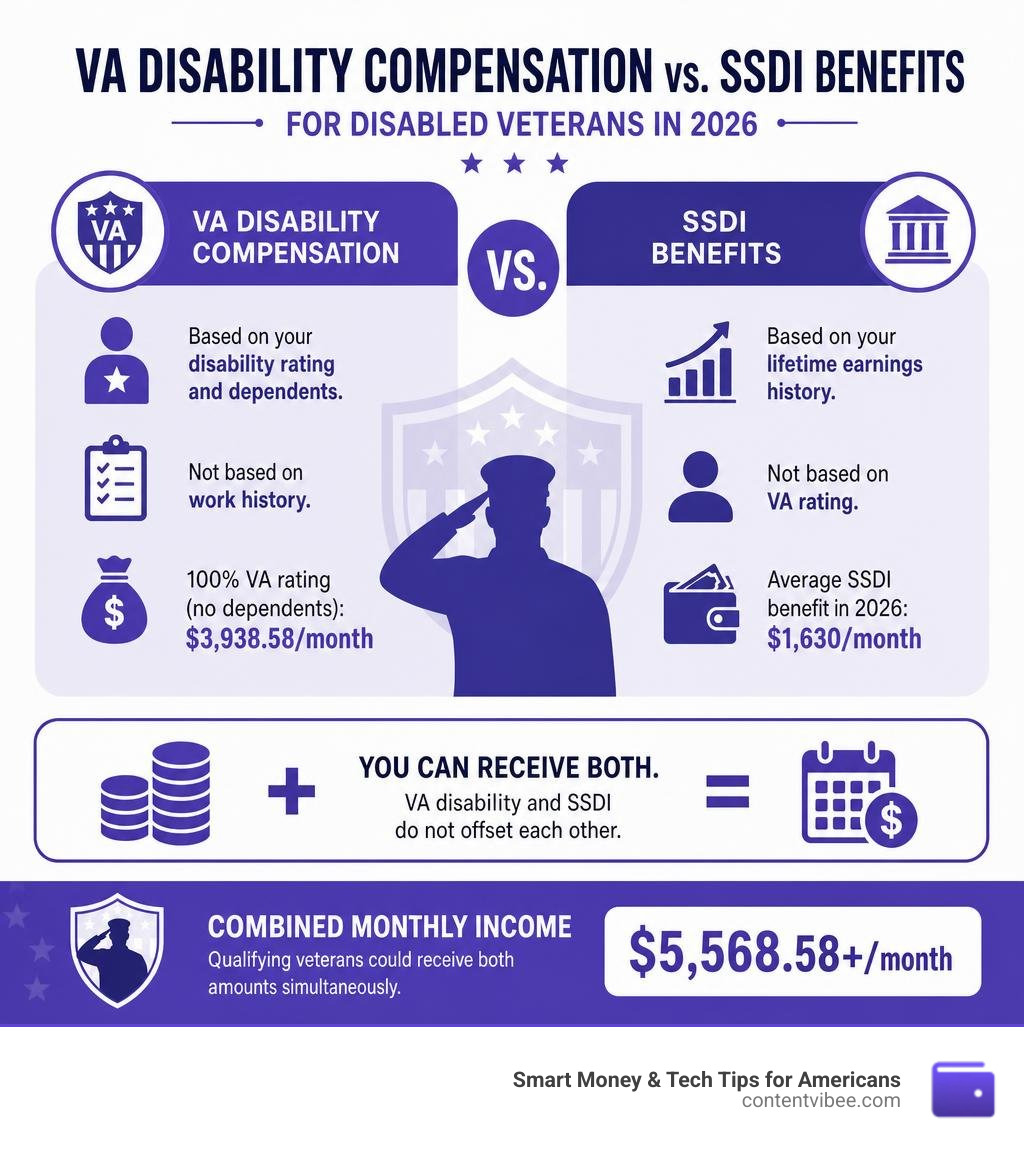
- Yes. VA disability compensation and Social Security Disability Insurance (SSDI) are two separate programs.
- They do not offset each other — receiving one does not reduce the other.
- Your SSDI amount is based on your lifetime earnings history, not your VA rating.
- Your VA compensation is based on your disability rating and dependents, not your work history.
- In 2026, the average SSDI benefit is about $1,630/month, while a 100% VA rating pays $3,938.58/month (no dependents).
- Combined, qualifying veterans could receive both amounts simultaneously.
Many veterans — and their spouses — don’t realize they may be leaving thousands of dollars on the table each year simply because they didn’t know both benefits were available at the same time.
The math can get complicated fast. SSDI uses a formula based on your indexed earnings history. VA compensation uses its own “whole person” rating system. And neither calculator is built with the other in mind.
That’s exactly why this guide exists — to help you understand both systems, use the right tools, and estimate your full picture of potential monthly income.
Understanding SSDI and VA Disability: Can You Receive Both?
The short answer is a resounding yes. You can absolutely receive both VA disability compensation and Social Security Disability Insurance (SSDI) at the same time. This is known as concurrent receipt, and unlike some other government benefits, there is no offset between the two.
This means your VA disability paycheck will not reduce your SSDI monthly payment, and your SSDI payment will not lower your VA benefits. If you qualify for both, you get the full amount of both.
To make sense of how these programs operate side-by-side, it helps to understand their fundamental differences. We have broken down the core contrasts in the table below to show you how dual eligibility works in practice. For a broader look at how the federal system manages these programs, check out A Comprehensive Guide To Social Security Benefits.
| Feature | VA Disability Compensation | Social Security Disability Insurance (SSDI) |
|---|---|---|
| Primary Authority | Department of Veterans Affairs (VA) | Social Security Administration (SSA) |
| Tax Status | 100% Tax-Free | May be taxable (depending on total household income) |
| Basis for Approval | Service-connected injury or illness | Total inability to perform Substantial Gainful Activity (SGA) |
| Payment Structure | Scaled rating from 10% to 100% | All-or-nothing (you are either disabled or you are not) |
| Calculation Method | Flat rates based on rating percentage and dependents | Based on lifetime earnings history (FICA contributions) |
| Impact on the Other | No impact / No offset | No impact / No offset |
Key Differences in Eligibility, Tax Status, and Benefit Amounts
To qualify for SSDI, you must have worked in jobs covered by Social Security and paid FICA taxes. You must also meet the SSA’s strict definition of disability, which requires that your medical condition prevents you from working and is expected to last at least one year or result in death.
VA disability, on the other hand, does not require you to be completely unable to work (unless you are applying for Individual Unemployability). It only requires that your disability was caused or worsened by your active-duty military service.
The tax status of these two benefits is another critical distinction. VA disability compensation is completely tax-exempt at both the federal and state levels. SSDI benefits, however, may be subject to federal income taxes if your combined income (including half of your SSDI benefits plus any other taxable income) exceeds certain thresholds.
When it comes to the actual cash amounts, the figures for 2026 highlight how much these two programs can boost your household budget:
- Average SSDI Benefit: Approximately $1,630 per month in 2026.
- Maximum SSDI Benefit: Up to $4,130.50 per month in 2026 for individuals with very high lifetime earnings.
- 100% VA Disability Rating Pay: $3,938.58 monthly (effective December 1, 2025, for a veteran with no dependents). This rate reflects a 2.8% COLA increase.
If you want to dive deeper into the specific VA pay structures, including how dependents alter your baseline, you can find the complete breakdown using the 2026 VA Disability Calculator With Pay Charts – Veterans United.
How SSDI Benefits Are Calculated for Veterans
Unlike VA benefits, which are determined by a medical rating schedule, SSDI is an earned insurance benefit. The SSA calculates your monthly check using your lifetime earnings history.
To be eligible for SSDI, you must first accumulate enough “work credits.” You earn credits when you work and pay Social Security taxes. You can earn up to four credits per year. Generally, you need 40 credits, 20 of which must have been earned in the 10 years ending with the year you became disabled. However, younger veterans may qualify with fewer credits.
Once you meet the work credit threshold, the SSA uses a two-step mathematical formula to determine your monthly payment:
- Average Indexed Monthly Earnings (AIME): The SSA takes up to 35 of your highest-earning years, adjusts them for inflation (indexing), and calculates your average monthly earnings over that period.
- Primary Insurance Amount (PIA): The SSA applies a multi-tiered formula to your AIME using specific percentages (called “bend points”). This formula is highly progressive, meaning it replaces a larger percentage of lower-income earnings than higher-income earnings.
Because the math can be a bit overwhelming, we suggest taking a look at our guide on how to Estimate Your Monthly Retirement Benefits In 5 Easy Steps to get a clearer picture of how the SSA tracks and values your work history.
The Impact of Dependents, Age, and Earnings on Your SSDI Estimate
While your primary SSDI payment is based entirely on your personal earnings record, your family status can also increase your total household benefit. If you are approved for SSDI, your eligible dependents—such as your spouse or minor children—may qualify for auxiliary benefits.
- Spouse Benefits: Your spouse may receive up to 50% of your PIA if they are caring for your child who is under age 16 or disabled, or if your spouse is at least 62 years old.
- Child Benefits: Your unmarried children under age 18 (or up to 19 if still in high school) may each receive up to 75% of your PIA.
However, the SSA limits the total amount a family can receive. The family maximum cap typically restricts total family benefits to between 150% and 175% of your individual PIA. If the total of all family benefits exceeds this cap, the dependents’ payments are reduced proportionally (your personal benefit remains untouched).
Additionally, your ongoing earnings can impact your eligibility. To receive SSDI, you cannot engage in what the SSA calls Substantial Gainful Activity (SGA). In 2026, the SGA limit is $1,690 per month for non-blind individuals. If you earn more than this amount from active employment, the SSA will generally find that you are not disabled, regardless of your medical conditions.
How to Use a Disabled Veteran Social Security Calculator to Estimate Your Benefits

Now that you know you can receive both benefits, the next logical step is to calculate what your combined monthly income might look like. Because the SSA and the VA use entirely different systems, standard calculators will only show you one side of the coin.
To get an accurate estimate of your SSDI payments, you can use specialized tools like the SSDI Calculator 2026 | Estimate Your Disability Payments – Allsup. This tool allows you to plug in your work history and age to find a reliable baseline for your Social Security benefit.
Why You Need a Specialized Disabled Veteran Social Security Calculator
Standard calculators often fail veterans because they don’t account for the unique rules of “VA Math” or how military-specific factors interact with the Social Security system.
When calculating VA disability, the VA does not simply add your ratings together. For example, if you have a 50% rating for PTSD and a 30% rating for a back injury, your combined rating is not 80%. Instead, the VA uses the Whole Person Theory.
Under this method:
- You start as 100% efficient (healthy).
- The highest rating is applied first. A 50% rating leaves you 50% efficient.
- The next rating (30%) is applied only to that remaining 50% efficiency. 30% of 50 is 15%.
- Your combined rating is 50% + 15% = 65%, which the VA rounds to the nearest 10%, giving you a final rating of 70%.
Additionally, if you have injuries affecting paired extremities (like both knees or both wrists), the VA applies a bilateral factor, adding a 10% bonus to those specific ratings before combining them with the rest.
Understanding this math is crucial because your final VA payout is determined strictly by these rounded percentages. To see how these complex calculations work in real-time, you can use the interactive 2026 VA Disability Calculator & VA Math Breakdown or explore the rating combinations on the VA Disability Calculator 2026 — Combine Ratings + See Pay. If you need to cross-reference your findings with a legal perspective, the VA Disability Calculator – 2026 Estimates | InjuredVeterans.com is another excellent resource.
Step-by-Step Guide to Using a Disabled Veteran Social Security Calculator
To get the most accurate estimate of your combined benefits, follow this simple process:
- Gather Your Documents: Grab your most recent VA rating decision letter and log into your personal account on the SSA website to download your Social Security Statement.
- Estimate Your SSDI: Enter your birth year, your average annual income over the last 10 to 35 years, and your estimated disability onset date into an official tool like the Benefit Calculators | SSA.
- Calculate Your VA Pay: Input your individual disability ratings, bilateral details, and dependent information into a VA calculator to find your exact tax-free monthly compensation.
- Combine and Plan: Add your estimated SSDI amount to your VA compensation. Remember to factor in potential tax obligations on the SSDI portion, while keeping the VA portion completely tax-free.
For more specialized financial planning options, you can read our reviews of the Best Free Social Security Calculator Options Your No Cost Retirement Roadmap or learn how to optimize household income with the Do The Math Top Social Security Calculators For Married Couples.
Frequently Asked Questions about Veteran Social Security Benefits
Navigating the intersection of military benefits and federal retirement or disability systems can raise a lot of questions. We have compiled answers to the most common queries veterans have when planning their financial futures.
Does a 100% VA disability rating guarantee SSDI approval?
No, it does not. A 100% service-connected disability rating from the VA does not guarantee that you will be approved for SSDI. The two agencies use entirely different legal and medical criteria to define “disability.”
However, there is some good news. If you have a 100% P&T (Permanent and Total) rating from the VA, the SSA will expedite the processing of your SSDI application. While this high-priority status speeds up the timeline, you must still provide sufficient medical evidence to meet the SSA’s strict definition of total disability. That approximately two-thirds of all initial SSDI applications are denied, making strong medical documentation vital.
How does the VA bilateral factor affect my overall rating?
The bilateral factor is a 10% bonus added to your combined rating when you have service-connected disabilities affecting both sides of your body (such as both shoulders, both hips, or both ankles).
The VA calculates this by combining the ratings for the bilateral disabilities first, adding 10% of that combined value to the total, and then combining that sum with any other non-bilateral disabilities. This boost can easily push a veteran into a higher payment bracket.
Can I work while receiving both VA disability and SSDI?
Yes, but with strict limitations.
For VA Disability: You can work and earn an unlimited amount of money unless you are receiving TDIU (Total Disability Individual Unemployability). TDIU pays veterans at the 100% rate because their service-connected disabilities prevent them from maintaining “substantially gainful employment.” If you have TDIU, you cannot earn more than the federal poverty level.
For SSDI: You can work, but your earnings must remain below the Substantial Gainful Activity (SGA) limit of $1,690 per month (in 2026). The SSA also offers a Trial Work Period (TWP), which allows you to test your ability to work for up to nine months within a rolling five-year window. During the TWP, you can earn an unlimited amount without losing your SSDI benefits.
Conclusion
Securing your financial future as a disabled veteran doesn’t have to be a guessing game. By taking advantage of both VA disability and SSDI, you can build a stable, reliable income stream that honors your service and protects your family.
At Smart Money & Tech Tips for Americans, we are dedicated to helping U.S. consumers navigate the complex intersections of personal finance, government benefits, and modern technology. Don’t let confusing math or bureaucratic jargon keep you from getting what you have earned.
To take the next step in planning your financial roadmap, check out our How Much Social Security Will I Get Calculator to start mapping out your monthly cash flow with confidence.


