


Why the Margin Formula Matters for Your Financial Health
The margin formula is one of the most important calculations any business owner — or anyone managing money — needs to understand. Yet it’s one of the most commonly confused concepts in finance.
Here’s the quick answer:
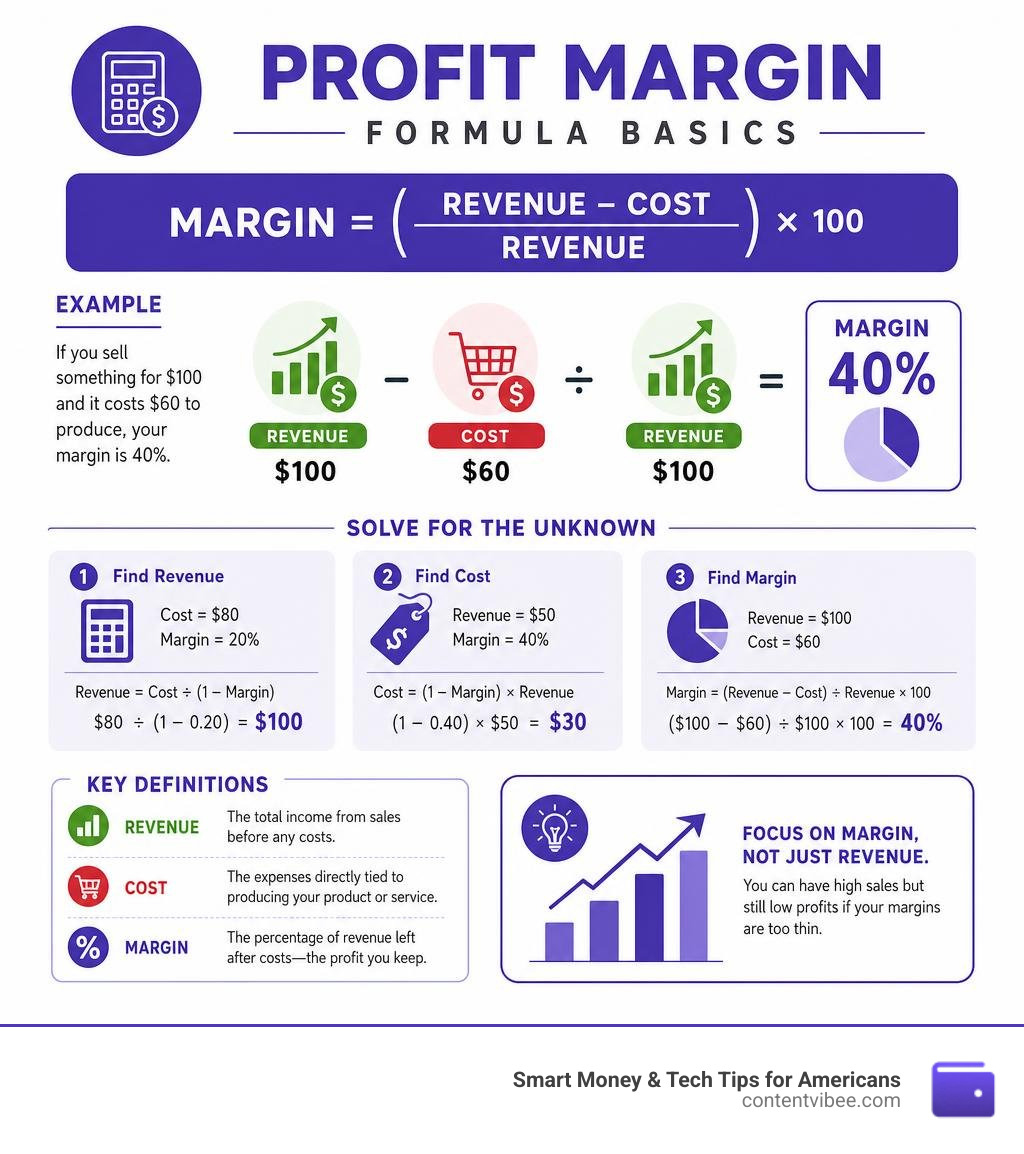
Profit Margin Formula:
Margin = ((Revenue − Cost) ÷ Revenue) × 100
For example, if you sell something for $100 and it costs you $60 to produce, your margin is 40%.
| What You Know | What You Calculate |
|---|---|
| Revenue = $100, Cost = $60 | Margin = (($100 − $60) ÷ $100) × 100 = 40% |
| Cost = $80, Margin = 20% | Revenue = $80 ÷ (1 − 0.20) = $100 |
| Revenue = $50, Margin = 40% | Cost = (1 − 0.40) × $50 = $30 |
It sounds simple. But here’s where many people go wrong — they confuse margin with markup, or they track revenue closely while ignoring whether their margins are actually healthy.
As one common observation in finance puts it: you could be selling like crazy and still face financial struggles if your margins are off.
Whether you run a small business, manage a household budget, or are planning for retirement and want to understand how companies you invest in actually make money — knowing how to read and calculate a margin is a foundational skill.
Understanding the margin formula and How It Works
To grasp how the margin formula works, we first need to break down its core components. At its heart, profit margin is a relative metric. It does not tell you how many dollars you have in the bank; instead, it tells you what percentage of every dollar earned is kept as profit after costs are paid.
Let’s look at the basic building blocks:
- Revenue (or Sales): This is the total amount of money coming into your business from selling goods or services. It is often referred to as the “top line” of your income statement.
- Cost of Goods Sold (COGS): This represents the direct costs associated with producing or purchasing the products or services you sell. For a retail business, this is what you paid the wholesaler for your inventory. For a manufacturer, it includes raw materials and direct labor.
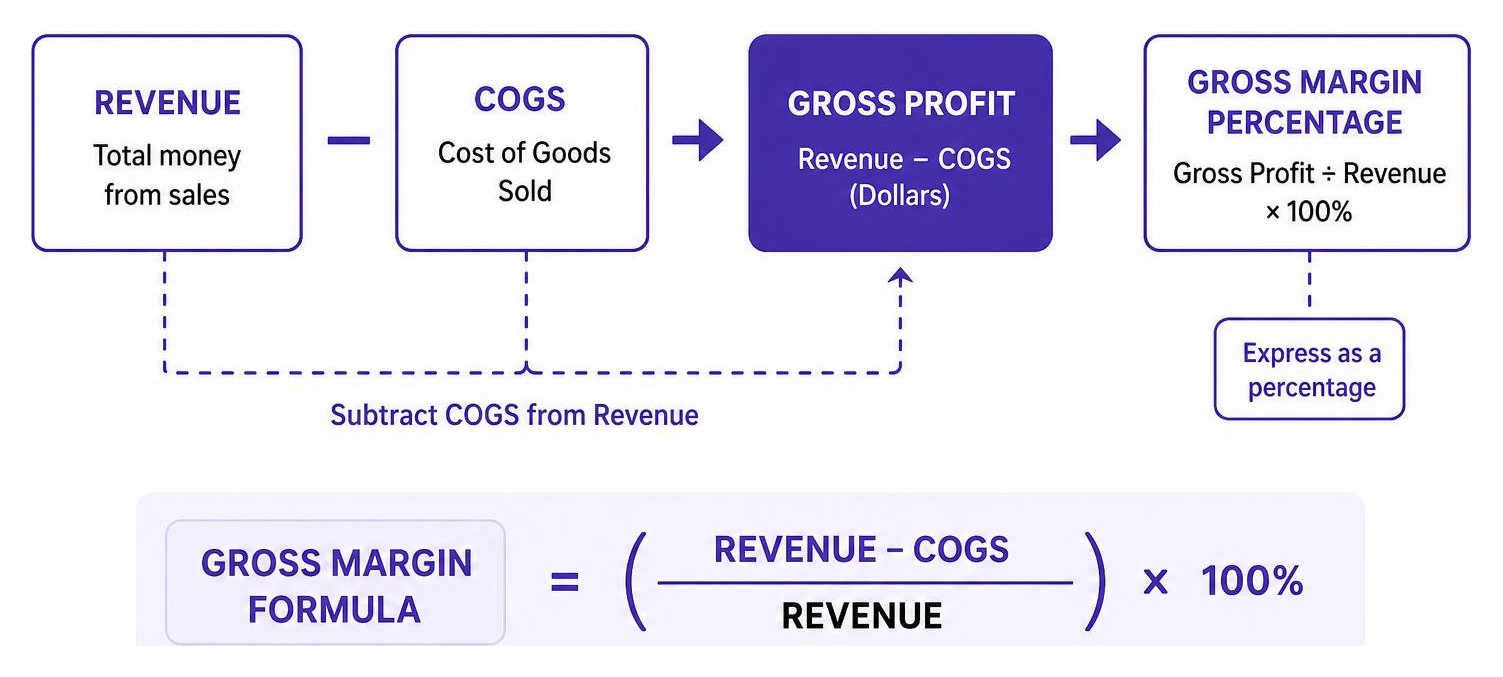
- Gross Profit: This is the absolute dollar amount left over after you subtract COGS from your revenue (Gross Profit = Revenue − COGS).
The Gross margin is simply this gross profit expressed as a percentage of your total revenue.
Why do we use a percentage instead of just looking at the cash profit? Because percentages allow for comparison. If Business A makes $50,000 in profit on $100,000 of revenue, and Business B makes $50,000 in profit on $500,000 of revenue, they look identical on paper if we only look at absolute profit. However, Business A has a 50% margin, while Business B has a 10% margin. Business A is far more efficient and has a much higher margin of safety if costs rise or sales decline.
Step-by-Step Guide to the Gross margin formula
When you want to calculate the gross profit margin manually, you can follow these simple, structured steps:
- Identify your total revenue: Find the total sales for the period or the exact selling price of a single unit.
- Determine your Cost of Goods Sold (COGS): Calculate the direct costs of making or buying that product or delivering that service.
- Calculate the Gross Profit: Subtract the COGS from your revenue.
- Apply the margin formula: Divide the Gross Profit by the Revenue.
- Convert to a percentage: Multiply the resulting decimal by 100.
For a single item, we can look at this from a “unit” perspective:
- Unit Margin = Selling Price per Unit − Cost per Unit
- Margin Percentage = (Unit Margin ÷ Selling Price per Unit) × 100
Let’s look at a practical example. Suppose we run an e-commerce shop selling custom leather wallets. We sell each wallet for $50. The leather, thread, and direct labor to assemble one wallet cost us $20.
Using our steps:
- Revenue = $50
- COGS = $20
- Gross Profit = $50 − $20 = $30
- Margin calculation: ($30 ÷ $50) × 100 = 60%
This means for every dollar we collect from a customer, we keep $0.60 to help cover our other operating costs (like website hosting, advertising, and packaging) and to keep as net profit. For more details on tracking direct costs versus operating overhead, you can read the comprehensive Gross Profit Margin Guide from Salesforce.
How to Calculate Profit Margin in Excel
If you are managing a larger product catalog or tracking monthly business performance, doing these calculations by hand is tedious. Excel is the perfect tool for automating this.
To set up a basic margin sheet in Excel, follow this layout:
- In cell A1, type the label: Revenue
- In cell B1, type the label: COGS
- In cell C1, type the label: Gross Profit
- In cell D1, type the label: Profit Margin
Now, input your data:
- In cell A2, enter your revenue (e.g., 500)
- In cell B2, enter your cost (e.g., 300)
Next, enter the formulas:
- In cell C2, type: =A2-B2 (This calculates your absolute profit)
- In cell D2, type: =C2/A2 (This divides the profit by your total revenue)
To make cell D2 look like a proper margin, select the cell, go to the Home tab, and click the % (Percent Style) button. Excel will automatically multiply the decimal by 100 and display it as 40%.
If you want to dive deeper into spreadsheet optimization and find out how to easily integrate these calculations into your daily workflows without any manual guesswork, check out our guide on how to stop eyeballing it excel add margin formulas made easy.
Margin vs. Markup: Understanding the Critical Differences
Many business leaders use the terms “margin” and “markup” interchangeably. This is a costly mistake. While both metrics use the exact same inputs (your cost and your selling price), they tell entirely different financial stories because they use different denominators.
- Margin is calculated as a percentage of the selling price. It looks forward at your top-line revenue.
- Markup is calculated as a percentage of the cost price. It looks backward at what you paid.
Here is the mathematical difference:
- Margin Formula: (Selling Price − Cost) ÷ Selling Price
- Markup Formula: (Selling Price − Cost) ÷ Cost
Let’s see this in action with a side-by-side comparison. If you buy a product for $50 and sell it for $100, your profit is $50.
| Metric | Calculation | Result |
|---|---|---|
| Margin | $50 Profit ÷ $100 Selling Price | 50% |
| Markup | $50 Profit ÷ $50 Cost Price | 100% |
If you confuse these two, you could severely underprice your products. For example, if you know you need a 40% margin to keep your business profitable, and you mistakenly apply a 40% markup to a product that costs you $60, you will set the price at $84 ($60 × 1.40).
However, if we run the margin formula on that $84 price: (($84 − $60) ÷ $84) × 100 = 28.5%
You wanted a 40% margin, but you ended up with 28.5% because you applied a markup instead. This is called a phantom loss — where your actual profitability is lower than what you assumed because of a simple math error. To avoid this, many retailers use the “Rule of 3” pricing strategy, where the selling price is set at three times the cost price to ensure a healthy margin buffer that accounts for unexpected platform fees, shipping costs, or advertising expenses.
Converting Between Markup and the margin formula
If your suppliers talk in markups but your accountant talks in margins, you need to know how to convert between the two. You don’t have to guess. You can use these simple mathematical conversion formulas:
To convert Markup to Margin:
Margin = Markup ÷ (1 + Markup)
For example, if your markup is 50% (0.50): 0.50 ÷ (1 + 0.50) = 0.50 ÷ 1.50 = 0.3333 (or 33.33% Margin)
To convert Margin to Markup:
Markup = Margin ÷ (1 − Margin)
For example, if your target margin is 25% (0.25): 0.25 ÷ (1 − 0.25) = 0.25 ÷ 0.75 = 0.3333 (or 33.33% Markup)
To save yourself the manual calculations and prevent pricing mistakes, you can use our interactive tools/margin calculator/markup to margin calculator to instantly convert your numbers.
Gross Margin vs. Net Margin: What Business Owners Need to Know
While gross margin is incredibly useful for evaluating the profitability of a specific product, it doesn’t represent the ultimate bottom line of your company. For that, you must look at Net Margin.
The primary difference lies in which expenses are included in the calculation:
- Gross Margin: Only subtracts the direct costs of production (COGS) from your revenue. It ignores rent, marketing, payroll, utilities, insurance, taxes, and interest.
- Net Margin: Subtracts all business expenses from your revenue. This includes your operating overhead, administrative costs, marketing budgets, software subscriptions, taxes, and interest payments.
For instance, if your business generates $100,000 in quarterly revenue with a COGS of $25,000, your gross profit is $75,000 (a 75% gross margin). But if you also spent $25,000 on office rent and employee payroll, and another $25,000 on taxes and marketing, your net profit is $25,000.
Your Net Margin would be: ($25,000 ÷ $100,000) × 100 = 25%
A high gross margin is fantastic, but if your operating overhead is too high, your net margin will shrink to zero, leaving the business in a fragile financial position. To understand how to manage these layers of expenses effectively without hurting your day-to-day operations, read our deep dive on how gross margin cost demystified for small businesses.
Industry Benchmarks: What is a Good Profit Margin in 2026?
What constitutes a “good” profit margin? There is no single magic number. A profit margin that would spell disaster for a software company might represent outstanding performance for a grocery store.
Across all US industries, the average gross margin sits around 39%. However, the variance between sectors is massive:

When we look at specific sectors in 2026, the contrast is stark:
- Software Systems & Applications: Average gross margins reach 72.38% (with entertainment software at 65.38%). Since software has near-zero replication costs, these companies retain the vast majority of their sales revenue as gross profit.
- Retail Real Estate Investment Trusts (REITs): Average gross profit margins of 77.48%.
- Financial Services (Non-Bank & Insurance): Average gross margins of 68.37%.
- Healthcare Products: Average gross margins of 56.04%.
- General Retail: Average gross margins around 32.22%.
- Food Wholesalers: Average gross margins of 15.36%.
- Auto & Truck Manufacturing: Average gross margins of 11.11%.
- Oilfield Services: Average gross margins of 10.71%.
For a broader look at historical averages and how these ratios are used by analysts to evaluate market health, you can review the Profit margin statistics compiled on Wikipedia.
Retail, Manufacturing, and Software Margin Standards
Why are these industry standards so different? It comes down to their business models:
- Retail: Retailers typically work with thin margins but compensate with high transaction volume. A grocery store or food wholesaler might operate on a 10% to 15% gross margin, meaning they must constantly turn over their inventory to remain profitable.
- Manufacturing: Manufacturers have heavy physical constraints. They must purchase raw materials, maintain expensive machinery, and employ assembly labor. This limits their gross margins, which often hover between 10% and 35%.
- Software and Services: Software companies and service-based businesses have high upfront development or labor costs, but very low variable costs per unit sold. This allows them to achieve gross margins above 70%.
For new businesses, trying to achieve a software-level margin in a retail environment is mathematically impossible. Instead, focus on sustainable growth and consistency. A net margin of 5% is generally considered poor across most sectors, 10% is okay/average, and 20% or higher is considered a very healthy, good margin that supports reinvestment.
Frequently Asked Questions about Profit Margins
Can a profit margin be over 100%?
No, a profit margin cannot exceed 100% (unless your production costs are somehow negative, which is mathematically and practically impossible in standard business). Because profit margin is a measure of how much profit is contained within your revenue, the maximum possible profit is equal to your total revenue (if your costs are $0), which results in a 100% margin.
However, markup can easily exceed 100%. For example, luxury goods, designer clothing, or restaurant drinks often have markups of 500% or even 1,000% of their base cost.
What is a margin call in stock trading?
In investing and stock trading, “margin” has a different definition. It refers to borrowed funds used to buy securities.
A margin call occurs when the total value of your trading account falls below the broker’s maintenance margin requirement (which is typically set at 25% under Federal Reserve Regulation T). If your investments decline in value and your equity drops below this threshold, your broker will issue a margin call, demanding that you immediately deposit more cash or sell off assets to pay down the loan. If you fail to do so, the broker has the right to liquidate your positions without your approval.
To calculate your exact risk threshold, you can use the formula and calculator provided in the Margin Call Price Formula and Calculator resource.
How do I calculate a 20% profit margin?
To price your products to achieve a target 20% profit margin, you cannot simply add 20% to your cost. Instead, you must use the selling price formula derived from the margin formula:
Selling Price = Cost ÷ (1 − Target Margin)
To calculate a 20% margin:
- Convert 20% to a decimal (0.20).
- Subtract it from 1 (1 − 0.20 = 0.80).
- Divide your product cost by 0.80.
If your product cost is $80: $80 ÷ 0.80 = $100 Selling Price
You can easily run these calculations for any target margin using our free tools/margin calculator/omni margin calculator.
Conclusion
Understanding the margin formula is more than an academic exercise — it is a critical requirement for building a stable financial future. At ContentVibee, we believe that true financial literacy is the key to making smart decisions, whether you are managing a growing business, optimizing your personal investments, or planning your retirement under complex guidelines like the SECURE Act 2.0.
By keeping a close eye on your gross and net margins, you can protect your cash flow, price your offerings with confidence, and avoid the common traps that sink otherwise busy businesses.
Ready to stop guessing and start multiplying your profits? Calculate your margins easily with our free Margin Calculator and make sure your pricing strategy is built to last. If you are an industry professional looking to optimize your client billing, don’t miss our specialized guide on the margin calculator for accountants stop undercharging and start multiplying your profits.


