


The Age That Changes Everything About Your Retirement Money
Understanding 59 1/2 retirement withdrawal rules is one of the most important steps you can take before leaving the workforce. At this exact age — 59 years and 6 months — the IRS lifts the 10% early withdrawal penalty on most retirement accounts, including 401(k)s, traditional IRAs, and 403(b)s.
Here’s what you need to know at a glance:
- Before age 59½: Withdrawals from tax-deferred accounts are subject to ordinary income tax plus a 10% penalty in most cases
- At age 59½ and older: The 10% penalty disappears — but you still owe ordinary income tax on traditional account withdrawals
- Roth IRAs: Contributions can be withdrawn anytime penalty-free; earnings require age 59½ AND a 5-year holding period
- RMDs begin at age 73 (or 75 if you were born in 1960 or later) — not at 59½
- Exceptions exist that let some people avoid the 10% penalty even before 59½ (disability, first-time home purchase, medical expenses, and more)
The half-year matters more than most people realize. A person who is 59 years and 5 months old faces a very different tax situation than someone who just turned 59½. That six-month gap can cost — or save — thousands of dollars in penalties, depending on the decisions made in that window.
This guide walks you through the rules, the exceptions, the strategies, and the planning steps that matter most as you approach or cross this milestone.
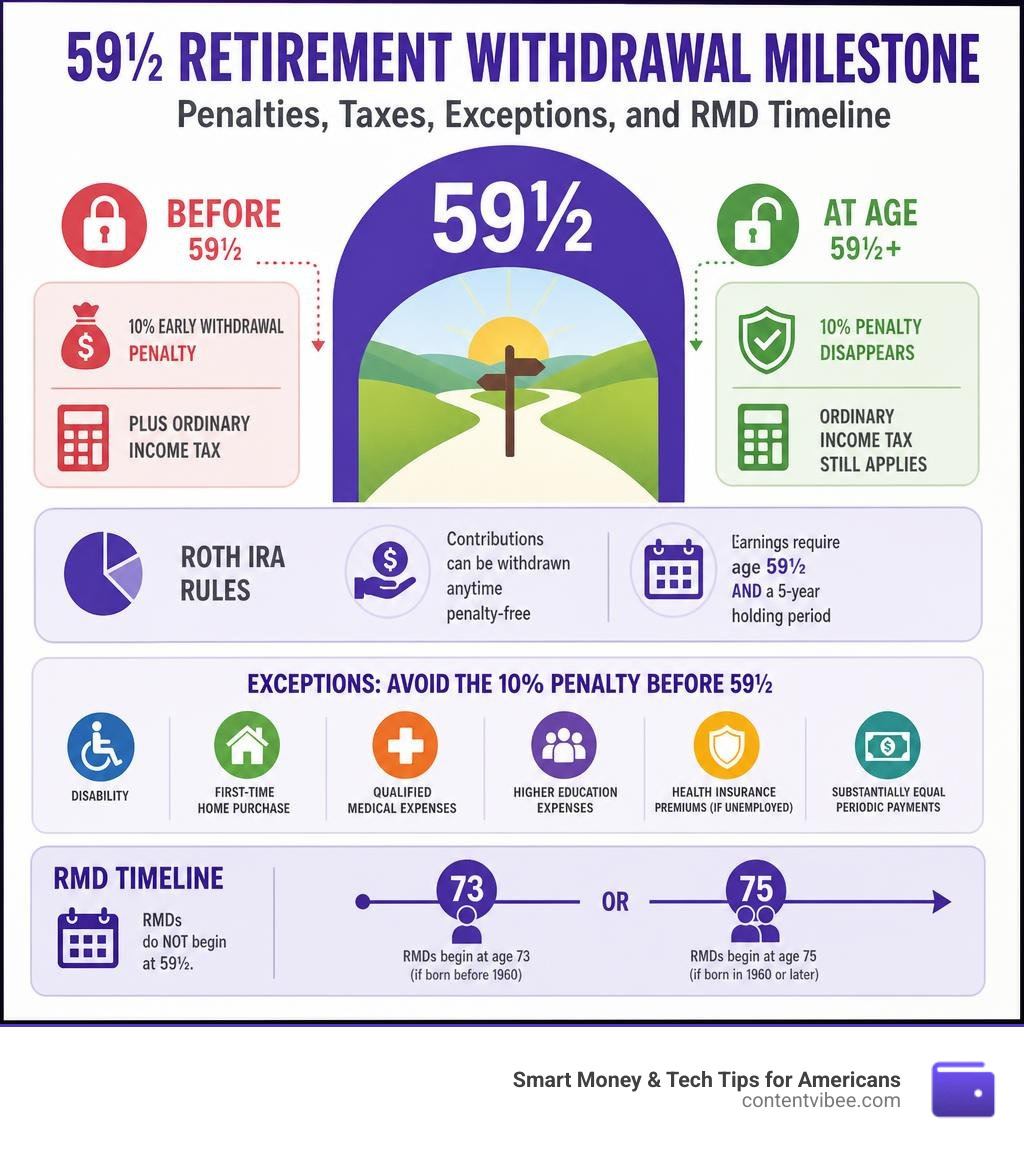
59 1 2 retirement withdrawal terms at a glance:
Understanding the 59 1 2 retirement withdrawal Rules and Why They Exist
Why did the IRS choose such a specific, quirky number as 59½ instead of a round number like 60? In tax law, half-years allow for precise planning, but the core reason for the rule is simple: to act as a psychological and financial speed bump.
The federal government grants generous tax breaks to encourage Americans to save for their golden years. Traditional retirement accounts allow your investments to grow tax-deferred, meaning you don’t pay taxes on capital gains, dividends, or interest along the way. In exchange for these tax benefits, the IRS expects you to keep those funds locked away until you actually reach retirement age.
The IRS baseline for the earliest a person can withdraw from a qualified retirement plan without penalties is age 59½. If you tap into these tax-deferred accounts early, the government clawbacks some of those benefits by imposing a 10% early withdrawal penalty on top of the ordinary income taxes you already owe. To understand how the mechanics of this milestone affect your retirement nest egg, you can read more about What’s the 59½ rule for early retirement savings withdrawals?
Tax Consequences Before and After Age 59 ½
The biggest misconception about reaching age 59½ is that your withdrawals suddenly become tax-free. Let us clear this up: the tax bill never disappears; only the penalty does.
When you withdraw money from a traditional 401(k), 403(b), or traditional IRA, every dollar is treated as ordinary income. The IRS taxes these distributions at your current marginal income tax rate.
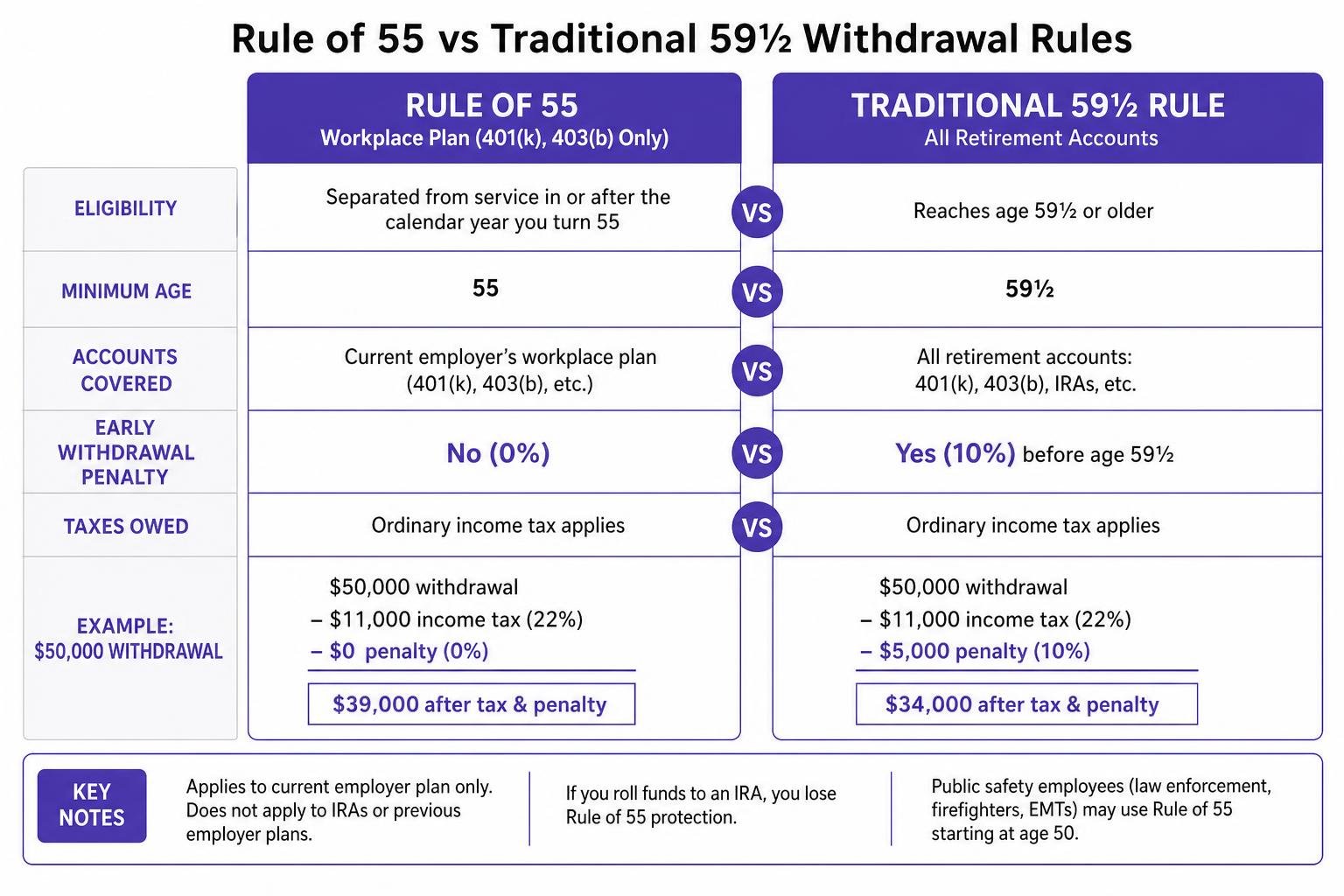
Let’s look at a quick comparison of how a $50,000 withdrawal from a traditional 401(k) is treated before and after this milestone, assuming a 22% federal tax bracket:
- At Age 58: You will owe $11,000 in federal income taxes (22%) plus a $5,000 early withdrawal penalty (10%), leaving you with only $34,000.
- At Age 59½: You will owe the same $11,000 in income taxes, but the penalty drops to $0, leaving you with $39,000.
For a deeper dive into how these brackets and distribution rules work across different accounts, explore our In Depth Guide To Retirement Withdrawal Rules.
Navigating Exceptions to the 10% Early Withdrawal Penalty
While the IRS is strict about the 59½ milestone, they are not entirely heartless. They recognize that life happens — medical emergencies, job losses, and natural disasters can strike when least expected. Because of this, several statutory exceptions exist that allow you to access your retirement funds early without suffering the 10% penalty.
The landmark SECURE 2.0 Act introduced several new exceptions designed to make retirement accounts more flexible. For instance, you can now take a penalty-free distribution of up to $1,000 per calendar year for emergency personal expenses. Additionally, victims of domestic abuse can withdraw up to the lesser of $10,000 or 50% of their account balance penalty-free.
To review the full, comprehensive list of federal exceptions and verify if your situation qualifies, check out the Retirement topics – Exceptions to tax on early distributions – IRS reference page.
How to Avoid Penalties on a 59 1 2 retirement withdrawal Using Exceptions
If you need to make a 59 1 2 retirement withdrawal before actually hitting your half-birthday, you may qualify under one of these traditional, highly utilized exceptions:
- First-Time Home Purchase: You can withdraw up to a lifetime limit of $10,000 from an IRA to help purchase or build a primary residence for yourself, your children, or your grandchildren.
- Qualified Higher Education Expenses: You can take penalty-free distributions from an IRA to pay for tuition, fees, books, and room and board at an eligible post-secondary school for yourself, your spouse, or your dependents.
- Unreimbursed Medical Expenses: If you have medical bills that exceed 7.5% of your Adjusted Gross Income (AGI), you can withdraw funds penalty-free to cover them.
- Disaster Recovery: If you live in a federally declared disaster area, you may withdraw up to $22,000 penalty-free to recover from physical or financial damage.
That while these exceptions waive the 10% penalty, you will still owe ordinary income tax on the distributed amounts.
The Rule of 55 vs. Traditional Retirement Rules
For those who want to retire early, the “Rule of 55” is one of the most powerful tools in the financial planning shed. This IRS provision allows you to take penalty-free distributions from your workplace retirement plan — like a 401(k) or 403(b) — if you separate from service (whether via layoff, firing, or voluntary retirement) in or after the calendar year you turn 55.
There are a few crucial rules to keep in mind:
- Current Employer Only: The Rule of 55 only applies to the retirement plan of the employer you just left. If you have old 401(k) plans sitting with previous employers, you cannot access them penalty-free under this rule unless you rolled them into your current employer’s plan before separating.
- No IRAs: This rule does not apply to traditional or Roth IRAs. If you roll your 401(k) into an IRA immediately after leaving your job at age 55, you permanently lose the Rule of 55 protection for those funds.
- Public Safety Exception: Qualified public safety employees (such as law enforcement officers, firefighters, and EMTs) can utilize this exception starting at age 50.
To learn more about the mechanics of this early retirement loophole, read our guide on Retirement Topics Exceptions To Tax On Early Distributions At 55.
401(k) Loans, Hardship Withdrawals, and Qualified Distributions
If you are still employed and need to access your 401(k) funds before age 59½, you generally have three pathways, each with its own set of rules:
- 401(k) Loans: Most employer plans allow you to borrow up to 50% of your vested balance or $50,000 (whichever is less). You pay the interest back to your own account, and as long as you repay it within five years, there are no taxes or penalties. However, if you leave your job, you may have to repay the balance immediately or face taxes and penalties on the unpaid amount.
- Hardship Withdrawals: These are distributions taken because of an “immediate and heavy financial need” (like preventing eviction or paying funeral costs). Hardship withdrawals are taxable and still subject to the 10% penalty unless you meet a specific IRS exception.
- Qualified Distributions: These are standard, penalty-free distributions taken after you reach age 59½ or qualify through disability.
Before you make a permanent decision that could derail your compounding interest, utilize our interactive Before You Cash Out Use This 401K Withdrawal Calculator First.
Strategic Income Bridging and Penalty-Free Access Before 59 ½
If your goal is to retire in your early or mid-50s, you need a plan to bridge the financial gap between your retirement date and age 59½. One of the most structured ways to do this is through IRS Section 72(t).
Under Section 72(t), you can set up Substantially Equal Periodic Payments (SEPP). This strategy allows you to take penalty-free distributions from an IRA at any age. The catch is that you must calculate these payments using one of three IRS-approved methods, and you must commit to taking these exact payments for at least five years or until you turn 59½, whichever is longer. If you break the schedule or modify the payments by even a dollar, the IRS retroactively applies the 10% penalty to all prior distributions.
Because of this extreme inflexibility, many early retirees prefer to build a bridge using taxable brokerage accounts first. Since brokerage accounts hold post-tax money, you can withdraw your principal at any time, and your investment gains are taxed at favorable long-term capital gains rates (which can be as low as 0% depending on your income). To understand how to balance these accounts, refer to Understanding the 59 1/2 Rule – Annuity.org.
Roth Conversions and the 5-Year Rule for a 59 1 2 retirement withdrawal
Another excellent way to access retirement funds early is by building a Roth conversion ladder.
When you convert traditional IRA funds into a Roth IRA, you pay ordinary income taxes on the converted amount in the year of the conversion. However, once those funds are in the Roth IRA, the converted principal can be withdrawn tax-free and penalty-free after a five-year waiting period.
By converting a set amount of money each year, you create a “ladder” of penalty-free income that begins paying out five years down the road.
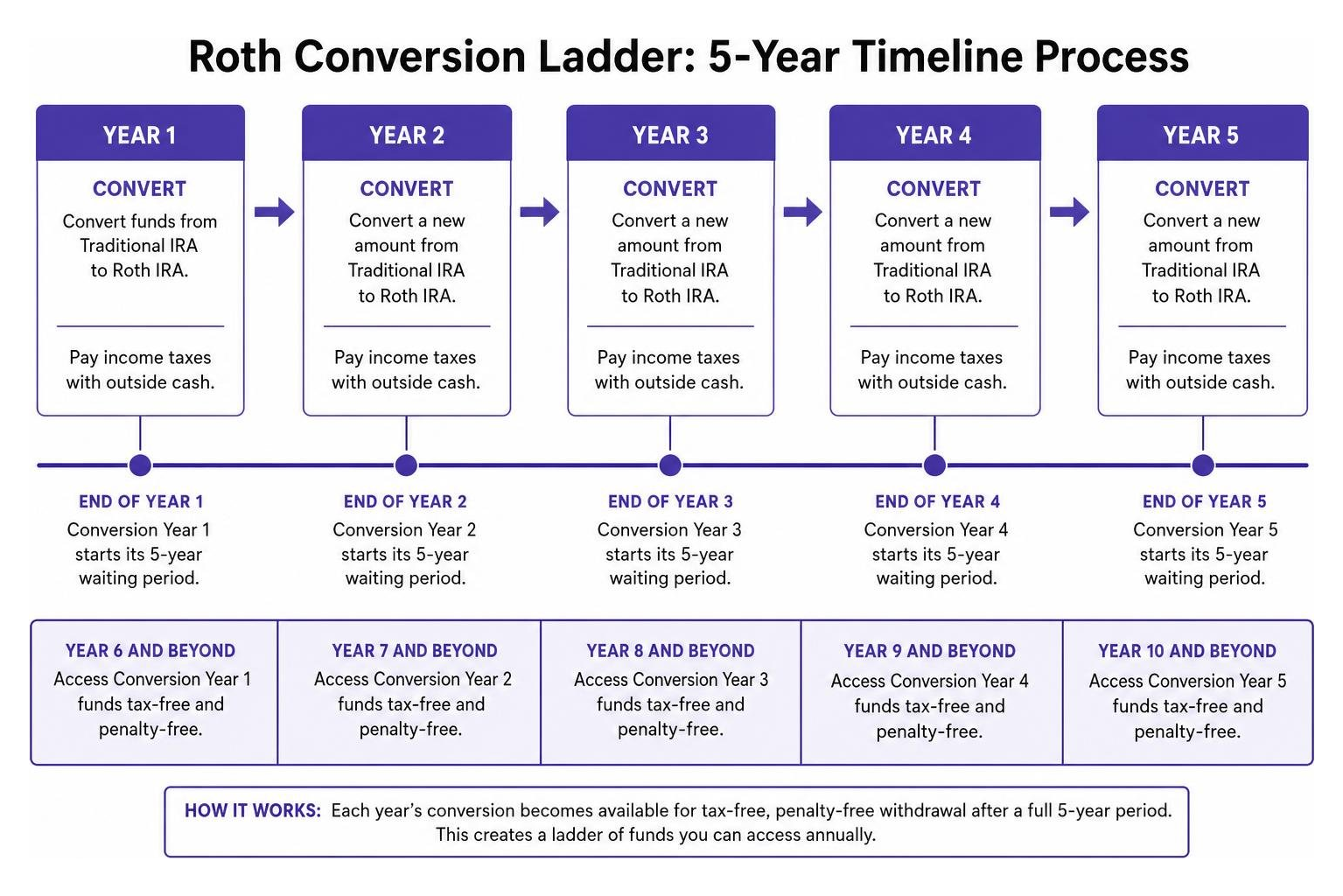
Pro-tip: Always pay the conversion taxes using cash held in a taxable brokerage or bank account. If you use a portion of the converted retirement funds to pay the tax bill, that portion will trigger the 10% early withdrawal penalty if you are under 59½.
To learn how to execute this strategy smoothly, read our guide on How To Withdraw From Your 401K After 59 %C2%Bd Without Crying.
Bridging the Gap to Social Security and Medicare
Retiring at or near age 59 means you still have several years to wait before other safety nets kick in:
- Social Security: The earliest you can claim benefits is age 62, but doing so permanently reduces your monthly payout by about 30% compared to waiting for your Full Retirement Age (FRA).
- Medicare: You generally do not qualify for Medicare until age 65.
To bridge the healthcare gap, you can look into COBRA (which can extend your employer coverage for up to 18 months), buy a plan on the Affordable Care Act (ACA) marketplace, or utilize Health Savings Account (HSA) funds.
If you have an HSA, you can make tax-free withdrawals for Previously Unreimbursed Qualified Medical Expenses (often abbreviated as HSA PUQME) to pay for healthcare costs. Because there is no deadline on when you must reimburse yourself, you can use medical receipts from years ago to pull tax-free cash out of your HSA today.
Deciding Between a 401(k) and an IRA Before Age 59 ½
As you approach age 59, you might wonder whether you should leave your money in your employer’s 401(k) plan or roll it over into an Individual Retirement Account (IRA). This choice has significant implications for your withdrawal flexibility.
| Feature | Employer 401(k) | Individual Retirement Account (IRA) |
|---|---|---|
| Penalty-Free Access Age | 59½ (or age 55 under the Rule of 55) | 59½ |
| In-Service Withdrawals | Allowed only if the plan document permits | N/A (You control the account) |
| Investment Options | Limited to the plan’s specific mutual fund menu | Virtually unlimited (stocks, bonds, ETFs) |
| Roth Conversions | Generally not supported while actively employed | Fully supported at any time |
| 72(t) SEPP Payments | Highly difficult to execute | Standard and widely supported |
If you plan to utilize the Rule of 55, keeping your money in your current 401(k) is essential. However, if you have already reached age 59½, executing a trustee-to-trustee rollover to an IRA is often the smarter move. It gives you complete control over your investments, lower administrative fees, and the ability to easily execute strategic Roth conversions.
Managing Sequence-of-Returns Risk at Age 59
One of the biggest dangers of retiring at or near age 59 is sequence-of-returns risk. This is the risk that a market downturn will occur in the very early years of your retirement.
If you are forced to sell depreciated stocks to fund your living expenses during a market crash, you permanently deplete your portfolio’s principal, making it incredibly difficult for your nest egg to recover when the market eventually rebounds.
To manage this risk:
- Build a Cash Reserve: Keep 2 to 3 years’ worth of living expenses in cash, certificates of deposit (CDs), or short-term treasury bills. If the stock market drops, you can live off this cash reserve instead of selling equities at a loss.
- Adopt a Dynamic Spending Strategy: Be prepared to reduce your discretionary spending during market downturns to protect your portfolio.
Planning Steps at Age 59 to Maximize Tax Efficiency

Now that it is July 2026, we are operating under the full implementation of the SECURE Act 2.0. If you are sitting on the launchpad of your 59th year, here is a practical checklist to maximize your tax efficiency:
- Maximize Catch-Up Contributions: If you are still working, take advantage of catch-up contributions. For the 2026 tax year, individuals aged 50 and older can contribute an extra $7,500 to their 401(k) and $1,000 to their IRA. (That under SECURE 2.0, if you are aged 60 to 63, you qualify for an even higher enhanced catch-up limit).
- Fill Lower Tax Brackets: Don’t let your lowest tax brackets go to waste. If you retire at 59 and have a low-income year, consider taking strategic distributions or converting traditional funds to a Roth IRA up to the top of the 10% or 12% tax brackets. This allows you to pay taxes at historically low rates today, protecting you from higher rates or Required Minimum Distributions (RMDs) later in life.
- Verify Plan Rules: Contact your HR department or plan administrator to verify if your 401(k) allows in-service withdrawals or rollovers once you hit age 59½.
If you are looking to stay active or generate some extra income during this transition, you might even consider part-time work, such as Retirement Tax Preparer Jobs For Retired Accountants, which offers excellent flexibility.
Frequently Asked Questions about Retirement Withdrawals
Can I withdraw from my 401(k) at 59 ½ while still working?
Yes, but it depends entirely on your employer’s plan document. While the IRS permits “in-service distributions” starting at age 59½, about 30% of employer plans do not allow them or place strict limitations on them. Check with your HR representative to confirm your plan’s specific rules.
When do Required Minimum Distributions (RMDs) start?
Under the SECURE Act 2.0, RMDs do not begin at age 59½. If you were born between 1951 and 1959, your RMDs begin at age 73. If you were born in 1960 or later, your RMDs do not begin until age 75. This leaves a massive “golden window” between age 59½ and your RMD age to strategically manage your tax brackets.
Does the 59 ½ rule apply to Roth IRAs?
Yes, but with a twist. You can withdraw your original Roth IRA contributions at any age, for any reason, tax-free and penalty-free. However, to withdraw the earnings tax-and-penalty-free, you must be at least 59½ years old AND the account must have been open for at least five tax years.
Conclusion
Reaching age 59½ is a major milestone, but it is just one piece of the puzzle. At ContentVibee, we specialize in helping Americans navigate complex, shifting regulations like the SECURE Act 2.0. Successful retirement planning is not just about accumulating wealth; it is about keeping as much of it as possible through smart, tax-efficient distribution strategies.
Before you make any major moves, we highly recommend consulting with a qualified fee-only financial planner or tax advisor to tailor these steps to your unique financial situation. To model your own safe withdrawal rate and see how your portfolio will hold up over a 30-year retirement, check out our guide on Demystifying the 4 Percent Retirement Withdrawal Calculator.


