


Why Retirement Withdrawal Rules Can Make or Break Your Financial Security
Retirement withdrawal rules determine when you can access your savings, how much you’ll owe in taxes, and whether the IRS will hit you with costly penalties.
Here’s a quick overview of the most critical rules:
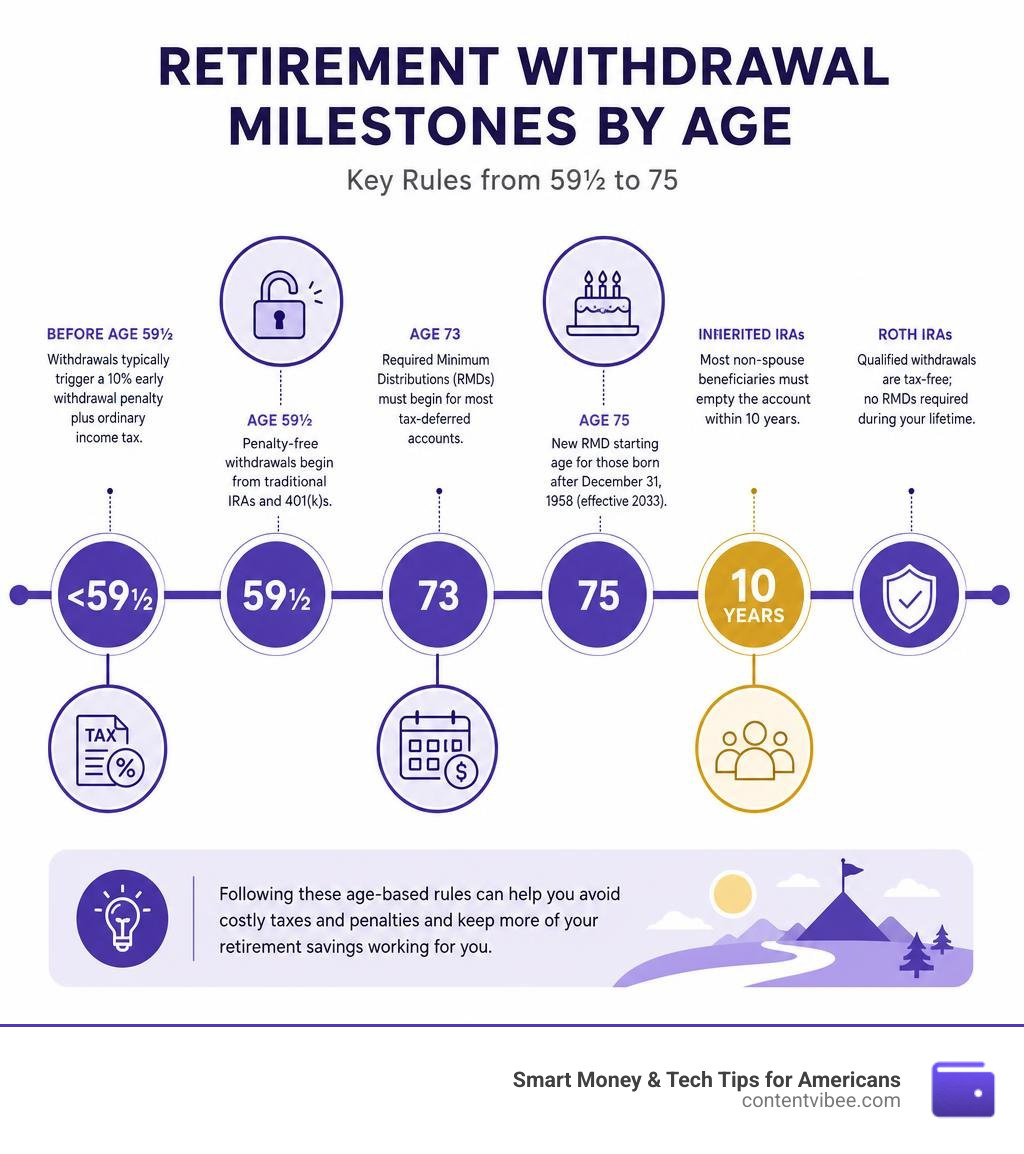
| Milestone | Rule |
|---|---|
| Before age 59½ | Withdrawals typically trigger a 10% early withdrawal penalty plus ordinary income tax |
| Age 59½ | Penalty-free withdrawals begin from traditional IRAs and 401(k)s |
| Age 73 | Required Minimum Distributions (RMDs) must begin for most tax-deferred accounts |
| Age 75 | New RMD starting age for those born after December 31, 1958 (effective 2033) |
| Inherited IRAs | Most non-spouse beneficiaries must empty the account within 10 years |
| Roth IRAs | Qualified withdrawals are tax-free; no RMDs required during your lifetime |
These rules aren’t just technical details — getting them wrong can cost you thousands. Miss an RMD and the IRS can charge a 25% excise tax on the amount you should have withdrawn. Tap your 401(k) too early and you could lose a significant chunk of your savings to taxes and penalties before you even spend a dollar.
Whether you’re a few years from retirement or already drawing down your accounts, understanding these rules is one of the most important steps you can take to protect your financial future.
This guide covers everything — from early withdrawal exceptions to RMD calculations, tax-efficient sequencing, inherited IRA rules, and the best withdrawal strategies to make your money last.
Understanding the Core Retirement Withdrawal Rules by Age
Navigating the transition from saving for retirement to spending your hard-earned cash requires a keen understanding of your age-based milestones. The IRS looks at your age as the primary gatekeeper for when your money can be accessed penalty-free and when you are legally required to start taking it out.
As we look at the landscape in July 2026, the rules have shifted significantly due to recent federal legislation. If you do not align your withdrawal schedule with these age milestones, you run the risk of losing a substantial portion of your portfolio to avoidable taxes and penalties. To build a solid foundation for managing your nest egg, check out The Ultimate Guide to Retirement Money Management.
Penalty-Free Access: The Age 59½ Milestone
The age of 59½ is one of the most celebrated milestones in retirement planning. Before this point, the IRS generally views your retirement accounts as off-limits. If you try to withdraw money from a traditional IRA or a workplace 401(k) before reaching age 59½, you will usually face a 10% early withdrawal penalty.
Once you reach 59½, however, you enter the “normal withdrawal” phase. You can take distributions from your traditional IRA or 401(k) without worrying about that extra 10% penalty.
It is important to remember that “penalty-free” does not mean “tax-free.” Withdrawals from traditional tax-deferred accounts are still treated as ordinary income. The amount you withdraw will be added to your taxable income for the year, and you will owe ordinary income taxes on it based on your federal and state tax brackets. For a deeper look at how these rules function across different account types, read more about IRA and 401(k) Withdrawal Rules.
Required Minimum Distributions (RMDs) and the SECURE Act 2.0
While the IRS is happy to let you leave your money in tax-deferred accounts to grow for decades, they eventually want their tax cut. This is where Required Minimum Distributions (RMDs) come into play. You cannot keep your retirement funds in these accounts indefinitely.
Thanks to the SECURE Act 2.0, the age at which you must begin taking these mandatory annual withdrawals has increased:
- Age 73: If you reached age 72 after December 31, 2022, your RMDs must begin by April 1 of the year following the year you turn 73. This is the active rule for retirees right now in 2026.
- Age 75: For individuals who turn 74 after December 31, 2032 (meaning those born in 1959 or later), the RMD age will increase to 75 starting in 2033.
These updates have fundamentally changed how retirees plan their late-stage distributions. To make sure you do not get caught off guard by these shifting timelines, read Don’t Let Uncle Sam Catch You Napping With These 2026 RMD Changes and consult The Essential RMD Age Table Guide for Smart Retirees.
Early Withdrawals: Penalties, Taxes, and Workplace Plan Exceptions
Sometimes life throws an unexpected curveball, and you might find yourself needing to access your retirement accounts before age 59½. Doing so without planning can be incredibly expensive.
When you take an early withdrawal, you generally face a double whammy:
- Ordinary Income Tax: You will pay regular income taxes on the distributed amount, with federal tax rates ranging from 10% to 37% depending on your total income.
- The 10% Penalty: The IRS levies an additional 10% early distribution tax on top of your regular income tax.
To report these early distributions and calculate the penalty (or claim an exception), you must file Form 5329 with your federal tax return. For official guidelines on how these rules apply, see the IRS resource on Hardships, early withdrawals and loans.
Exceptions to the 10% Penalty for Early Retirement Withdrawal Rules
Fortunately, the IRS provides several exceptions to the 10% early withdrawal penalty. If you meet the specific criteria for one of these exceptions, you will still owe ordinary income tax on the withdrawal, but you can avoid the 10% penalty entirely.
Some of the most common exceptions include:
- Unreimbursed Medical Expenses: If you have medical bills that exceed 7.5% of your Adjusted Gross Income (AGI), you can withdraw funds penalty-free to cover them.
- Higher Education Expenses: You can withdraw funds from an IRA to pay for qualified higher education expenses (such as tuition, fees, books, and room and board) for yourself, your spouse, your children, or your grandchildren.
- First-Time Home Purchase: You can withdraw up to a lifetime limit of $10,000 from an IRA to help buy, build, or rebuild a first home for yourself or a qualified family member.
- The Rule of 55: If you leave or lose your job in or after the calendar year you turn 55, you can take penalty-free withdrawals directly from that specific employer’s 401(k) plan. To understand how this works, see Retirement Topics Exceptions to Tax on Early Distributions at 55.
- Governmental 457(b) Plans: These unique workplace plans allow penalty-free withdrawals upon job separation, regardless of your age. Learn more about this strategy by reading How to Withdraw From Your 457b Early Without Paying Penalties.
Workplace Plans vs. IRAs: Hardships, Loans, and the Rule of 55
Workplace retirement plans like 401(k)s have different operational rules than IRAs when it comes to accessing money early. Understanding these differences can save you from making a costly mistake.
For example, IRAs do not allow loans; any attempt to borrow from an IRA is treated as a prohibited transaction and a full distribution of the account. However, many 401(k) plans allow participants to take out loans. These loans are typically limited to the lesser of $50,000 or 50% of your vested account balance. As long as you repay the loan within five years (or longer if used to purchase a primary residence) with interest paid back into your own account, the loan is not taxed.
If you cannot take a loan, you might look into a hardship distribution. Hardship distributions are allowed only when there is an “immediate and heavy financial need,” such as preventing eviction, paying for funeral costs, or covering sudden medical bills. That hardship distributions cannot be rolled back into an IRA or another plan later.
Before making any sudden moves, check out Before You Cash Out Use This 401k Withdrawal Calculator First and read the official 401k Resource Guide Plan Participants General Distribution Rules to understand the long-term impact on your savings.
Strategic Withdrawal Frameworks and Portfolio Longevity
How you withdraw your money during retirement is just as important as how much you saved. Without a structured strategy, you run the risk of running out of money due to inflation, market volatility, and sequence-of-returns risk (the risk of a market downturn occurring early in your retirement when you are actively withdrawing funds).
| Strategy | How It Works | Pros | Cons |
|---|---|---|---|
| 4% Rule | Withdraw 4% in year one; adjust the dollar amount for inflation each year after. | Simple to execute; highly predictable income. | Rigid; does not adapt to severe market crashes. |
| Fixed-Dollar | Withdraw a set dollar amount (e.g., $40,000) every year, ignoring inflation. | Extremely predictable. | Purchasing power erodes over time due to inflation. |
| Fixed-Percentage | Withdraw a constant percentage (e.g., 4%) of the remaining portfolio balance annually. | Portfolio will never run out of money. | Income fluctuates wildly based on market performance. |
| Bucket Strategy | Divide assets into short-term cash, mid-term fixed income, and long-term equities. | Protects short-term spending from market drops. | Requires active management and rebalancing. |
To explore how these strategies can be tailored to your unique financial situation, review Retirement withdrawal rules and strategies – BlackRock.
The 4% Rule and Fixed-Dollar Strategies
The 4% rule is the classic starting point for retirement income planning. Originating from historical market studies, it suggests that if you withdraw 4% of your portfolio’s total value in your first year of retirement, and then adjust that dollar amount annually to account for inflation, your portfolio has an incredibly high probability of lasting at least 30 years.
For example, if you retire with a $1 million portfolio, you would withdraw $40,000 in your first year. If inflation is 3% that year, you would withdraw $41,200 in the second year, regardless of how the stock market performed. This provides excellent income predictability, but it can be risky if the market experiences a severe downturn right after you retire. To see how this applies to your specific nest egg, use the resource on Demystifying the 4 Percent Retirement Withdrawal Calculator.
How Volatility Impacts Retirement Withdrawal Rules
While fixed-dollar strategies prioritize predictability, other frameworks focus on protecting your portfolio from market volatility.
A systematic withdrawal plan involves withdrawing only the income (dividends and interest) generated by your investments, leaving the underlying principal untouched. While safe, this can limit your spending during low-yield environments.
Alternatively, many retirees opt for the bucket strategy to insulate their day-to-day living expenses from short-term market drops.
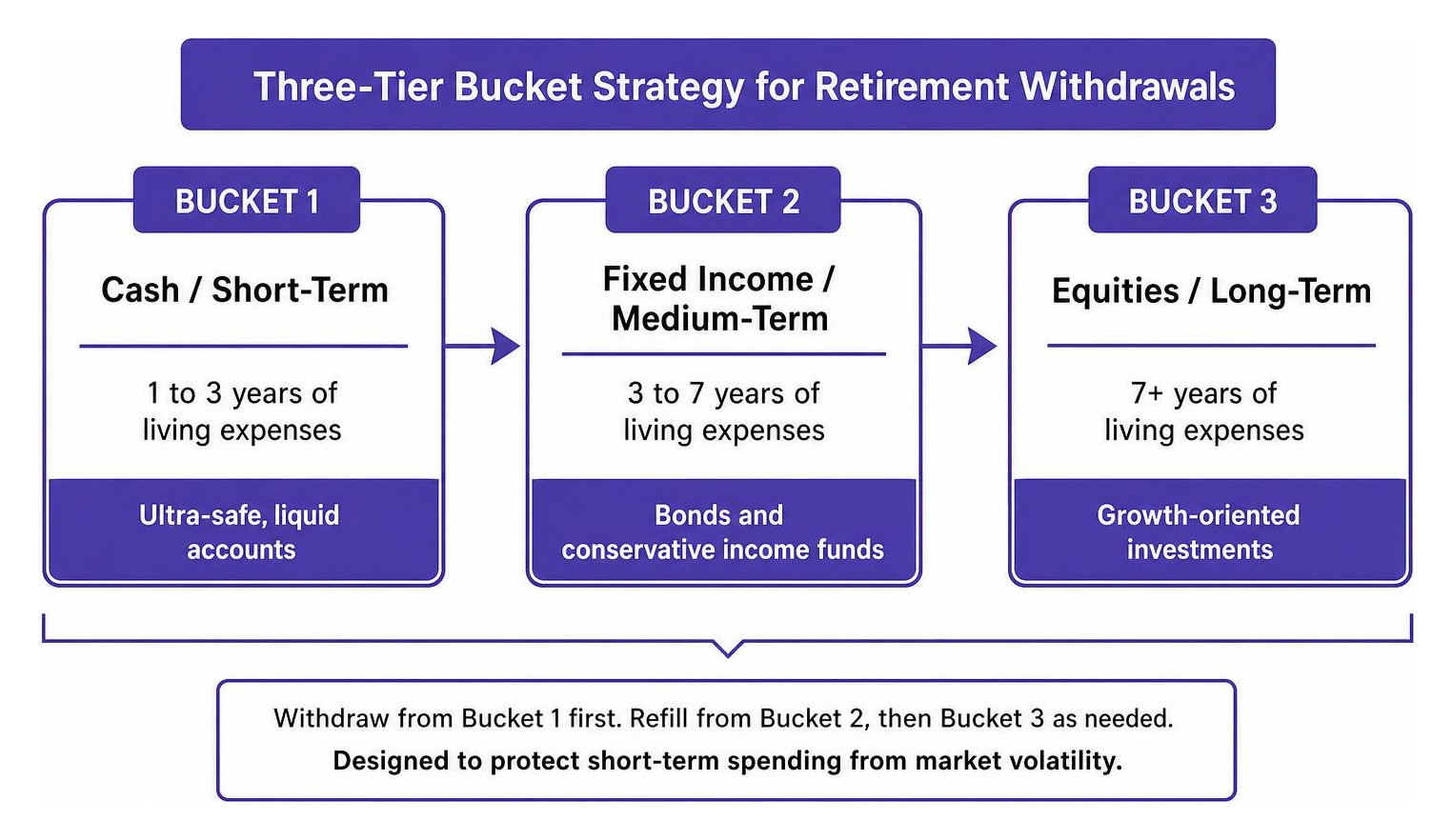
In this setup, you divide your savings into three distinct “buckets”:
- Bucket 1 (Cash/Short-Term): Holds 1 to 3 years of living expenses in ultra-safe, liquid accounts like high-yield savings accounts or CDs.
- Bucket 2 (Fixed Income/Medium-Term): Holds 3 to 7 years of expenses in bonds and conservative income funds.
- Bucket 3 (Equities/Long-Term): Holds growth-oriented investments like stocks and real estate.
When the stock market drops, you do not have to sell your stocks at a loss. Instead, you live off the cash in Bucket 1, giving your long-term investments in Bucket 3 time to recover.
Tax-Efficient Sequencing and Inherited Account Rules
To maximize your retirement income, you must think like a tax strategist. Your retirement savings are likely spread across different types of accounts, each with its own tax rules.

Traditional IRAs and 401(k)s are funded with pre-tax dollars, meaning withdrawals are taxed as ordinary income. Roth IRAs and Roth 401(k)s are funded with after-tax dollars, meaning qualified withdrawals are completely tax-free. To review the official IRS publications regarding these tax structures, refer to Distributions from Individual Revenue Arrangements (IRAs).
Minimizing Lifetime Tax Exposure with Smart Sequencing
Most retirees make the mistake of withdrawing from their accounts in a random order, which can push them into higher tax brackets and trigger higher Medicare premiums. A classic tax-efficient sequencing strategy looks like this:
- Withdraw from taxable brokerage accounts first (which benefit from lower long-term capital gains tax rates).
- Withdraw from tax-deferred traditional accounts next.
- Withdraw from tax-free Roth accounts last, allowing them to grow tax-free for as long as possible.
Additionally, retirees over the age of 70½ can utilize Qualified Charitable Distributions (QCDs). A QCD allows you to transfer up to $105,000 per year directly from your traditional IRA to a qualified charity. This transfer is not counted as taxable income, yet it counts toward satisfying your annual RMD. To learn more about how QCDs can lower your tax bill, read the Retirement plans FAQs regarding IRAs distributions (withdrawals) | Internal Revenue Service.
Inherited IRAs and Complex Distribution Rules for Beneficiaries
If you inherit a retirement account, you must act carefully. The rules for beneficiaries depend heavily on your relationship to the deceased and when they passed away.
Under the SECURE Act, most non-spouse beneficiaries who inherit an IRA must fully distribute all assets from the account by the end of the 10th year following the year of the original owner’s death (the “10-year rule”).
However, “Eligible Designated Beneficiaries” are exempt from the strict 10-year rule and can stretch distributions over their own life expectancy. This group includes:
- Surviving spouses (who can also roll the inherited IRA into their own name).
- Minor children of the account owner (until they reach the age of majority).
- Disabled or chronically ill individuals.
- Individuals who are not more than 10 years younger than the deceased owner.
To understand the exact legal definitions and distribution requirements, see the federal register on Required Minimum Distributions as well as the codification under 26 CFR § 1.408-4 – Treatment of distributions from individual retirement arrangements..
Frequently Asked Questions About Retirement Distributions
What happens if you miss a Required Minimum Distribution (RMD)?
If you fail to withdraw your full RMD by the annual deadline (usually December 31), the IRS can impose an excise tax on the amount that was not distributed.
Historically, this penalty was a brutal 50%. Today, the excise tax is 25% of the undistributed amount. However, if you correct the mistake quickly and file Form 5329 within the correction window (typically within two years), the penalty is reduced to 10%.
How do you calculate your annual RMD amount?
Your RMD is calculated annually by taking your account balance as of December 31 of the prior year and dividing it by a life expectancy factor. This factor is determined by the IRS and is typically found in the Uniform Lifetime Table.
For example, if your traditional IRA balance was $500,000 on December 31 of last year, and your life expectancy factor for your current age is 26.5, your RMD for this year would be:
$$\$500,000 / 26.5 = \$18,867.92$$
You must calculate and withdraw this minimum amount for each tax-deferred account you own (though you can aggregate your traditional IRA RMDs and take the total from a single IRA).
What are the best alternatives to taking an early retirement withdrawal?
Before tapping your retirement accounts early and triggering taxes and penalties, consider these alternatives:
- Roth IRA Contributions: You can always withdraw your original Roth IRA contributions (but not the earnings) tax- and penalty-free at any time.
- 401(k) Loans: If your employer’s plan allows it, you can borrow up to $50,000 without triggering a tax penalty, as long as you repay it on time.
- Home Equity Lines of Credit (HELOCs): Borrowing against your home’s equity can provide a lower-interest alternative to cashing out your retirement.
- Personal Loans or Short-Term Financing: For temporary cash flow crunches, a low-interest personal loan may cost far less than the combined tax and penalty of an early withdrawal.
Conclusion
Mastering the complex web of retirement withdrawal rules is essential for protecting your hard-earned savings. From avoiding early withdrawal penalties to navigating the latest SECURE Act 2.0 RMD changes, every decision you make impacts your lifetime tax liability and the longevity of your portfolio.
At ContentVibee, we specialize in delivering clear, actionable guidance on complex financial regulations. We want to help you make sense of these rules so you can retire with confidence, clarity, and peace of mind.
Ready to see how these rules apply to your portfolio? Take control of your distribution strategy today by using our interactive Demystifying the 4 Percent Retirement Withdrawal Calculator to build a sustainable plan for your future.


