


What the RMD Penalty Costs You — and How to Fix It Fast
The RMD penalty is one of the most expensive tax mistakes a retiree can make — and it catches thousands of Americans off guard every year.
Here’s the quick answer if you need it now:
| Situation | Penalty Rate |
|---|---|
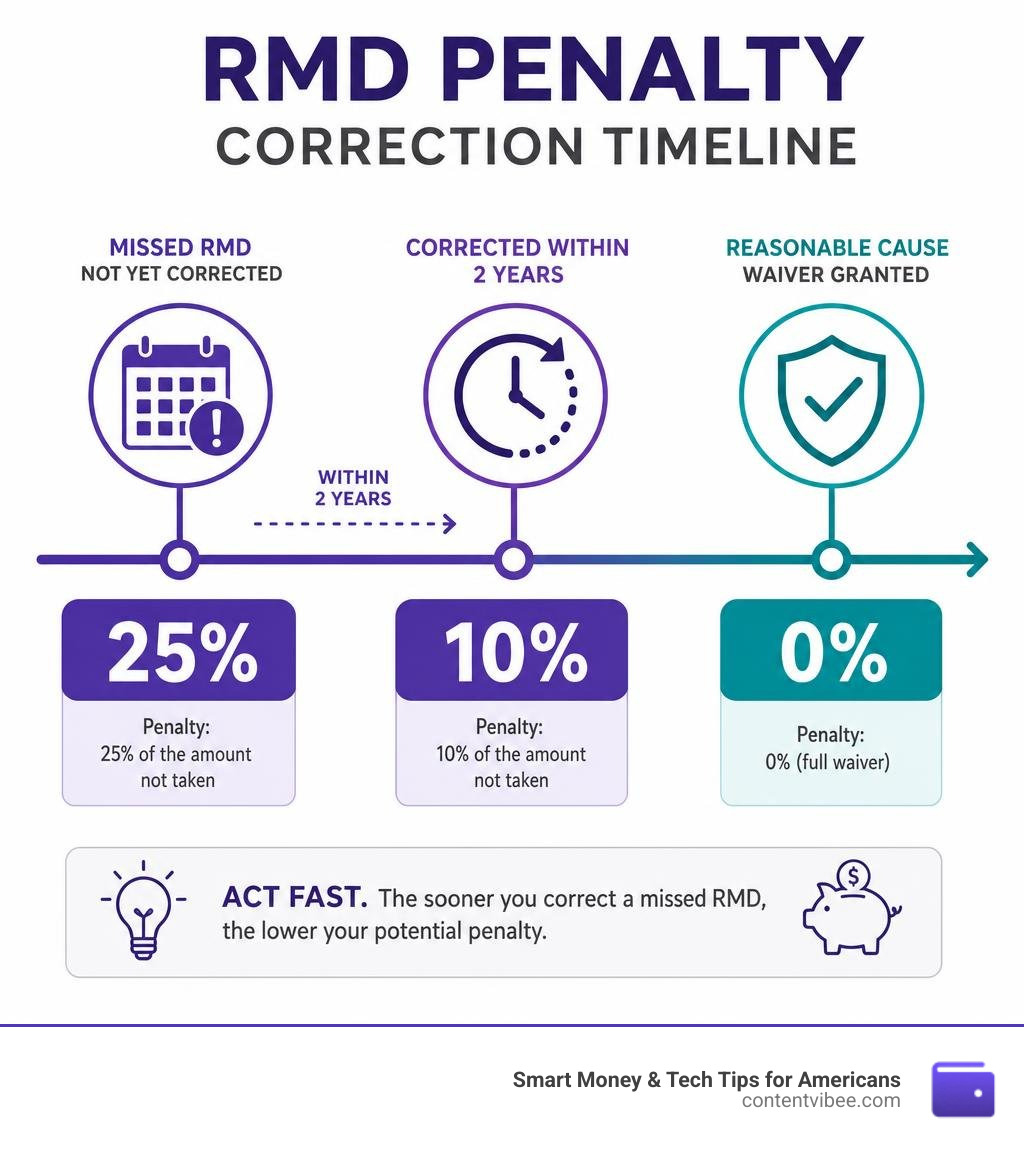
| Missed RMD, not yet corrected | 25% of the amount not taken |
| Missed RMD, corrected within 2 years | 10% of the amount not taken |
| Missed RMD, reasonable cause shown | Potentially 0% (full waiver) |
| Pre-2023 missed RMD | 50% (old rate, no longer applies) |
Example: If you missed a $20,000 RMD, you could owe $5,000 at the 25% rate — or just $2,000 if you fix it within the two-year correction window.
The good news? Most people who act quickly — and file the right paperwork — can dramatically reduce or even eliminate this penalty.
Under the SECURE 2.0 Act, passed in late 2022, the IRS cut the missed-RMD excise tax from a brutal 50% down to 25%. And if you correct the mistake within a two-year window, that rate drops further to just 10%. The IRS also has a formal waiver process for people who missed their distribution due to a genuine error.
This guide walks you through exactly what to do, step by step — and it won’t take you more than an hour to get started.
Understanding the SECURE 2.0 RMD Penalty Structure
For decades, the penalty for failing to take a Required Minimum Distribution (RMD) was feared as one of the most punitive codes in the entire tax book. If you missed your deadline, the IRS slapped you with a massive 50% excise tax on the amount you failed to withdraw.
Fortunately, the legislative landscape shifted with the passage of the SECURE 2.0 Act. Under these updated rules, which govern RMDs for 2023 and later years, the financial burden is much lighter, though still highly significant if ignored.
The standard rmd penalty (technically referred to by the IRS as an “additional tax on excess accumulation” under Internal Revenue Code Section 4974) has been reduced to 25% of the shortfall amount. Furthermore, if you correct the mistake within a designated IRS correction window, the penalty is slashed to just 10%.
Understanding how these rates apply is the first step in protecting your retirement nest egg. As outlined in this analysis of how costly missed RMDs are from The Vanguard Group, Inc, failing to manage your distributions proactively can quietly erode years of investment growth.
To help visualize how the penalty structure has evolved, here is a comparison of the old rules versus the current guidelines:
RMD Penalty Rates: Pre-SECURE 2.0 vs. Current Rules
| Metric | Pre-2023 Rules | Current Rules (SECURE 2.0) |
|---|---|---|
| Standard Penalty Rate | 50% of the shortfall | 25% of the shortfall |
| Reduced Penalty Rate | N/A (No automatic reduction) | 10% of the shortfall (if corrected timely) |
| Waiver for Reasonable Cause | Available via Form 5329 | Available via Form 5329 |
| Statute of Limitations | Often unlimited if Form 5329 not filed | Unlimited if Form 5329 not filed |
How to Calculate Your Potential RMD Penalty
Calculating your penalty is a straightforward process, but you must first determine your exact “shortfall.” The shortfall is the difference between the RMD amount you were legally required to withdraw and the amount you actually took before the deadline.
To find your required distribution, you must divide your account balance as of December 31 of the prior year by your life expectancy factor. This factor is determined by your age using the IRS Uniform Lifetime Table (or the Joint Life and Last Survivor Expectancy Table if your spouse is your sole beneficiary and is more than 10 years younger than you). For a complete breakdown of these calculations, read The Essential RMD Age Table Guide For Smart Retirees.
Let’s look at three real-world examples to see how the mathematical calculation works out under the current 25% and 10% tiers:
- Scenario A (The 25% Standard Penalty): George (age 78) had a required minimum distribution of $10,000 for the tax year. Due to a oversight, he completely forgot to take the distribution and did not correct it before the IRS discovered the error. George’s shortfall is $10,000. Under the standard rate, his rmd penalty is calculated as: $$\$10,000 \times 25\% = \$2,500$$
- Scenario B (The 10% Corrected Penalty): Tom (age 74) missed his $8,000 RMD. However, he caught the error on his own a few months later, immediately withdrew the $8,000, and filed the appropriate tax paperwork within the correction window. Because he corrected the mistake promptly, his penalty drops to 10%: $$\$8,000 \times 10\% = \$800$$
- Scenario C (The Partial Shortfall Penalty): Margaret (age 82) was required to take $15,000 but only withdrew $5,000, leaving a partial shortfall of $10,000. If she corrects this within the two-year window, her penalty is 10% of the untaken portion: $$\$10,000 \times 10\% = \$1,000$$
The Two-Year Correction Window Mechanics
The 10% reduced rate is not a permanent safety net; it is governed by a strict timeline known as the “correction window.” Under SECURE 2.0, the correction window begins on the date the excise tax is imposed (January 1 of the year following the missed distribution).
The window closes on the earliest of the following dates:
- The date the IRS mails a notice of deficiency (an audit letter) regarding the missed distribution.
- The date the IRS assesses the excise tax.
- The last day of the second taxable year after the tax is imposed.
For example, if you missed an RMD that was due by December 31, 2024, the excise tax was technically imposed on January 1, 2025. Your two-year correction window runs until December 31, 2027—unless the IRS catches the error and sends you a notice before that date.
This makes it critical to keep up with the shifting age requirements. To make sure you know exactly when your first distribution is due under the modern rules, check out our guide on Mastering The SECURE Act 2.0 RMD Age Shifts.
Immediate Action Plan After Discovering a Missed RMD
Finding out you missed an RMD can cause a brief moment of panic. However, the worst thing you can do is freeze. The IRS looks far more favorably on taxpayers who take swift, voluntary action to correct their mistakes than those who wait to be caught.
When you discover a missed distribution, you must execute a specific sequence of steps immediately. First, you must calculate the exact shortfall. Second, you must take the make-up distribution. Third, you must file Form 5329.
Be aware of a major tax trap called tax year stacking. When you take a make-up distribution, that money is taxed as ordinary income in the calendar year you actually receive it. If you miss your 2025 RMD and take the make-up distribution in 2026, you will have to take your normal 2026 RMD in that same year.
Receiving two large distributions in a single tax year can push you into a higher federal income tax bracket, increase your state taxes, and potentially trigger Medicare IRMAA surcharges. To evaluate your withdrawal options and timing, you can review the guide on Required Minimum Distributions | RMD Rules & Options | Fidelity.
Step 1: Take the Shortfall Distribution Immediately
Your very first physical step is to contact your account custodian (the bank, brokerage, or mutual fund company holding your retirement account) and request the distribution of the missed amount.
When you make this request, you must:
- Clearly state that this is a “make-up distribution” for the missed tax year.
- Keep this transaction entirely separate from your current-year RMD. Do not combine them into a single withdrawal request, as this makes your paper trail confusing for the IRS.
- Request that the custodian issue a separate tax statement if possible, or keep meticulous personal records of the transaction date and amount.
Taking care of this immediately is vital, especially given the upcoming regulatory environment. For more information on navigating these timelines, see our article on how to Dont Get Caught Off Guard By These 2026 RMD Changes.
Step 2: File Form 5329 to Report the Correction
Once the shortfall has been distributed, you must report the error and the correction to the IRS using Form 5329 (Additional Taxes on Qualified Plans and Other Tax-Favored Accounts).
You must file a separate Form 5329 for each tax year in which an RMD was missed. If you missed distributions in both 2024 and 2025, you cannot combine them on a single form; you must submit the 2024 Form 5329 and the 2025 Form 5329.
On Form 5329, you will navigate to Part IX (Additional Tax on Excess Accumulation in Qualified Retirement Plans). Here is how you complete the lines:
- Line 52: Enter the minimum required distribution amount for the year.
- Line 53: Enter the amount actually distributed to you during the year.
- Line 54 (Shortfall): Subtract Line 53 from Line 52. This is your missed amount.
- Line 55: This is where you calculate your tax. If you are paying the reduced 10% penalty, you will compute 10% of Line 54. If you are requesting a waiver, you will follow a different set of instructions (detailed in the next section).
The distribution itself will eventually be reported to you on Form 1099-R. To understand how these forms interact, read our guide on Demystifying Form 1099-R And Your Retirement Distributions.
How to Get Your Missed RMD Penalty Waived Entirely
While reducing your penalty to 10% is a good backup plan, your primary goal should be to get the rmd penalty waived entirely. Under Internal Revenue Code Section 4974(d), the IRS has the authority to waive the excise tax completely if you can prove two things:
- The shortfall was due to a reasonable error.
- You have taken reasonable steps to remedy the shortfall (i.e., you have already taken the make-up distribution).
The IRS is surprisingly generous with these waivers. If you act in good faith, correct the mistake before they send you a bill, and submit a clear, polite explanation, the waiver is highly likely to be granted. You can review the official parameters for these relief programs on the Retirement plan and IRA required minimum distributions FAQs – IRS.
Step-by-Step Guide to Requesting an RMD Penalty Waiver
To request a full waiver of the penalty, you must fill out Form 5329 in a very specific way. Rather than calculating the tax on Line 55, you will use the form to signal to the IRS that you are requesting relief.
Here is the exact procedure:
- Complete Lines 52, 53, and 54 of Form 5329 Part IX to establish the shortfall.
- On Line 55, write “RC” (which stands for Reasonable Cause) and the amount of the shortfall you want waived in parentheses next to the line. If you want the entire penalty waived, write the full shortfall amount.
- On Line 56, enter “0” (or the remaining taxable portion if you are only requesting a partial waiver). This tells the IRS that you do not owe any additional tax with this filing.
- Draft a concise, factual letter of explanation (also known as a reasonable cause statement).
- Attach the letter of explanation and documentation of your make-up distribution to Form 5329 and submit it. You can file Form 5329 as an attachment to your annual Form 1040, with an amended return (Form 1040-X), or as a standalone document if you have already filed your taxes for the year.
If you are retired and looking for professional help to draft these statements, you might be interested in exploring Retirement Tax Preparer Jobs For Retired Accountants, where experienced tax pros often assist peers with complex IRS filings.
What Counts as “Reasonable Cause” to the IRS?
The IRS does not grant waivers for simple carelessness, but they do accept a wide variety of life disruptions as “reasonable cause.”
Commonly accepted reasons include:
- Serious Illness or Disability: You or an immediate family member suffered a severe medical emergency that distracted you from managing your financial affairs.
- Death in the Family: The death of a close family member or the person who typically handles your household finances.
- Custodian or Advisor Error: Your financial institution calculated the wrong RMD amount, failed to process a scheduled distribution, or gave you incorrect written advice. (You should attach copies of correspondence or bank statements proving this).
- First-Time RMD Confusion: You recently reached RMD age and misunderstood the complicated “Required Beginning Date” rules (specifically, the option to delay your first RMD until April 1 of the following year).
- Natural Disasters: You were affected by a federally declared natural disaster, fire, or severe weather event that disrupted mail or banking services.
Special RMD Rules for Inherited IRAs and Beneficiaries
The rules surrounding inherited retirement accounts are notoriously complex, and they represent a significant minefield for the rmd penalty.

If you inherit an IRA or a 401(k), you do not get to follow the same timeline as the original owner. Instead, your distribution requirements depend on when the owner died, your relationship to them, and whether they had already begun taking their own RMDs.
The 10-Year Rule and Annual Distribution Requirements
For individuals who inherited an account in 2020 or later under the original SECURE Act, most non-spouse beneficiaries are subject to the 10-year rule. This rule requires the entire balance of the inherited account to be fully distributed by December 31 of the tenth year following the year of the owner’s death.
For several years, there was widespread confusion about whether beneficiaries had to take annual distributions during those ten years, or if they could simply wait and empty the account in year ten. In 2024, the IRS issued final regulations clarifying that if the original owner had already reached their Required Beginning Date and started taking RMDs, the beneficiary must take annual RMDs in years 1 through 9, and then empty the account in year 10.
If you fail to take these annual distributions, you face the standard 25% or 10% rmd penalty on the shortfall. Even worse, if you miss the final year-10 deadline to empty the account, the penalty applies to the entire remaining balance of the account.
Year-of-Death RMD Deadlines for Beneficiaries
Another common mistake involves the year the original owner passes away. If the deceased owner had an RMD requirement for the year of their death but died before taking it, that RMD must still be distributed.
The responsibility for taking this “year-of-death RMD” falls on the beneficiary, not the deceased person’s estate. The beneficiary must withdraw the deceased owner’s RMD by December 31 of the year of death.
Fortunately, the IRS provides a small administrative grace period: if the beneficiary fails to take the year-of-death RMD by the deadline, they have until the later of December 31 of the following year or their own tax-filing deadline to correct the oversight and request a waiver of the penalty.
Proactive Strategies to Prevent Future RMD Mistakes
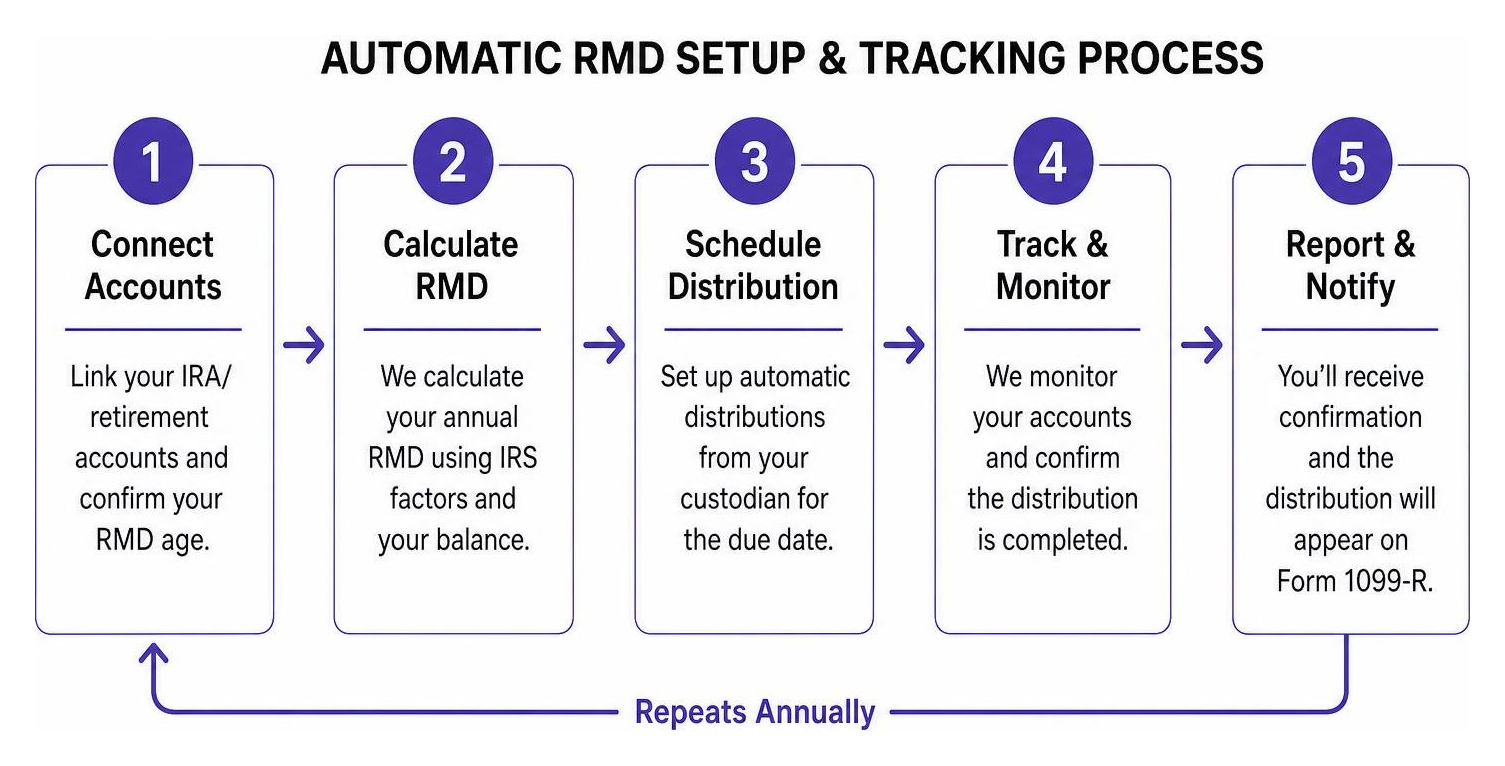
The easiest way to deal with an rmd penalty is to make sure you never trigger one in the first place. With a few simple organizational steps, you can automate your retirement accounts and eliminate the risk of human error.
- Enroll in Automatic RMD Programs: Almost every major custodian offers a free service that automatically calculates and distributes your RMD each year. You can schedule the funds to be sent to your checking account or a taxable brokerage account on a specific date (such as every year on November 15).
- Consolidate Your Accounts: If you have multiple old 401(k) plans and IRAs scattered across different banks and brokerages, it is incredibly easy to miss a distribution. Consolidating your traditional IRAs into a single account makes tracking your RMDs simple.
- Set Calendar Reminders: Do not rely on your custodian to remind you. Set a recurring digital calendar alert for November 1 and December 1 of every year to review your retirement accounts and verify that your distributions have successfully cleared.
Understanding Account Aggregation Rules
One of the most frequent causes of missed RMDs is a misunderstanding of how different retirement accounts can be combined for distribution purposes. The IRS has very strict rules about “aggregation.”
- Traditional IRAs: You must calculate the RMD for each Traditional IRA you own separately. However, you can aggregate the total RMD amount and withdraw it from any combination of your Traditional IRAs. For example, if IRA A has a $3,000 RMD and IRA B has a $4,000 RMD, you can take the entire $7,000 from IRA B.
- 403(b) Plans: Similar to IRAs, you must calculate the RMD for each 403(b) separately, but you can aggregate the total and withdraw it from one or more of your 403(b) accounts.
- 401(k) and 457(b) Plans: No aggregation is allowed. If you have three different 401(k) plans from former employers, you must calculate and withdraw the exact RMD from each individual plan separately. You cannot satisfy a 401(k) RMD by taking money out of an IRA or another 401(k).
- Inherited IRAs: You cannot mix your personal RMDs with inherited RMDs. Inherited accounts must be kept entirely separate, and you can only aggregate distributions among inherited IRAs that you received from the same deceased individual.
Frequently Asked Questions about RMD Penalties
Does missing an RMD affect my next year’s distribution calculation?
No. Each year’s RMD is an independent calculation. Your RMD for next year will be calculated using your actual account balance as of December 31 of this year, regardless of whether you missed or corrected a prior distribution. The missed amount does not compound or alter the mathematical formula for future years.
Are Roth accounts subject to the RMD penalty?
During your lifetime, no. Original owners of Roth IRAs are completely exempt from lifetime RMDs. Furthermore, starting in tax year 2024, the SECURE 2.0 Act eliminated lifetime RMD requirements for designated Roth accounts in workplace plans, such as Roth 401(k) and Roth 403(b) accounts.
However, beneficiaries who inherit Roth accounts are still subject to RMD rules and the 10-year rule, meaning they can face penalties if they fail to empty the inherited Roth account by the end of the tenth year.
What happens if I never file Form 5329 for a missed RMD?
If you miss an RMD and simply ignore it, the IRS has no time limit to catch you. The standard three-year statute of limitations on tax returns does not apply to the RMD excise tax unless you actually file Form 5329 for the missed year.
If you never file the form, the statute of limitations never starts running. The IRS can audit you ten or fifteen years later, demand the 25% penalty, and tack on compounding interest and failure-to-file penalties for the entire intervening decade.
Conclusion
An rmd penalty can be a stressful and expensive headache, but it is entirely manageable if you act quickly. By taking your make-up distribution immediately, utilizing the SECURE 2.0 two-year correction window, and submitting a polite request for a waiver via Form 5329, you can resolve the issue in less than an hour of actual paperwork.
At ContentVibee, we are dedicated to helping Americans navigate the complex, shifting landscape of retirement planning with clear, actionable advice. Don’t let tax rules catch you off guard—stay proactive, automate your distributions, and protect your hard-earned savings.
To learn more about optimizing your retirement withdrawals and avoiding unnecessary taxes, check out our guide on how to Learn more about exceptions to early distribution taxes.


