


Estimate Your Claim With an Accident Injury Compensation Calculator
An accident injury compensation calculator gives you a quick, non-binding estimate of what a personal injury claim could be worth. It generally combines two parts:
- General damages: payment for the injury itself, including pain, suffering, and how long symptoms are expected to last.
- Special damages: money you lost or spent because of the accident, such as medical bills, missed pay, travel costs, and unpaid help from family or friends.
The result can change sharply based on the injury’s severity, medical prognosis, accident date, available evidence, and each person’s share of fault. It is a useful planning tool, not a guaranteed settlement figure.
For UK-style claims, calculators may use the Judicial College Guidelines and, for qualifying whiplash cases, the tariff in force on the date of the accident. In the US, the rules, insurance limits, and fault laws vary by state, so any online estimate should be treated as a starting point rather than legal advice.
The most useful calculators also separate the gross claim value from what you may actually receive after legal fees, insurance costs, and any reduction for shared fault.
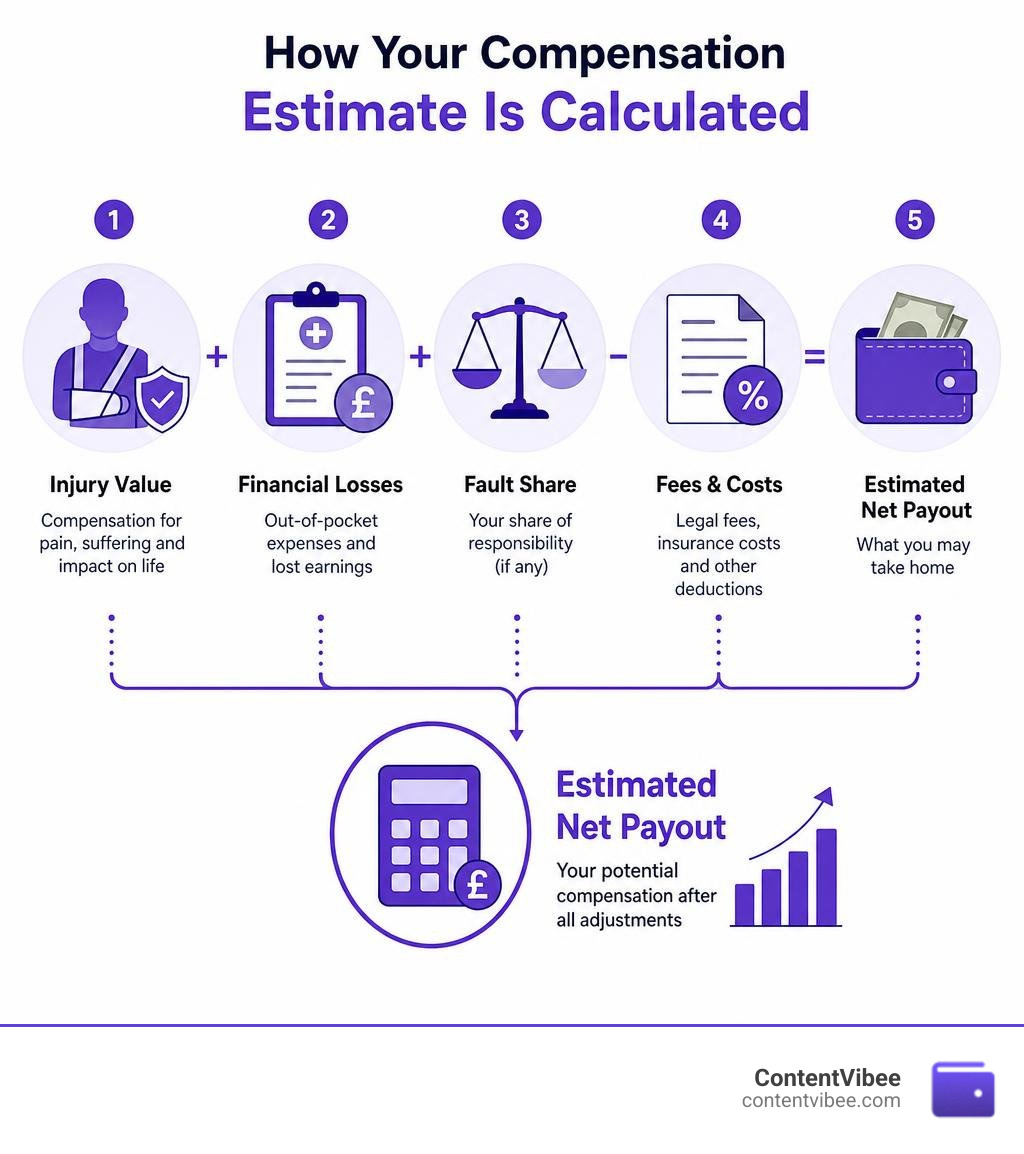
How an Accident Injury Compensation Calculator Evaluates Claim Worth
When you open an accident injury compensation calculator, the tool breaks down your claim into distinct legal categories. Compensation is not a random number pulled out of thin air; it is built on structured mathematical models, legal frameworks, and evidentiary guidelines.
At its core, every claim valuation combines two distinct financial pools:
- General Damages: Non-financial harm, covering physical pain, mental anguish, loss of amenity, and temporary or permanent disability.
- Special Damages: Quantifiable financial losses incurred directly because of the incident, designed to put you back in the financial position you would have enjoyed had the accident never happened.
An accurate interactive estimator evaluates these components alongside liability (who caused the crash or injury) to build a baseline figure. You can explore how these components interact by using a dedicated Settlement Calculator Estimate Your Claim Amount tool.
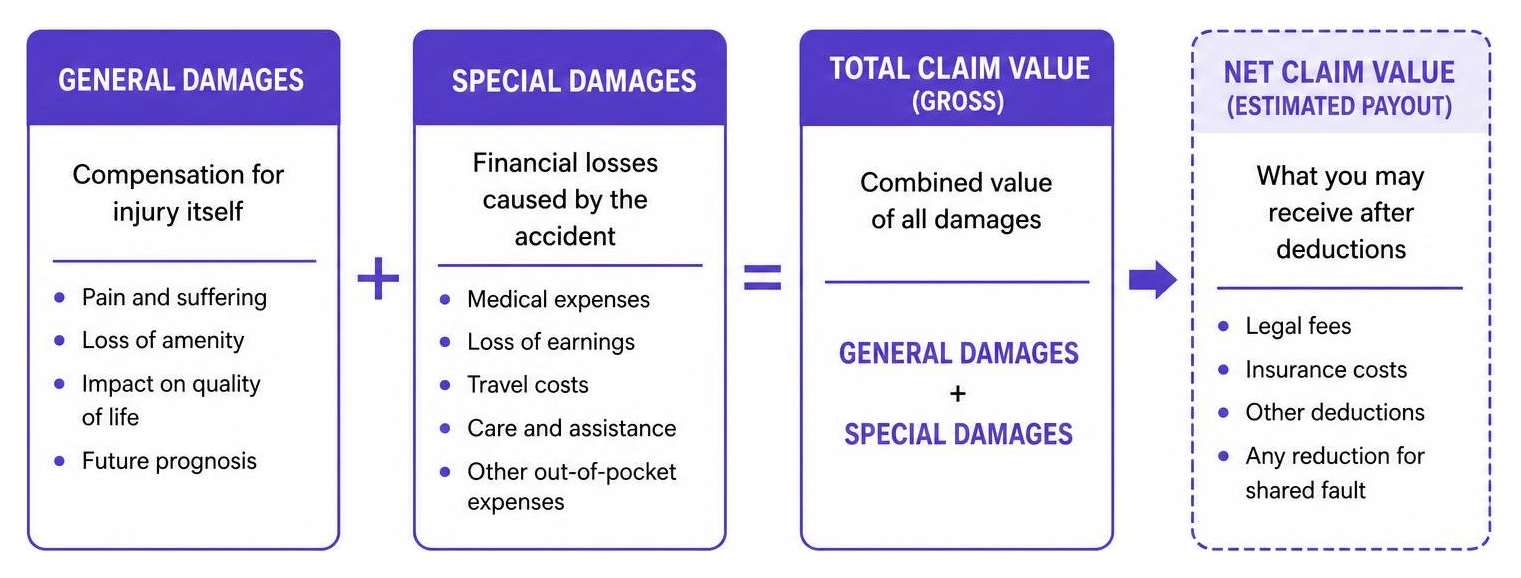
Evaluating General Damages with Judicial College Guidelines
To calculate general damages for physical or psychological harm, modern online software relies on standardized reference benchmarks. In the UK legal system, the standard framework is the Judicial College Guidelines (17th Edition). In US jurisdictions, claims often rely on multiplier formulas (typically multiplying special damages by a factor between 1.5 and 5 depending on severity) or per diem daily rates.
Under the Judicial College Guidelines (17th Edition), every part of the body is categorized with designated monetary ranges reflecting injury severity:
- Minor Injuries: Soft tissue sprains or superficial cuts with complete recovery expected within weeks or months.
- Moderate Injuries: Fractures or ligament damage resulting in minor long-term pain, scarring, or slight operational limitation.
- Severe Injuries: Complex fractures, permanent nerve damage, major organ disruption, or persistent chronic pain requiring ongoing medical care.
- Catastrophic Injuries: Severe brain trauma, paralysis, or amputations causing permanent life-altering impairment.
A quality accident injury compensation calculator looks closely at your prognosis period—how many months or years a qualified medical professional predicts you will suffer symptoms. For deeper insight into how pain and suffering values are computed, check out our guide on Cracking the Code The Real Formula for Pain and Suffering Settlements.
Calculating Special Damages and Financial Losses
While general damages cover bodily harm, special damages account for every dollar or pound that leaves your bank account due to the incident. An accident injury compensation calculator will prompt you to enter historical and future financial losses.
Key financial losses you can add to your compensation estimate include:
- Lost Wages: Income lost from taking time off work, including missed regular hours, contractual or customary overtime, performance bonuses, and lost sales commissions.
- Future Loss of Earnings: Reduced earning capacity if your injury forces you into lower-paying duties or premature retirement.
- Medical Expenses: Out-of-pocket costs for prescription medications, private physiotherapy sessions, surgeries, assistive equipment, and specialized rehabilitation care.
- Unpaid Family or Friend Care: Compensation for informal care provided by relatives or friends who helped you dress, cook, clean, or travel to appointments while incapacitated.
- Property and Travel Costs: Repair or replacement costs for damaged vehicles, clothing, or electronics, alongside mileage and parking costs for medical visits.
Tracking every single receipt is critical. For practical strategies on handling healthcare expenditures during a claim, read The Ultimate Guide to Paying Medical Bills After a Car Wreck.
Key Factors That Shift Your Compensation Calculator Estimate
Two identical injuries can lead to drastically different payouts based on context. Factors such as statutory deadlines, changing legal schedules, exact prognosis periods, and injury combinations heavily influence final values.
It is critical to note that the date of your accident—not the date you file your claim—determines which legal tariffs or schedules apply. For instance, UK whiplash schedule tariffs updated on 31 May 2025 established new statutory payout bands. Furthermore, most jurisdictions enforce strict statutory limits (typically 3 years from the date of the incident in the UK and 2 to 3 years across most US states). If you attempt to file after the limitation period expires, your right to compensation is usually forfeited entirely.
Using an Accident Injury Compensation Calculator for Mixed Injury Claims
A “mixed injury” claim occurs when a road traffic accident causes soft-tissue whiplash alongside a distinct physical or psychological injury—such as a fractured wrist, knee contusion, or severe clinical anxiety.
In statutory portal systems like the Official Injury Claim portal in the UK:
- Whiplash Portions: Valued using fixed statutory tariffs dictated strictly by the prognosis length (ranging from “not more than 3 months” up to “more than 18 months, not more than 24 months”).
- Non-Whiplash Portions: Valued separately using traditional Judicial College Guidelines based on medical evidence.
When the non-whiplash element or the combined value of a mixed injury claim exceeds statutory thresholds (such as £5,000 for injury compensation), the claim exits the simplified portal route entirely. It is then litigated or negotiated through standard civil court procedures.
If you suffered a neck or back injury alongside other physical trauma, you can test scenarios using our specialized Neck Injury Settlement Calculator.
Impact of Shared Fault and Contributory Negligence
Your total compensation payout will be scaled down if you bear partial responsibility for the accident or your resulting injuries—a legal principle known as contributory negligence or comparative fault.
Common examples of shared fault include:
- Failing to wear a seatbelt during a motor vehicle collision (which may reduce physical injury awards by 15% to 25%).
- Crossing a road outside a designated pedestrian zone while distracted.
- Failing to wear mandated personal protective equipment (PPE) in a workplace environment.

When an accident injury compensation calculator processes shared fault, it applies a straightforward percentage reduction to your combined damages:
$$\text{Final Payout} = \text{Total Damages (General + Special)} \times (100\% – \text{Fault Percentage})$$
For example, if your general and special damages total £20,000 (or $20,000), but you are found 25% at fault for failing to wear protective equipment, your net recovery drops by £5,000 ($5,000) to £15,000 ($15,000). To understand how fault percentages intersect with payout formulas, review our guide on How the Multiplier Method Decides Your Accident Payout.
Self-Representation vs Legal Help: What You Actually Take Home
A common mistake claimants make when using an accident injury compensation calculator is confusing the gross claim value with the net settlement amount deposited into their bank account. How you manage your claim determines what percentage of the initial figure you keep.
If you handle a straightforward, low-value whiplash claim yourself through public self-service channels (such as the UK’s OIC portal), you do not pay solicitor fees. You keep 100% of the calculated tariff value, but you must gather evidence, complete filings, and negotiate settlements on your own.
Conversely, hiring a personal injury lawyer provides professional representation, medical expert instructions, and negotiation leverage. However, solicitor fees and legal expenses will be deducted from your final payout upon success.
| Claim Feature | Self-Representation (Portal) | Solicitor Representation |
|---|---|---|
| Legal Fee Deductions | 0% (Keep 100% of award) | Up to 25% capped success fee from general damages |
| ATE Insurance Costs | £0 / $0 | Deducted from final settlement if policy required |
| Handling Mixed / Complex Claims | Difficult; risk of under-valuing injuries | Expert valuation using Judicial College Guidelines |
| Time & Administrative Effort | High personal burden | Low personal burden (managed by legal team) |
| Best Suited For | Uncomplicated, minor soft-tissue injuries | Complex, mixed, severe, or disputed liability claims |
Success Fees, ATE Insurance, and Legal Cost Deductions
When working with personal injury lawyers under a conditional fee agreement (“No Win, No Fee”), two primary cost elements impact your take-home payout:
- Success Fee: Legally capped at a maximum of 25% of the compensation awarded for pain, suffering, and loss of amenity (general damages) and past financial losses. Crucially, success fees cannot be deducted from future financial losses.
- After the Event (ATE) Insurance Premium: A legal protection policy taken out to cover disbursement costs (such as court fees and independent medical report charges) if the claim is unsuccessful. The premium is typically paid out of the final settlement upon winning.
For a thorough breakdown of how legal deductions operate across various claim types, read Demystifying Personal Injury Lawyer Fees and Contingency Percentages.
Required Inputs for an Accurate Accident Injury Compensation Calculator Result
To get a realistic figure from an online estimator, you must feed it accurate, verified information. Garbage in yields garbage out.
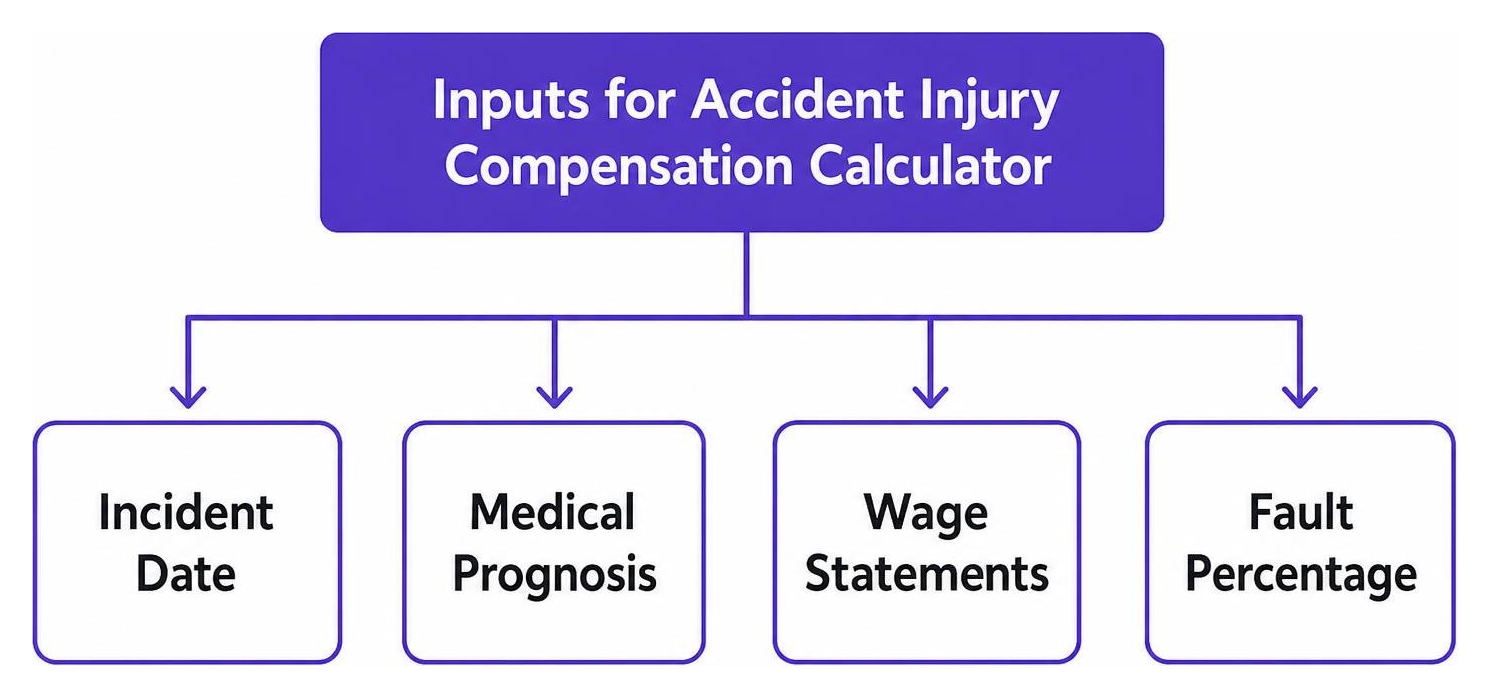
Before running an accident injury compensation calculator, collect the following key inputs:
- Exact Accident Date: Confirms whether your claim falls within the statutory limitation period and identifies which legal tariff schedule applies.
- Injury Severity & Prognosis Period: Detailed medical documentation establishing how long full recovery will take.
- Detailed Financial Records: Wage slips, tax filings, timecards, and receipts documenting lost earnings, missed overtime, and medical expenses.
- Care Hours Log: Records of exact hours friends or relatives spent providing unpaid domestic assistance.
- Age at Incident: Used to compute long-term future financial losses and pension adjustments.
To run scenarios with these inputs, try our Realistic Settlement Calculator.
Next Steps After Getting Your Compensation Estimate
Once an accident injury compensation calculator provides a preliminary estimate, you can take practical steps to convert that digital projection into actual financial recovery.
Follow this step-by-step framework:
- Obtain an Independent Medical Assessment: Do not rely solely on initial emergency room notes. Schedule a formal examination with an accredited medical expert who can draft a thorough prognosis report.
- Consolidate All Receipts and Financial Proof: Build a folder containing every pay stub, medical invoice, travel log, and care journal entry.
- Evaluate Your Claim Route: Decide whether to self-represent through a designated portal or retain a personal injury solicitor based on claim complexity and mixed-injury status.
- Submit a Formal Letter of Claim: Issue a detailed claim notification letter to the fault party’s insurance provider setting out liability grounds and itemized damages.
Navigating Lowball Offers and Insurance Adjusters
Insurance adjusters frequently issue early settlement offers soon after an accident. These initial “lowball” offers are designed to settle claims before the full extent of your physical injuries and financial losses is known.
If an insurer presents an early offer that falls below your estimated calculator breakdown:
- Do Not Panic or Accept Prematurely: Once you sign a full liability release, you cannot reopen your claim even if your injuries worsen later.
- Compare Against Independent Prognosis Data: Ensure the offer reflects your expert medical report rather than the insurer’s optimistic timelines.
- Issue a Detailed Written Counteroffer: Submit a written response explaining why the offer is inadequate, supported by wage records and medical evidence.
Learn proven negotiation strategies in our guide on How to Handle a Lowball Car Accident Settlement Offer.
Frequently Asked Questions about Injury Calculators
Are online accident injury calculators completely accurate?
No. An accident injury compensation calculator provides an estimated baseline range based on algorithms, statutory guidelines, and user inputs. It cannot evaluate subjective witness credibility, subtle medical complexities, or local court nuances. Formal valuations require a comprehensive medical assessment and review by a legal professional.
How does the date of the accident affect compensation tariffs?
The date of the accident dictates which legal statutory framework applies. For instance, UK whiplash claims subject to statutory tariffs use the rate schedule active on the exact date of the collision. Tariff schedules updated on 31 May 2025 apply only to accidents occurring on or after that date. Older incidents are governed by previous tariff schedules or earlier Judicial College Guidelines editions.
Will using a compensation calculator trigger unwanted contact from solicitors?
Legitimate financial education tools allow you to calculate figures anonymously without submitting personal contact details. However, marketing lead-generation tools require your phone number or email address before revealing results. Always check the site’s privacy policy to ensure your details will not be sold or passed to third-party solicitor panels without explicit consent.
Conclusion
An accident injury compensation calculator is a powerful starting point for understanding your claim’s financial value. By breaking down your potential award into general damages for pain and suffering and special damages for financial losses, these tools help you set realistic expectations.
Gross claim estimates differ from your net take-home pay. Factoring in potential shared fault deductions, solicitor success fees (capped at 25%), and ATE insurance premiums gives you a clear picture of what you will actually receive. Armed with clear medical evidence and documented financial records, you can counter lowball insurance offers and pursue fair compensation.
Ready to take the next step in evaluating your injury claim? Connect with Top Legal Experts today to receive personalized guidance tailored to your case.


