


What You’ll Actually Pay a Personal Injury Lawyer (And Why It’s Less Scary Than You Think)
How much does a personal injury lawyer cost is one of the first questions injured people ask — and the short answer is: usually nothing upfront.
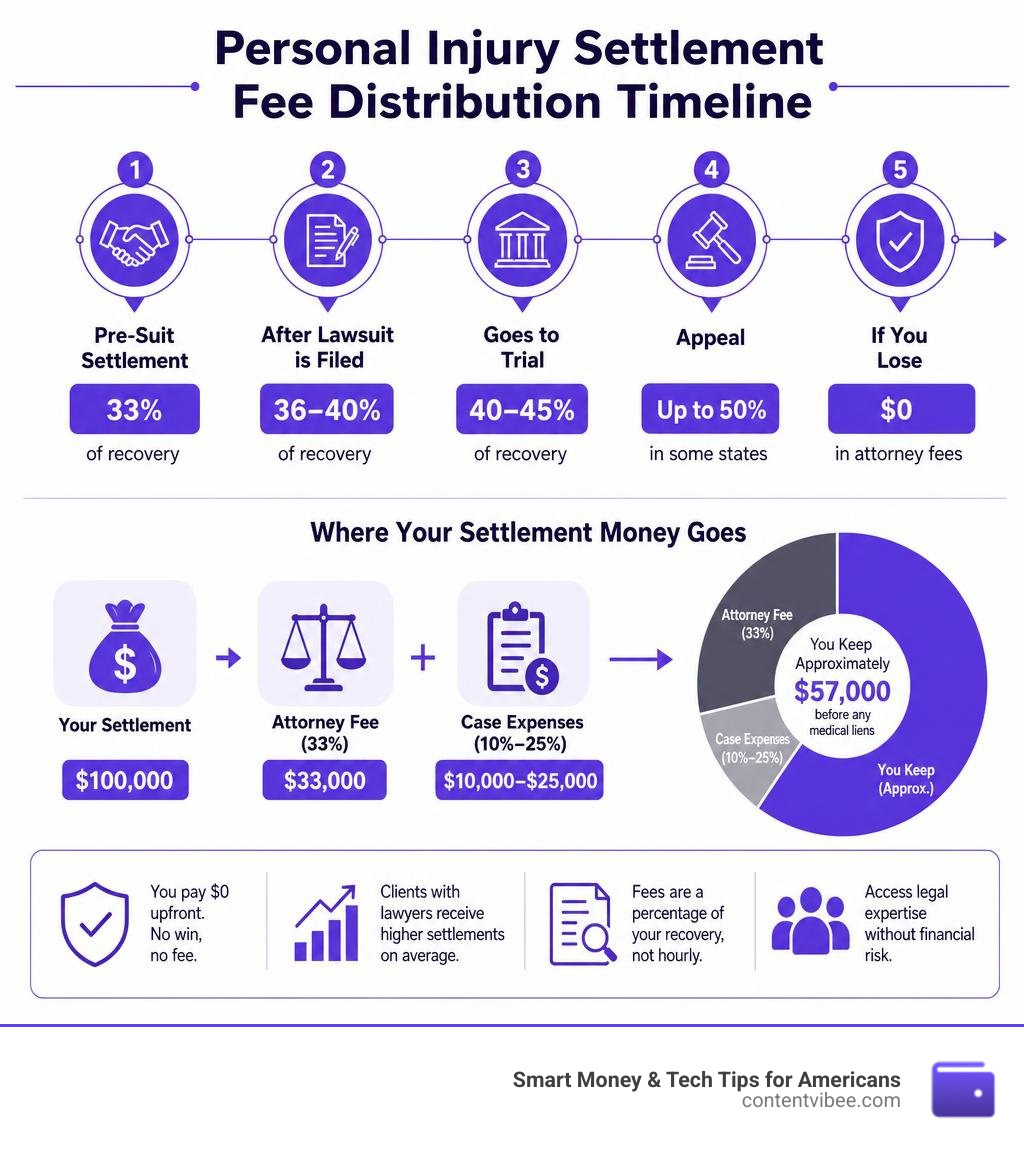
Here’s a quick breakdown:
| Case Stage | Typical Lawyer Fee |
|---|---|
| Pre-suit settlement | 33% of recovery |
| After lawsuit is filed | 36–40% of recovery |
| Goes to trial | 40–45% of recovery |
| Appeal | Up to 50% in some states |
| If you lose | $0 in attorney fees |
The key facts to know right away:
- Most personal injury lawyers work on a contingency fee — they only get paid if you win
- The standard fee is one-third (33%) of your settlement for cases that resolve before a lawsuit is filed
- On top of that fee, case expenses (court filings, expert witnesses, medical records) typically add another 10–25%
- Clients represented by an attorney receive settlements averaging 3.5 times higher than those who go it alone
So on a $100,000 settlement, you might pay roughly $33,000 in attorney fees plus $10,000 in expenses — keeping around $57,000 before any medical liens are resolved.
That math still tends to work in your favor. Research consistently shows that represented claimants walk away with more money in their pocket — even after fees — than people who negotiate directly with insurance companies.
Read on for a full breakdown of how fees work, what hidden costs to watch for, and how to make sure you’re getting a fair deal before you sign anything.
How Much Does a Personal Injury Lawyer Cost Under the Contingency Fee Model?
When you’re dealing with physical pain, doctor visits, and missed time at work, the last thing you want to worry about is paying a lawyer hundreds of dollars an hour. Fortunately, the personal injury legal market is built on a structure designed to keep representation accessible: the contingency fee model.
Unlike corporate attorneys who bill by the hour, or criminal defense lawyers who often charge flat upfront retainers, personal injury lawyers operate under a “no win, no fee” guarantee. This means their payment is entirely contingent upon successfully recovering money for you through a settlement or a court verdict. If they recover nothing, you owe them nothing for their time.
But why do law firms take on this level of financial risk? It comes down to a built-in risk premium. Because personal injury attorneys invest dozens or even hundreds of hours of work into a case with no guarantee of payment, the percentage they charge when they win compensates them for the cases they inevitably lose. This model aligns your attorney’s financial interests directly with yours: the more money they recover for you, the more they earn for their firm.

Before you sign any paperwork, it is essential to understand how this payment structure impacts your final payout. For a deeper dive into the mechanics of these agreements, check out our guide on understanding contingency fees and accident claims.
The Standard Contingency Fee Percentages in 2026
In 2026, the standard contingency fee for a personal injury attorney in the United States typically ranges between 33% and 40% of the gross recovery.
While the “one-third rule” (33.3%) remains the baseline for cases settled out of court, several factors can cause this percentage to shift. Many law firms utilize a sliding scale or a tiered fee agreement. For simple, clear-cut cases — like a straightforward rear-end collision where liability is obvious — some attorneys may agree to a slightly lower percentage. Conversely, highly complex cases like medical malpractice, product liability, or commercial truck accidents often command higher percentages due to the immense resources required to build them.
To understand how these standard rates compare to other practice areas and what you can expect to pay across the industry, read our comprehensive 2026 guide to legal fees.
How Case Stages Affect How Much Does a Personal Injury Lawyer Cost
The total fee you pay is rarely set in stone; instead, it usually escalates based on the procedural stage at which your case resolves. The closer a case gets to a courtroom, the more work, time, and financial risk the attorney must absorb.
Here is how the contingency fee percentage typically rises as your claim progresses:
- Pre-Suit Settlement (25% – 33.3%): If your attorney can negotiate a fair settlement with the insurance company before filing a formal lawsuit in court, you will pay the lowest fee tier. This stage involves gathering medical records, drafting a demand letter, and negotiating with insurance adjusters.
- Post-Filing but Pre-Trial (36% – 40%): If the insurance company refuses to offer a reasonable settlement, your lawyer will file a formal lawsuit. Once the complaint is filed, the litigation phase begins, which includes depositions, written discovery, and motions. Because of the increased workload, the fee typically bumps up to 36% or 40%.
- Trial Verdict (40% – 45%): Fewer than 5% of personal injury cases actually go to a jury trial. However, if your case is one of them, preparing for and executing a trial requires an enormous amount of time and energy. At this stage, the fee is almost always at least 40%.
- Appeals (45% – 50%): If you win at trial but the defense appeals the verdict, your attorney must write appellate briefs and present oral arguments. Some agreements specify that the fee will rise to 50% to account for this highly specialized work.
Understanding these milestones helps you weigh settlement offers logically. For instance, accepting a slightly lower settlement pre-suit might net you more money than a slightly higher offer after a lawsuit is filed, simply because of the lower fee tier. For more details on how these stages impact your bottom line, read our article on how much do lawyers charge for accident claims.
Beyond the Percentage: Additional Costs and Case Expenses
When calculating how much does personal injury lawyer cost, many people overlook the difference between attorney fees and case expenses. The contingency percentage only covers the lawyer’s labor. Building a strong legal case also requires out-of-pocket expenses, which are separate from the attorney’s fee.

These case expenses commonly include:
- Court Filing Fees: Charging between $100 and $500 to open a lawsuit in civil court.
- Medical Records Retrieval: Hospitals and clinics charge administrative fees to copy and send your medical history.
- Deposition Transcripts: Court reporters charge per page (averaging $5 to $8 per page) to transcribe sworn testimonies.
- Expert Witness Fees: Medical experts, accident reconstructionists, and life-care planners charge premium rates to analyze your case and testify. Medical experts often charge $500 to $1,000+ per hour.
- Investigation & Travel: Fees for police reports, private investigators, and travel costs.
Depending on the complexity of your injury, these expenses can range from a few hundred dollars to tens of thousands of dollars. To learn more about how these costs accumulate, see what to expect with personal injury lawyer costs.
Here is a comparison of typical expenses for a minor pre-litigation settlement versus a fully litigated trial:
| Expense Category | Pre-Litigation Settlement (Average) | Full Trial Case (Average) |
|---|---|---|
| Filing & Court Fees | $0 | $300 – $500 |
| Medical Records | $50 – $200 | $200 – $1,000 |
| Expert Witnesses | $0 | $5,000 – $30,000+ |
| Depositions & Transcripts | $0 | $2,000 – $10,000 |
| Total Estimated Expenses | $50 – $250 | $7,300 – $41,500+ |
Gross vs. Net Settlement Calculations
One of the most critical clauses in any personal injury representation agreement is whether the attorney’s fee is calculated using the gross method or the net method. This distinction can result in thousands of dollars of difference in your final take-home payout.
- The Gross Method (Standard): The attorney calculates their fee percentage based on the total settlement before any case expenses are deducted.
- The Net Method: The attorney deducts case expenses from the total settlement first, and then calculates their fee percentage on the remaining balance.
Let’s look at how this plays out on a $100,000 settlement with a 33.3% fee and $10,000 in case expenses:
| Calculation Step | Gross Method | Net Method |
|---|---|---|
| Total Settlement | $100,000 | $100,000 |
| Less Case Expenses | $10,000 (deducted after fee) | $10,000 (deducted before fee) |
| Basis for Attorney Fee | $100,000 | $90,000 |
| Attorney Fee (33.3%) | $33,300 | $29,970 |
| Final Client Payout | $56,700 | $60,030 |
As you can see, the net method leaves an extra $3,330 in your pocket. Always read your retainer agreement carefully to identify which method your lawyer uses. For a deeper explanation of these calculations, read our guide on the truth about lawyer fees and what they actually take.
Additionally, before you receive your final check, your attorney is legally required to resolve any medical liens. If your health insurance, Medicare, or a hospital paid for your treatment after the accident, they have a right to be reimbursed from your settlement. Your attorney will negotiate with these lien holders to reduce what you owe, maximizing your final take-home recovery.
Evaluating the Value: Is Hiring a Personal Injury Attorney Worth It?
Given that a lawyer can take 33% to 40% of your settlement, plus expenses, you might wonder: Is it cheaper to handle the claim myself?
While a do-it-yourself (DIY) approach might work for minor parking lot dings with no bodily injuries, hiring an attorney is almost always financially advantageous for moderate to severe injuries. According to data from the Insurance Research Council (IRC), injured claimants who hire attorneys receive settlements averaging 3.5 times higher than those who represent themselves.
Why is there such a massive gap?
- Insurance Adjuster Dynamics: Insurance companies are profit-driven corporations. They know unrepresented claimants do not know the true value of their claim and cannot threaten a lawsuit. Consequently, they routinely offer lowball settlements.
- Legal Expertise: Attorneys understand how to calculate non-economic damages, such as pain and suffering, loss of enjoyment of life, and future medical costs.
- The Threat of Litigation: Insurance companies are far more likely to settle for a fair amount when they know the attorney on the other side has trial experience and is willing to file a lawsuit.
Even after deducting attorney fees and expenses, your net take-home recovery is typically much higher with professional representation. To see real-world examples of how hiring a lawyer impacts your final payout, read how much does a personal injury lawyer cost and what you actually pay.
State Laws and Fee Regulations
State rules play a significant role in governing attorney fees. While the American Bar Association (ABA) Model Rule 1.5 requires all legal fees to be “reasonable,” some states impose strict statutory limits on what a personal injury attorney can charge.
For example, Florida has specific statutory caps on contingency fees that scale down as the recovery amount increases (especially for settlements exceeding $1 million). Florida also enforces unique rules for medical malpractice cases. Similarly, California has a sliding scale for medical malpractice cases under MICRA (Medical Injury Compensation Reform Act), which caps fees at 40% of the first $50,000 and drops down to 15% for any recovery exceeding $600,000.
These state-specific rules are designed to protect consumers from excessive fees. If you are filing a claim in the Sunshine State, make sure you understand how local rules apply by reading how much do personal injury lawyers charge in Florida.
How to Negotiate and Understand Your Fee Agreement
Many people do not realize that personal injury attorney fees are negotiable. While highly sought-after, experienced trial attorneys rarely discount their standard rates, you have negotiating leverage if your case is strong, liability is clear, and the defendant has a large insurance policy.
When evaluating a fee agreement, keep these strategies in mind:
- Ask for a Tiered Structure: Request a lower percentage (e.g., 25% or 30%) if the case settles quickly before a lawsuit is filed.
- Negotiate the Expense Order: Push for the “net method” of calculating fees so that expenses are deducted before the attorney’s percentage is taken.
- Request a Costs Cap: Ask your lawyer to cap out-of-pocket litigation expenses at a specific dollar amount unless they obtain your written permission to exceed it.
Never sign a retainer agreement until you have read it thoroughly and understand every clause. For a detailed checklist of what to look for in a representation contract, refer to our article on how much does a personal injury lawyer charge.
Frequently Asked Questions About Personal Injury Lawyer Costs
FAQ 1: Can you negotiate how much does personal injury lawyer cost?
Yes, you can negotiate the contingency fee percentage. While many law firms start with a standard 33.3% or 40% rate, these numbers are not set by law for general personal injury claims. If your case involves clear liability (such as being hit by a commercial vehicle with a dashcam recording the incident) and high-value damages, the risk to the law firm is low. In these scenarios, you can request a fee discount or a tiered structure that keeps the rate lower if the case resolves early.
FAQ 2: What happens to case expenses if I lose my case?
Under a standard “no win, no fee” contingency agreement, you owe $0 in attorney fees if your case is unsuccessful. However, case expenses are separate.
Depending on how your retainer agreement is written, you might still be responsible for reimbursing the law firm for advanced costs (like expert witness fees or filing fees) even if you lose. Fortunately, most reputable personal injury firms will write off these expenses if they do not win your case. Always confirm this in writing before signing. For more details on protecting yourself from hidden costs, check out how much does it cost to hire an attorney.
FAQ 3: Are personal injury settlements taxable?
According to the IRS, proceeds from a personal injury settlement or verdict that compensate for physical sickness or physical injuries are non-taxable. This includes compensation for medical bills, pain and suffering, emotional distress stemming from the physical injury, and loss of consortium.
However, there are exceptions. If you receive punitive damages, or if you receive interest on your settlement, those specific portions are taxable. Additionally, if you claim a tax deduction for your medical expenses in prior years, you must report that portion of the settlement as taxable income.
Conclusion
Navigating the aftermath of an accident is stressful enough without the added fear of unpredictable legal bills. By utilizing the contingency fee model, the personal injury legal system ensures that anyone can access high-quality representation, regardless of their financial situation.
At ContentVibee, we believe that understanding your legal rights and the financial mechanics of your case is the best way to plan for a secure financial recovery. Before you hire an attorney, take the time to evaluate their fee agreement, clarify how expenses are handled, and run the math on your potential settlement.
If you are ready to take the next step and want a deeper look at the average costs of representation across the country, explore our comprehensive resources on personal injury claims.


