


What Is the Formula for Pain and Suffering Settlement — and What Should You Expect?
The formula for pain and suffering settlement is not a single fixed equation — but there are two widely used methods that attorneys, insurance adjusters, and courts rely on to put a dollar value on your pain.
Here’s the quick answer:
The Two Main Formulas:
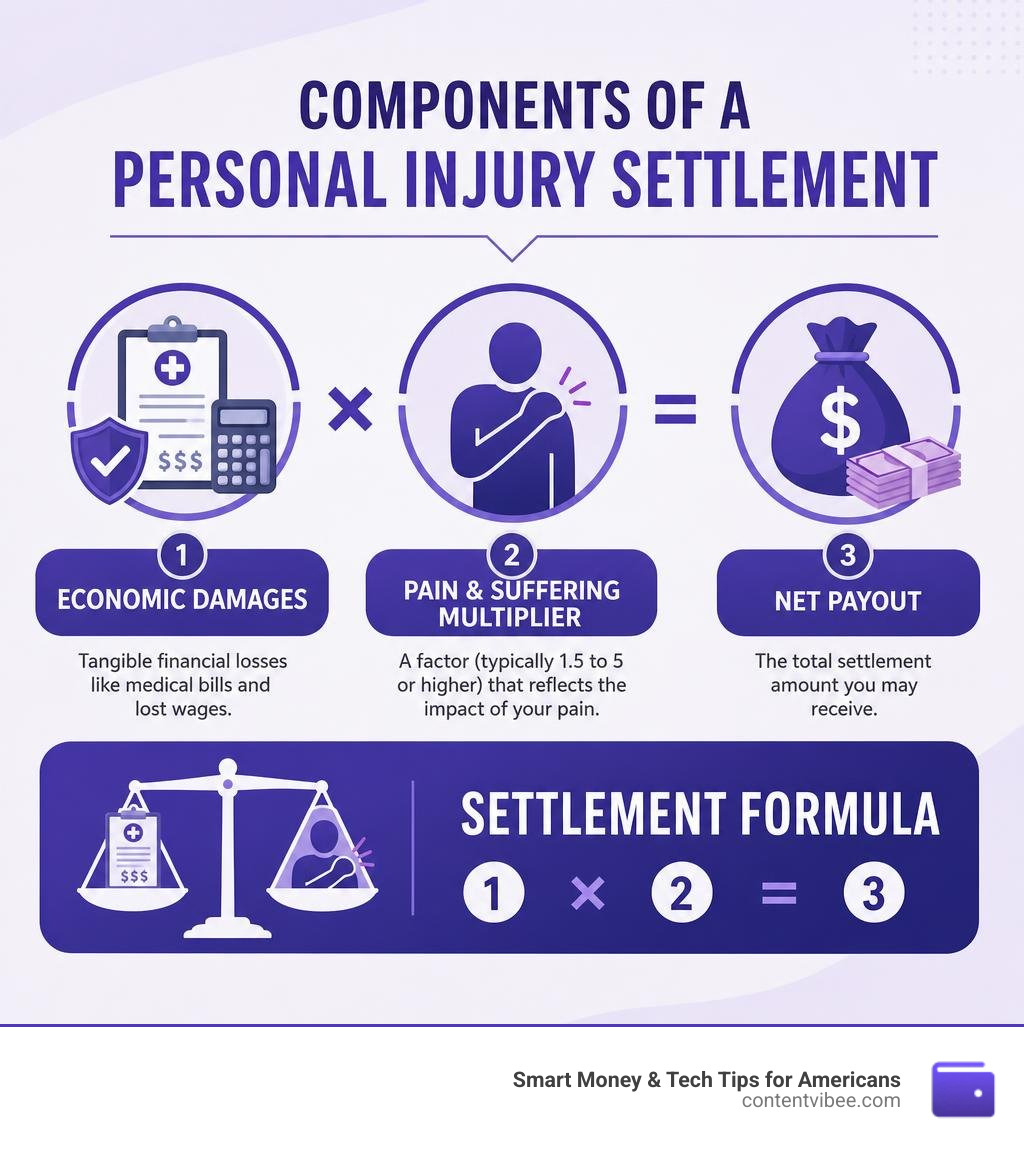
Multiplier Method — Add up your economic damages (medical bills + lost wages), then multiply by a number between 1.5 and 5 (or higher for catastrophic injuries).
- Example: $20,000 in medical bills × 3 = $60,000 in pain and suffering
Per Diem Method — Assign a daily dollar rate to your suffering, then multiply by the number of days you experienced pain.
- Example: $200/day × 180 days = $36,000 in pain and suffering
Most insurance companies use the multiplier method as their starting point. The multiplier they choose — and the one you push for — can make a dramatic difference in your final payout.
Here’s the problem: insurers are trained to anchor low. Their first offer is typically 30–50% below fair value. And their internal software (like Colossus) is configured to minimize payouts — not reflect your actual suffering.
Understanding how the formula works puts you in a much stronger negotiating position.
Economic vs. Non-Economic Damages: What’s Included?
When you file a personal injury claim, your damages are split into two primary buckets: economic damages (often called “special damages”) and non-economic damages (referred to as “general damages”).

To successfully apply the formula for pain and suffering settlement, you must first understand what goes into each bucket.
Economic Damages (Special Damages)
These are the objective, out-of-pocket financial losses resulting from your injury. Because they come with receipts, invoices, and pay stubs, they are relatively easy to calculate. They include:
- Medical bills: Emergency room visits, surgeries, prescription medications, physical therapy, and future medical care.
- Lost wages: The income you lost while recovering from your injuries.
- Loss of earning capacity: If your injuries prevent you from returning to your previous job or working at all in the future.
- Property damage: The cost to repair or replace your vehicle or other personal belongings damaged in the accident.
Non-Economic Damages (General Damages)
These represent the subjective, non-monetary impact of the injury on your life. This is where “pain and suffering” lives. Because there is no invoice for physical agony or emotional trauma, putting a dollar figure on these losses is highly complex. They include:
- Physical pain and discomfort: The actual physical hurt caused by your injuries and medical treatments.
- Emotional distress and psychological harm: Anxiety, depression, PTSD, sleep disturbances, and fear.
- Loss of enjoyment of life: The inability to participate in hobbies, recreational activities, or daily pleasures you enjoyed before the accident.
- Loss of consortium: The negative impact of the injury on your relationship with your spouse or family members.
- Disfigurement and scarring: The psychological and physical toll of permanent visible changes to your body.
Non-economic damages often drive the bulk of a personal injury settlement’s value, sometimes accounting for 50% to 80% of the total payout. To get a deeper look at how these elements interact, read our guide on The Car Accident Settlement Formula And How To Beat It.
The Standard Formula for Pain and Suffering Settlement: Multiplier vs. Per Diem
When negotiating a personal injury settlement, attorneys and insurance adjusters generally rely on two primary calculation methods.

To see how these two methodologies compare side-by-side, look at the table below:
| Feature | The Multiplier Method | The Per Diem Method |
|---|---|---|
| Primary Base | Total economic damages (medical bills + lost wages) | A daily rate (often tied to your daily wage) |
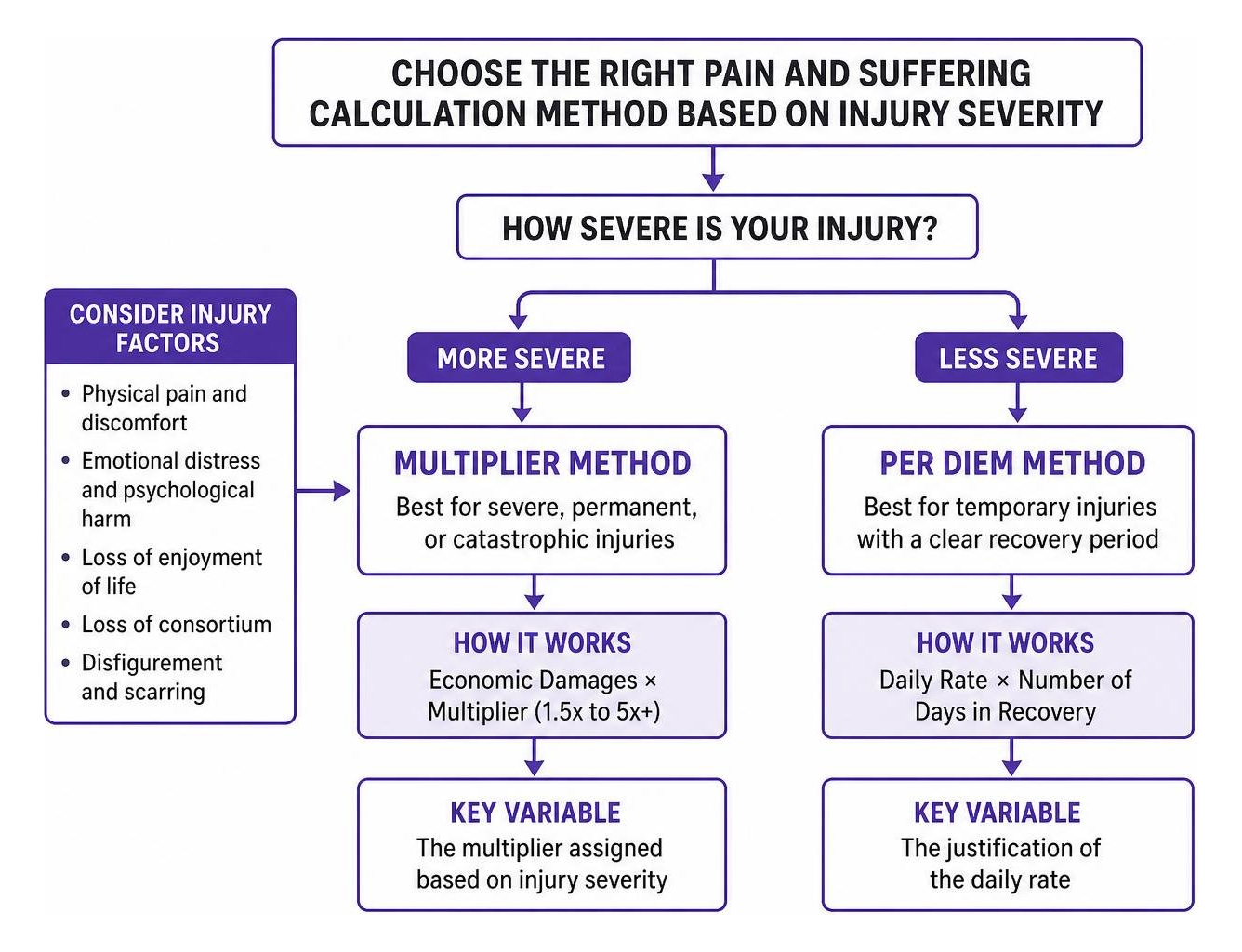
| Calculation | Economic Damages × Multiplier (1.5x to 5x+) | Daily Rate × Number of Days in Recovery |
| Best Suited For | Severe, permanent, or catastrophic injuries | Temporary injuries with a clear, defined recovery period |
| Insurance Preference | Highly preferred as a starting negotiation point | Rarely accepted by insurers for long-term claims |
| Key Variable | The multiplier assigned based on injury severity | The justification of the daily rate |
To help you visualize how to approach your valuation, we have outlined the decision-making process:
The Multiplier Method: Scaling by Injury Severity
The multiplier method is the most common formula for pain and suffering settlement used in the insurance industry. The basic premise is simple: the more severe your physical injuries, the more pain and suffering you must have endured.
Under this method, your total economic damages are multiplied by a number (the “multiplier”), typically ranging from 1.5 on the low end to 5 (or higher) on the high end.
The multiplier bands generally break down as follows:
- Minor Injuries (1.5x to 2.5x): Soft tissue injuries, minor whiplash, sprains, or bruises that resolve within a few weeks or months without surgery.
- Moderate Injuries (2.5x to 4.0x): Simple bone fractures, deep lacerations, moderate whiplash, or herniated discs that require physical therapy, specialized treatment, or minor medical procedures.
- Severe Injuries (4.0x to 6.0x): Compound fractures, injuries requiring major surgical interventions, moderate traumatic brain injuries (TBIs), or nerve damage with lasting effects.
- Catastrophic Injuries (6.0x to 10.0x+): Permanent paralysis, loss of limbs, severe TBIs, spinal cord damage, or permanent disfigurement.
For example, if you sustained a fractured arm in an accident resulting in $15,000 in medical bills and $5,000 in lost wages ($20,000 total economic damages), a moderate multiplier of 3.0 would yield $60,000 in pain and suffering damages, bringing your total estimated settlement value to $80,000.
To run your own numbers using this framework, you can use our Car Accident Settlement Calculator.
The Per Diem Method: Calculating a Daily Rate
The per diem (daily rate) method calculates your pain and suffering by assigning a specific dollar value to each day you had to live with the pain of your injuries, starting from the day of the accident until you reach Maximum Medical Improvement (MMI).
The formula is straightforward:
$$\text{Daily Rate} \times \text{Number of Days in Recovery} = \text{Pain and Suffering Value}$$
The biggest challenge with the per diem method is justifying the daily rate. A common, highly defensible strategy is to use your actual daily earnings as the benchmark. The logic is that living with the daily pain and disruption of an injury is at least as difficult as a regular day of work.
Example: If you earn an annual salary of $50,000, and work 250 days a year, your daily wage is $200. If it takes you 120 days to fully recover from your injuries, your pain and suffering calculation would be:
$$\$200/\text{day} \times 120\text{ days} = \$24,000$$
While this method is highly logical for temporary injuries with a clear recovery timeline, it is rarely appropriate for permanent or long-term injuries. Insurers will flatly reject a per diem calculation that stretches over decades, as the final sum would be extraordinarily high.
How Insurance Companies Use the Formula for Pain and Suffering Settlement
If you think an insurance adjuster sits at their desk with a calculator manually multiplying your bills by three, think again. In 2026, major insurance carriers rely heavily on proprietary claims-evaluation software like Colossus, Claim IQ, and Liability Navigator.
These algorithmic systems are designed to standardize payouts and, more importantly, protect the insurance company’s bottom line. Here is how they typically work:
- Data Input: The adjuster enters your medical diagnostic codes (ICD codes), the types of doctors you saw (specialists vs. general practitioners), and the duration of your treatment.
- Algorithmic Weighting: The software assigns points to your injuries. It heavily weights objective medical findings (like an X-ray showing a broken bone or an MRI showing a torn ligament) while heavily discounting subjective complaints of pain, anxiety, or emotional distress.
- Lowball Anchoring: The system generates a settlement range. Because the software is configured to minimize risk and cost, the adjuster’s opening offer is often anchored at the absolute bottom of this range — sometimes just 35% to 55% of the claim’s true value.
To beat the insurance adjuster’s software, you must feed it what it wants: objective, undeniable medical documentation that justifies a higher multiplier or daily rate.
Critical Factors That Adjust Your Settlement Value
No two personal injury cases are identical. Even if two people suffer the exact same injury, their pain and suffering payouts can vary wildly based on several critical factors.
Injury Severity and Recovery Time
A permanent injury or one requiring surgical intervention will naturally command a higher multiplier than a soft tissue injury that heals with a few weeks of rest. The longer your recovery period, the more days of suffering you can document.
Impact on Daily Life and Occupation
The subjective nature of pain and suffering means your lifestyle and career play a massive role in your claim’s value. For instance, if an avid runner or a professional piano teacher suffers a severe finger or foot injury, the loss of enjoyment of life and career impact is far greater than it would be for someone with a sedentary lifestyle. This unique impact justifies a much higher multiplier.
Clear Liability
If the other party was 100% at fault (such as a drunk driver rear-ending you while you were stopped at a red light), the insurance company knows a jury would be highly sympathetic to you. This gives you leverage to demand a higher multiplier. If liability is shared, your leverage drops.
State Laws and Restrictions
The legal landscape of your state dramatically impacts the final math of your settlement:
- Comparative Negligence: Many states follow comparative negligence rules. For example, California follows pure comparative negligence, meaning if you are found 20% at fault for an accident, your final pain and suffering award is reduced by 20%.
- Damage Caps: Some states limit how much you can recover for non-economic damages. In Tennessee, the statutory cap for non-economic damages is generally $750,000 for most personal injury cases. In California, medical malpractice non-economic damages are capped at $250,000 under MICRA (though this cap does not apply to auto accidents or slip-and-falls). Conversely, Washington state has no statutory caps on pain and suffering compensation in personal injury cases.
- No-Fault Thresholds: In Kentucky, which operates under a no-fault insurance system, you cannot claim pain and suffering damages unless you meet a specific threshold: more than $1,000 in medical expenses, a broken bone, permanent injury, or death.
Why Online Calculators Can’t Perfect the Formula for Pain and Suffering Settlement
It is incredibly tempting to jump online, plug three numbers into a free “settlement estimator,” and assume the resulting number is what your case is worth. However, online calculators have severe limitations.
Algorithms cannot evaluate human variables. They cannot look at your scar and see how it affects your self-esteem. They cannot read your daily journal entries to feel the depth of your depression. They cannot assess your credibility as a witness, nor can they predict how sympathetic a local jury might be to your specific situation.
Furthermore, online tools cannot evaluate pre-existing conditions, which insurance adjusters frequently use to argue that your pain was not caused by the accident. While calculators are excellent for establishing a baseline range, relying solely on them to negotiate can lead to leaving tens of thousands of dollars on the table.
For a complete breakdown of when you can handle a claim yourself versus when you need professional help, read our analysis on Diy Vs Attorney Can You Handle Your Car Accident Settlement Alone.
To explore the baseline math further, you can check out these reputable online estimation resources:
- Pain and Suffering Calculator – Estimate General Damages | LawsuitSettlementEstimator.com
- Pain and Suffering Calculator: How to Calculate Your Damages (2026) | SetCalc
- Pain and Suffering Calculator 2026 — Free Settlement Estimator
- How Is Pain and Suffering Calculated? Complete 2026 Guide | ClaimCalc
- Pain and Suffering Calculator: How To Calculate Your Settlement Amount – d2law.com
- Free pain and suffering calculator 2026 – devcalculator.com
How to Document Your Claim to Maximize Recovery
To successfully demand a higher multiplier or daily rate, you must build an undeniable paper trail from day one. Because pain is subjective, objective documentation is your most powerful weapon.
Here is how you can build a rock-solid case:
- Be Explicit with Your Doctors: Do not play the hero. When speaking to your physicians, physical therapists, or specialists, describe your pain and physical limitations in detail. Ensure they write these details down so they are hardcoded into your official medical records.
- Keep a Daily Pain Journal: Write down your daily pain levels on a scale of 1 to 10. Document specific limitations, such as: “Could not sleep more than 3 hours due to throbbing neck pain,” or “Missed my daughter’s graduation because I couldn’t sit in a chair for more than 15 minutes.”
- Gather Witness Statements: Obtain written statements from family members, friends, neighbors, and coworkers. They can describe how the injury has visibly changed your mood, energy levels, and ability to perform daily tasks.
- Document Mental Health Treatment: If you are experiencing anxiety, depression, or PTSD after the accident, seek professional therapy. Clinical notes from a licensed therapist or psychiatrist are incredibly powerful evidence of emotional distress.
- Ensure Strict Treatment Compliance: Attend all doctor appointments and physical therapy sessions. If you skip treatments or allow large gaps in your care, the insurance adjuster will use their software to argue that your pain was not severe enough to warrant compensation.
Frequently Asked Questions About Pain and Suffering Formulas
Is pain and suffering compensation taxable under federal law?
Generally, no. Under Internal Revenue Code (IRC) Section 104(a)(2), settlement proceeds received on account of personal physical injuries or physical sickness are entirely tax-free. This tax-exempt status extends to the pain and suffering portion of your settlement, provided it originates from a physical injury.
However, there are exceptions. If you receive compensation for purely emotional distress that did not originate from a physical injury, that portion of the settlement is taxable. Additionally, any punitive damages awarded to punish the negligent party are always taxable.
How do state damage caps affect my pain and suffering payout?
State damage caps place a hard statutory limit on the amount of non-economic damages you can recover, regardless of what any formula for pain and suffering settlement calculates.
For example, if you reside in Tennessee, your non-economic damages are capped at $750,000 for most personal injury cases. If you are filing a medical malpractice claim in California, your pain and suffering damages are subject to the MICRA cap of $250,000. It is vital to check your local state laws, as a statutory cap can instantly slash a high-value jury verdict or settlement negotiation.
When should I hire a personal injury attorney instead of settling myself?
If your injuries are minor (such as soft tissue sprains), your medical bills are under $3,000, and you fully recover within a few weeks, you can likely handle the claim yourself.
However, you should almost certainly hire an experienced personal injury attorney if:
- Your injuries require surgery, result in permanent impairment, or cause visible scarring.
- Liability is disputed, or the insurance company is blaming you for the accident.
- Your medical bills and lost wages exceed $10,000.
- You are dealing with complex state laws, multiple insurance policies, or medical liens.
According to data from the Insurance Research Council, represented claimants recover roughly 3.5 times more on average than those who represent themselves — even after accounting for attorney contingency fees.
To learn more about how lawyer fees are structured, read our detailed guides on Demystifying Personal Injury Lawyer Fees And Contingency Percentages and Will A Car Accident Lawyer Take All My Money Understanding Contingency Fees.
Conclusion
Cracking the code of the formula for pain and suffering settlement is all about understanding the math that insurers use and learning how to counter it with solid, objective evidence. Whether you utilize the multiplier method or the per diem method, the strength of your documentation will ultimately dictate the success of your negotiation.
At Smart Money & Tech Tips for Americans, we believe that managing your personal finances also means protecting your financial health after an unexpected life event. Securing a fair settlement is the first step toward safeguarding your financial future and ensuring your long-term recovery is fully funded.
Ready to explore your options and run the numbers for your specific situation? Explore our suite of personal injury settlement calculators to get started:
- Realistic Settlement Calculator
- Personal Injury Settlement Calculator
- Structured Settlement Calculator
- Az Guide To How Much Is My Car Accident Settlement Worth