


Why Child Support Attorneys Matter When the Stakes Are High
Child support attorneys help parents navigate one of the most stressful parts of any separation or divorce – making sure children are financially protected and that court orders are fair, enforceable, and up to date.
If you need a quick answer on what these lawyers actually do, here it is:
What child support attorneys help with:
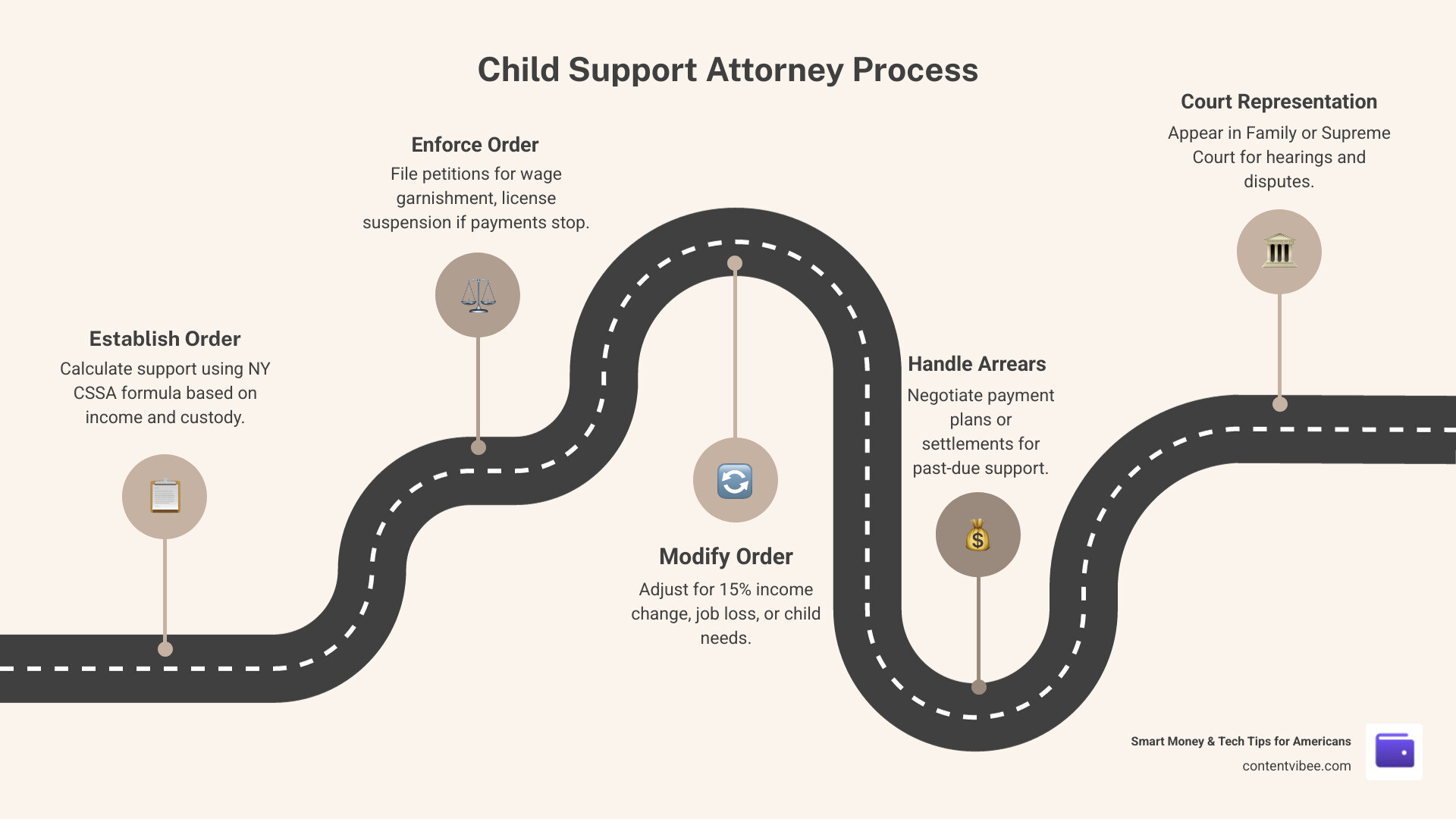
- Establishing orders – calculating the right amount under New York’s Child Support Standards Act (CSSA)
- Enforcing orders – taking legal action when a parent stops paying
- Modifying orders – changing support amounts when income or circumstances shift significantly
- Handling arrears – dealing with past-due support and payment disputes
- Representing you in court – Family Court or Supreme Court hearings, negotiations, and filings
Child support disputes can get complicated fast. Income changes, custody arrangements, add-on expenses like medical bills and childcare, and enforcement issues all affect what gets paid – and what doesn’t.
In New York alone, there is a high demand for experienced legal help in this area, reflecting the complexity of the state’s guidelines and the high stakes for families.
This guide breaks down how child support works in New York, how it’s calculated, when orders can change, and how to find the right attorney for your situation.
What Child Support Means in New York and Who Must Pay
In New York, child support is the legal duty of parents to contribute financially to their child’s upbringing. The key idea is simple: children should keep receiving financial support even if their parents separate, divorce, or were never married.
Both parents are responsible. Usually, the parent who has the child living with them most of the time is treated as the custodial parent, while the other parent is often the one who pays support. But “usually” does a lot of work here. Support is not based on labels alone. Income, custody arrangements, and parenting time all matter.
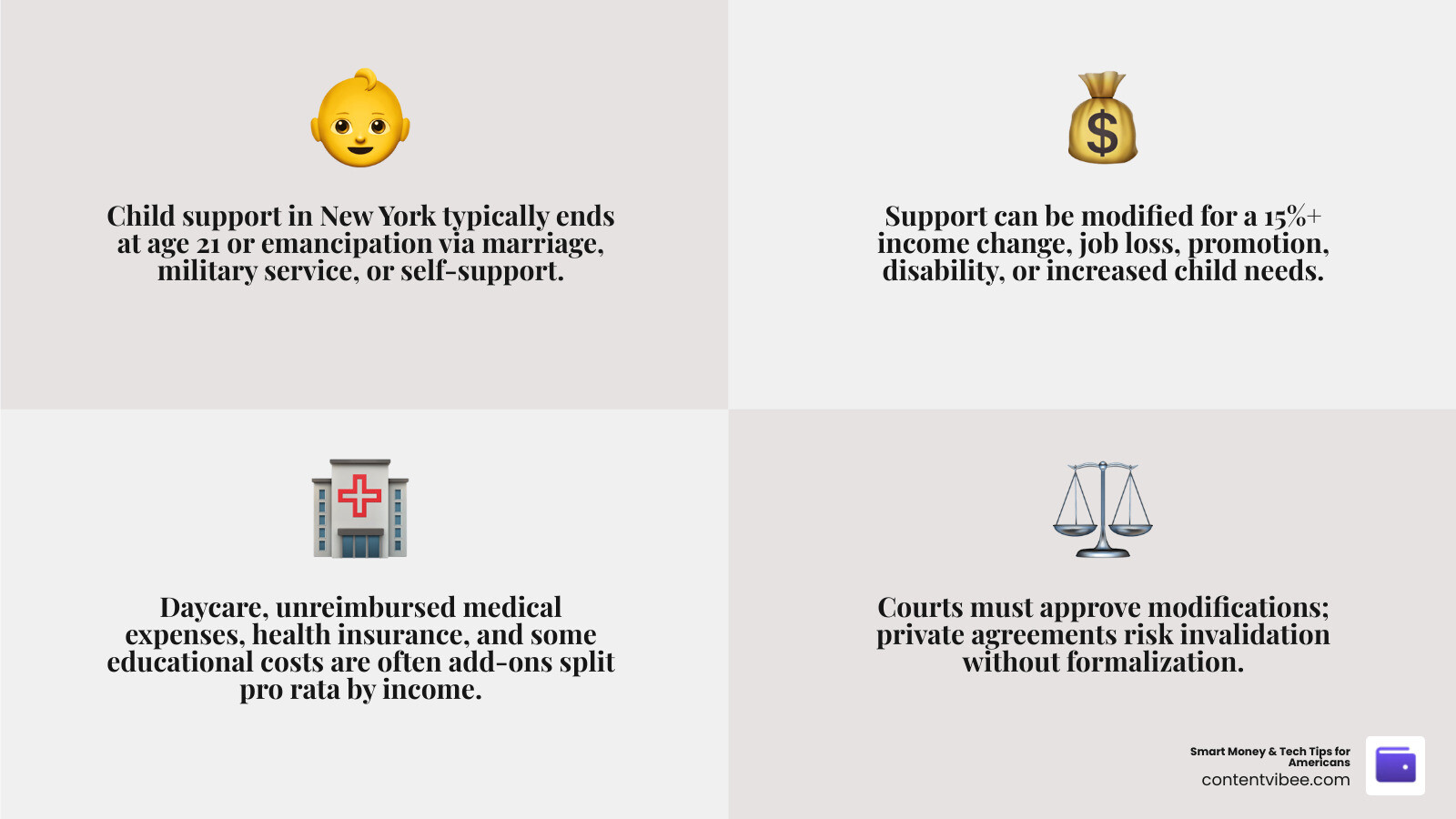
New York child support generally continues until the child turns 21. It can end earlier if the child becomes emancipated, such as through marriage, military service, or becoming fully self-supporting.
What child support covers beyond monthly basics
Child support is not just a monthly number pulled from thin air. It is meant to help cover a child’s real-life costs, including:
- Housing
- Food
- Clothing
- Utilities
- Health insurance
- Uninsured medical expenses
- Daycare and child care
- Educational costs
- Transportation and daily living needs
Some of these are wrapped into the base support amount, while others may be added on separately and split between parents based on income.

A common point of confusion is that parents think the basic monthly amount covers everything. It often does not. Extra expenses like child care needed for work, health insurance premiums, and certain medical or educational costs may be allocated separately on a pro rata basis.
Who is legally required to pay child support
A parent can be ordered to pay child support in several types of cases, including:
- Divorce cases
- Paternity cases
- Custody proceedings
- Family Court support proceedings
- Supreme Court matrimonial actions
The higher-earning parent often pays more, especially when there is a significant income gap. Parenting time can affect the analysis, but it does not automatically erase support. Even in shared custody arrangements, one parent may still owe support if that parent earns substantially more or if the child primarily resides with the other parent.
How New York Calculates Support Under the CSSA
New York uses the Child Support Standards Act, or CSSA, to calculate the presumptive amount of child support. This is the starting formula courts use before deciding whether any adjustments or deviations are appropriate.
Under the CSSA, the basic percentages are:
- 17% for one child
- 25% for two children
- 29% for three children
- 31% for four children
- At least 35% for five or more children
Traditionally, these percentages apply to combined parental income up to $80,000, and then the court has discretion on income above that amount. In higher-income cases, judges may apply the percentage above the cap, stop at the cap, or do something in between based on the facts.
How child support attorneys explain the CSSA formula
When child support attorneys walk clients through the formula, they usually break it down into manageable steps:
- Determine each parent’s income.
- Apply allowed deductions.
- Combine the parents’ incomes.
- Apply the correct percentage based on the number of children.
- Split the obligation between the parents based on their pro rata share of income.
- Add any required extra expenses.
Typical deductions can include certain taxes and other legally recognized adjustments. Then the court looks at each parent’s share of the combined income.
Here is a simple comparison:
| Category | Usually included? | How split? |
|---|---|---|
| Basic child support | Yes | Based on CSSA percentage and pro rata income |
| Health insurance for child | Often added on | Usually pro rata |
| Unreimbursed medical expenses | Often added on | Usually pro rata |
| Work-related child care | Often added on | Usually pro rata |
| Education-related costs | Sometimes added on | Depends on order or court ruling |
Attorneys also help clients understand that the worksheet matters. A small mistake in reported income, deductions, or add-on expenses can change the monthly amount in a very un-fun way.
Factors that can raise or lower the presumptive amount
The guideline amount is presumptively correct, but not untouchable. Courts may deviate when the standard formula would be unjust or inappropriate.
Factors that may influence the amount include:
- Parenting time and custody structure
- The child’s standard of living before the separation
- Special medical or developmental needs
- Child care costs
- Health-related expenses
- Educational costs
- Tax consequences
- Whether a parent supports other children
- Significant income disparity
- High combined parental income above the cap
In higher-income cases, courts may hold what practitioners often call a Casano hearing to evaluate whether the guideline should be extended above the cap and by how much. This is one area where legal help can matter a lot, because arguments about lifestyle, fairness, and the child’s needs can get technical fast.
How parenting schedules and unequal earnings affect support
Parenting schedules matter, but they do not work like a simple overnight calculator in every case.
If one parent has the child most of the time, support is usually more straightforward. If the parents share custody, things can get more contested. A court may still order one parent to pay support if that parent is the higher earner or if the other parent bears more day-to-day expenses.
For example:
- Equal parenting time does not always mean zero support
- A higher-earning parent may still owe support in shared custody
- A parent with fewer overnights often pays more
- Courts may consider whether one home carries more of the child’s routine expenses

This is one of the biggest reasons people hire child support attorneys. Support and custody are connected, but they are not the same thing.
When Orders End, Change, or Stay Owed
Child support orders do not last forever, but they also do not disappear just because life gets messy.
In New York, support usually ends at age 21 unless the child becomes emancipated sooner. Early emancipation may happen if the child:
- Marries
- Joins the military
- Becomes self-supporting
That said, if support was not paid when it was due, those arrears can survive even after the child is grown. In other words, the monthly obligation may end, but unpaid past-due support can still be collected.
When child support attorneys seek a modification
A child support order can sometimes be changed, but not just because one parent feels the amount is unfair on a Tuesday.
Courts typically look for a substantial change in circumstances. Based on the research, a 15% change in either party’s income is commonly treated as a strong reason to ask for modification. A three-year review may also be relevant in some cases, depending on the order and applicable rules.
Common reasons to seek a modification include:
- Job loss
- Promotion or major raise
- Disability
- Major change in health
- Increased needs of the child
- Big change in child care costs
- Significant change in parenting arrangements
A critical point: the order does not change automatically. A parent usually needs court approval. If someone keeps paying the old amount without filing, or stops paying without filing, that can create a nasty arrears problem.
Can child support arrears be reduced
Arrears are past-due child support. Once they accumulate, they are difficult to erase.
A key New York principle from the research is that courts generally do not just wipe out arrears because the owing parent asks nicely. In many situations, only the party owed the money can agree to forgive or reduce certain arrears. That makes prompt action essential.
Possible ways to deal with arrears include:
- Negotiating with the other parent where legally allowed
- Requesting a payment plan
- Challenging incorrect accounting
- Proving that credits should apply
- Seeking settlement options on enforceable terms
But in general, old support debt is much harder to fix than future support. That is why filing early matters.
What happens if a parent stops paying
Failing to pay court-ordered child support can trigger serious enforcement tools, including:
- Wage garnishment
- Money judgments
- Tax refund intercepts
- License suspension
- Passport denial
- Contempt proceedings
- Possible jail time in extreme cases
These consequences are one reason legal advice is worth getting early. If you are owed support, an attorney can help enforce. If you owe support but cannot pay, an attorney can help you seek modification before enforcement snowballs.
How Child Support Attorneys Help With Enforcement, Disputes, and Court
A lot of parents imagine child support cases are just math. They are not. They are math plus paperwork plus deadlines plus human conflict, which is a less fun equation.
Child support attorneys help with:
- Filing support petitions
- Bringing enforcement actions
- Seeking modifications
- Responding to objections
- Gathering financial disclosure
- Negotiating settlement terms
- Preparing evidence for hearings
- Representing clients in court or before support magistrates
They can also help clients review an existing agreement before it becomes a court order, which is important because a “deal” that sounds fair in the kitchen may look very different in a courtroom.
What a child support attorney actually does in a case
In a real case, an attorney may:
- Build a case strategy based on income, custody, and expenses
- Prepare or respond to a support petition
- File a modification petition
- Bring a contempt motion for nonpayment
- Request financial records and supporting documents
- Analyze self-employment or irregular income
- Negotiate a settlement
- Appear at hearings
- Review whether a proposed order follows New York law
For a practical overview of New York support issues, see Child support in New York.
Where child support cases are commonly handled in New York City
In New York City, child support matters are commonly handled in:
- Family Court
- Supreme Court, especially when support is part of a divorce action
Common borough locations include:
- Manhattan
- Brooklyn
- Queens
- Bronx
- Staten Island
Which court handles the issue may depend on whether there is a pending divorce, whether support is being sought on its own, and what other family law issues are already before the court.
When to hire child support attorneys instead of handling it alone
Some cases are simple enough for parents to at least start gathering information on their own. Others are lawyer territory from day one.
Signs you may need a lawyer include:
- One parent is self-employed
- Income is irregular, hidden, or disputed
- There are large bonuses, commissions, or cash earnings
- The case involves arrears
- You need enforcement
- You need a modification quickly
- Custody is contested
- The other side already has counsel
- There are interstate issues
- You are being accused of nonpayment
- The support amount seems far off from the actual family finances
If your case includes hidden income or a fight over add-on expenses, trying to do it alone can feel like bringing a butter knife to a tax audit.
How to Choose Child Support Attorneys in New York, NY
Not every family lawyer handles support cases with the same depth. When comparing child support attorneys, we recommend looking for a lawyer who regularly handles:
- Support calculations under the CSSA
- Modifications
- Enforcement cases
- Arrears disputes
- Hearings and court appearances
- Cases involving custody overlap
- Local court practice in New York City
Also look at the fee structure, responsiveness, and whether the attorney explains things in plain English instead of sounding like a legal textbook with coffee.
Questions to ask before hiring counsel
Before hiring anyone, ask:
- Do you handle child support cases regularly?
- Have you dealt with modification and enforcement matters like mine?
- How do you bill: hourly, flat fee, or mixed?
- Is there a consultation fee?
- What documents should I bring?
- What timeline should I expect?
- Will you personally handle my hearings?
- How often will I get updates?
- What outcomes seem realistic in my situation?
A good attorney should not promise miracles. They should explain risks, likely outcomes, and next steps.
Finding top-rated child support attorneys in New York
Legal directories and professional associations can help you build a shortlist of qualified counsel. These tools are useful for filtering by:
- Practice area
- Location
- Years of experience
- Firm size
- Language
- Reviews or profile details
Compare local legal guides before you decide
We always recommend comparing more than one source before choosing counsel. Local buyer’s guides can help you ask better questions and spot differences in experience, pricing approach, and case focus.
You can review these guides before deciding:
Frequently Asked Questions About Child Support Attorneys
Below are quick answers to some of the most common New York child support questions.
When does child support usually end in New York
Usually at age 21.
It may end sooner if the child is emancipated, such as by:
- Marriage
- Military service
- Becoming fully self-supporting
Ending current support does not automatically erase unpaid arrears.
Can support be changed if income drops or rises
Yes, but usually only through proper legal process.
A substantial change in circumstances can justify modification. Research commonly points to a 15% change in either party’s income as a strong basis to seek review. Job loss, disability, a major raise, or a large increase in the child’s needs can all matter.
The court must generally approve the change. Private side deals are risky unless properly formalized.
Are daycare, medical, and school costs included in support
Often yes, but not always inside the base monthly amount.
These expenses may be treated as add-ons and divided between parents according to their income shares. Common examples include:
- Health insurance premiums for the child
- Unreimbursed medical expenses
- Work-related child care
- Some educational expenses
For a broad public-agency overview of support services, see Child support services overview.
Conclusion
If you are dealing with child support, the smartest first step is to get organized before the conflict gets more expensive.
Start with this document checklist:
- Recent tax returns
- Pay stubs
- W-2s or 1099s
- Proof of health insurance costs
- Child care invoices
- School or activity expenses
- Existing court orders
- Payment history
- Any messages about support disputes
Then consider speaking with a lawyer if your case involves enforcement, modification, arrears, contested income, or a custody dispute tied to support.
At Smart Money & Tech Tips for Americans, we publish practical legal guides to help families make more informed decisions. If you want to compare more resources before hiring counsel, visit our legal guides hub.