


What You’ll Actually Pay When You Refinance a Mortgage
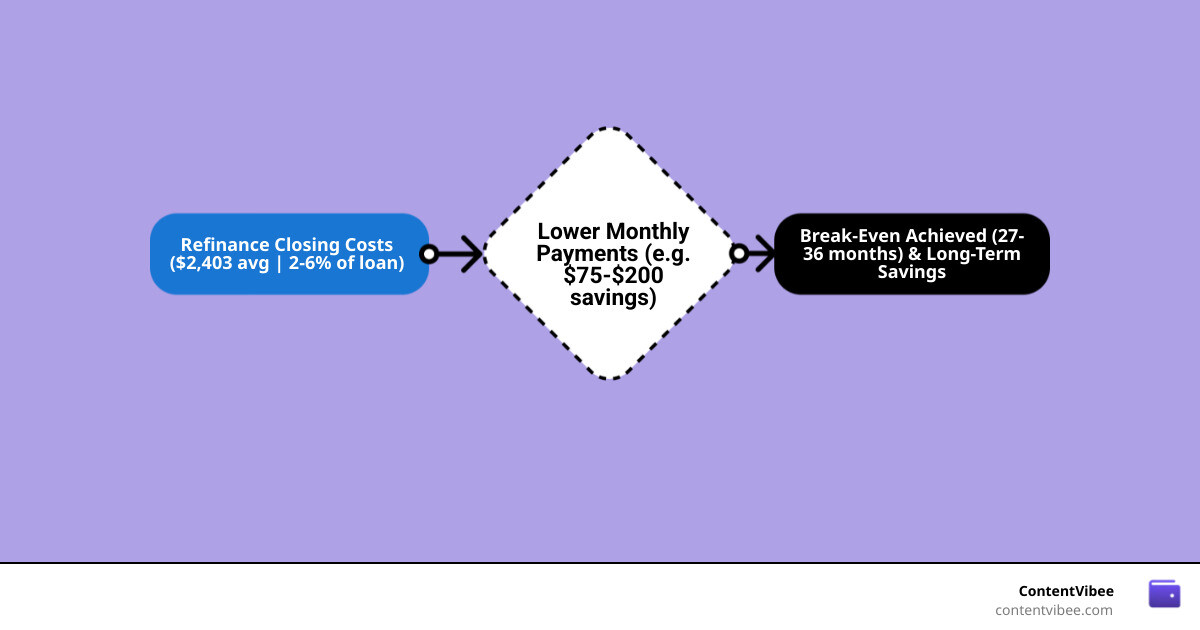
The cost to refinance a mortgage typically falls between 2% and 6% of your loan amount — that’s $6,000 to $18,000 on a $300,000 loan. Most homeowners end up somewhere in the middle, and the average refinance closing cost came in at $2,403 in 2024 (though that figure can vary widely by state and loan size).
Here’s a quick snapshot of what to expect:
| Loan Amount | Low End (2%) | High End (6%) |
|---|---|---|
| $150,000 | $3,000 | $9,000 |
| $200,000 | $4,000 | $12,000 |
| $300,000 | $6,000 | $18,000 |
| $400,000 | $8,000 | $24,000 |
These costs cover things like origination fees, appraisal, title services, and more — all paid at closing before your new loan takes effect.
The good news? Those upfront costs can pay for themselves over time through lower monthly payments. But only if you stay in your home long enough to hit the break-even point.
This guide breaks down every fee, explains when refinancing is actually worth it, and shows you how to keep your costs as low as possible.
What Is the Typical Cost to Refinance in 2026?
As we look at the market in May 2026, the cost to refinance remains a significant consideration for homeowners. While mortgage rates fluctuate, the structural costs of getting a new loan stay relatively consistent. Generally, we tell our clients to expect total costs to land in that 2% to 6% range of the new loan principal.
These costs aren’t just one big “refinance fee.” Instead, they are a collection of smaller charges from your lender, the government, and third-party service providers like appraisers and title companies. In Virginia, these costs can feel like a lot upfront, but when compared to the long-term interest savings of a lower rate, they often make perfect sense.
How Much Does the cost to refinance usually add up to?
When we look at the hard numbers, the cost to refinance usually averages out to about $5,000 according to Freddie Mac research, but your specific total depends heavily on your loan size. For a $150,000 mortgage, you might see costs between $3,000 and $9,000. If you are refinancing a $300,000 home in a mid-range market, a 2% closing cost would put you at exactly $6,000.
It is important to distinguish between the “closing costs” (the fees for services) and “prepaid items” (like property taxes and homeowners insurance). While both require cash at the closing table, the prepaids are money you would have spent anyway—the closing costs are the true “price” of the refinance.
The fees included in the cost to refinance
To understand why the cost to refinance is what it is, we need to look under the hood. Most of these fees are non-negotiable, but some vary significantly between lenders.
| Fee Category | Common Cost Range | Description |
|---|---|---|
| Application Fee | $75 – $500 | Covers the initial processing of your request. |
| Origination Fee | 0.5% – 1.5% of loan | The lender’s charge for making the loan. |
| Appraisal Fee | $300 – $1,000 | Pays for a professional to value your home. |
| Credit Report Fee | $25 – $50 | The cost to pull your credit history. |
| Title Search & Insurance | $400 – $900 | Ensures the home is legally yours to pledge. |
| Recording Fee | $25 – $250 | Paid to the local government to record the new deed. |
| Underwriting Fee | $400 – $900 | Covers the cost of verifying your financial info. |
Some lenders might also charge for “discount points.” One point costs 1% of the loan amount and typically lowers your interest rate by about 0.25%. This is an optional part of the cost to refinance that only makes sense if you plan to stay in the home for many years. For more detail on these specific charges, check out our guide on Average Refi Closing Costs.
Why refinance costs change by lender, loan type, and location
Not every homeowner pays the same amount. Your personal financial profile—specifically your credit score, Debt-to-Income (DTI) ratio, and home equity—dictates the risk the lender takes. Higher risk often translates to higher fees or rates.
Location also plays a massive role. In Virginia, recording taxes and attorney fees differ from other regions. If you’re local to the area, you’ll want to dive deeper into What Are The Average Closing Costs In Virginia to see how our state’s specific taxes impact your bottom line.
Loan types also shift the cost. Conventional loans often require a full appraisal, whereas “streamline” options for FHA or VA loans might waive that requirement, saving you hundreds of dollars upfront.
When the cost to refinance is worth paying
Refinancing is like hitting the reset button on your mortgage. It’s a lot of paperwork, but it can be a brilliant financial move if the timing is right. We generally suggest that a rate drop of 0.5% to 0.75% is enough to make a refinance worth considering, though some experts wait for a full 1% drop.
Beyond just the interest rate, you might pay the cost to refinance to:
- Change the loan term: Switching from a 30-year to a 15-year mortgage to pay the house off faster.
- Remove PMI: If your home value has risen and you now have 20% equity, refinancing into a conventional loan can kill that monthly mortgage insurance.
- Switch from an ARM to a fixed rate: This provides peace of mind if you think market rates are about to climb.
How to calculate your refinance break-even point
The “break-even point” is the most important number in your refinance journey. It tells you exactly how many months it will take for your monthly savings to “pay back” the upfront cost to refinance.
The Formula: Total Closing Costs ÷ Monthly Savings = Months to Break Even
Let’s look at a few examples:
- The Small Save: You pay $2,000 in costs to save $75 a month. It will take you 26.7 months to break even.
- The Standard Refi: You pay $3,000 in costs to save $100 a month. You break even in 30 months.
- The Big Save: You pay $5,000 in costs to save $200 a month. You break even in just 25 months.
If you plan to sell the house in two years but your break-even point is 30 months, you’re actually losing money by refinancing!
When refinancing makes sense and when it does not
Refinancing is a tool, and like any tool, it’s only useful if it fits the job.
Pros of Refinancing:
- Lower monthly payments.
- Reduced total interest paid over the life of the loan.
- Ability to tap into equity for home improvements or debt consolidation.
- Stability of a fixed-rate payment.
Cons of Refinancing:
- Upfront “out-of-pocket” costs.
- Resetting the clock on your loan (starting a new 30-year term).
- Potentially higher lifetime interest if you extend the term significantly.
If you are already 15 years into a 30-year mortgage and you refinance into a new 30-year mortgage, you might lower your monthly payment, but you’ll be paying interest for a total of 45 years. That’s a win for the bank, not necessarily for you!
How cash-out and government refinance costs compare
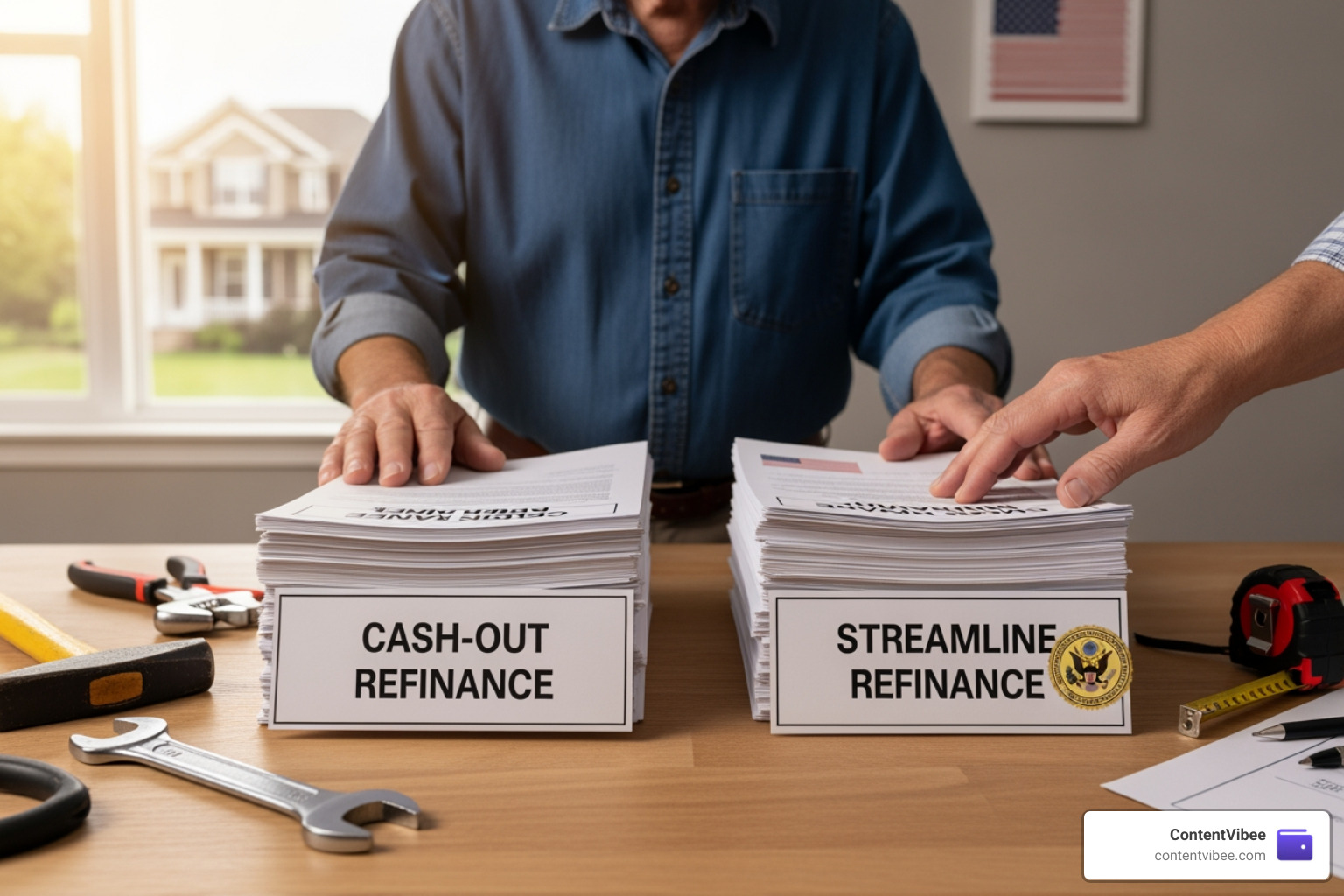
A “rate-and-term” refinance is the most common, but “cash-out” refinances are popular for those needing to fund renovations or pay off high-interest debt. Because you are borrowing more than you currently owe, lenders view cash-out loans as higher risk, which can lead to slightly higher interest rates and fees.
Government-backed loans offer “streamline” options that are often much cheaper.
- FHA Streamline: Often skips the appraisal and credit check. You’ll still pay the upfront Mortgage Insurance Premium (MIP), but the process is faster.
- VA IRRRL (Interest Rate Reduction Refinance Loan): This is incredibly cost-effective for veterans. It requires a small funding fee (0.5%) but limits other closing costs significantly.
How to lower refinance costs and qualify for better terms
You don’t have to just accept the first quote you get. We always recommend shopping around. Since the cost to refinance varies by lender, getting at least three Loan Estimates allows you to compare the Annual Percentage Rate (APR). The APR is a better comparison tool than the interest rate alone because it includes the fees.
To qualify for the best terms, you should aim for:
- A credit score of at least 620 for conventional (580 for FHA).
- A Debt-to-Income (DTI) ratio between 36% and 45%.
- At least 20% equity in the home to avoid private mortgage insurance.
No-closing-cost refinance options and the trade-offs
You might see ads for a “no-closing-cost” refinance. Is it a scam? No, but it’s also not free. There are two ways lenders do this:
- Rolling costs into the loan: Your $200,000 loan becomes a $205,000 loan. You don’t pay cash today, but you pay interest on that $5,000 for the next 30 years.
- Lender Credits: The lender pays your closing costs in exchange for giving you a higher interest rate (e.g., 6.5% instead of 6.25%).
This is a great strategy if you don’t have the cash upfront or if you only plan to stay in the home for a few years. However, over 30 years, a no-closing-cost refinance is almost always more expensive than paying the fees upfront.
Qualification checklist and next steps before you apply
Before you sign on the dotted line, make sure your financial house is in order. Improving your credit score by even 20 points can save you thousands in interest over time.
Your Refinance Checklist:
- [ ] Check your credit report for errors.
- [ ] Gather two years of tax returns and W-2s.
- [ ] Estimate your home’s current value (look at recent sales in your Virginia neighborhood).
- [ ] Calculate your current LTV (Loan-to-Value) ratio.
- [ ] Compare Loan Estimates from at least three lenders.
To get a head start on what lenders are looking for, read our guide on the Pre Approval Home Loan Process. Understanding the requirements early will make the actual application much smoother.
If you’re ready to see how a refinance fits into your broader financial picture, we recommend Understanding The Real Estate Buying Process to see how equity and ownership work in your favor.
Refinancing is a big step, but it’s one of the most powerful ways to take control of your monthly budget. By understanding the cost to refinance and doing the math on your break-even point, you can move forward with confidence.
Reach out today to find out how much you can save and to get started on a refinance loan.
View more personal finance tips in our Real Estate category


