


What to Expect From a Car Accident Injury Settlement Estimate
Getting a car accident injury settlement estimate is often the first step toward understanding what your claim may be worth — and whether an insurance offer is fair or too low.
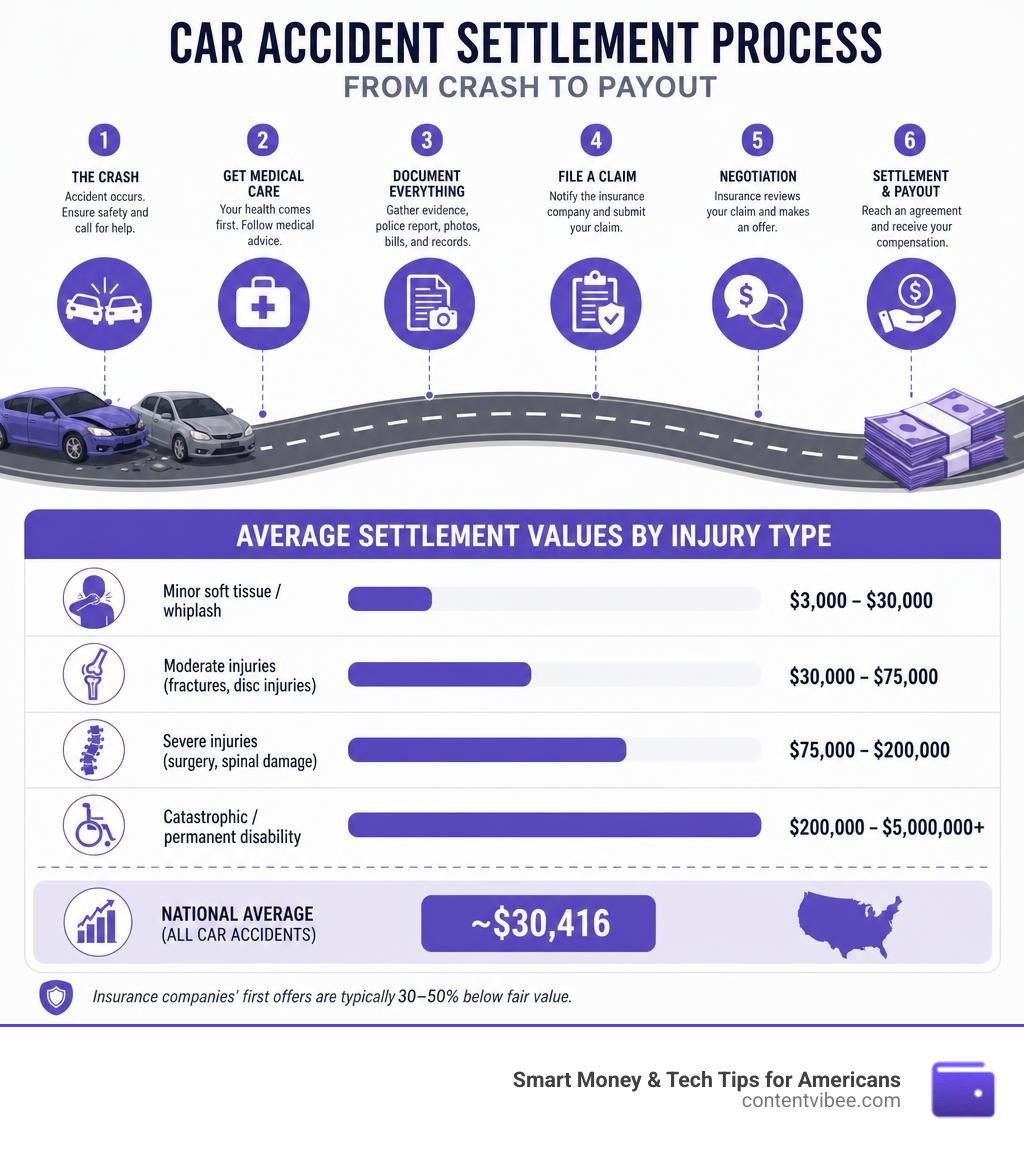
Here’s a quick snapshot of typical settlement values in 2026:
| Injury Type | Typical Settlement Range |
|---|---|
| Minor soft tissue / whiplash | $3,000 – $30,000 |
| Moderate injuries (fractures, disc injuries) | $30,000 – $75,000 |
| Severe injuries (surgery, spinal damage) | $75,000 – $200,000 |
| Catastrophic / permanent disability | $200,000 – $5,000,000+ |
| National average (all car accidents) | ~$30,416 |
The national average sounds reassuring. But it hides a huge range. A whiplash claim might settle for $11,000. A spinal cord injury can reach $16 million.
Where you live matters just as much as how badly you were hurt. New York averages $287,000 per settlement. The national average is $30,416. That’s nearly a 10x difference — same country, very different outcomes.
The other thing worth knowing right away: insurance companies’ first offers are typically 30–50% below fair value. Knowing your estimated range before you negotiate can be the difference between leaving money on the table and getting what you actually deserve.
This guide walks you through how settlement estimates are calculated, what factors raise or lower your number, and when you need a lawyer in your corner.
Understanding Car Accident Settlement Calculators and How They Work
When you search for a car accident injury settlement estimate, you will inevitably run into dozens of online settlement calculators. These tools are incredibly popular because they promise a quick, painless answer to a highly stressful question: “How much money am I going to get?”
At their core, basic settlement calculators are simple mathematical templates. You type in your medical bills, your lost wages, and your property damage, and the tool applies a standard formula to spit out a number.
However, technology has evolved. In 2026, advanced platforms use artificial intelligence (AI) algorithms trained on massive legal databases containing tens of thousands of real-world case outcomes. Instead of relying on a rigid, outdated formula, these AI tools analyze specific language details about your crash, the exact types of injuries you sustained, and how those injuries impact your daily quality of life.
By comparing your input against historical data points—such as local jury verdicts and insurance payouts in your specific zip code—these modern tools can provide a much more nuanced baseline. If you want to see how these calculations look in practice, you can try using a Realistic Settlement Calculator to get an initial range for your case.
Yet, even the smartest AI cannot replace human legal expertise. While a calculator is a fantastic starting point to make sure you are in the right ballpark, it is ultimately just a data-driven model. It does not know if the defense attorney is notoriously difficult, whether the local judge has a bias, or how convincing you would be as a witness.
The Multiplier Method vs. Per Diem Method
To understand how these calculators—and insurance adjusters—estimate your pain and suffering, you need to understand the two main calculation methods: the Multiplier Method and the Per Diem Method.
The Multiplier Method is the undisputed industry standard used by major insurance carriers (often fed into proprietary claims software like Colossus). Here is how it works:
- First, you calculate your total economic damages (your concrete, receipts-backed financial losses like medical bills and lost wages).
- Next, you multiply that total by a number (the “multiplier”) between 1.5 and 5, depending on the severity of your injuries.
- The resulting number is your estimated non-economic damage (pain and suffering) value.
For example, if you have $10,000 in medical bills and $5,000 in lost wages, your economic damages are $15,000. If your injuries were moderate (like a broken wrist requiring a cast), a multiplier of 3 might be applied.
- $15,000 (Economic) x 3 (Multiplier) = $45,000 (Pain and Suffering)
- Total Estimate: $15,000 + $45,000 = $60,000
Our Car Accident Settlement Guide 2026 breaks down how multipliers are typically assigned:
- 1.5x to 2x: Minor soft-tissue injuries (bruises, minor whiplash, sprains) with a brief recovery period.
- 2x to 3x: Moderate injuries (simple fractures, minor herniated discs) requiring physical therapy.
- 3x to 4x: Severe injuries requiring surgery, joint replacements, or leaving semi-permanent scarring.
- 5x or higher: Catastrophic, permanent injuries (spinal cord damage, amputations, severe traumatic brain injuries).
The Per Diem Method, on the other hand, assigns a daily dollar value to your pain and suffering. “Per diem” is Latin for “by the day.” The daily rate is often based on your actual daily earnings, under the theory that dealing with severe pain is at least as difficult as a hard day’s work. If your daily rate is set at $250 and you suffer for 120 days before fully recovering, your pain and suffering estimate would be $30,000 ($250 x 120).
Why an Online Car Accident Injury Settlement Estimate Can Be Misleading
Online calculators are great for educational purposes, but relying on them as a guaranteed payout is a recipe for disappointment. There are several critical real-world variables that online algorithms simply cannot fully evaluate.
First are insurance policy limits. If a calculator estimates your claim is worth $150,000, but the driver who hit you only carries the state minimum bodily injury liability limit of $25,000, you are facing a massive hurdle. Unless you have robust underinsured motorist (UIM) coverage or the defendant is independently wealthy, your payout will likely top out at that $25,000 policy limit.
Second are pre-existing conditions. If you had a bad back before the crash, the insurance company will fight tooth and nail to prove the accident did not cause your pain. A calculator cannot review your past medical records to determine how much of your current pain is actually new.
Finally, treatment gaps can completely tank a claim. If you waited three weeks after the crash to see a doctor, or if you skipped your physical therapy appointments for a month, insurance adjusters will use this as proof that your injuries were not actually serious.
To explore these limitations further and test different financial scenarios, you can browse through our suite of Tools/Settlement Calculators/ to see how changing these variables alters your potential outcome.
Key Factors That Influence Your Settlement Value

When insurance adjusters look at your file, they are not just looking at a single number. They are evaluating a complex web of evidence. The ultimate value of your car accident injury settlement estimate hinges on several concrete factors:
- Injury Severity: This is the single most important factor. Objective medical evidence—like X-rays showing broken bones, MRIs showing torn ligaments, or surgical reports—is incredibly hard for insurance companies to dispute.
- Consistency of Medical Treatment: To get a fair settlement, you must document your recovery. This means following your doctor’s orders to the letter. If you want to understand how to handle these mounting costs during your recovery, check out The Ultimate Guide To Paying Medical Bills After A Car Wreck.
- Lost Wages and Earning Capacity: If you missed work, you are entitled to recover those lost wages. If your injury permanently prevents you from returning to your high-paying career, your lost future earning capacity can skyrocket the value of your claim.
- Property Damage: While vehicle repairs are settled separately from bodily injuries, the severity of the vehicle damage heavily influences the adjuster’s perception. A crumpled, totaled car makes severe physical injuries highly believable; a minor scratch on a bumper makes a claim of severe neck pain much harder to sell.
How Comparative Negligence Affects Your Payout
Who caused the accident, and can you prove it? This is the question of liability, and it is rarely entirely black and white. Most states use some form of comparative negligence to determine payouts when multiple parties share fault.
There are three primary systems used across the United States:
- Pure Comparative Negligence (e.g., California, New York, Florida): You can recover compensation even if you were 99% at fault for the crash. However, your payout is reduced by your exact percentage of fault. If your damages are $100,000 but you are found 40% at fault (perhaps for speeding through an intersection where someone ran a red light), you will receive $60,000.
- Modified Comparative Negligence (The most common system): You can only recover damages if your percentage of fault is below a specific threshold—typically 50% or 51%, depending on the state. If you cross that threshold (for example, if a jury decides you were 51% at fault in a 51% bar state), you receive absolutely nothing. If you are under the threshold, your payout is reduced by your percentage of fault.
- Contributory Negligence (The strictest system, used in a handful of states like Alabama, Maryland, and North Carolina): If you contributed to the accident in any way—even just 1%—you are completely barred from recovering any compensation whatsoever.
Average Settlement Amounts by Injury and Accident Type
Because averages are heavily skewed by multi-million dollar catastrophic cases, looking at median values and ranges based on your specific injury type provides a much more realistic picture.
| Injury / Accident Type | Median Settlement Value | Key Factors |
|---|---|---|
| Whiplash / Neck Strain | ~$11,271 | Often resolved without surgery; heavily dependent on physical therapy records. |
| Moderate Herniated Disc | ~$35,000 – $75,000 | May involve epidural steroid injections; value increases if surgery is required. |
| Traumatic Brain Injury (TBI) | ~$710,500 | Evaluated based on cognitive impact, ability to work, and long-term care needs. |
| Spinal Cord Injury | ~$16,059,715 | Catastrophic cases involving paralysis, lifetime medical equipment, and 24/7 care. |
| Commercial Truck Accident | ~$103,654 | Settlements average 3.4x higher than standard car accidents due to high federal policy limits. |
| Pedestrian Accident | ~$95,000 | High values reflect the extreme vulnerability of pedestrians hit by heavy vehicles. |
How to Calculate Your Car Accident Injury Settlement Estimate

Now that you know the underlying math, let’s walk through how to actually calculate an estimate for your own claim. To get started, you can use our interactive Tools/Settlement Calculators/Realistic Settlement Calculator to plug in your numbers as we go.
Step-by-Step Guide to Calculating Your Damages
To build a comprehensive estimate, follow these steps:
- Gather All Medical Bills: Add up every single medical expense related to the crash. This includes the initial ambulance ride, ER visit, diagnostic imaging (X-rays/MRIs), specialist visits, physical therapy, prescription medications, and even the cost of over-the-counter medical devices like neck braces or crutches.
- Calculate Lost Wages: Multiply your hourly rate by the number of hours you missed. If you are salaried, divide your annual salary by 2,080 (the standard number of working hours in a year) to find your hourly rate, then multiply by your missed hours. Make sure to get a signed “Lost Wages Letter” from your employer’s HR department to prove this.
- Project Future Expenses: If you are still in pain and your doctor says you will need another surgery, ongoing physical therapy, or future medications, work with your medical providers to estimate these future costs.
- Determine Your Pain and Suffering Multiplier: Be honest about your recovery. If you had soft-tissue injuries that healed in six weeks, use a 1.5x multiplier. If you broke a bone or have a documented disc bulge, use a 2.5x to 3x multiplier.
- Apply the Formula:
(Total Medical Bills + Lost Income + Future Care) = Total Economic DamagesTotal Economic Damages x Multiplier = Pain and Suffering ValueTotal Economic Damages + Pain and Suffering Value = Gross Settlement Estimate
- Factor in Liability: If you were partially at fault, reduce your gross estimate by your estimated percentage of fault.
How to Get a Realistic Car Accident Injury Settlement Estimate
The biggest mistake injury victims make is rushing to calculate their settlement before they have actually finished healing.
To get a truly realistic estimate, you must wait until you reach Maximum Medical Improvement (MMI). MMI is the point at which your doctor determines your condition has stabilized and is not expected to improve any further.
If you settle your claim before reaching MMI, you run a massive financial risk. Once you sign a settlement release and cash the check, your claim is closed forever. If you discover three months later that you need a $100,000 spinal fusion surgery, you cannot go back to the insurance company for more money. You will be entirely on your own.
Always keep detailed folders of every piece of medical documentation, doctor’s notes, and diagnostic reports. If you have received an early offer from an insurer, read Dont Cash That Check Yet How To Evaluate An Insurance Settlement Offer to make sure you aren’t falling into a common trap.
When to Consult a Personal Injury Attorney
If your accident was a minor fender-bender with no injuries, or if you only had a stiff neck that cleared up after a single chiropractic visit, you can likely handle the insurance claim on your own.
However, if your injuries required significant medical treatment, if you missed more than a few days of work, or if the insurance company is disputing who was at fault, you should consult an attorney.
Insurance adjusters are professional negotiators. Their job is not to help you; their job is to protect their company’s bottom line by paying you as little as possible. They are highly skilled at using friendly, reassuring language to convince you to accept a lowball offer before you realize the true extent of your injuries. Our article on the First Offer Blues Navigating Auto Accident Settlement Averages details exactly how these initial negotiations play out and why first offers are rarely fair.
Data from the Insurance Research Council shows that accident victims represented by personal injury attorneys receive, on average, 3.5 times higher gross settlements than those who represent themselves. Even after paying attorney fees, most victims still walk away with significantly more money in their pockets.
Understanding Attorney Fees and Contingency Agreements
Many people avoid calling a lawyer because they are terrified of expensive hourly fees. Fortunately, almost all personal injury attorneys work on a contingency fee basis.
This means:
- You pay $0 upfront.
- The attorney covers all the costs of investigating your crash, gathering medical records, and hiring experts.
- The attorney only gets paid if they successfully secure a settlement or court verdict for you.
- Their fee is a pre-agreed percentage of your final payout—typically 33% if the case settles out of court, and up to 40% if the case goes to trial.
To learn more about how these financial agreements work and what to watch out for in a contract, read our detailed guide on How Much Does A Personal Injury Lawyer Charge.
Frequently Asked Questions About Car Accident Settlements
What is the average car accident settlement in 2026?
As of 2026, the national average bodily injury settlement for a car accident is approximately $30,416. However, this number is heavily influenced by geography and injury severity. For example, settlements in California average $185,000, while New York averages $287,000. Minor soft-tissue cases typically settle for under $15,000, while severe surgical cases frequently exceed $100,000.
Should I accept the insurance company’s first settlement offer?
In almost all cases, no. Insurance companies intentionally make their first offers 30% to 50% below the actual value of the claim. They do this to test whether you are desperate for quick cash or don’t know what your case is actually worth. Always treat the first offer as a starting point for negotiation, and never sign anything until you have reached Maximum Medical Improvement.
How long does it take to receive a car accident settlement?
The timeline varies wildly based on the complexity of your case:
- Minor injuries with clear liability: 3 to 6 months.
- Moderate injuries requiring extensive physical therapy: 6 to 18 months.
- Severe injuries requiring surgery or disputed liability: 1 to 3 years.
The process cannot safely be completed until you have reached MMI, as settling earlier risks leaving you with unpaid medical bills.
Conclusion
Navigating the aftermath of a car crash is physically, emotionally, and financially exhausting. Getting a realistic car accident injury settlement estimate is a vital tool to help you regain control of your life, protect your financial health, and ensure you aren’t taken advantage of by greedy insurance carriers.
Use online tools to build your baseline knowledge, keep meticulous records of your medical care, and don’t hesitate to reach out to a professional if the insurance company starts playing games. For more interactive tools to help you plan your financial recovery, explore our Tools/Settlement Calculators/ to make sure you are making the smartest financial decisions possible.


