


What You Need to Know Before Working While Receiving Spousal Benefits
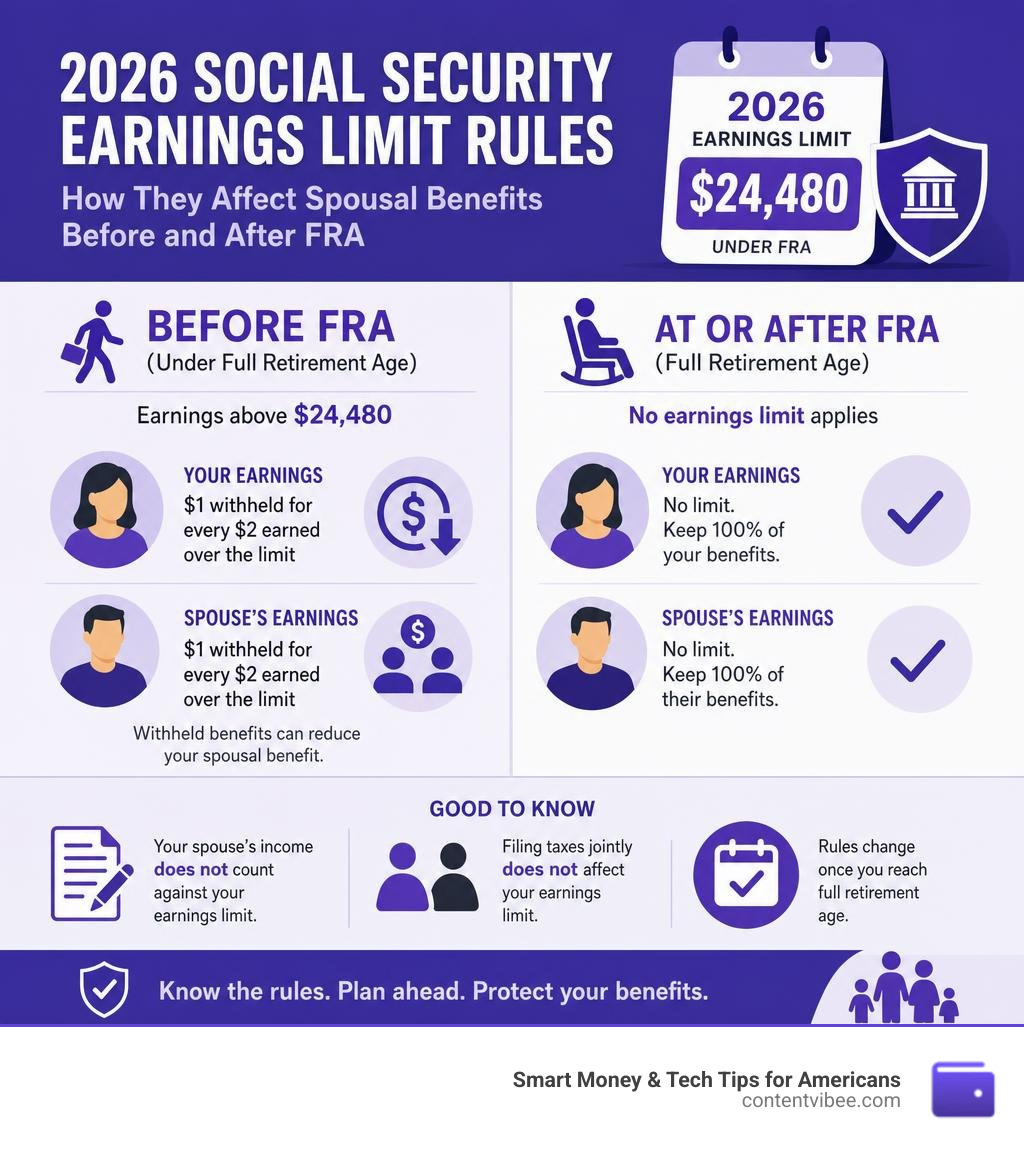
Many retirees wonder whether are spousal benefits reduced by working — and the short answer is: it depends on whose income we’re talking about and whether you’ve reached full retirement age.
Here’s a quick breakdown:
| Situation | Does Work Reduce Spousal Benefits? |
|---|---|
| You receive spousal benefits and earn above $24,480 (under FRA in 2026) | Yes — $1 withheld per $2 over the limit |
| You receive spousal benefits and are at or above full retirement age | No — no earnings limit applies |
| Your spouse (the worker) earns above the limit before their FRA | Yes — their benefits can be withheld, which can affect your spousal benefit |
| Your spouse’s income, not yours, while you collect spousal benefits | Only if their withheld benefits affect your payment |
| You file jointly for taxes and your spouse earns above the limit | No — their income does not count against your earnings limit |
The rules here aren’t simple. Your own work income, your spouse’s work income, and the age at which you claimed benefits can all play a role.
More than 2 million people collected spousal retirement benefits as of early 2026. Many of them — or their partners — are still working. Understanding exactly how the earnings test applies (and when it doesn’t) can save you from unexpected benefit reductions.
This guide breaks it all down in plain language, covering both spouses’ scenarios, divorced spouse rules, and strategies to protect your benefits.
Related content about are spousal benefits reduced by working:
- application for spousal benefits
- applying for spousal disability benefits
- can a spouse collect ss spousal benefits
How the Social Security Earnings Test Affects Spousal Benefits
To understand how working affects your spousal benefits, we first have to look at the Social Security Administration’s (SSA) annual earnings test. If you collect any type of Social Security benefit—including a spousal benefit—before you reach your official full retirement age (FRA), the SSA keeps a close eye on your paycheck.
For the year 2026, the SSA has set two very specific earnings limits depending on how close you are to your full retirement age.
- If you are under full retirement age for the entire year of 2026: The annual earnings limit is $24,480. If you earn more than this amount, the SSA will withhold $1 of your benefits for every $2 you earn above the limit.
- If you reach full retirement age during the year 2026: The annual earnings limit rises significantly to $65,160. In this case, the SSA will withhold $1 of your benefits for every $3 you earn above the limit, but they only count the money you make in the months before you actually reach your birthday month of full retirement age.
It is highly important to understand what actually counts as “earnings” under these rules. The SSA only looks at your active work income. This includes your gross wages as an employee or your net earnings if you are self-employed.
What doesn’t count? Pretty much everything else. Your pensions, investment dividends, interest, capital gains, annuities, and government benefits do not count toward the earnings limit. If you are sitting back and collecting rental income or watching your stock portfolio grow, none of that will trigger a benefit reduction.
For more technical details on how the SSA handles work income and benefit calculations, you can explore the Benefits Planner: Retirement | Receiving Benefits While Working | SSA.
To help you visualize how these 2026 limits work in practice, we have put together a quick comparison:
| Your Age Status in 2026 | Annual Earnings Limit | Withholding Rate | What Counts as Income? |
|---|---|---|---|
| Under FRA All Year | $24,480 | $1 withheld for every $2 earned over limit | Gross wages and net self-employment only |
| Reaching FRA in 2026 | $65,160 | $1 withheld for every $3 earned over limit (prior to FRA month) | Gross wages and net self-employment only |
| At or Above FRA | No Limit | None | None |
If you are new to this concept and want a foundational overview of what these benefits actually are, take a look at our guide on What is a Social Security Spousal Benefit?.
How the Earnings Limit Applies to Spousal Benefits
Now let’s look at the mechanics of how the earnings test interacts with your spousal record. If you are the spouse who is claiming benefits based on your partner’s work history, your individual work income is what the SSA evaluates.
A very common point of confusion for married couples is tax filing status. Many couples believe that because they file a joint tax return, their incomes are combined for the Social Security earnings test. Thankfully, this is a myth!
The SSA looks at each person’s earnings completely separately. If you are receiving a spousal benefit and you decide to take a part-time job, only the money you earn from that job will be tested against the $24,480 limit (assuming you are under FRA). Your spouse’s high salary will not drag down your spousal benefit under your own earnings test.
To make sure you qualify to receive these benefits in the first place, you can read our step-by-step instructions on How to Check Your Eligibility for Spousal Social Security Benefits.
Strategies to Minimize or Avoid Reductions
If you want to keep working but hate the idea of sending your hard-earned benefits back to the government, there are a few practical strategies you and your spouse can use:
- Watch Your Claiming Age Closely: The simplest way to completely bypass the earnings test is to wait until your own full retirement age to claim your spousal benefit. Once you hit that magic age (which is 67 for anyone born in 1960 or later), the earnings limit vanishes. You can earn millions of dollars a year, and the SSA won’t touch a single penny of your spousal benefit.
- Coordinate Your Claiming Timing: If the lower-earning spouse wants to work, they might choose to delay claiming their spousal benefit until they reach FRA, or at least until their annual work income drops below the $24,480 threshold.
- Keep Your Monthly Earnings Under the Limit in Your First Year: If you retire mid-year, the SSA has a special “monthly earnings test” that can help you. For 2026, if you earn $2,040 or less per month, you can still get your full benefit for that month, regardless of how much you earned earlier in the year before you retired.
To run the numbers for your specific situation and see how different ages affect your monthly payout, try out our Tools/Finance Calculator/Social Security Spousal Benefit Calculator.
Are Spousal Benefits Reduced by Working? The Rules for Both Partners
When we ask the question, are spousal benefits reduced by working, we have to look at both sides of the marriage. Because a spousal benefit is inherently tied to two different people—the primary worker and the spouse claiming on their record—the work habits of both partners can trigger reductions.

If both of you are under full retirement age and both of you are working, you run the risk of a “dual reduction.” This is where the primary earner’s work reduces their own benefit (which subsequently reduces the spousal benefit), and the secondary earner’s work reduces their spousal benefit even further.
To see the exact legal policy on how these reductions are structured, you can refer to the official SSA – POMS: RS 00615.201 – Reduced Spouse’s Benefits – 12/07/2023. For a broader look at the rules, check out The Ultimate Guide to Spousal Social Security Eligibility.
Are Spousal Benefits Reduced by Working When You Claim Early?
If you decide to claim your spousal benefit early—meaning anytime between age 62 and your full retirement age—your base benefit is permanently reduced right from the start.
At full retirement age, a spouse can receive up to 50% of the higher-earning spouse’s full retirement benefit. However, if your full retirement age is 67 and you choose to claim your spousal benefit at age 62, that benefit is slashed by 35%. This means you will only receive 32.5% of your partner’s full benefit amount.
The SSA calculates this reduction using a very specific monthly formula:
- For the first 36 months before your FRA, the benefit is reduced by 25/36 of 1% for each month.
- For any additional months beyond the first 36 months (up to a maximum of 60 months if you claim at 62), the benefit is reduced by an additional 5/12 of 1% per month.
If you add work income on top of this early claim, you face a double whammy. Not only is your monthly check permanently smaller because you claimed early, but if you earn more than $24,480 in 2026, the SSA will withhold those already-reduced checks until the overage is paid off.
To learn more about the golden rules of claiming, check out our guide on The Golden Rules Can a Spouse Collect SS Spousal Benefits.
Are Spousal Benefits Reduced by Working After Full Retirement Age?
Here is the good news: once you reach your full retirement age, the answer to are spousal benefits reduced by working becomes a resounding no.
Starting the exact month you reach your FRA, you can work as many hours as you want and earn as much money as you can dream up without any risk of your spousal benefit being reduced.
Even better, if you had benefits withheld in the past because you worked while under FRA, the SSA will perform a retroactive adjustment. When you reach FRA, they will recalculate your monthly benefit upward to credit you for the months they withheld your payments. Over time, you will get that withheld money back in the form of higher monthly checks.
To see how this affects couples where both partners have worked, see our article Can a Married Couple Both Collect Social Security.
What Happens If the Higher-Earning Spouse Continues Working?
What if you aren’t working, but your spouse—the primary worker on whose record you are claiming—is still working and earning a high income?
This is where the rules can catch you off guard. If the primary worker spouse is under full retirement age and continues to work, their earnings can directly impact your spousal benefit.
If the worker spouse earns enough to exceed the annual earnings limit ($24,480 in 2026), the SSA will begin withholding their retirement benefits. Because your spousal benefit is auxiliary to their record, your spousal benefit will also be withheld during the months their benefit is suspended due to their excess earnings.
In other words, if your spouse’s work causes their own check to be withheld, your spousal check is withheld too.
To read the administrative details on how these payments are processed, you can review SSA – POMS: RS 00202.020 – Spouse’s Benefits – Payment – 01/20/2026. You can also read more about joint claiming rules in Both Spouses Collect Social Security.
Divorced Spouses: How Working Affects Your Benefits
If you are divorced, the rules regarding working and spousal benefits are actually a bit more generous, thanks to a concept called “independent entitlement.”
To claim benefits on your ex-spouse’s record, you must meet a few basic criteria:
- Your marriage must have lasted at least 10 years.
- You must have been divorced for at least 2 consecutive years.
- You must be at least 62 years old and currently unmarried.
If you meet these rules, you can receive a divorced spouse benefit that is equal to up to 50% of your ex-spouse’s full retirement benefit.
The biggest advantage for divorced couples is that your ex-spouse’s current work habits have zero impact on your benefit. Under the independent entitlement rule, as long as your ex-spouse is eligible for retirement benefits (even if they haven’t claimed them yet because they are still working), you can still file for and receive your divorced spousal benefit.
Furthermore, if your ex-spouse is working and earning way over the limit, their high earnings will not cause your divorced spousal benefit to be withheld.
However, your own work income is still subject to the standard earnings test. If you are a divorced spouse under FRA and you earn more than $24,480 in 2026, your benefit will be reduced based on your own earnings.
To learn more about how divorced couples navigate these systems, read Do Both Spouses Collect Social Security.
Frequently Asked Questions About Spousal Benefits and Working
Navigating the intersection of work and Social Security can raise a lot of questions. Here are some of the most common questions we hear from retirees.
Does my spouse’s income affect the earnings limit for my Social Security benefits?
No. Even if you file your taxes jointly, the SSA does not combine your incomes when applying the earnings limit.
Your earnings limit is based solely on your own individual work income. If you are receiving a spousal benefit on your partner’s record and you work, only your wages or self-employment income will count against your personal $24,480 limit (for 2026). Your spouse’s high paycheck will not trigger a reduction in your benefit.
For a complete look at how these individual limits fit into the broader system, check out A Comprehensive Guide to Social Security Benefits.
Can a spouse’s work income reduce both their own benefit and the spousal benefit?
Yes, in certain situations, work income can cause a reduction in both benefits.
This typically happens under the rules of “dual entitlement.” If you qualify for your own retirement benefit but your spousal benefit is higher, the SSA will pay your own benefit first, and then top it off with an “excess spousal benefit” to bring you up to the higher spousal amount.
If you are under FRA and you work, your earnings can reduce both your own retirement benefit and your excess spousal benefit. Additionally, if you receive a reduced spouse’s benefit alongside Disability Insurance Benefits (DIB), complex recalculations apply.
To read the highly technical policy on how disability and spousal benefits interact, see SSA – POMS: RS 00615.260 – Reduced Spouse’s Benefit and DIB Entitlement (B, HA) – 01/04/2017. If you are ready to apply, make sure you use The Ultimate Checklist for Your Application for Spousal Benefits.
What happens to withheld spousal benefits once I reach full retirement age?
Many people fear that any benefits withheld due to the earnings test are gone forever. Fortunately, this is not the case!
Once you reach your full retirement age, the SSA will recalculate your benefit. They will look at how many months you did not receive a check because of your excess earnings. They will then adjust your monthly benefit upward to account for those withheld months.
While you don’t get a single lump-sum check for the withheld amount, you do get a permanent monthly raise that helps you recoup that money over time.
Conclusion
At Smart Money & Tech Tips for Americans, we believe that planning your retirement should not feel like trying to solve a Rubik’s cube in the dark.
To wrap up: are spousal benefits reduced by working? If you are under your full retirement age and earning more than the 2026 limit of $24,480, yes, your benefits will be temporarily reduced. However, if you have reached your full retirement age, you can work as much as you like with absolutely no reductions.
By taking the time to understand the earnings limits, coordinating your claiming ages, and tracking your work income, you can protect your household finances and build a highly secure retirement.
For more tips on maximizing your household income, head back to our guide on What is a Social Security Spousal Benefit? and start planning your next move today!


