


The Number Every California Injury Victim Needs to Know Before Signing Anything
How much do lawyers take from settlement in California is one of the most important financial questions you can ask before hiring a personal injury attorney — and the answer is more layered than most people expect.
Here is the short version:
| Case Stage | Typical Attorney Fee |
|---|---|
| Before a lawsuit is filed | 33.3% of gross settlement |
| After a lawsuit is filed | Up to 40% of gross settlement |
| Workers’ compensation cases | ~15% (court-approved) |
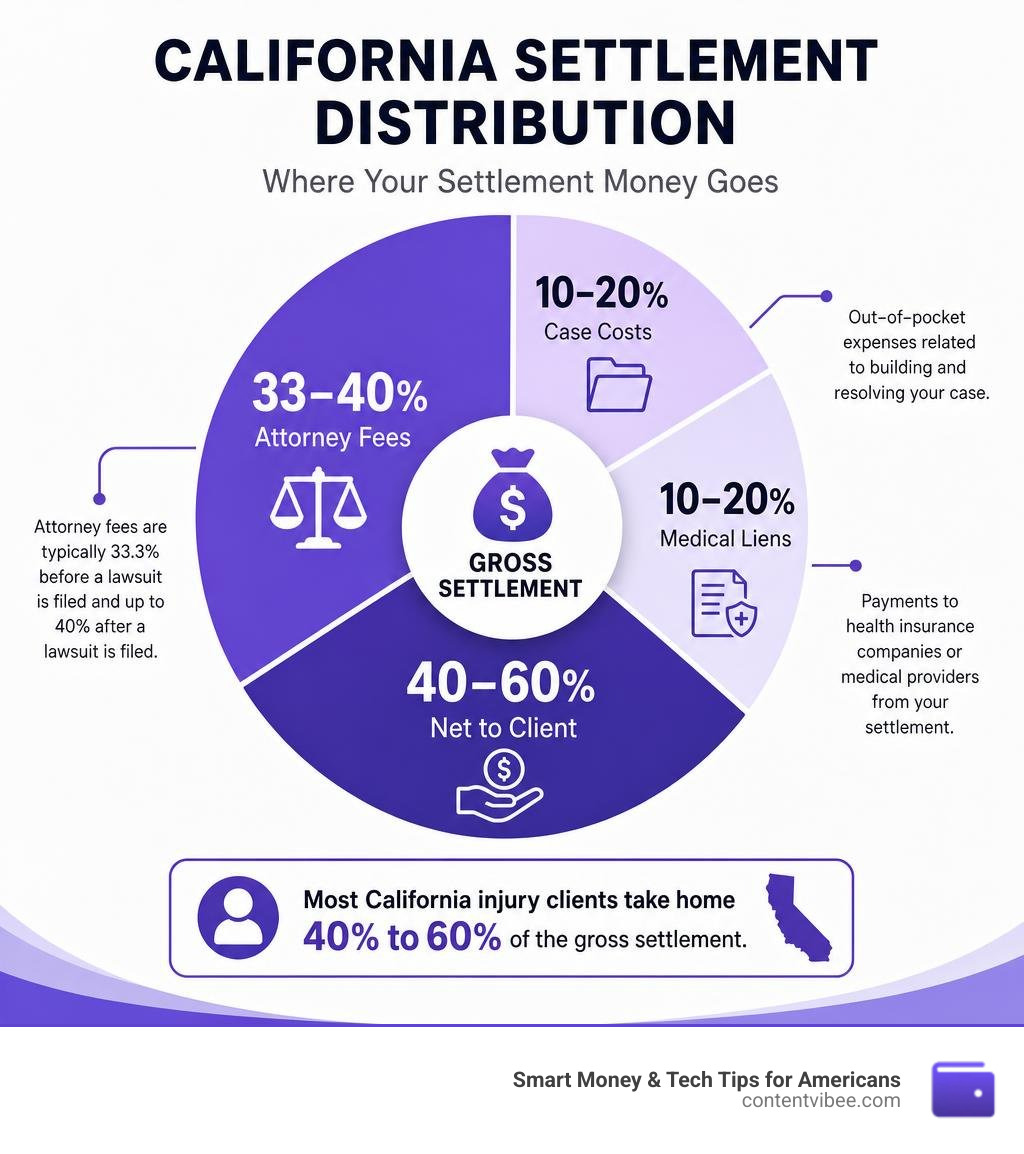
But the attorney’s cut is only part of the story. After fees, case costs, and medical liens are all paid out, most California injury clients take home between 40% and 60% of the gross settlement amount.
On a $100,000 settlement, that can mean walking away with as little as $46,000 — or as much as $67,000 — depending on your specific situation.
This guide breaks down every deduction, shows you real math at four settlement sizes, and explains what you can do to protect your share.
How much do lawyers take from settlement in california helpful reading:
- what percentage does a lawyer take from a settlement
- is it worth hiring an attorney for a car accident
- truck accident lawyer florida
How Much Do Lawyers Take From Settlement in California?
When you are injured in an accident, the financial stress can feel overwhelming. Between medical bills piling up and missed paychecks, the last thing you want to worry about is a giant upfront legal bill. Fortunately, personal injury lawyers in California almost always work on a contingency fee model. This means they only get paid if they win your case, taking a predetermined percentage of the final settlement or court award.
However, the legal landscape in California has specific rules governing how these fees are structured and disclosed. To protect consumers, California law requires all contingency fee agreements to be in writing under Business and Professions Code § 6147. This written agreement must clearly outline:
- The exact contingency fee percentage the attorney will receive.
- How disbursements, case costs, and medical bills will affect your final payout.
- Whether the attorney’s fee is calculated based on the gross settlement (the total amount recovered before expenses) or the net recovery (the amount left after expenses are paid).
Additionally, the State Bar of California enforces Rule 1.5 of the Rules of Professional Conduct, which strictly prohibits attorneys from charging unconscionable fees. This ensures that the percentage taken by your lawyer remains fair and aligned with the actual work performed. To get a deeper understanding of how these fee structures function across different legal scenarios, check out our comprehensive guide on the truth about lawyer fees and what percentage they actually take.
Pre-Suit vs. Post-Suit: How Much Do Lawyers Take From Settlement in California Before Trial?
The stage at which your personal injury claim is resolved plays a massive role in determining the final percentage your lawyer will take. In California, most contingency fee agreements are structured on a sliding scale that increases as the case progresses through the legal system.
If your case is resolved during the pre-suit phase — meaning your attorney negotiates a settlement with the insurance company before filing a formal lawsuit in court — the standard pre-litigation contingency fee rate is typically 33.3% (or one-third) of the gross recovery. This phase involves gathering medical records, drafting demand letters, and negotiating directly with insurance adjusters.
However, if the insurance company refuses to offer a fair settlement, your lawyer may need to file a formal lawsuit. Once litigation begins, the complexity, time, and resources required to push the case forward increase dramatically. Consequently, the contingency fee rate typically jumps to 40% of the gross recovery. This post-suit rate covers the intense demands of the discovery process, depositions, court hearings, and trial preparation. For a detailed breakdown of how these fees are structured and regulated throughout the state, you can refer to this resource on What Are California Personal Injury Attorney Fees?.
Factors That Determine How Much Do Lawyers Take From Settlement in California
While the 33.3% to 40% range is standard, several factors can influence the exact percentage your lawyer takes from a settlement in California:
- Case Complexity: Straightforward cases, such as a clear-cut rear-end collision with documented soft-tissue injuries, are easier to resolve and may sometimes be negotiated at a lower rate. On the other hand, complex cases involving commercial trucks, product liability, or brain injuries require specialized legal expertise and extensive resources, which can justify a higher percentage.
- Attorney Experience and Reputation: Highly sought-after attorneys with a proven track record of securing multi-million dollar verdicts may charge higher contingency fees. However, their experience often allows them to secure substantially larger gross settlements, which can result in a higher net recovery for you, even with a slightly higher fee.
- Trial Preparation: If your case goes all the way to a jury trial, the sheer volume of work and financial risk assumed by the law firm is immense. Some agreements include a clause that raises the fee slightly above 40% if a jury verdict or trial is required to resolve the dispute.
To understand how these variables impact the cost of legal representation, read our detailed article on how much do lawyers charge for accident claims.
The Real Math: Case Costs, Medical Liens, and Your Net Recovery
To fully understand how much do lawyers take from settlement in california, we must look beyond the flat attorney fee percentage. The “gross settlement” is the total amount of money paid out by the insurance company. The “net recovery” is the actual cash that lands in your bank account after all deductions are made.
Besides the attorney’s fee, your gross settlement is subject to two major deductions: case expenses and medical liens. Let’s look at the real-world math. On a typical California personal injury settlement, claimants generally net between 40% and 60% of the gross settlement.
To help visualize this, we have outlined four realistic settlement tiers based on standard California cases, factoring in attorney fees, advanced litigation costs, and negotiated medical liens:
| Gross Settlement | Case Stage & Attorney Fee % | Attorney Fee Amount | Advanced Case Costs | Negotiated Medical Liens | Net to Client (Take-Home) | Net % of Gross |
|---|---|---|---|---|---|---|
| $30,000 (Minor Injury) | Pre-Suit (33.3%) | $10,000 | $380 | $2,500 | $17,120 | 57% |
| $100,000 (Disc Herniation) | Pre-Suit (33.3%) | $33,300 | $1,175 | $12,000 | $53,525 | 53% |
| $250,000 (Surgical Case) | Post-Suit (40%) | $100,000 | $12,100 | $25,000 | $112,900 | 45% |
| $1,000,000 (Catastrophic) | Post-Suit (40%) | $400,000 | $44,500 | $80,000 | $475,500 | 48% |
As you can see, as a case moves into litigation (the $250,000 and $1,000,000 tiers), the combination of a 40% fee and higher advanced case costs reduces the client’s net percentage. However, the total dollar amount the client takes home is still vastly superior to what they could have secured without professional representation. For a deeper dive into these specific settlement tiers, check out this guide on How Much Do I Actually Take Home From a Personal Injury Settlement in California? Real Math at $30K, $100K, and $1M.
Understanding Case Costs and Advanced Expenses
Building a strong personal injury case requires capital. Attorneys typically advance these “case costs” out of their own pockets so you do not have to pay anything upfront. These expenses are separate from the attorney’s percentage fee and are deducted from the gross settlement once it is finalized.
Common advanced case costs include:
- Court Filing Fees: The cost of filing a lawsuit in California courts.
- Expert Witnesses: Fees paid to medical experts, accident reconstructionists, or economic planners to provide testimony.
- Depositions: Costs for court reporters, videographers, and transcript copies.
- Travel Costs: Expenses incurred by the legal team for travel, investigations, and court appearances.
- Medical Record Retrieval: Fees charged by hospitals and clinics to release your medical history.
It is crucial to review your fee agreement to confirm whether these costs are deducted before or after the attorney’s fee is calculated, as this can slightly alter your final payout. To learn more about how these expenses are categorized, read our breakdown of how much does a personal injury lawyer charge.
Medical Liens and Health Insurance Subrogation
Medical liens are often the largest non-attorney deduction from a personal injury settlement. When you receive treatment for accident-related injuries, healthcare providers or insurance companies may assert a legal claim (a lien) against your future settlement to recover the cost of the care they provided.

In California, these liens can come from several sources:
- Private Health Insurance (Subrogation): Your private insurer has a right to be paid back for bills they covered. However, California Civil Code Section 3040 places strict statutory limits on how much a private health plan can recover from your settlement.
- Government Programs (Medi-Cal and Medicare): If Medi-Cal or Medicare covered your treatment, they are legally required to seek reimbursement. Dealing with government liens can add months to your settlement timeline.
- Medical Providers on Lien: Some doctors will treat you on a personal injury lien, meaning they agree to wait for payment until your case settles.
One of the highest-leverage services a personal injury lawyer provides is lien negotiation. Experienced attorneys routinely negotiate with medical providers and health insurance companies to secure 20% to 50% reductions on these liens. In real-dollar terms, a successful lien negotiation can return thousands of dollars back to the client’s pocket, often offsetting a large portion of the contingency fee itself.
Taxability and Timelines for California Settlements
Once you agree to a settlement, two final questions inevitably arise: “Will Uncle Sam take a cut?” and “When will I actually get my money?” Understanding the rules around taxes and distribution timelines in 2026 is critical for your financial planning. To get a broad overview of the entire post-settlement process, check out our Car Accident Settlement Guide 2026.
Are California Personal Injury Settlements Taxable?
The short answer is: generally, no. Under Internal Revenue Code (IRC) Section 104(a)(2), compensatory damages received on account of personal physical injuries or physical sickness are excluded from gross income. This means you do not pay federal or California state income tax on money meant to compensate you for medical bills, physical pain and suffering, or physical therapy.
However, there are a few important exceptions to keep in mind:
- Punitive Damages: Any portion of a settlement awarded to punish the at-fault party is fully taxable.
- Interest Income: If your case was in court for a long time and you received pre-judgment or post-judgment interest, that interest is taxable.
- Purely Emotional Distress: If you receive a settlement for emotional distress that did not stem from a physical injury (for example, a pure defamation or employment case), that money is taxable.
- Previously Deducted Medical Expenses: If you write off your medical expenses on your tax return in a previous year and then receive a settlement covering those same bills, you must report that portion as income under the “tax benefit rule.”
How Long Does It Take to Receive Your Settlement Check?
Getting to a settlement agreement is a huge victory, but you won’t walk out of the room with a check in hand. The disbursement process typically takes anywhere from 4 to 12 weeks to fully resolve.
Here is the typical timeline of what happens after you sign the settlement release:
- Check Issuance (Weeks 1-3): The insurance company processes the release and mails a check to your attorney’s office.
- IOLTA Trust Account Deposit (Weeks 3-4): By law, your attorney must deposit the settlement check into a specialized trust account called an IOLTA (Interest on Lawyers’ Trust Accounts). The bank must clear the funds, which usually takes 3 to 10 business days.
- Lien Resolution (Weeks 4-8): Your attorney contacts Medicare, Medi-Cal, and your medical providers to finalize the negotiated lien amounts. This is often the longest step, as government agencies move notoriously slowly.
- Final Disbursement (Weeks 6-12): Your attorney drafts a detailed, itemized settlement statement showing the gross amount, attorney fees, advanced costs, paid liens, and the final net check written to you.
If you are currently holding an early offer from an insurance company and wondering if it is fair, check out our guide on how to evaluate an insurance settlement offer before signing away your rights.
Frequently Asked Questions About California Settlement Math
Can you negotiate a lawyer’s contingency fee in California?
Yes, contingency fees are negotiable under California law. Under California Rules of Professional Conduct Rule 1.5, fees must be conscionable, and there is no law setting a mandatory flat rate for personal injury claims.
If your case is highly straightforward (such as a clear-cut rear-end accident where the other driver accepts full blame) or if the potential settlement is exceptionally large, you can ask the attorney for a sliding-scale fee or a lower pre-suit rate. However, keep in mind that a highly experienced lawyer who charges a standard 33.3% fee may secure a gross settlement that is twice as large as what a discount lawyer might negotiate, ultimately netting you more money in the long run.
What happens to advanced costs if you lose your case?
Under a standard “no-recovery, no-fee” contingency agreement, you do not owe your lawyer any attorney fees if your case is unsuccessful. However, you must look closely at your contract’s terms regarding advanced case costs.
While many reputable personal injury firms in California agree to waive advanced costs (like filing fees and expert witness fees) if they lose, some contracts state that the client remains responsible for reimbursing these third-party expenses. Always ask your attorney to clarify this clause before signing.
How does the Howell Rule affect medical liens in California?
The Howell Rule is a landmark California legal precedent established by the state Supreme Court in Howell v. Hamilton Meats & Provisions. Under this rule, a personal injury plaintiff can only recover the amount of medical expenses that were actually paid or accepted as full payment by their medical providers — not the inflated “billed” sticker price.
This rule keeps medical liens realistic. If a hospital bills $50,000 for your care, but your health insurance negotiated that bill down and paid only $10,000 to fully satisfy the debt, your medical damages in the lawsuit are limited to $10,000. This protects your settlement from being entirely drained by inflated, unnegotiated hospital bills.
Conclusion
Navigating the financial realities of a personal injury claim can feel like learning a whole new language. At Smart Money & Tech Tips for Americans, we believe that transparency is the key to making smart financial decisions. Knowing how much do lawyers take from settlement in california is the first step toward securing your financial future after an unexpected accident.

When hiring an attorney, never hesitate to ask tough questions about their fee structure, how they calculate gross versus net fees, and their strategy for negotiating medical liens. A great lawyer will welcome these questions and walk you through the math with complete transparency. For a deeper look at the true costs of hiring legal help, read our complete guide on how much a personal injury lawyer costs. Protect your rights, audit your settlement statements, and make sure your hard-earned recovery stays exactly where it belongs — in your pocket.


