


What You Need to Know About Credit Cards Before You Apply
Credit cards are one of the most powerful financial tools available to Americans — but only when you choose the right one.
Here’s a quick overview to answer the most common questions right away:
| Question | Quick Answer |
|---|---|
| What types of credit cards exist? | Cash back, travel rewards, balance transfer, secured, student, and no-annual-fee cards |
| What credit score do I need? | Most rewards cards prefer 670+; secured cards accept 300+ |
| What is the average U.S. credit score? | 715 (as of April 2025) |
| Can I get a card with bad credit? | Yes — secured cards are designed for this |
| What hurts my score most? | Missing payments (payment history = 35% of your FICO Score) |
| What’s the fastest way to build credit? | On-time payments + keeping balances below 30% of your limit |
Whether you’re trying to earn rewards on everyday spending, pay down debt with a 0% intro APR offer, or rebuild a credit score that took a hit — the card you pick matters enormously.
The problem is there are hundreds of options. Annual fees, reward rates, intro offers, foreign transaction fees — it’s a lot to sort through.
This guide cuts through the noise. We’ll walk you through every major card type, explain what to look for when comparing offers, and show you how to use a credit card to actually improve your financial life — no matter where you’re starting from.
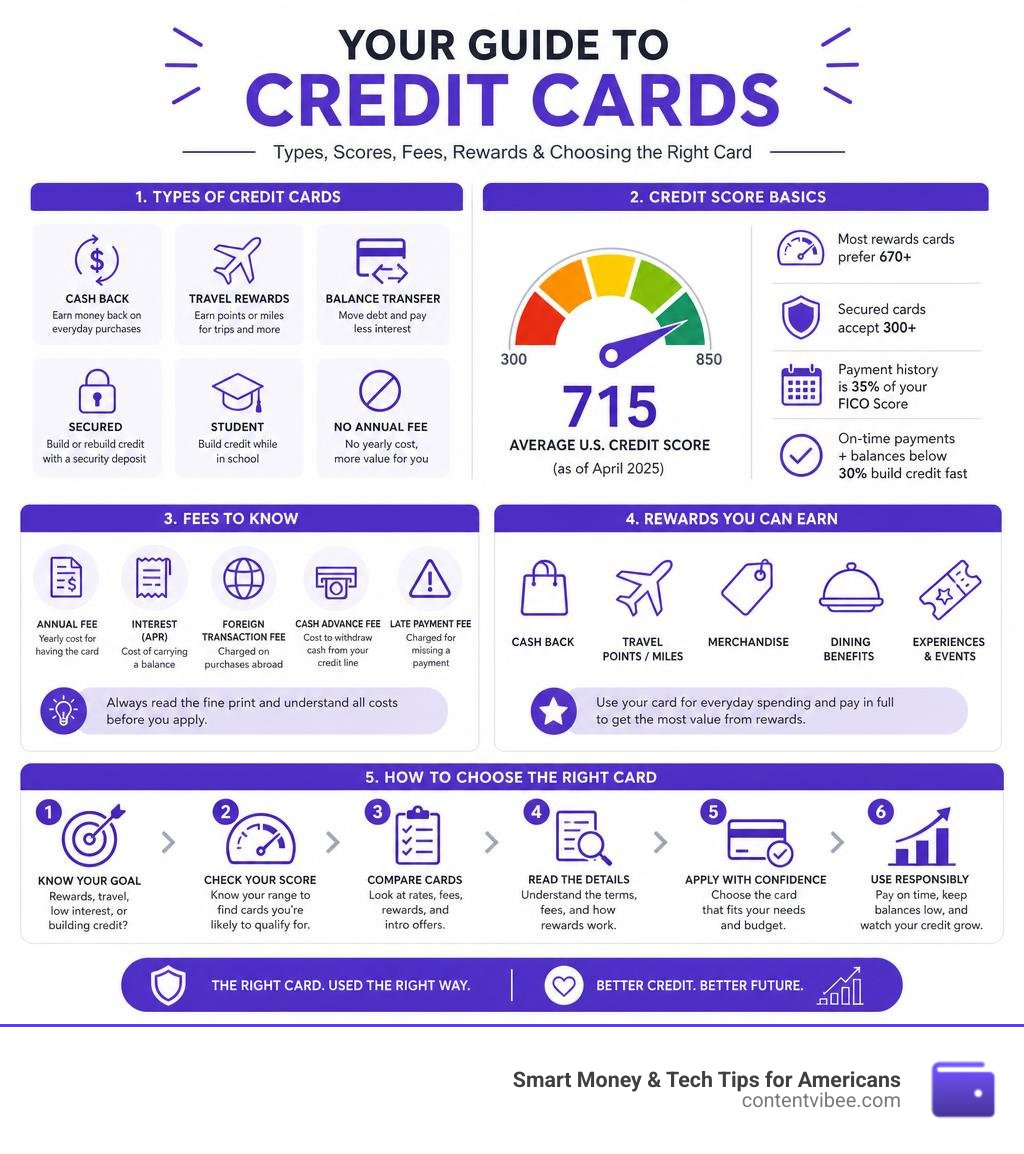
Understanding the Main Types of Financial Cards
When you start looking for a new card, the sheer volume of choices can feel overwhelming. To make the best choice for your wallet, it helps to understand that almost all credit cards fall into a few distinct categories. Each type is designed to solve a specific financial problem or reward a particular spending habit.
- Rewards Cards: These cards earn points or miles on your purchases, which you can later redeem for travel, merchandise, or unique experiences. They are best for people who pay their balances in full every month and want to get extra value from their regular spending.
- Cash Back Cards: A subset of rewards cards, these offer a straightforward refund on your purchases. Whether it is a flat-rate card earning a consistent percentage on everything you buy or a tiered card offering higher percentages on categories like groceries or gas, cash back is the ultimate flexible reward.
- Travel Perks Cards: Designed for frequent flyers and road warriors, these cards offer travel-specific benefits like airport lounge access, free checked bags, and hotel elite status.
- Balance Transfer Cards: If you are carrying high-interest debt on an existing card, these options allow you to move your balance to a new card with a 0% introductory APR period, helping you pay off your debt faster without accumulating more interest.
- Secured Cards: Built specifically for those with damaged credit or no credit history at all, these require a refundable security deposit that serves as your credit limit. They are excellent stepping stones to traditional credit.
- No-Annual-Fee Cards: Perfect for budget-conscious consumers, these cards cost nothing to keep in your wallet year after year, allowing you to build credit or earn basic rewards without an upfront cost.
Maximizing Rewards with Premium Credit Cards
If you have a solid credit history and want to elevate your lifestyle, premium rewards cards offer unparalleled luxury perks. These cards generally carry higher annual fees, but they offset those costs with robust point-earning structures, statement credits, and travel protections.
For food lovers and daily spenders, The American Express® Gold Card is a standout option. It focuses heavily on dining and everyday purchases, offering 4X points at restaurants worldwide (on up to $50,000 per year) and 4X points at U.S. supermarkets (on up to $25,000 per year). Additionally, it provides cardmembers with up to $120 in annual dining credits, $120 in Uber Cash, and Resy credits that can unlock more than $500 in annual value for a $325 annual fee.
For the ultimate travel experience, the Platinum Card® offers over $3,500 in potential annual value. While it carries a premium annual fee, it unlocks access to the Global Lounge Collection (featuring over 1,550 airport lounges worldwide), up to $200 in airline fee credits, up to $600 in hotel credits, and elite status with major hotel chains. It also earns an impressive 5X points on flights booked directly with airlines or through American Express Travel.
Everyday Value with Cash Back and No-Fee Options
You do not need to pay a hefty annual fee to get great value from your plastic. Cash back and no-annual-fee cards are perfect for straightforward, daily spending. They provide clear, tangible rewards without forcing you to calculate the value of points or miles.
For iPhone users, the Apple Card – Apple offers a seamless, modern approach to credit. It features no fees of any kind—no annual fees, late fees, or foreign transaction fees. When you use it with Apple Pay, you earn 2% Daily Cash back on all purchases, and 3% back at Apple and select partner merchants. The cash is deposited directly into your Apple Cash account daily, meaning you can spend it or save it in a high-yield savings account immediately.
If you are a frequent online shopper, the Prime Visa Credit Card | Chase is an incredibly lucrative addition to your wallet. For Prime members, it offers an unlimited 5% back on purchases at Amazon.com, Whole Foods Market, and Chase Travel. It also earns 2% back at gas stations, restaurants, and on local transit, all with a $0 annual card fee.
Key Factors to Evaluate When Comparing Credit Cards
Before you hit the “apply” button, it is vital to look past the flashy marketing and evaluate the card’s underlying financial terms. Comparing these key factors will ensure you do not end up with a card that costs you more than it is worth.

When comparing cards, always look at the following metrics:
| Card Category | Typical APR Range | Common Annual Fee | Key Rewards / Benefits |
|---|---|---|---|
| Premium Rewards | 19.49% – 28.49% (Variable) | $250 – $695 | High point multipliers, lounge access, luxury travel credits |
| Cash Back / No-Fee | 18.24% – 27.49% (Variable) | $0 | 1.5% to 5% cash back, mobile wallet integration |
| Secured / Rebuilding | 13.49% – 35.99% (Variable) | $0 – $49 | Credit bureau reporting, path to credit upgrades |
How Intro APR and Balance Transfer Offers Work
Introductory 0% APR offers are powerful tools for managing large expenses or consolidating high-interest debt. When a card offers a 0% intro APR on purchases, it means you can carry a balance without accruing interest for a set period—often between 12 and 21 months.
Balance transfer offers work similarly but are designed for existing debt. You move your balance from a high-interest card to a new card with a 0% introductory rate on balance transfers. This stops interest from piling up, allowing 100% of your monthly payment to go toward reducing your principal balance.
To find these interest-saving opportunities, look into the Wells Fargo Visa® Credit Cards and Mastercard® | Wells Fargo lineup, which frequently features some of the longest introductory APR periods in the industry. For example, some Wells Fargo cards offer up to 21 months of 0% introductory APR on purchases and qualifying balance transfers, giving you nearly two years to pay down your balances interest-free.
Navigating Fees and Interest Rates
While rewards are exciting, card fees can quickly eat into your profits if you aren’t careful. Understanding how these fees work is the first step to avoiding them entirely.
- Annual Fees: Charged once a year for holding the card. Make sure the card’s rewards and statement credits outweigh this fee.
- Late Payment Fees: Charged if you miss your payment due date. You can easily avoid this by setting up automatic payments.
- Foreign Transaction Fees: A 1% to 3% fee tacked onto purchases made outside the United States. If you travel internationally, look for a card that waives this fee.
- Balance Transfer Fees: Usually 3% to 5% of the total amount transferred. Even with this fee, a 0% intro APR transfer usually saves you hundreds of dollars compared to high credit card interest rates.
To avoid paying interest altogether, make it a habit to pay your “statement balance” in full every single month. If you pay the full statement balance by the due date, issuers grant you a grace period, meaning they will not charge you a single penny of interest on your purchases.
How to Build or Rebuild Credit from Scratch
Your credit score is a crucial grade of your financial reliability. In the United States, FICO scores range from 300 to 850. As of April 2025, the average FICO score in the U.S. stood at 715. If your score is below that average—or if you do not have a score at all—it can be difficult to qualify for apartment rentals, auto loans, or competitive mortgage rates.
Fortunately, credit cards are the most effective tool for building or repairing that score from scratch. Every month, credit card issuers report your payment activity to the three major credit bureaus: Equifax, Experian, and TransUnion. By using a card responsibly, you create a steady stream of positive data points that pull your score upward.

Rebuilding Your Score with Secured Credit Cards
If you have a poor credit score (typically between 300 and 579) or a limited credit history, traditional unsecured cards may reject your application. This is where secured credit cards save the day.
With a secured card, you provide a refundable security deposit (often starting around $200) that acts as your collateral and usually determines your credit limit. Because the deposit protects the lender if you fail to pay, approval rates are incredibly high.
Some modern secured cards do not even require a credit check. For example, fintech options like the Varo Believe secured card have shown remarkable results: more than 90% of customers who started with no credit score at all established a score after using the card for just one month. Even better, Varo Believe customers see an average credit score increase of 40+ points after just three months of consistent, on-time payments.
If you prefer working with established financial institutions in California, you can explore specialized Visa Credit Cards from regional banks like California Bank & Trust, which offer secure, reliable paths to build your credit profile with local support.
Habits That Maximize Your Credit Score
Getting approved for a credit-builder card is only the first step; how you use it determines how quickly your score rises. To maximize your progress, focus on the two heaviest components of your FICO score:
- Payment History (35% of your score): This is the single most important factor. A single late payment can knock dozens of points off your score. Set up automatic monthly payments for at least the minimum payment due—though paying the full balance is always best—to guarantee you never miss a deadline.
- Credit Utilization (30% of your score): This measures how much of your available credit limit you are using at any given time. For instance, if your secured card has a $500 limit and you carry a $250 balance, your utilization is 50%. To keep your score in excellent health, keep your credit utilization below 30%, and ideally below 10%. If your limit is $500, try to keep your reported balance under $150.
Choosing the Right Issuer for Your Financial Goals
Not all credit card issuers are built the same. Depending on your financial goals, you might prefer the national reach of a massive bank, the community-focused benefits of a credit union, or the high-tech simplicity of a modern fintech platform.
Traditional major banks offer highly competitive rewards programs, massive ATM networks, and robust mobile apps. However, they may have stricter approval requirements and higher interest rates.
Traditional Banks vs. Credit Unions
For many Californians, credit unions are an incredibly attractive alternative to big banks. Because credit unions are member-owned, not-for-profit organizations, they return their profits to members in the form of lower interest rates, reduced fees, and personalized customer service.
If you live or work in Southern California, checking out the credit card options at Credit Cards through California Coast Credit Union can connect you with excellent low-rate cards and local community perks. Similarly, checking out Credit Union Credit Cards | California & North Island … via California Credit Union provides access to versatile rewards cards designed specifically for California residents, often with lower APRs than national commercial banks can offer.
Co-Branded and Travel Partner Options
If you are loyal to a specific airline or hotel chain, a co-branded credit card can supercharge your loyalty points and provide highly specific travel luxuries.
For travelers who prefer United Airlines, the United Explorer Credit Card | Chase.com is a perfect example of co-branded value. It offers up to 60,000 bonus miles for new cardmembers, a free first checked bag for you and a companion (saving up to $160 per roundtrip), priority boarding, and two United Club one-time passes every year.
Frequently Asked Questions About Card Ownership
What is the easiest card to get with bad credit?
Secured credit cards are by far the easiest to qualify for when you have bad credit. Because you provide a refundable security deposit that reduces the issuer’s risk, many secured cards do not require a credit check or a minimum credit score for approval.
How does credit utilization affect my score?
Credit utilization makes up 30% of your FICO score. It measures how much of your total credit limit you are using. Keeping your balances low relative to your limits shows lenders that you are not relying too heavily on borrowed money, which quickly boosts your score.
Can I prequalify for a card without hurting my credit?
Yes! Many modern card issuers offer prequalification tools on their websites. These tools use a “soft pull” or soft inquiry to check your eligibility, which gives you an accurate estimate of your approval odds without affecting your credit score. A “hard pull” only occurs after you formally submit the application.
Conclusion
At Smart Money & Tech Tips for Americans, we believe that understanding credit cards is a foundational step toward long-term financial freedom. Whether you are starting with a poor credit score or looking to optimize a premium rewards strategy, the decisions you make today will shape your financial opportunities for years to come.
By paying your bills on time, keeping your utilization low, and choosing cards that align with your natural spending habits, you can make your money work harder for you.
Ready to take the next step on your financial journey? Explore our comprehensive Smart Money & Credit Guide for more practical tips, tools, and tech-savvy advice to help you master your wallet!


