


Why Every Borrower Needs a Monthly Loan Repayment Calculator
A monthly loan repayment calculator is one of the fastest ways to find out exactly what a loan will cost you — before you sign anything.
Here’s what it tells you instantly:
- Monthly payment — what you owe each month
- Total interest paid — the real cost of borrowing over time
- Total repayment amount — principal plus all interest combined
- Payoff date — when you’ll be completely debt-free
To use one, you only need three numbers:
- Loan amount (how much you’re borrowing)
- Interest rate (the annual rate from your lender)
- Loan term (how many months or years to repay)
Enter those, and you get your monthly payment in seconds.
Most lenders advertise the monthly payment front and center — and bury the total interest you’ll pay. That gap matters more than most people realize.
Consider this: a $10,000 loan at 11.5% APR costs $1,844 in interest over 36 months. Stretch that same loan to 48 months, and the total interest jumps to $2,618 — that’s $774 more, just for a lower monthly payment.
For retirees and pre-retirees managing fixed incomes, that kind of hidden cost can quietly drain cash flow that could otherwise go toward investments or living expenses.
A loan repayment calculator puts all three numbers in front of you at once, so you can make a genuinely informed decision — not just the one your lender is hoping you’ll make.
Explore more about monthly loan repayment calculator:
Understanding the Mechanics of Loan Repayment
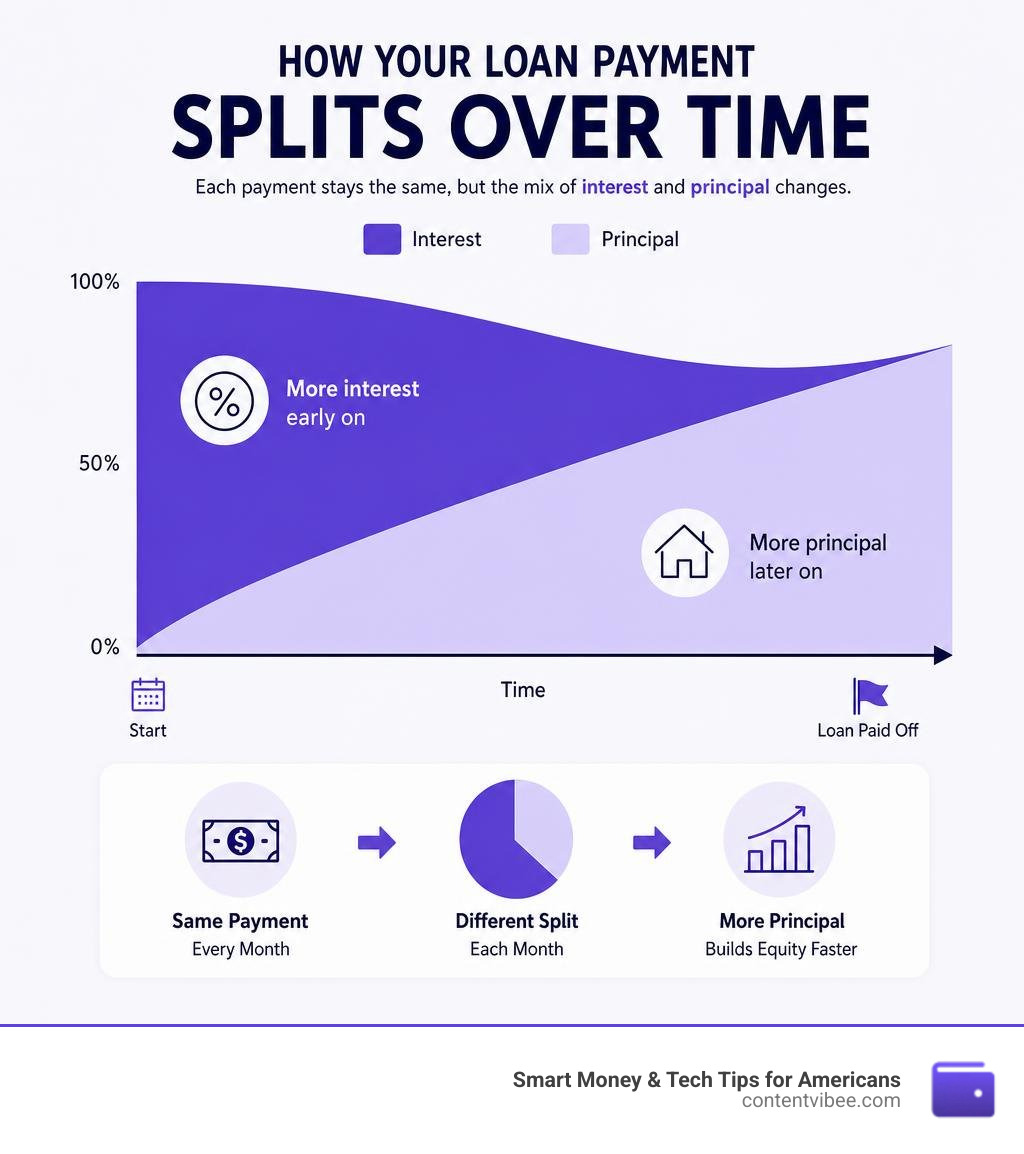
When you take out an installment loan, you agree to pay back the borrowed amount plus interest over a set period. But how does that money actually get split up behind the scenes?
The magic (and sometimes the frustration) of standard loans lies in a process called amortization. Amortization is simply the spreading out of loan payments over multiple equal installments. In the early stages of your loan, a massive chunk of your monthly payment goes directly toward paying off the interest. Over time, as the principal balance shrinks, the calculation shifts, and more of your payment goes toward paying down the actual principal.
If you don’t use a tool to visualize this, you might be shocked to look at your statement after a year of timely payments only to find your total balance has barely budged. That is why understanding these mechanics is so crucial for your long-term financial health.
What Is a Monthly Loan Repayment Calculator and How Does It Work?
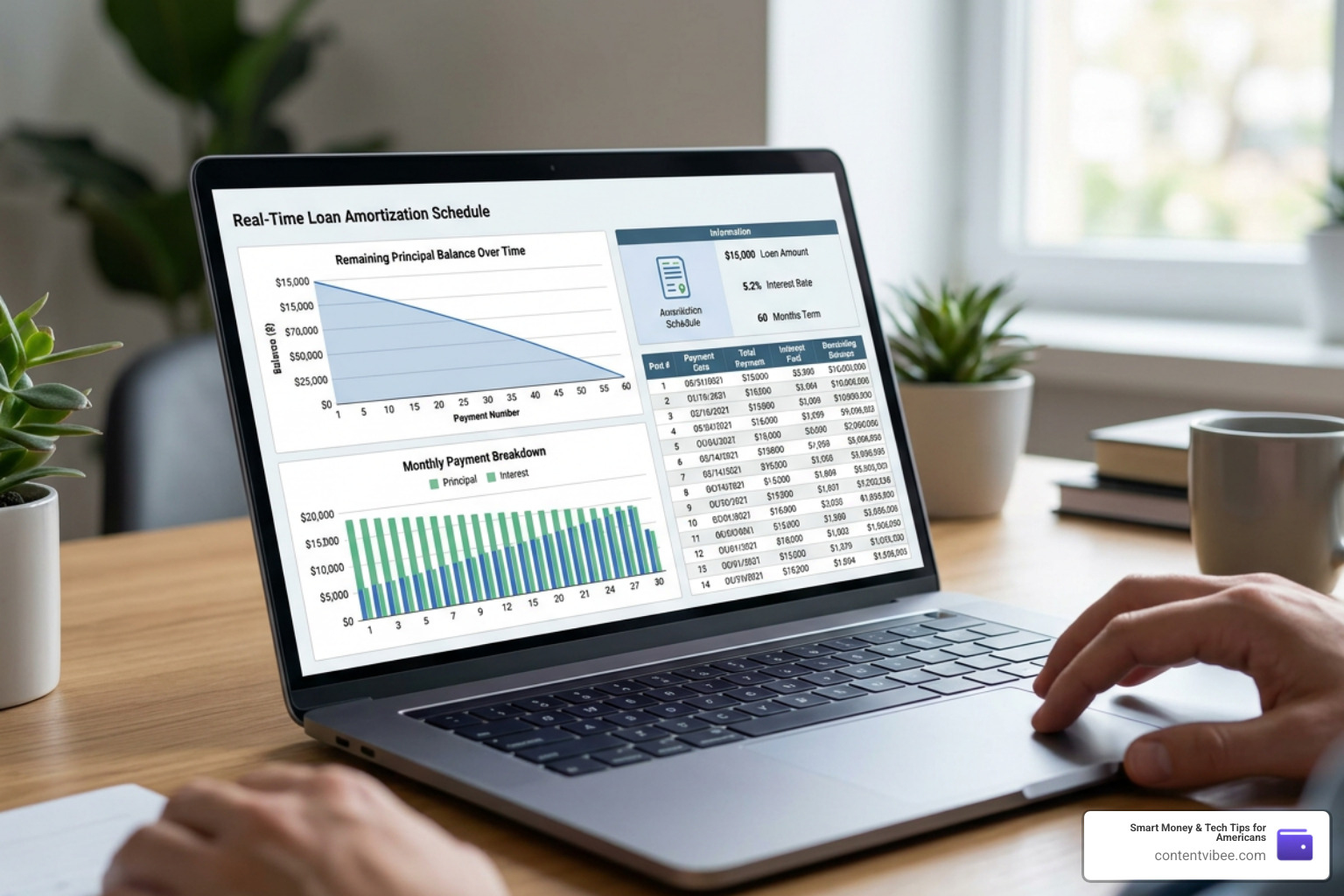
A monthly loan repayment calculator is an interactive digital tool designed to model the exact path of your debt payoff journey. Instead of guessing how a lender arrived at a specific monthly payment, you plug in your basic loan terms, and the calculator instantly applies the standard mathematical rules of amortization to give you a clear, unbiased breakdown.
These calculators work by simulating the life of your loan month by month. They take your annual interest rate, divide it by the number of payment periods in a year, and apply that rate to your remaining principal balance to determine your interest cost for that month. The rest of your fixed payment is then used to reduce the principal.
Using an online tool like a Payment Calculator takes the guesswork out of the borrowing process. Whether you are looking at personal loans, auto loans, or a mortgage, this tool ensures you never have to take a lender’s word at face value.
Ready to test out your own numbers? Take control of your finances with our comprehensive suite of tools and see exactly where your hard-earned money is going.
Key Inputs Needed for a Monthly Loan Repayment Calculator
To get an accurate picture of your future loan, you cannot just guess the inputs. A monthly loan repayment calculator relies on five distinct variables:
- Loan Amount (Principal): The total amount of money you are borrowing upfront.
- Interest Rate: The annual percentage rate charged by the lender. That this is the base cost of borrowing before additional fees.
- Loan Term: The duration you have to pay the loan back, usually expressed in months (e.g., 36, 48, 60, or 72 months) or years (such as 15 or 30 years).
- Payment Frequency: While most loans default to monthly payments, some lenders allow biweekly, semimonthly, or weekly schedules.
- Fees: Upfront costs like loan origination fees, which are often deducted from your payout or rolled directly into your loan balance.
By accurately gathering these details from your loan estimate, you can prevent unexpected surprises when the first bill arrives.
The Standard Amortization Formula Explained
For those who want to understand the exact math driving their monthly payments, we can look at the standard amortization formula. Lenders use this equation to determine your fixed monthly payment ($M$):
$$M = P \frac{r(1+r)^n}{(1+r)^n – 1}$$
Where:
- $M$ = Your total monthly payment.
- $P$ = The principal loan amount.
- $r$ = Your monthly interest rate (annual interest rate divided by 12 months). For example, a 6% annual rate becomes a monthly rate of 0.005 (0.06 / 12).
- $n$ = The total number of payments (loan term in years multiplied by 12).
Let’s walk through a real-world scenario. If you borrow $20,000 as a personal loan at 10% interest for 5 years (which equals 60 monthly payments):
- $P$ = $20,000
- $r$ = 0.10 / 12 = 0.008333
- $n$ = 60
Plugging these values into the formula yields a fixed monthly payment of about $425, with a total interest cost of about $5,500 over the life of the loan. Instead of doing this complex algebra by hand, you can use a Repayment Calculator to instantly compute these amounts for any scenario.
How Interest Rates, Terms, and Fees Impact Your Payments
Every loan is a balancing act. Adjusting one variable — like your interest rate or your term length — will instantly trigger a shift in your monthly payment and your total interest costs.
To see this balancing act in action, take a look at how different terms and rates affect a standard $20,000 loan:
| Loan Amount | Interest Rate (APR) | Term Length | Monthly Payment | Total Interest Paid |
|---|---|---|---|---|
| $20,000 | 7% | 24 Months | $896 | $1,496 |
| $20,000 | 7% | 60 Months | $396 | $3,758 |
| $20,000 | 7% | 72 Months | $340 | $4,556 |
| $20,000 | 12% | 60 Months | $445 | $6,691 |
As you can see, extending your term from 24 months to 72 months on a 7% loan drops your monthly payment by $556, but it more than triples your total interest cost, adding an extra $3,060 in pure profit for the lender.
For a deeper dive into managing auto-specific loans, check out The Ultimate Guide to Using a Car Loan Rates Calculator.
Interest Rate vs. APR: Why the Difference Matters
One of the most expensive mistakes a borrower can make is confusing their base interest rate with the Annual Percentage Rate (APR).
- Interest Rate: This is the basic cost to borrow the principal balance, expressed as a yearly percentage. It does not account for any other fees associated with the loan.
- APR (Annual Percentage Rate): This is a much more comprehensive number. It includes both the interest rate and any mandatory upfront fees, such as origination fees, administrative charges, or prepaid interest.
Because APR represents the true, all-inclusive yearly cost of borrowing, it is the only number you should use when comparing loan offers side-by-side. For example, federal student loans often come with origination fees (historically around 1.057% for Direct Subsidized/Unsubsidized loans, and 4.228% for Direct PLUS loans). These upfront fees effectively reduce the amount of cash you receive while keeping your repayment obligation based on the full balance.
To see how these hidden fees change your actual bottom line, you can read more at How much will this loan cost you? — Loan Payment Calculator – Monthly Payment & Amortization Calculator (2026) | UseACalculator.com or test your numbers directly using our tools: Take control of your finances with our comprehensive suite of tools.
How Loan Term Length Affects Monthly Payments and Total Interest
Choosing the right loan term is a direct trade-off between your current monthly budget and your future financial freedom.
Short-term loans (like a 36-month personal loan or a 15-year mortgage) require higher monthly payments, but they secure lower interest rates and allow you to pay off the debt rapidly, saving you thousands of dollars in interest. Long-term loans (like a 72-month auto loan or a 30-year mortgage) stretch out your payments to keep your monthly budget comfortable, but they subject you to higher interest rates and a prolonged amortization schedule.
For instance, consider these real-world benchmarks:
- A $35,000 auto loan at 6% for 72 months yields a monthly payment of about $580 before taxes and fees.
- A $45,000 student loan at 6.8% for 10 years has a monthly payment of about $518 under a standard fixed-payment plan (refer to the Loan Payment Calculator – Finaid for similar educational loan scenarios).
- A $250,000 mortgage at 6.5% for 30 years has a principal-and-interest payment of about $1,580 per month.
If you are currently trying to find the sweet spot for a vehicle purchase, our breakdown in The 5-Year Car Loan Roadmap: Navigating 15k, 30k, and 50k Auto Loans can help you map out the perfect term length.
How to Use a Monthly Loan Repayment Calculator to Compare Loan Offers

When you are shopping for a loan, you should never accept the first offer that comes your way. Lenders count on borrowers being too impatient to compare rates. By using a monthly loan repayment calculator, you can act as your own advocate and evaluate multiple offers without any sales pressure.
Start by gathering formal loan estimates or pre-qualification offers. Instead of looking only at the monthly payment, plug each offer’s principal, term, and APR into a Loan Calculator | Bankrate or a Loan Calculator | Monthly Payment, Interest & Payoff Date .
Look closely at the total interest paid over the life of each option. Sometimes, a lender who offers a slightly lower monthly payment is actually charging higher upfront fees or extending your term, which costs you far more in the long run. If you are a business owner looking to compare commercial financing options, you can find a tailored strategy in our Commercial Loan Calculator Guide for Smart Business Owners.
Comparing Payment Frequencies: Monthly, Biweekly, and Weekly
Did you know that simply changing how often you send money to your lender can shave months off your debt and save you hundreds of dollars? While most borrowers default to a monthly schedule, many lenders allow you to choose weekly, biweekly, or semimonthly payment frequencies.
It is important to understand that biweekly and semimonthly schedules are not the same:
- Semimonthly (24 payments per year): You make two payments per month (usually on the 1st and 15th). This splits your standard monthly payment exactly in half, resulting in the same annual total.
- Biweekly (26 payments per year): You make a payment every two weeks. Because there are 52 weeks in a year, this results in 26 half-payments — which is equivalent to 13 full monthly payments instead of the usual 12.
This “accelerated” biweekly schedule quietly injects an extra month’s payment into your principal balance every single year. For example, on a $25,000 loan at 7% for 5 years, a standard monthly payment schedule costs about $4,702 in total interest. Switching to a biweekly payment schedule reduces your total interest to about $4,663, helping you pay off the principal balance ahead of schedule.
To see how different frequencies alter your payoff timeline, run your numbers through our Take control of your finances with our comprehensive suite of tools.
Accelerating Your Payoff with Extra Payments
If you want to escape debt even faster, the single most effective strategy is making extra principal payments. Because interest is calculated based on your remaining principal balance, any extra money you pay directly reduces that balance, meaning less interest can accrue in all subsequent months.
Let’s look at the numbers. On a $20,000 personal loan at 7% over 60 months, adding just $100 extra per month to your payment:
- Saves you $1,201 in total interest.
- Shortens your payoff timeline by 16 months.
Whether you choose to make a small extra payment every month, a larger payment once a year (like using your tax refund), or a one-time lump sum payment, the savings compound rapidly. You can use a specialized tool like the Loan Repayment Calculator (Free) — Amortization & Extra Payments | DuskTools to visualize exactly how much time and money your extra payments will save.
To plan your prepayment strategy safely and avoid potential lender traps, read our guide: The Early Bird Gets the Title: Your Guide to Car Loan Prepayment Calculators.
Advanced Considerations: Rules, Taxes, and Common Mistakes
Before you sign a loan agreement, you must look beyond the basic math. Real-world borrowing involves navigating tax laws, lender regulations, and distinct financing structures. For example, if you are torn between leasing and financing a major asset, you should review Everything You Need to Know About Lease vs Finance to understand the structural differences.
Country-Specific Repayment Rules and Tax Implications
Because we are focusing on US-based borrowers, it is important to understand how the IRS treats different types of loan interest:
- Mortgage Interest: For primary and secondary homes, mortgage interest is often tax-deductible if you itemize your deductions on your federal tax return, subject to IRS limits.
- Student Loan Interest: You may be able to deduct up to $2,500 of student loan interest paid on qualified educational loans each year, even if you do not itemize your deductions. This deduction is subject to income phase-outs.
- Personal and Auto Loan Interest: Interest paid on personal consumer loans or standard auto loans is not tax-deductible.
Additionally, compounding rules can vary. While most US consumer loans compound interest monthly or daily, other countries have entirely different standards (such as Canadian mortgages, which use semi-annual compounding by law). Always verify how interest is compounding on your specific loan agreement.
Common Loan Repayment Mistakes to Avoid
To protect your wallet, watch out for these common borrowing pitfalls:
- The Low Payment Trap: Lenders love to offer incredibly low monthly payments by stretching the loan term out to 72 or 84 months. Never evaluate a loan solely by its monthly payment; always look at the total borrowing cost over the life of the loan.
- Ignoring Upfront Fees: A loan with a lower advertised interest rate might actually be more expensive than its competitors if it carries a massive origination fee. Always compare loans using the APR.
- Overlooking Prepayment Penalties: Some lenders charge a fee if you pay off your loan early, because early payoffs reduce the amount of interest they can collect from you. Always ask your lender for a written statement confirming that there are no prepayment penalties before signing.
Frequently Asked Questions about Loan Repayment
Can I pay off my loan early without a penalty?
In most cases, yes. The vast majority of modern personal loans, auto loans, and student loans in the United States do not carry prepayment penalties. However, some subprime lenders or specialized business loans still include these fees. Always review your loan contract or request a written payoff statement from your lender to confirm that you can make extra payments or pay off the balance early without incurring a penalty.
How does compounding frequency affect my total loan cost?
Compounding frequency refers to how often the lender calculates and adds accrued interest to your principal balance. The more frequently compounding occurs (e.g., daily compounding versus monthly compounding), the more interest will accumulate over time. While the difference is usually nominal on small personal loans, daily compounding can add thousands of dollars to large, long-term debts like mortgages.
What is a debt-to-income (DTI) ratio and why does it matter?
Your debt-to-income (DTI) ratio is the percentage of your gross monthly income that goes toward paying your recurring monthly debts (such as rent, mortgage, auto loans, credit cards, and student loans). Lenders use your DTI ratio to measure your ability to manage monthly payments. Most lenders require a DTI ratio below 43% to approve a new loan, while a DTI ratio below 36% is generally required to qualify for the most competitive interest rates.
Conclusion
Taking control of your debt does not require a degree in finance. By using a monthly loan repayment calculator, you can instantly cut through lender marketing, unearth hidden borrowing costs, and build an optimized payoff strategy that fits your unique lifestyle.
At ContentVibee, we believe that smart money decisions start with clear, actionable information. Whether you are comparing loan terms, evaluating interest rates, or preparing to make extra payments to claim your financial freedom, having the right tools makes all the difference.
Take the first step toward masterfully managing your cash flow today: Take control of your finances with our comprehensive suite of tools and watch your debt disappear.


