


The Case for Waiting: What Social Security Age 70 Benefits Actually Pay
Social Security age 70 benefits are the highest monthly payments the program can pay you — and the difference compared to claiming early is substantial.
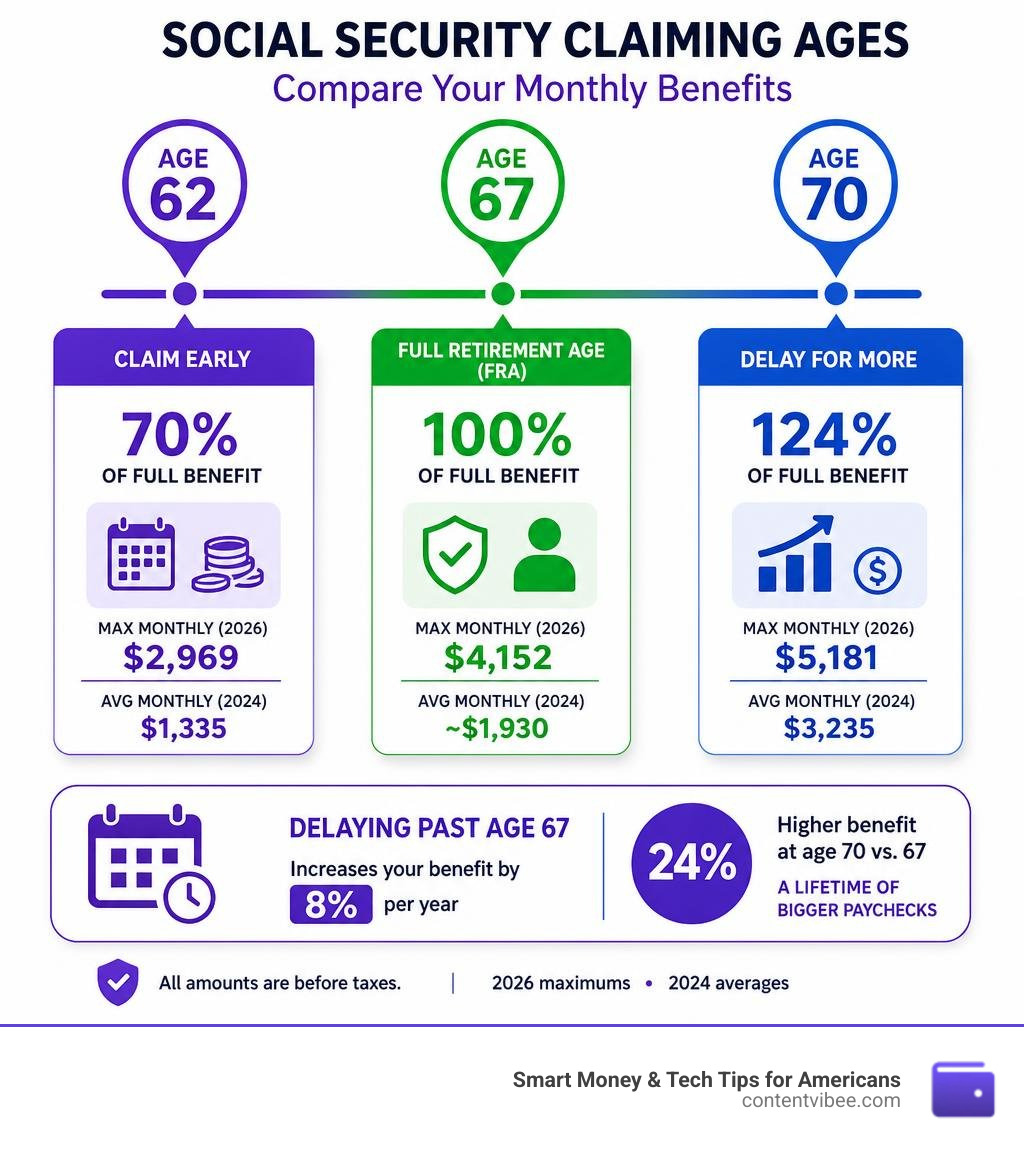
Here’s a quick snapshot of what you can expect in 2026, depending on when you claim:
| Claiming Age | Maximum Monthly Benefit (2026) | Average Monthly Benefit (2024) | % of Full Benefit |
|---|---|---|---|
| Age 62 | $2,969 | $1,335 | 70% |
| Age 67 (FRA) | $4,152 | ~$1,930 | 100% |
| Age 70 | $5,181 | $3,235 | 124% |
The core idea is simple: every year you delay past your full retirement age (67 for most people today), your monthly check grows by 8%. Wait from 67 to 70, and you lock in a permanent 24% increase for the rest of your life.
That’s not a small difference. For a married couple where one spouse lives into their late 80s, it can mean hundreds of thousands of dollars more in lifetime income.
But waiting isn’t right for everyone. Your health, finances, and family situation all matter. That’s exactly what this guide walks through.
A 2022 study from the National Bureau of Economic Research found that more than 90% of workers ages 45 to 62 would maximize their lifetime Social Security income by waiting until age 70. Yet in 2024, only 8.7% of new claimants actually did so.
Most people are leaving real money on the table — often without realizing it.
The Math Behind Social Security Age 70 Benefits
To truly appreciate why delaying your claim is such a powerful financial move, we need to lift the hood and look at the engine. Social Security calculations can feel like high school algebra all over again, but we promise to keep this painless.
Your journey starts with your Primary Insurance Amount (PIA). This is the base monthly benefit you are entitled to receive once you reach your Full Retirement Age (FRA). For anyone born in 1960 or later, your FRA is exactly 67. The Social Security Administration (SSA) calculates your PIA by looking at your 35 highest-earning years, adjusting those earnings for inflation, and applying a formula to find your average indexed monthly earnings.
If you want to get an idea of where you stand before making any major moves, you can easily Estimate Your Monthly Retirement Benefits In 5 Easy Steps using online tools.
But here is where the math gets exciting: your PIA is not a static ceiling. If you choose to delay claiming your benefits past your FRA, the government rewards your patience. Under the rules outlined in the Benefits Planner: Retirement | Delayed Retirement Credits | SSA , your benefit increases by a fixed percentage for every single month you delay, up until you turn 70.
In 2026, the stakes are higher than ever. If you have been a high earner throughout your career and have consistently hit or exceeded the Social Security taxable maximum—which is $184,500 in 2026—your maximum possible benefit at age 70 is a staggering $5,181 per month. Compare that to the maximum of $4,152 you would get at age 67, or the $2,969 you would get if you filed early at age 62. By waiting, you are securing an extra $2,212 every single month compared to the earliest claiming age.
Additionally, delaying your benefits offers a massive advantage when it comes to Cost-of-Living Adjustments (COLA). Social Security benefits are adjusted annually to keep pace with inflation. Because COLA is calculated as a percentage of your current benefit, a higher base benefit means larger dollar-amount increases every time inflation adjustments are applied. For example, a 2.8% COLA on a $2,400 monthly benefit adds $67.20 to your check. But that same 2.8% COLA applied to a delayed benefit of $2,976 adds $83.33. Over a retirement spanning two or three decades, this “COLA amplification effect” acts as a powerful shield against rising prices.
How Delayed Retirement Credits Boost Your Payout
The secret sauce of Social Security age 70 benefits is the delayed retirement credit. Set by federal law, these credits guarantee an 8% annual increase in your benefit for every year you delay past your Full Retirement Age.
It is important to understand that this 8% growth is additive, not compounding. This means you earn a straight 0.667% increase for every single month you wait.
- Delaying 1 year past FRA gets you a 8% boost.
- Delaying 2 years gets you a 16% boost.
- Delaying 3 years (moving from age 67 to 70) gets you a permanent 24% boost.
This 8% annual return is virtually unmatched by any low-risk investment product on the market today. It is backed by the full faith and credit of the U.S. government, making it an incredibly secure way to grow your guaranteed retirement income. If you are trying to visualize how these credits accumulate month by month, taking a look at a Timing Is Everything The Best Age To Take Social Security Calculator Guide can help you map out your personal timeline.
To see these credits in action, let’s look at a quick comparison chart of how your birth year and claiming age work together:
| Birth Year | Full Retirement Age (FRA) | Benefit at Age 62 (% of PIA) | Benefit at Age 70 (% of PIA) | Total Increase (62 vs. 70) |
|---|---|---|---|---|
| 1943–1954 | 66 | 75% | 132% | 76% |
| 1955 | 66 & 2 months | 74.2% | 130.67% | 76.1% |
| 1960 or later | 67 | 70% | 124% | 77% |
As you can see, for those of us born in 1960 or later, waiting until 70 yields a 124% payout of our primary insurance amount, representing a massive 77% increase over what we would receive at age 62.
Maximum and Average Social Security Age 70 Benefits in 2026
While the theoretical maximum of $5,181 per month in 2026 sounds incredible, we must remember that this figure is reserved for those who earned at or above the taxable maximum for at least 35 years of their working life. For the rest of us, looking at the actual averages paints a more realistic picture of what to expect.
As of recent data, the average monthly Social Security benefit for retirees who claimed at age 70 was approximately $3,033 to $3,235. This is a dramatic contrast to the overall average retiree benefit of $2,076, and it absolutely dwarfs the average monthly benefit of $1,335 received by those who claimed early at age 62.
When we break these numbers down by gender, we also see the real-world impact of historical wage gaps:
- Men aged 70 received an average monthly benefit of nearly $3,334 (with retired-worker averages sitting around $2,530 in some cohorts).
- Women aged 70 received an average monthly benefit of nearly $2,691 (with retired-worker averages around $2,024 in some cohorts).
Even with these variations, the data is clear: waiting until age 70 significantly increases your baseline check, regardless of your gender or career path. If you want to dive deeper into the historical data and find the sweet spot for your own filing strategy, check out our comprehensive guide on the Best Age To Collect Ss. You can also review the Guide on Taking Social Security: 62 vs. 67 vs. 70 | Charles Schwab for external perspective on how these averages fit into a broader wealth-management strategy.
Key Advantages of Waiting Until Age 70 to Claim

Deciding when to claim your benefits is more than just a math problem; it is a core pillar of your overall financial security. Here in California, where the cost of living can be notoriously high, maximizing your guaranteed income is one of the smartest defensive moves you can make.
Here are the primary advantages of holding out for Social Security age 70 benefits:
- Mitigating Longevity Risk: Longevity risk is simply the risk of outliving your money. With modern healthcare and healthier lifestyles, many of us will live well into our 80s and 90s. While a personal investment portfolio can fluctuate or run dry, Social Security payments are guaranteed for life. Delaying to age 70 builds a larger, inflation-protected floor of income that you cannot outlive.
- Unbeatable Risk-Adjusted Returns: Finding a guaranteed, risk-free 8% annual return in the financial markets is virtually impossible. By choosing to “invest” in your Social Security benefit by delaying your claim, you are securing a return that no annuity or treasury bond can match.
- Strategic Tax Planning Opportunities: The years between your retirement and age 70 represent a unique “tax valley.” Because you do not yet have RMDs (Required Minimum Distributions) from traditional IRAs or 401(k)s, and you aren’t yet collecting Social Security, your taxable income may be at an all-time low. This is the perfect window to perform strategic Roth conversions. By converting taxable retirement funds to tax-free Roth accounts during these years, you can significantly lower your future tax bills and potentially reduce the taxes you will eventually pay on your Social Security benefits.
If you are trying to weigh these benefits against your personal timeline, our detailed guide on the Best Age To Collect Ss is an excellent resource to help you visualize your options.
Maximizing Survivor and Spousal Benefits
For married couples, the decision of when to claim Social Security should never be made in a vacuum. Your claiming age has a profound impact on what your spouse will receive if you pass away.
Under Social Security rules, when one spouse passes away, the surviving spouse is entitled to receive the larger of their own monthly benefit or 100% of the deceased spouse’s monthly benefit. The smaller of the two benefits disappears.
This means that if you are the higher-earning spouse, delaying your claim until age 70 does not just maximize your own check while you are alive—it also locks in the maximum possible survivor benefit for your husband or wife. If you pass away first, your surviving spouse will step into your larger, delayed benefit. This is a crucial piece of life insurance and estate planning that many couples overlook.
However, spousal benefits while both partners are alive work a bit differently. A spouse can receive up to 50% of the other’s Primary Insurance Amount (PIA) if claimed at Full Retirement Age. But note this critical rule: spousal benefits do not earn delayed retirement credits. If you are claiming a spousal benefit on your partner’s record, there is absolutely no financial benefit to waiting past your own FRA to claim it.
Navigating these joint rules can get complicated. To make sure you and your partner aren’t missing out on valuable income, we highly recommend reading our articles on Do Both Spouses Collect Social Security and The Ultimate Guide To Spousal Social Security Eligibility. For a more detailed breakdown of the regulations, you can also check out The Golden Rules Can A Spouse Collect Ss Spousal Benefits and Social Security at 70 vs 70 Comparison – securitypension.com .
The Break-Even Analysis: Is Delaying Worth It?

One of the most common tools used to evaluate this decision is the “break-even analysis.” This calculation determines the exact age at which the total lifetime benefits collected by delaying to age 70 surpass the total benefits collected by claiming earlier (such as at age 62 or 67).
Let’s look at how the math plays out in a typical scenario:
- Claiming at 67 vs. 70: If your monthly benefit at age 67 is $2,400, delaying until age 70 bumps that monthly check up to $2,976 (a 24% increase). By waiting three years, you forfeit $86,400 in potential income ($2,400 x 36 months). However, once you turn 70, you are making $576 more every single month. To recover that $86,400 of bypassed income, you need to collect your larger check for 150 months (12.5 years). This puts your break-even age at 82.5 years old.
- Claiming at 62 vs. 70: If you compare claiming at 62 (receiving a heavily reduced benefit) to waiting until 70, the break-even age typically lands between 80 and 82 years old, depending on COLA and investment assumptions.
While this math seems straightforward, it has limitations. Traditional break-even analyses often assume you will invest your early benefits, or they fail to account for the survivor benefit impact for married couples. To run your own scenarios and see how different variables affect your personal timeline, you can explore the Best Free Social Security Calculator Options Your No Cost Retirement Roadmap.
The break-even calculation is only one piece of the puzzle. Your decision should also account for your health, family history, and personal peace of mind.
Who Should Delay to Age 70 vs. Claiming Earlier?
Because there is no one-size-fits-all answer, we like to look at this through a personalized decision framework.
You should strongly consider delaying to age 70 if:
- You are in excellent health: If you have a family history of longevity and expect to live past age 82, delaying is almost always the mathematically superior choice.
- You are the higher-earning spouse: As discussed, maximizing your benefit secures a higher guaranteed survivor benefit for your spouse.
- You have other income sources: If you have a healthy retirement portfolio, a pension, or plan to keep working, you can easily fund your lifestyle while letting your Social Security benefit grow.
- You want late-life simplicity: As we age, managing a complex investment portfolio can become stressful. Having a large, guaranteed, inflation-protected monthly check simplifies your finances in your later years.
On the flip side, claiming earlier (at FRA or age 62) might be your best move if:
- You have health concerns: If you have chronic health issues or a family history of shorter lifespans, collecting benefits early ensures you get to enjoy that money during your active years.
- You have immediate financial needs: If you need the cash to cover basic living expenses, healthcare, or housing, claiming early is a practical necessity.
- You are a single retiree with no dependents: Without a spouse who would inherit your survivor benefit, the stakes of the break-even calculation are purely personal.
Strategic Planning: How to Fund the Gap and Work Past 70
If you have decided that waiting for Social Security age 70 benefits is your goal, the next logical question is: How do I pay my bills between my retirement date and age 70?
This is where a portfolio bridge strategy comes in. Instead of viewing your retirement date and your Social Security claiming date as the same event, you decouple them. You retire at 65 or 67, and you intentionally draw down from your retirement accounts (like traditional 401(k)s or IRAs) to fund your living expenses for a few years while your Social Security benefit accumulates those precious 8% annual credits.
While spending down your personal savings early in retirement can feel counterintuitive, it is often incredibly tax-efficient. It reduces the size of your tax-deferred accounts, which in turn lowers your future Required Minimum Distributions (RMDs) and can prevent you from being pushed into a higher tax bracket later in life.
If you are planning to work during this transition period, there is more good news. Under the guidelines on Retirement Age and Benefit Reduction – Social Security Administration, the dreaded earnings test only applies if you claim benefits before reaching your Full Retirement Age. Once you hit your FRA, you can earn as much money as you want with absolutely zero benefit reductions. You can work past 70, collect your maximized Social Security check, and enjoy both income streams simultaneously.
To build a successful portfolio bridge, keep these key factors in mind:
- Calculate your exact gap amount: Know exactly how much annual income you need to replace during the waiting years.
- Assess your portfolio’s withdrawal rate: Ensure that drawing extra funds early won’t permanently damage your portfolio’s long-term sustainability.
- Optimize your tax brackets: Use the gap years to perform Roth conversions while your taxable income is low.
- Keep a cash cushion: Maintain a larger cash or short-term bond reserve to avoid being forced to sell equities during a market downturn.
Frequently Asked Questions About Social Security Age 70 Benefits
What is the maximum Social Security age 70 benefits payout in 2026?
In 2026, the maximum monthly Social Security benefit payable to a worker retiring at age 70 is $5,181. To qualify for this absolute limit, you must have earned at or above the Social Security taxable wage cap (which is $184,500 in 2026) for at least 35 years of your career. If you earned less than the maximum during your working years, your individual benefit will be lower, but you will still receive the exact same proportional 24% boost by waiting until age 70.
Does the monthly benefit keep increasing if I delay past age 70?
No. Delayed retirement credits stop accumulating the exact month you turn 70. Waiting until age 71 or 72 to file will not increase your monthly benefit by even a single penny (outside of standard annual COLA adjustments). In fact, waiting past age 70 is a costly mistake. While the SSA can pay up to six months of retroactive benefits, any months beyond that six-month window are permanently lost. If you have delayed your claim, make sure to file immediately upon turning 70!
Can I work and collect my age 70 benefits at the same time?
Absolutely. Once you reach your Full Retirement Age (67 for those born in 1960 or later), the Social Security earnings test no longer applies. You can earn an unlimited amount of income from a job or business while collecting 100% of your maximized age 70 benefit. However, that your earnings will still be subject to income taxes, and up to 85% of your Social Security benefits may become taxable if your combined income exceeds certain federal thresholds.
Conclusion
Deciding when to claim your Social Security benefits is one of the most critical financial choices you will make. While claiming early at age 62 offers immediate gratification, waiting for Social Security age 70 benefits provides an unparalleled, risk-free, inflation-protected income stream that can secure your financial future for decades.
At Smart Money & Tech Tips for Americans, we believe that armed with the right data and a clear strategy, you can confidently navigate your retirement roadmap. Whether you choose to claim early, at your full retirement age, or hold out for the maximum payout at 70, the key is making an intentional decision that aligns with your personal health, family goals, and financial needs.
Ready to take the next step in planning your retirement timeline? Explore our ultimate guide on the Best Age To Collect Ss to build your perfect roadmap today!


