


Can You Sue a Trucking Company After an Accident?
How to sue trucking company owners or operators starts with acting quickly: get medical care, document the crash, identify every responsible business, and preserve evidence before it is deleted or destroyed.
A truck crash claim can involve more than the driver. The motor carrier, freight broker, cargo loader, maintenance company, or truck-part maker may share fault. The challenge is that much of the best evidence, including electronic driving logs, truck data, inspection reports, and company messages, is controlled by the other side.
- Get treatment and keep records of injuries, bills, and lost work.
- Save photos, videos, witness details, and the police report.
- Send a written evidence-preservation request as soon as possible.
- Identify the carrier and other possible defendants through the truck’s USDOT information.
- File a lawsuit before your state’s deadline expires.
Most injury filing deadlines range from one to four years, but some trucking records may be kept for only three months. That gap is why early action matters. A lawsuit can seek payment for medical costs, lost income, pain and suffering, and, in some cases, additional damages for serious safety failures.
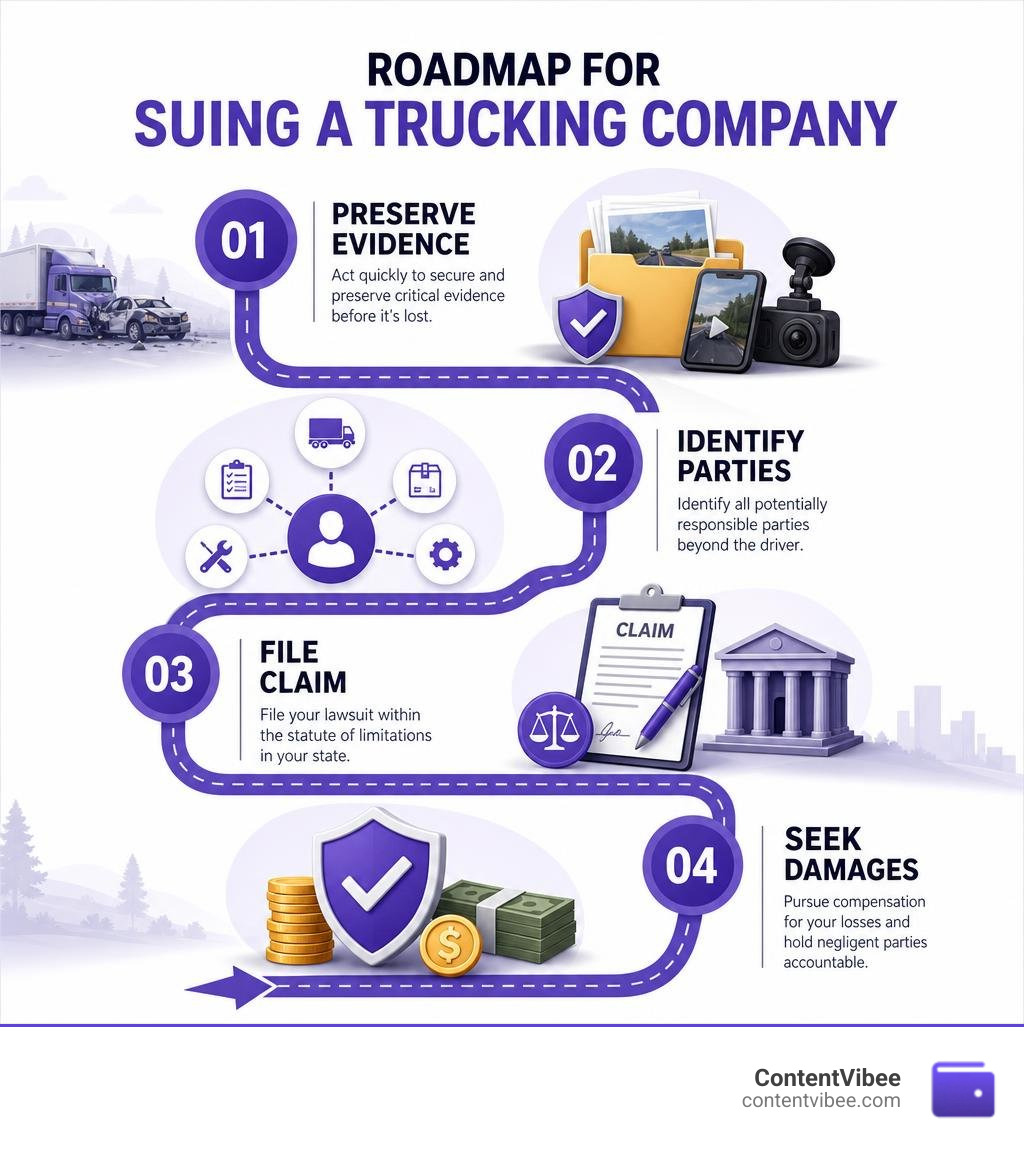
Step-by-Step Process: How to Sue Trucking Company Owners
Taking legal action against a commercial carrier is completely different from filing a routine auto accident claim. When you hit a passenger car, you usually deal with one driver and one insurance representative. But learning how to sue trucking company corporations means stepping into a multi-layered legal process governed by strict federal safety rules, corporate legal teams, and high-value insurance policies.
To succeed, you need to understand the procedural roadmap from the day of the crash to the moment your case resolves. The core process follows these sequential milestones:
- Step 1: Seek Immediate Medical Care and Scene Preservation: Collect police crash reports, photos, witness phone numbers, and initial medical evaluations.
- Step 2: Issue an Early Spoliation Demand: Send an explicit, formal legal letter to the motor carrier demanding they safeguard all digital records, black box data, and paper files.
- Step 3: Investigate Corporate Entities: Run safety lookups via federal databases to pin down the exact legal entity, registered agent, and parent company behind the truck.
- Step 4: Draft and File the Formal Legal Complaint: Detail the specific legal theories, safety code violations, and damages in the appropriate state or federal court.
- Step 5: Effectuate Formal Service of Process: Deliver the summons and complaint to the registered agent to initiate official court timelines.
- Step 6: Engage in Comprehensive Discovery: Exchange written interrogatories, demand internal corporate records, and conduct sworn depositions of dispatchers, safety directors, and mechanics.
- Step 7: Pretrial Negotiations, Mediation, or Trial: Attempt formal settlement talks backed by strong expert witness reports, or present your case before a jury.
If you are navigating a crash on the West Coast, reviewing a regional guide such as Find Qualified Los Angeles Truck Accident Lawyers can help you understand local court dynamics alongside federal mandates.
Identifying Liable Parties: Who Can Be Sued?
One of the biggest advantages in commercial vehicle litigation is that multiple parties often share financial responsibility. Rather than relying solely on a single individual’s personal auto policy, your lawsuit can target every business entity whose oversight or neglect contributed to the collision.
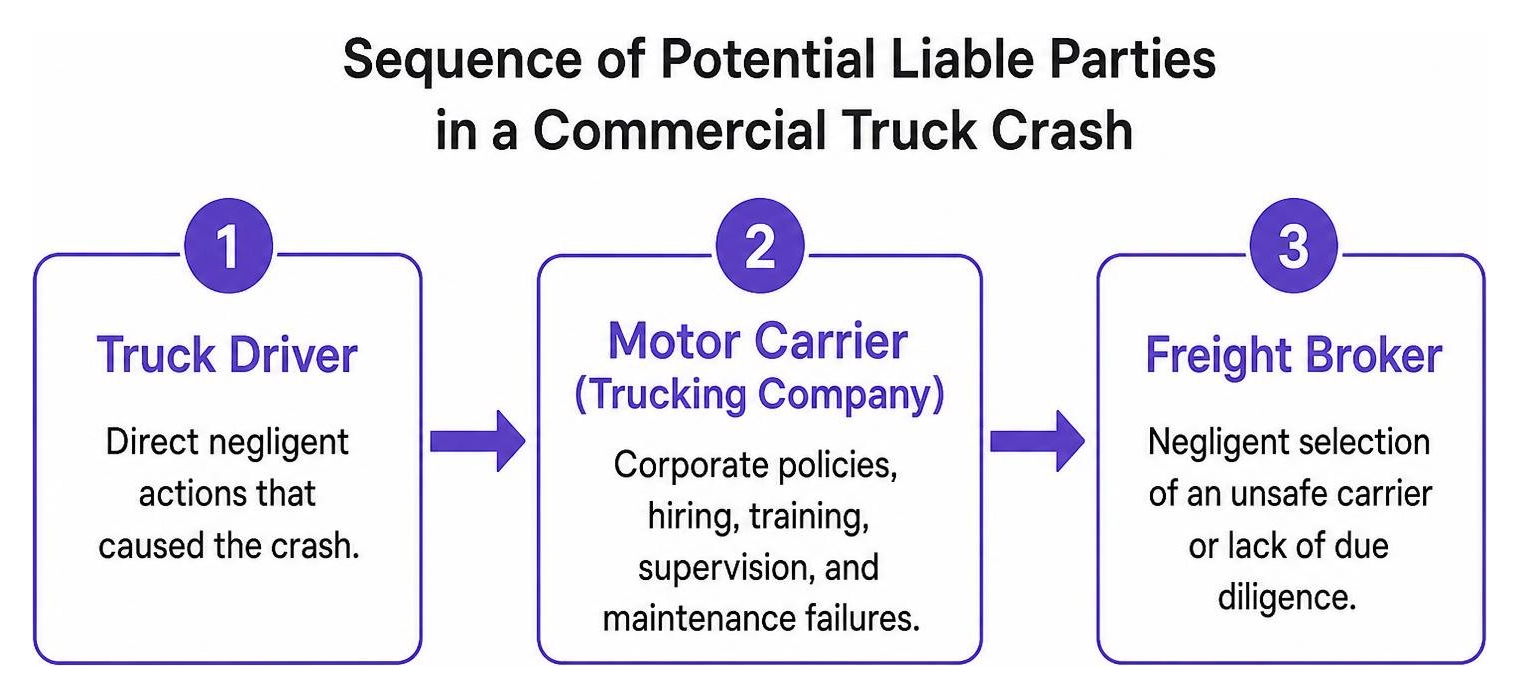
Depending on the facts uncovered during your investigation, you can bring claims against:
- The Truck Driver: For direct reckless behavior, such as speeding, texting while driving, driving under the influence, or exceeding mandatory driving hours.
- The Motor Carrier (Trucking Company): For hiring unqualified drivers, failing to run mandatory background checks, forcing drivers to break safety rules, or neglecting fleet maintenance.
- The Freight Broker: For hiring a carrier with a known history of severe safety violations without performing basic due diligence.
- The Cargo Loading Company: For improperly loading, balancing, or securing freight, causing cargo shifts that trigger jackknife or rollover accidents.
- Maintenance and Repair Contractors: For failing to spot critical mechanical defects, mismanaging brake repairs, or releasing unsafe vehicles onto the highway.
- Parts Manufacturers: For equipment failures involving defective tires, faulty steering assemblies, or malfunctioning air brakes.
Uncovering these relationships early requires reviewing transport contracts, bills of lading, and dispatch logs. For a full breakdown of how liability distributes across complex claims, see our Truck Accident Law Firm Complete Guide.
Filing the Complaint, Court Process, and Serving Summons
The formal legal battle begins when your attorney drafts and files the Complaint (sometimes called a Petition) in the correct court system. Choosing the right court—known as establishing jurisdiction and venue—depends on where the accident happened, where the carrier is headquartered, and whether federal laws are heavily involved.
If your case proceeds in federal court, the mandatory court filing fee is $350. Once the clerk issues the formal court Summons, you must legally serve these documents to the defendant’s registered corporate agent.
Under federal civil court rules, the deadline for a defendant to file an official Answer is strictly enforced:
- Standard Service: The defendant has 21 days after receiving formal service of the summons and complaint to respond.
- Waived Formal Service: If the trucking company formally agrees to waive summons service, they receive an extended deadline of 60 days to submit their answer.
If the motor carrier fails to file an answer within these windows, you can petition the court for a default judgment in your favor.
Critical Evidence and Federal Record Preservation Rules
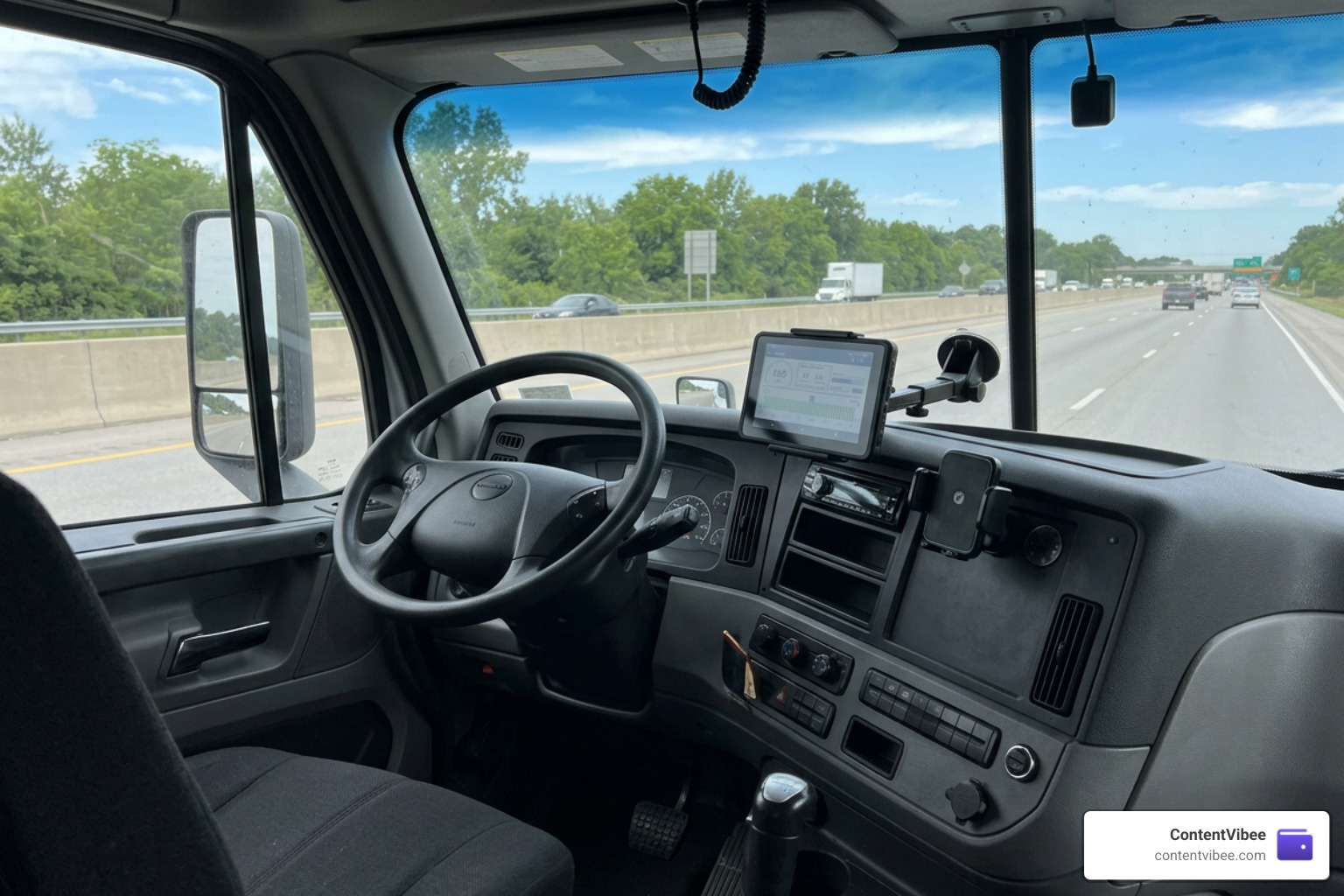
Proving liability in a truck crash requires physical, electronic, and paper evidence that rests almost entirely inside the trucking company’s filing cabinets and cloud servers. Commercial vehicles carry onboard computers, including the Engine Control Module (ECM) and Electronic Logging Devices (ELDs). These “black boxes” capture precise parameters, including vehicle speed, braking history, engine RPMs, steering inputs, and exact GPS coordinates right before impact.
However, this critical digital trail is at immediate risk of disappearing. Modern ELD systems routinely overwrite old telematics data in a matter of weeks, and physically damaged trucks can be repaired or scrapped quickly unless formal legal holds are established.
Spoliation Letters, ELD Data, and FMCSA Retention Schedules
To stop a commercial carrier from destroying crucial records, your lawyer must immediately send a Spoliation Letter. This official legal notice puts the company, its insurer, and its attorneys on notice that litigation is pending and that they have a strict duty to preserve all relevant evidence. If a company deletes data after receiving a spoliation letter, judges can impose severe sanctions, including telling the jury to presume the destroyed evidence proved the carrier was at fault.
Timing is urgent because Federal Motor Carrier Safety Administration (FMCSA) rules set surprisingly brief retention windows for essential records:
- Daily Vehicle Inspection Reports (DVIRs): Motor carriers are legally required to keep these for only 3 months.
- Roadside Inspection Reports: Must be retained for 12 months.
- Annual Inspection Records: Must be kept for 14 months from the date of the inspection report.
- General Maintenance and Repair Records: Must be retained for 1 year, plus 6 months after the vehicle leaves the company’s control.
- Driver Qualification Files: Including background checks, driving records, and medical certificates, these must be kept throughout employment plus 3 years after termination.
- Drug and Alcohol Test Results: Positive test results, refusals, and driver evaluations must be retained for 5 years, while negative test results are kept for 1 year.
If you delay taking legal action, essential inspection records proving the brakes were failing could legally be shredded before you ever file your lawsuit. Read our Truck Wreck Attorney Ultimate Guide to see how attorneys enforce spoliation demands.
How to Sue Trucking Company Entities Using US DOT Records
Before you can serve legal papers, you must correctly identify the precise corporate entity operating the truck. Commercial trucks display identification numbers on their cab doors, specifically their USDOT Number and MC (Motor Carrier) Number.
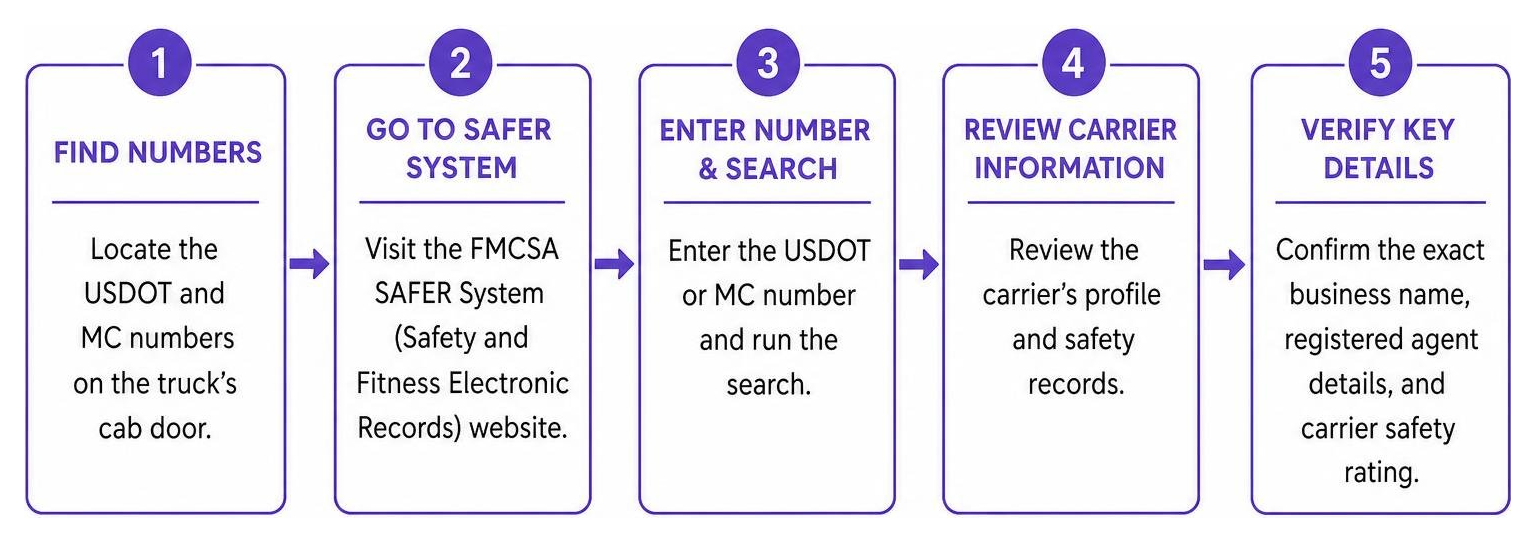
You can run these numbers through the FMCSA’s public SAFER System (Safety and Fitness Electronic Records) to verify essential corporate data:
- Exact Registered Business Name: Uncovers parent companies, shell corporations, and “Doing Business As” (DBA) aliases.
- Registered Agent Details: Identifies the official person or legal agency designated to accept lawsuit paperwork in your state.
- Carrier Safety Rating: Reveals prior federal safety violations, driver out-of-service rates, and past vehicle maintenance failures.
- Fleet Size and Operations: Displays how many commercial units they operate and whether they haul general freight or hazardous materials.
Using official federal records ensures you do not waste valuable time serving the wrong corporate entity or an affiliated subcontractor.
Establishing Legal Theories of Carrier Liability
To win your lawsuit, you must ground your legal claims in specific theories of liability under state law and federal safety regulations. Knowing how to sue trucking company operators effectively requires building a multi-pronged claim using both indirect and direct theories of negligence.
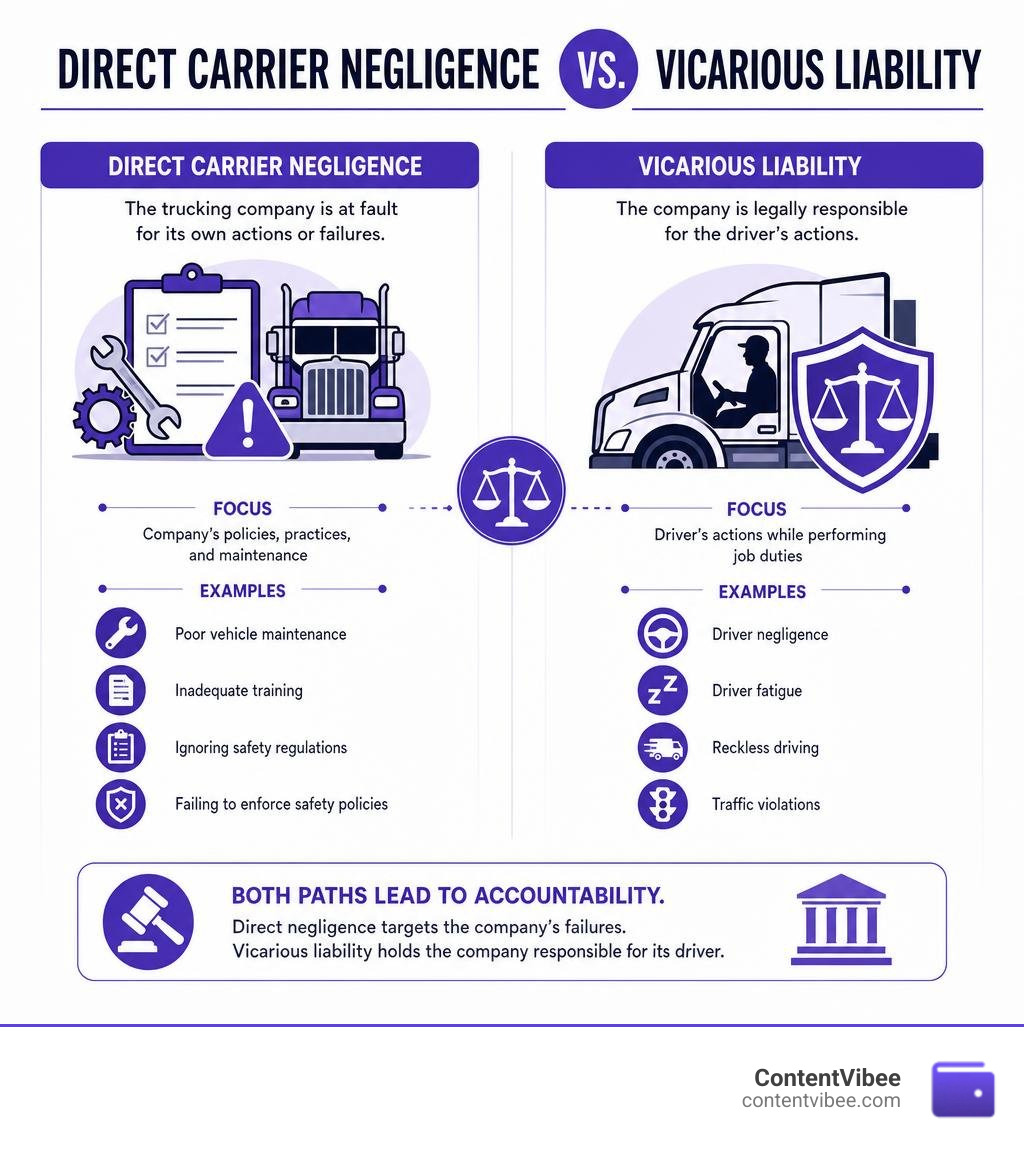
Vicarious Liability, Direct Negligence, and Negligence Per Se
When suing a motor carrier, legal claims generally fall under three primary legal frameworks:
| Legal Theory | What It Means | Common Real-World Example |
|---|---|---|
| Vicarious Liability (Respondeat Superior) | Holds an employer automatically liable for wrongful acts committed by employees acting within the scope of their employment. | A tired driver runs a red light while making a routine commercial delivery. |
| Direct Negligence | Holds the company accountable for its own internal corporate failures and systemic safety breakdowns. | The company hired a driver with three prior DUIs or failed to perform mandatory brake inspections. |
| Negligence Per Se | Establishes liability automatically if the driver or carrier violated an explicit safety statute designed to prevent injury. | Driving 14 hours straight in direct violation of FMCSA hours-of-service limits. |
To prove negligence per se, lawyers rely heavily on Title 49 of the Code of Federal Regulations (49 CFR). For example, 49 CFR § 395.3 caps commercial driving at 11 hours within a 14-hour on-duty window, following 10 consecutive hours off duty. Weekly limits further cap driving at 60 hours over 7 days or 70 hours over 8 days. Proving the carrier forced a driver to break these limits creates clear legal liability.
For comprehensive state-specific insights, examine our Truck Accident Attorney Dallas Guide 2026.
Overcoming the Independent Contractor Defense Under Federal Law
For decades, motor carriers tried to dodge injury lawsuits by claiming their drivers were “independent contractors” or “owner-operators” rather than traditional W-2 employees. Under basic state agency laws, companies are often shielded from the negligence of independent contractors.
However, federal law eliminates this loophole. Under 49 U.S.C. § 14102 and federal lease regulations, the Statutory Employee Doctrine applies.
Key Takeaway: If a motor carrier leases commercial equipment and operates it under its own DOT authority, federal law treats the driver as a statutory employee of that carrier—regardless of what their private employment contract says.
This rule prevents big trucking firms from shifting accountability onto individual drivers who carry small personal insurance policies. If the cab displayed the carrier’s DOT number, the carrier remains legally responsible for the driver’s conduct on the road.
Understanding Trucking Insurance, Damages, and Fees
Commercial truck crashes involve significant damage, severe injuries, and high medical expenses. Because the risk is so great, federal regulations require commercial motor carriers to carry robust liability insurance policies far exceeding passenger car coverage.
The FMCSA mandates the following minimum liability coverage thresholds based on vehicle weight and cargo type:
- General Freight (Over 10,001 lbs): Must carry at least $750,000 in primary liability insurance.
- Oil and Large Hazardous Materials: Minimum liability coverage increases to $1,000,000.
- Explosives, Poison Gas, or Radioactive Cargo: Must carry at least $5,000,000 in liability coverage.
In addition to primary policies, many commercial fleets carry millions more in secondary umbrella or excess coverage, ensuring funds are available for serious injury cases.
How Much Compensation Can You Recover in a Lawsuit?
If you win your lawsuit or secure a negotiated pre-trial settlement, your financial recovery will be broken down into three main types of damages:
- Economic Damages: Quantifiable financial losses, including emergency room care, surgeries, future rehabilitation, prescription medications, lost wages, diminished earning capacity, and property replacement costs.
- Non-Economic Damages: Intangible personal losses, including physical pain and suffering, emotional distress, loss of enjoyment of life, physical disfigurement, and loss of consortium.
- Punitive Damages: Extra financial penalties awarded in rare cases involving gross negligence or willful disregard for public safety—such as an executive intentionally pressuring drivers to bypass dangerous mechanical faults.
Evaluating these damages requires analyzing medical prognoses and financial reports. You can review regional legal frameworks using resources like our Florida Truck Accident Lawyer Guide 2026.
How to Sue Trucking Company Executives Without Upfront Legal Fees
Filing a complex commercial trucking lawsuit can cost tens of thousands of dollars in expert fees, court filing expenses, accident reconstruction, and data extraction. Fortunately, injured victims do not need to pay out-of-pocket to bring a claim.
Truck accident attorneys operate on a contingency fee basis:
- Zero Upfront Costs: You pay no retainers or hourly fees to start your case.
- Standard Percentage: The standard attorney contingency fee in a commercial vehicle case is typically around 33% (one-third) of the total recovery if settled before trial.
- Sliding Scale Fees: Fees may adjust upward (e.g., to 40%) if the case requires formal trial proceedings, covering extra court appearances and litigation risks.
- No Win, No Fee: If your attorney fails to secure a monetary recovery through settlement or verdict, you owe zero legal fees.
This structure allows injured individuals to challenge multi-billion-dollar freight corporations on equal legal footing. Learn more procedural insights from general resources like Nolo’s guide to truck accident claims or review comprehensive options in LegalClarity’s legal lawsuit overview.
Frequently Asked Questions About Truck Accident Lawsuits
What is the statute of limitations for filing a lawsuit against a trucking company?
The deadline to file a personal injury lawsuit against a trucking company depends on individual state laws. Most state statutes of limitations fall between 1 and 4 years from the exact date of the crash (with a small handful extending up to 6 years).
In rare situations involving delayed injury diagnosis, the “discovery rule exception” may extend the starting date. However, relying on exceptions is risky. Waiting too long can permanently bar your right to compensation, and federal record retention schedules mean key evidence can be legally destroyed within months.
How long does a truck accident lawsuit usually take from start to finish?
A commercial truck accident lawsuit typically takes between 12 and 24 months to reach a final resolution or trial verdict. Simple cases with undisputed liability may settle in 6 to 9 months, but contested cases take longer.
Once a formal lawsuit enters the Discovery Phase—where both sides exchange interrogatories, conduct oral depositions, and review internal files—it typically adds at least 6 months to the case timeline. This stage is critical because uncovering internal corporate emails or dispatcher messages often forces the carrier’s insurer to offer a fair settlement.
How do FMCSA post-crash drug and alcohol testing rules affect my case?
Federal law sets strict mandatory timelines for post-accident chemical testing under 49 CFR § 382.303. Following a crash involving a fatality, or a crash where the truck driver receives a traffic citation for a tow-away accident or bodily injury:
- Alcohol Testing: Must be conducted within 8 hours of the crash.
- Controlled Substance Testing: Must be conducted within 32 hours of the crash.
If the motor carrier fails to perform these tests within the federal windows, or if the test returns a positive result, it creates powerful evidence of negligence per se. Furthermore, FMCSA rules require carriers to keep positive drug and alcohol test records for 5 years, offering vital long-term proof for your legal claim.
Conclusion
Understanding how to sue trucking company operators comes down to taking decisive action quickly. Commercial carriers and their insurance teams launch immediate investigations to minimize their payout. Protecting your rights means building your defense just as fast.
By issuing a prompt spoliation letter, identifying all responsible parties through USDOT records, leveraging FMCSA safety rules, and securing skilled legal guidance on a contingency basis, you can hold negligent carriers accountable and recover the compensation you deserve.
For a complete look at protecting your rights after a commercial collision, explore our detailed Commercial Vehicle Accident Lawyers Guide 2026.


