


What Is Stocks by the Slice and How Does It Work?
Fidelity’s fractional share program, officially branded as Stocks by the Slice, allows retail investors to purchase partial units of U.S. equities and exchange-traded funds (ETFs). Instead of requiring you to buy an entire share priced at $500, $1,000, or more, the system enables you to execute dollar-based orders starting with as little as $1.
If you’re eager to slice your investments easily with Fidelity fractional shares, it is helpful to understand the scope of available assets. Eligibility covers National Market System (NMS) exchange-listed U.S. stocks and ETFs traded on major exchanges such as the New York Stock Exchange (NYSE) and Nasdaq. Over 7,000 individual stocks and ETFs are supported. However, over-the-counter (OTC) securities, foreign stocks listed on secondary international exchanges, and mutual funds are excluded from dollar-based stock slice trading.
To explore full feature lists directly on the platform, check out the Fidelity Fractional Share Learning Center as well as the official Fidelity Fractional Shares Portal.
Mechanics of Dollar-Based Investing and Decimal Precision
When placing dollar-based orders on Fidelity, the platform calculates share allocations out to three decimal places (.001). Meanwhile, dollar inputs are entered out to two decimal places (e.g., $250.00).
Because share quantities round down to the nearest 0.001 shares, your actual executed trade value may differ slightly by a fraction of a cent from the dollar amount you entered. For example, if you place a $20,000 order into a stock trading at $130 per share, traditional whole-share trading would limit you to 153 whole shares ($19,890 total value), leaving $110 sitting uninvested. Through dollar-based investing, you acquire 153.846 shares, putting your entire capital allocation to work immediately.
Core Rules for Buying Fractional Shares Fidelity in 2026
As of 2026, the essential rules for buying fractional shares fidelity remain straightforward and customer-friendly:
- Minimum Trade Requirement: Every fractional or dollar-based buy or sell order must have a minimum cash value of at least $1.00.
- Automatic Account Enrollment: You do not need to fill out complex paperwork or call customer service to activate fractional trading. Placing your first dollar-based or fractional trade automatically enrolls your account after you accept the updated customer agreement pop-up.
- Supported Account Types: Fractional trading is supported across standard retail individual and joint brokerage accounts, Traditional IRAs, Roth IRAs, Rollover IRAs, and Health Savings Accounts (HSAs).
- Execution Status: Fractional orders are designated as “Not Held” orders. This gives the broker time and price execution discretion during standard market hours to fill both the whole and fractional portions of your transaction effectively.
Fees, Minimums, and Execution Rules for Buying Fractional Shares Fidelity

Cost efficiency is one of the primary reasons retail traders use Fidelity for dollar-based investing. Understanding how zero-commission trading pairs with underlying regulatory charges ensures there are no surprises on your transaction confirmations.
$0 Commission Rates and Regulatory Assessment Fees
Fidelity maintains a $0 commission policy for online U.S. stock and ETF trades, including fractional shares placed via their website or mobile application. When evaluating the real cost of Fidelity fractional shares, retail investors pay zero standard trade processing fees.
However, selling fractional share positions involves minor regulatory assessment fees passed through from self-regulatory organizations (SROs) like FINRA and the SEC. These sell-side assessment fees typically range between $0.01 and $0.03 per $1,000 of principal sold.
| Trading Channel | Commission Fee | Additional Requirements |
|---|---|---|
| Online / Fidelity Mobile App | $0.00 | $1.00 trade minimum |
| FAST Automated Phone System | $12.95 per trade | Automated phone trade execution |
| Representative-Assisted Trade | $32.95 per trade | Live phone broker assistance |
To maximize your savings, always submit dollar-based trades online or through the mobile app. Fidelity calculates that retail traders save an average of $24.50 on a 1,000-share equity order compared to industry average trading costs.
Market Hours and ‘Not Held’ Order Execution
Fractional share and dollar-based orders follow specific execution boundaries that differ from standard whole-share trading:
- Regular Market Hours Only: Fractional share buys and sells can only be placed and executed during regular U.S. market hours, strictly between 9:30 a.m. and 4:00 p.m. Eastern Time. Pre-market (4:00 a.m. – 9:30 a.m. ET) and after-hours (4:00 p.m. – 8:00 p.m. ET) sessions do not support fractional share order execution.
- Day Orders Only: All fractional share orders must be placed as Day market or Day limit orders. Good-til-Canceled (GTC) fractional orders are not supported; any unexecuted order automatically expires at the market close.
- ‘Not Held’ Designation: When you submit a fractional order, it is automatically marked with a “Not Held” order status. This legal status grants the brokerage desk execution discretion regarding time and price to combine fractional share requests in the marketplace. Fractional orders execute with Fidelity acting as principal for the fractional portion and as agent for any whole share portion.
Account Eligibility, Dividends, and Corporate Actions

Integrating stock slices into your broader financial plan lets small regular deposits build substantial wealth over time. For instance, putting $250 a month into an equity investment portfolio earning a hypothetical 7% nominal annual growth rate can accumulate to $304,993 over 30 years, compared to just $95,460 in a traditional cash savings account yielding 0.39%.
Uninvested cash waiting to be deployed into fractional shares sits in your account’s core position—such as the Fidelity Government Money Market Fund (SPAXX)—earning competitive money market yields until trades settle.
| Feature / Capability | Whole Share Trading | Fractional Share Trading (Stocks by the Slice) |
|---|---|---|
| Minimum Purchase | Price of 1 full share | $1.00 minimum value |
| Online Commission | $0.00 | $0.00 |
| Extended Hours Trading | Yes (Pre-market & After-hours) | No (Regular market hours only) |
| ACATS Broker Transfer | Yes (Transfers in-kind) | No (Must be liquidated to cash) |
| Cash Dividends | 100% of payout per share | Proportional payout down to $0.01 |
| Proxy Voting Rights | Full shareholder voting rights | No voting rights on fractional portion |
| Supported Order Types | Market, Limit, Stop, GTC, Trailing | Day Market and Day Limit only |
Step-by-Step Walkthrough: Buying Fractional Shares Fidelity via App or Web
Ready to start trading stock slices? Follow our straightforward guide on enabling fractional trading on Fidelity:
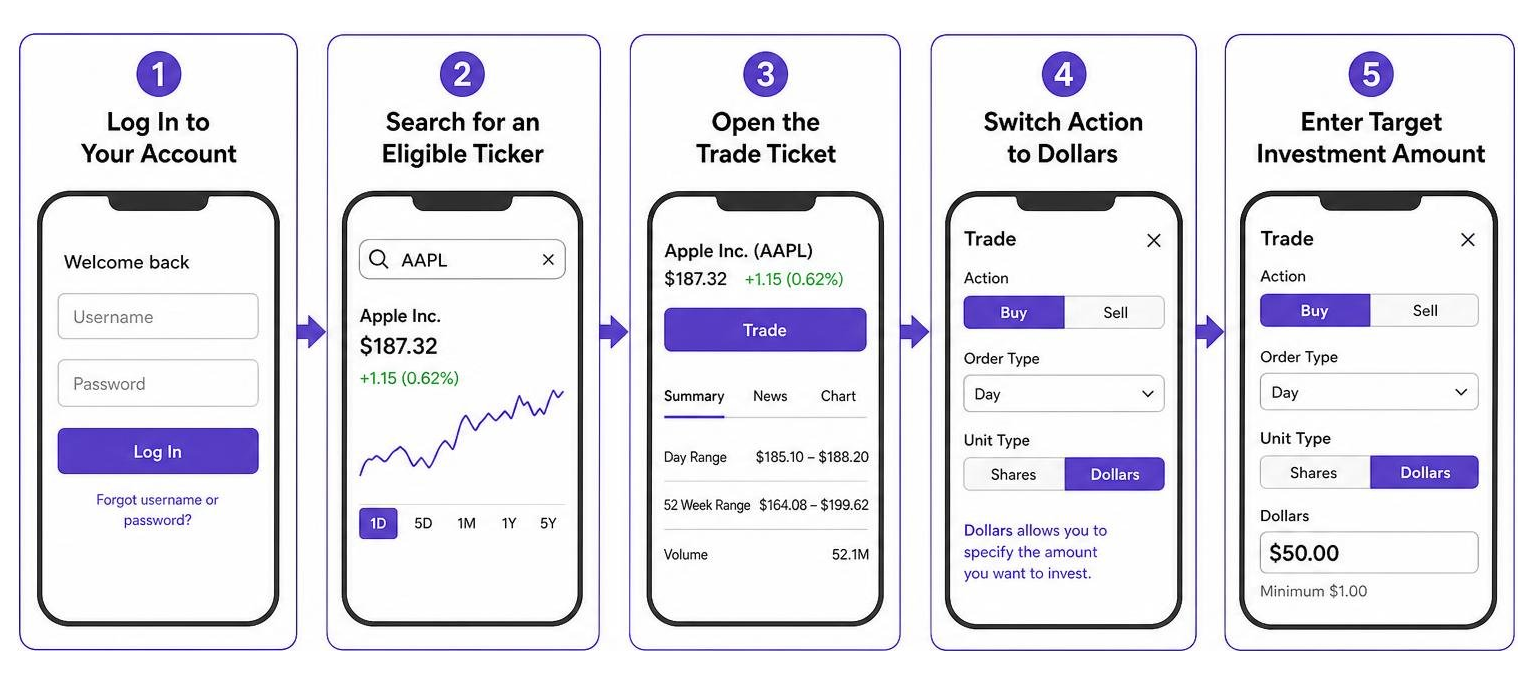
- Log In to Your Account: Open the Fidelity Mobile app or log in to the desktop website interface.
- Search for an Eligible Ticker: Enter the company ticker symbol or asset name (e.g., AAPL, MSFT, VTI) in the top search bar to pull up the security’s quote page.
- Open the Trade Ticket: Click the Trade button to launch the order form.
- Switch Action to Dollars: Under the order type parameters, locate the toggle or drop-down menu for order unit type. Switch the setting from Shares to Dollars.
- Enter Target Investment Amount: Type in your target dollar amount (minimum $1.00, formatted out to two decimal places like $50.00).
- Choose Order Type: Select Market Order (executes at current prevailing price) or Limit Order (executes at your specified price or better). Ensure the order duration is set to Day.
- Preview and Place Order: Review the estimated fractional share count calculated by the system, verify your account selection, and tap Submit Order.
- Set Up Recurring Investments (Optional): If you want to automate your wealth building, navigate to the Recurring Investments portal to establish weekly, bi-weekly, or monthly automated fractional share buys drawn from your core cash position or external bank account.
Cash Dividends, DRIP Integration, and Voting Limitations
Owning stock fractions entitles you to economic benefits, though key shareholder governance features function differently:
- Cash Dividends: Fractional share positions receive cash dividend distributions calculated on a proportional basis rounded to the nearest penny ($0.01). For instance, if you own 0.5 shares of a stock paying a $1.00 quarterly dividend per whole share, your account automatically receives a $0.50 cash payment.
- Dividend Reinvestment Program (DRIP): Dividends earned from whole or fractional shares can be automatically reinvested into additional stock fractions.
- DRIP Selling Behavior Shift: Once an account is enrolled in manual fractional share trading, the platform’s execution rule changes. Previously, selling your whole share holdings automatically liquidated lingering DRIP fractional pieces overnight. After enrollment, you must explicitly select both the whole and fractional share quantities on your trade ticket when closing out a position entirely.
- Proxy Voting Rights: You do not receive proxy voting materials or proxy ballots for the fractional component of your holdings. Proxy voting rights apply exclusively to whole shares.
- Corporate Actions: For mandatory stock splits (e.g., a 2-for-1 forward split), your fractional position adjusts proportionally (e.g., 0.5 shares become 1.0 whole share). However, participation in voluntary corporate actions (such as tender offers) is generally not supported for fractional share units.
Limitations, Taxes, and ACATS Transfer Restrictions

While dollar-based investing makes high-priced stocks accessible, retail investors must understand critical restrictions around brokerage account transfers and IRS tax accounting.
Inability to Transfer Fractional Shares and ACATS Cash Liquidation
Fractional share entries are recorded on the brokerage’s internal accounting books rather than registered on external central depository clearing networks. Consequently, fractional shares cannot be transferred directly to another broker using the Automated Customer Account Transfer Service (ACATS).
For official transfer parameters, refer to the Fidelity Account Trading FAQs.
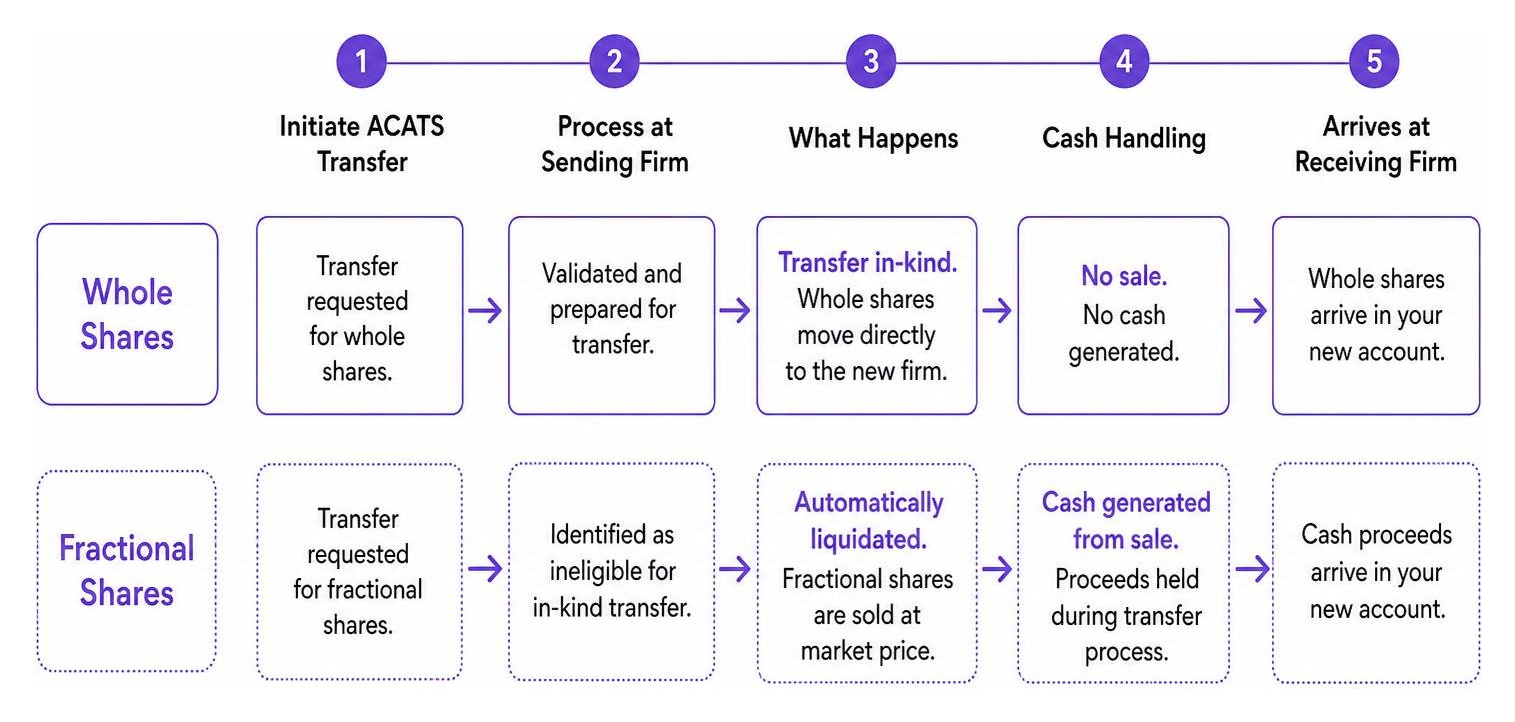
When you initiate an ACATS transfer to move your account to a different financial institution:
- Whole shares transfer “in-kind” directly to your new brokerage without triggering sales or taxes.
- Fractional share components cannot transfer in-kind. They are automatically liquidated into cash at prevailing market prices during the transfer process.
- The cash proceeds from the fractional share sale then sweep over to your new institution as part of the final account settlement.
Taxable Events, Cost Basis Tracking, and Form 1099-B
Trading stock slices inside a taxable individual or joint brokerage account creates standard tax obligations under IRS regulations:
- Taxable Sales: Liquidating a fractional share—whether manually executed by you or automatically liquidated during an ACATS transfer—is a taxable event. Selling a fractional position held for one year or less generates short-term capital gains (taxed at ordinary income rates), while selling a position held for longer than one year incurs long-term capital gains rates.
- Cost Basis Allocation: Fidelity tracks your cost basis, acquisition date, and holding periods for every fractional share purchase lot. Cost basis per fractional slice is reported to the IRS using the standard First-In, First-Out (FIFO) default method unless you select specific share lot identification.
- Form 1099-B Reporting: At the end of the tax year, all proceeds from fractional share sales, along with their associated cost basis and holding periods, are reported on consolidated tax Form 1099-B.
- Wash Sale Compliance: The IRS wash sale rule applies to fractional share transactions. Buying a fractional share of the same security within 30 days before or after selling whole or fractional shares at a loss disallows the tax loss deduction, adding the loss to the cost basis of the newly acquired position.
Essential Tax Record-Keeping Best Practices for Fractional Shares:
- Keep digital copies of annual Form 1099-B statements for tax records.
- Monitor automated recurring buy dates to prevent accidental wash sales when selling losing positions.
- Track cost basis adjustments if you regularly mix manual fractional purchases with DRIP reinvestment lots.
Frequently Asked Questions About Fidelity Fractional Shares
Can I transfer fractional shares to another broker?
No. Fractional share positions cannot be transferred in-kind to another brokerage firm via ACATS or paper stock certificates. If you decide to move your account to another broker, your whole shares will transfer in-kind, but any fractional share components must be sold. The resulting cash proceeds will then sweep over to your new brokerage.
Do fractional shares at Fidelity receive dividend payments?
Yes. Fractional share positions earn cash dividends on a proportional basis, provided the calculated dividend equals at least one penny ($0.01). If you hold 0.25 shares of a company paying a $2.00 dividend per whole share, your account receives $0.50 in cash dividends, which can be paid into your core money market position (SPAXX) or automatically reinvested via DRIP.
Can I vote in proxy shareholder decisions with fractional positions?
No. Proxy voting rights and participation in shareholder proxy votes apply exclusively to whole shares. The fractional portion of any position does not convey voting rights or proxy ballot privileges.
Conclusion
Fidelity’s Stocks by the Slice makes building a portfolio straightforward, accessible, and affordable for retail investors. By eliminating commission barriers and enabling dollar-based orders down to $1, the platform allows you to construct a diversified portfolio across top-tier U.S. equities and ETFs regardless of share prices.
While investors must keep in mind transfer limitations, the lack of proxy voting rights on partial shares, and regular market hour execution rules, these technical boundaries rarely offset the practical benefits of dollar-cost averaging.
For a complete breakdown of platform limits, pricing comparisons, and execution strategies, review Fidelity’s official trading guidelines and account resources.


