Wealth Management vs Investment Banking Salary and Fee Structure is one of the most searched comparisons in finance careers — and for good reason. The pay gap, fee models, and earning trajectories between these two fields are dramatically different.
Here’s a quick snapshot to answer the core question:
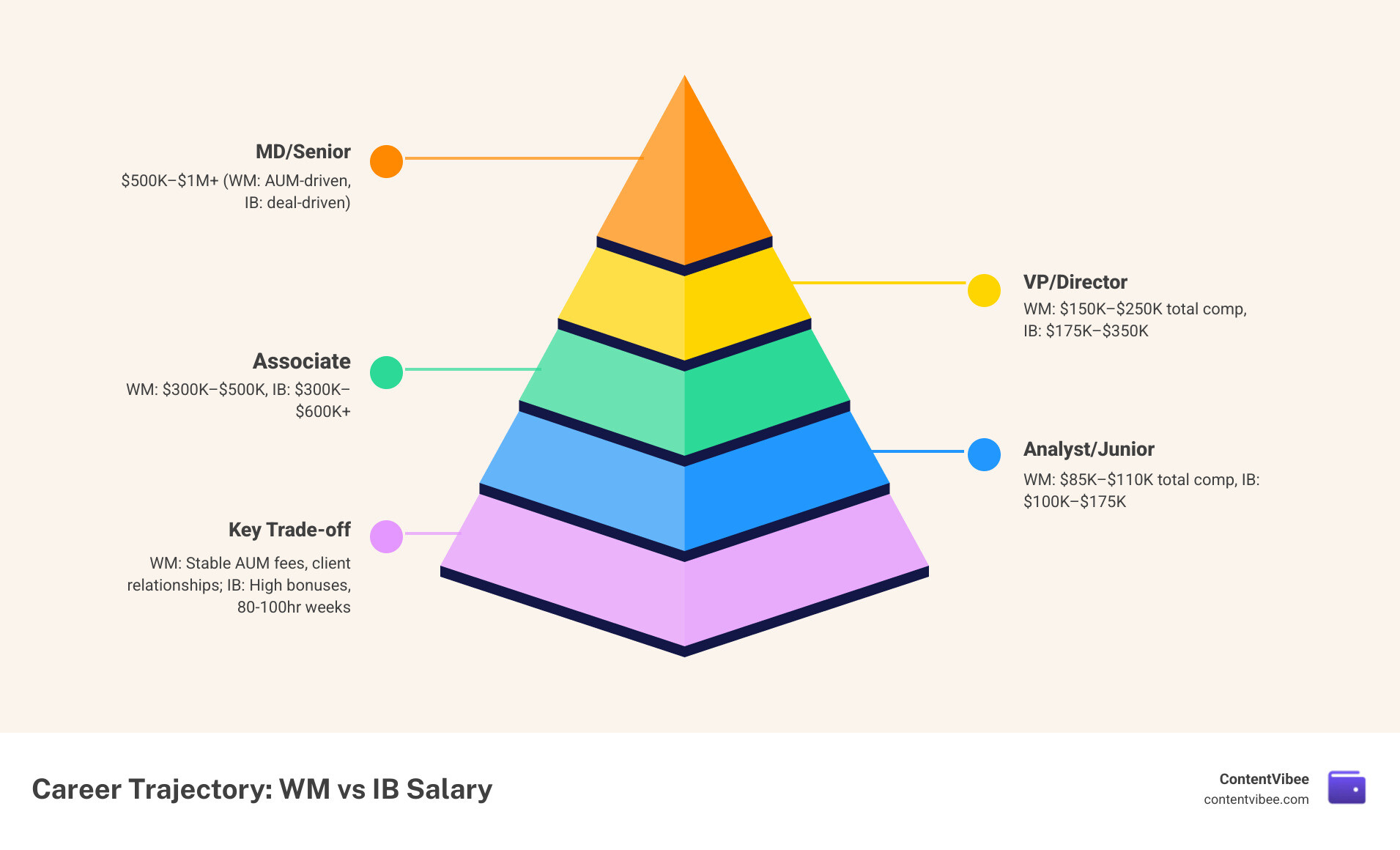
| Role Level | Wealth Management (US) | Investment Banking (US) |
|---|---|---|
| Analyst/Junior | $85K–$110K total comp | $100K–$175K total comp |
| Associate | $150K–$250K total comp | $175K–$350K total comp |
| VP/Director | $300K–$500K | $300K–$600K+ |
| MD/Senior | $500K–$1M+ (AUM-driven) | $500K–$1M+ (deal-driven) |
The short answer:
- Investment banking pays more at the junior and mid levels, with structured base + bonus
- Wealth management pays more variably — top performers with large client books can match or beat senior bankers
- Fee structures are fundamentally different: WM earns 0.5%–2% of AUM annually, while IB earns deal-based fees on transactions worth hundreds of millions
Both paths can lead to seven-figure earnings. But how you get there — and what you trade for it — couldn’t be more different.
The two fields attract very different personalities. Investment banking rewards analysts who can grind through 80–100 hour weeks on complex financial models. Wealth management rewards relationship builders who can win and keep high-net-worth clients over decades.
As one industry insider put it bluntly: “IB vs WM depends on what you want to do — they’re completely different jobs.”
This guide breaks down every layer of the compensation picture — base salaries, bonuses, fee structures, and long-term earning potential — so you can make a fully informed career decision.
Primary Differences in Salary and Bonus Structures
When we look at the core of Wealth Management vs Investment Banking Salary and Fee Structure, the first thing we notice is the predictability of the paycheck. In Investment Banking (IB), the structure is very rigid. You have a high base salary and a performance bonus that is often a significant percentage of that base. In Wealth Management (WM), especially as you progress, the “salary” often disappears entirely, replaced by a percentage of the revenue you generate from your “book of business.”
Historically, the 2023 bonus cycle saw a significant cooling in investment banking, as reported by Reuters, with some bonuses dropping 30% to 70% due to a freeze in the M&A and IPO markets. Entering April 2026, we see a market that has stabilized, but the lessons remain: IB pay is highly sensitive to market volatility. Wealth management, conversely, offers more stability because it is tied to Assets Under Management (AUM). Even in a down market, clients still need their assets managed, providing a more consistent floor for earnings.
Another key difference is the form of payment. While junior roles in both fields are mostly cash-heavy, senior roles in IB often involve “deferred compensation” or stock options that vest over several years. In wealth management, once you move past the initial training phase, you often transition to a commission-based model. This means your “bonus” isn’t decided by a committee; it’s a direct mathematical result of the fees your clients pay. For those planning their long-term financial security, understand the FRS Investment Plan and how different retirement vehicles interact with these high-earning career paths.
Entry-Level Expectations: Wealth Management vs Investment Banking Salary and Fee Structure for Analysts
For a fresh graduate in April 2026, the allure of the “Wall Street” paycheck is strongest in Investment Banking.
Investment Banking Analyst: At a bulge bracket or elite boutique firm, an Analyst (Year 1) can expect a base salary between $100,000 and $125,000. When you add a bonus that typically ranges from 30% to 75% of the base, the total compensation often lands between $130,000 and $175,000. Some boutiques may even push base pay higher to $120,000 to compete for top talent, often throwing in signing bonuses or relocation packages to sweeten the deal.
Wealth Management Analyst: The entry-level path in Wealth Management (often called Private Banking at large firms) is slightly more modest but still very lucrative compared to other industries. A junior private banker might see a base salary of $85,000 to $100,000. Bonuses here are more conservative, usually in the 15% to 30% range, leading to a total compensation of approximately $100,000 to $150,000.
While the IB analyst makes more, they are often working double the hours of their WM counterpart. The “hourly rate” in wealth management is frequently higher, even if the total year-end number is lower.
Wealth Management vs Investment Banking Salary and Fee Structure: A 2026 Comparison
As we move up the ladder, the gap in Wealth Management vs Investment Banking Salary and Fee Structure begins to shift based on the type of firm you choose.
Bulge Bracket vs. Boutique vs. Independent
- Bulge Bracket (GS, JPM, MS): These firms offer the highest base salaries and the most prestige. In IB, you are a cog in a massive deal-making machine. In WM, you have the backing of a global brand, which makes it easier to attract Ultra-High-Net-Worth (UHNW) clients.
- Elite Boutiques (Evercore, Lazard): In IB, these firms often pay better than bulge brackets, sometimes 30% more in all-in compensation, because they have lower overhead and higher revenue per head.
- Independent Advisory Practices (RIAs): This is where Wealth Management truly shines. While there is no “base salary” after the first few years, the payout percentages are much higher. An advisor at a large bank might only keep 35% to 40% of the fees they generate, whereas an independent advisor might keep 90% to 100% (minus their own business expenses).

Long-term Earning Potential: Wealth Management vs Investment Banking Salary and Fee Structure for MDs
At the Managing Director (MD) level, the “ceiling” for both roles is incredibly high, often reaching into the multi-millions. However, the nature of the work to earn that money is the defining factor.
In Investment Banking, an MD is a “rainmaker.” Their job is to originate deals. If they bring in a $500 million acquisition deal, the bank takes a massive success fee, and the MD gets a cut. A typical MD base salary is $350,000 to $450,000, but the bonus can be 2x or 3x that amount depending on deal flow.
In Wealth Management, an MD is a “relationship holder.” Their earnings are tied to their “book.” If a senior advisor manages $1 billion in assets with a 1% fee, that’s $10 million in annual revenue. Depending on the firm’s payout grid (usually 20% to 40%), that MD could easily take home $2 million to $4 million year after year, regardless of whether a “deal” happens. This recurring revenue is why many senior investment bankers eventually “exit” into wealth management—they want to stop the endless hunt for the next deal and instead manage the wealth they’ve helped create.
Revenue Generation Models and Fee Structures
The fundamental difference in Wealth Management vs Investment Banking Salary and Fee Structure lies in who pays and how.
Wealth Management Fees: The industry has largely shifted away from transaction-based commissions (getting paid for every stock trade) to an AUM-based model. Most firms charge between 0.5% and 2% of the assets they manage annually. For example, if you’re curious about what you’re actually paying at Edward Jones, it’s often a combination of these AUM fees and specific fund expenses.
- AUM Fees: 1% is the industry standard for the first $1M–$5M.
- Hourly Consultation: Some advisors charge $150 to $300 per hour for specific financial planning.
- Performance Fees: In some UHNW or family office settings, the manager might take a “cut of the upside,” similar to a hedge fund.
Investment Banking Fees: IB revenue is transactional and lumpy.
- M&A Success Fees: A percentage of the total deal value (e.g., 1% of a $1B deal).
- Underwriting Spreads: The “spread” between what a bank pays for new shares in an IPO and what they sell them for to the public.
- Retainers: Monthly fees paid by corporations just to have the bank “on call” for advice.

Scaling Compensation through Seniority and Specialization
As you progress, the skills that drive your pay change. In your early years, technical modeling is king. But as you reach the mid-level (VP and Director), your value shifts to your ability to manage people and, eventually, bring in clients.
Specialization is a major driver of high pay. For example, wealth managers who specialize in “alternative investments” like private equity or hedge funds often command higher fees. If you are exploring private equity investment strategies for your clients, you are providing a level of sophistication that justifies a premium. Similarly, knowing how much a client needs to invest with Blackstone or other elite managers allows you to act as a gatekeeper to exclusive opportunities.
Certifications:
- CFA (Chartered Financial Analyst): Highly valued in Investment Banking and for the “Investment Professionals” within Wealth Management who actually manage the portfolios.
- CFP (Certified Financial Planner): The gold standard for relationship-facing Wealth Managers. It signals expertise in tax, estate planning, and retirement.
Mid-Level Transitions: VPs and Directors
The VP level (usually 6–9 years into a career) is the “make or break” point.
- IB VPs: Base salaries range from $250,000 to $350,000. The bonus can push total compensation to $500,000+. At this stage, you are expected to run the “deal team” and start helping MDs with client relationships.
- WM VPs: Total compensation usually lands between $300,000 and $500,000. The focus is heavily on “Business Development.” If you can’t bring in new assets, your compensation will plateau.
Many VPs in Investment Banking choose this moment to transition into Private Equity or Corporate Development, seeking a better work-life balance or a “carry” (a share of profits) in a private equity fund.
Work-Life Balance and Effective Hourly Compensation
This is where the Wealth Management vs Investment Banking Salary and Fee Structure debate gets interesting. If we look at “total compensation,” Investment Banking usually wins. But if we look at “effective hourly pay,” Wealth Management is the clear victor.
- Investment Banking: Analysts and Associates often work 80 to 100 hours a week. This includes late nights, weekends, and being “on call” 24/7. If you make $150,000 but work 5,000 hours a year, your hourly rate is roughly $30.
- Wealth Management: A typical week is 50 hours. While there is pressure to network and find clients, the work rarely requires staying in the office until 3:00 AM to fix a PowerPoint slide. If you make $120,000 and work 2,500 hours, your hourly rate is $48.
For many, the “lifestyle trade-off” is the deciding factor. Wealth management allows for a long, sustainable career with remote work flexibility and the ability to be present for family. Investment banking is often viewed as a “sprint”—a way to make as much money as possible in 3 to 5 years before pivoting to something more sustainable.

Frequently Asked Questions about Wealth Management and Investment Banking
Can a top Wealth Manager out-earn an Investment Banker?
Absolutely. While the average senior investment banker might earn slightly more than the average wealth manager, the “top 1%” of wealth managers can be incredibly wealthy. An advisor with a $5 billion AUM book (which does happen at firms like Goldman Sachs or JP Morgan) can generate $50 million in annual fees. Even with a modest payout, they could earn $10M–$15M+ annually. This often exceeds the pay of all but the most elite “Group Head” MDs in investment banking.
What are the typical fee percentages for High-Net-Worth clients?
For High-Net-Worth (HNW) clients with $1M to $10M, the fee is usually around 1%. For Ultra-High-Net-Worth (UHNW) clients with $25M+, the fee often scales down to 0.50% or even 0.35%, simply because the dollar amounts are so large. However, these clients often pay extra for “ancillary services” like tax prep, estate planning, and bill pay.
How did the 2023 bonus cycle affect 2026 compensation trends?
The 2023 slump led to a “flight to quality.” Firms became much more selective about who they paid top dollar. By April 2026, we’ve seen a shift where base salaries have remained high to retain talent, but bonuses are more strictly tied to individual revenue generation rather than just “showing up.” In Wealth Management, this has manifested as higher “payout grids” for advisors who bring in “new money” versus those who just maintain existing accounts.
Conclusion
Choosing between Wealth Management vs Investment Banking Salary and Fee Structure isn’t just about the number on your W-2. It’s about how you want to spend your days. Do you want to be in the middle of a $10 billion corporate merger, fueled by caffeine and adrenaline? Or do you want to build a “book” of families you help over generations, growing your income as you grow their legacy?
Investment banking offers higher “guaranteed” pay in the early years and a faster track to the mid-six figures. Wealth management offers a slower start but a more sustainable, entrepreneurial path where you truly own your client relationships.
Regardless of the path you choose, staying informed about market trends and proprietary research is key. For those who prefer a self-directed approach to their own investments alongside their career, services like Zacks Investment Research provide the tools to manage wealth effectively. If you’re looking for more info about money and credit services, or if you’re ready to dive deeper into your financial planning, we are here to help you navigate the complexities of the financial world.
Your career is your largest asset—invest in the path that aligns with both your financial goals and your desired lifestyle.