

Blackstone Investment Fund Minimum Investment Requirements vary by fund, but here is a quick overview so you can find the right fit fast:
| Fund | Minimum Initial Investment | Who Can Invest |
|---|---|---|
| BREIT (Real Estate Income Trust) | $2,500 | Accredited investors meeting suitability standards |
| BXPE (Private Equity Strategies) | $25,000 | Accredited investors / qualified purchasers |
| BREIF II (Real Estate Income Fund II) | $25,000 | Qualified clients only (closed to new investors) |
Note: BREIF II is closed to new investors as of its 2020 liquidation approval.
Blackstone is the world’s largest alternative asset manager. For most of its history, only institutions and ultra-wealthy investors could access its funds — think multi-million dollar commitments as a baseline.
That has changed.
Over the past few years, Blackstone launched a new generation of semi-liquid funds designed for individual investors. These funds have dramatically lower entry points — as low as $2,500 — and offer monthly subscriptions instead of locked-up capital calls.
But low minimums don’t mean no requirements. Each fund still has eligibility rules, specific share classes, and liquidity limits you need to understand before investing.
This guide breaks it all down clearly, including how U.S. and non-U.S. requirements differ, what fees look like, and what risks come with these lower-minimum structures.
Core Blackstone Investment Fund Minimum Investment Requirements
When we talk about Blackstone Investment Fund Minimum Investment Requirements, we are looking at a spectrum of accessibility. Blackstone has strategically tiered its products to allow different “entry points” into alternative investments.
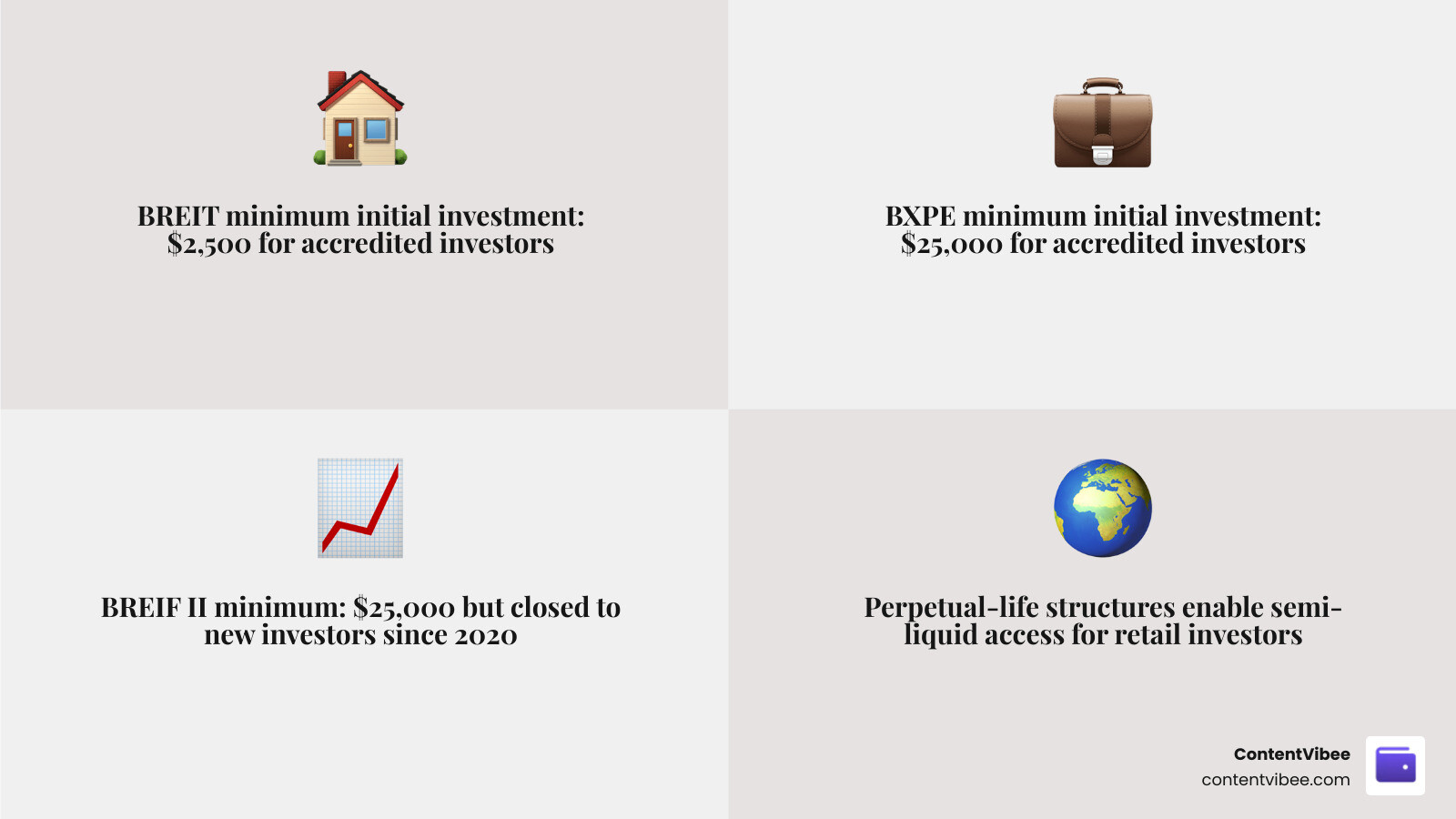
For many years, the “gold standard” for a retail entry point into Blackstone was the Blackstone Real Estate Income Trust (BREIT). According to the Offering Terms – BREIT | Blackstone Real Estate Income Trust, the minimum initial investment is a remarkably accessible $2,500. This fund is a perpetual-life, non-listed REIT that focuses primarily on stabilized, income-generating U.S. commercial real estate.
Moving up the ladder, we encounter the Blackstone Private Equity Strategies (BXPE). This fund represents a “democratized” version of institutional private equity. As noted in the research for BXPE: Blackstone Private Equity Strategies Fund | Alternatives Investor, the minimum initial investment is $25,000. While ten times higher than BREIT, it is still a fraction of what traditional private equity funds demand.
Finally, there is the Blackstone Real Estate Income Fund II (BREIF II). This fund also carried a $25,000 minimum for initial investments, with a $5,000 minimum for any subsequent investments. However, it is important to note that BREIF II is currently in an orderly liquidation phase and is generally closed to new investors.

Comparing Blackstone Investment Fund Minimum Investment Requirements to Traditional PE
To appreciate why a $25,000 minimum is a big deal, we have to look at how “old school” private equity (PE) works. Traditionally, if you wanted to invest in a Blackstone buyout fund, you needed to be an institutional giant like a pension fund or a sovereign wealth fund. We are talking about capital commitments starting at $5 million or $10 million.
Traditional PE also uses “capital calls.” You don’t just hand over $5 million on day one; the fund “calls” the money as they find deals over several years. This makes it almost impossible for the average person to manage their cash flow.
The new “semi-liquid” or “evergreen” structures like BXPE have changed the game. As highlighted in Why Invest in BXPE – BXPE | Blackstone Private Equity Strategies Fund, these vehicles allow for monthly subscriptions. You put your $25,000 in, and it starts working immediately across a diversified portfolio of 15+ private equity strategies. There are no capital calls to worry about, making the democratization of finance a reality for many more households.
How Share Classes Affect Blackstone Investment Fund Minimum Investment Requirements
It isn’t just about the fund name; the “Share Class” you choose can change your effective minimum and your total cost. Blackstone funds typically offer several classes, such as Class D, Class I, Class S, and Class Y.
- Class I (Institutional): Usually has the lowest ongoing fees but often requires a higher minimum investment or must be purchased through specific fee-based brokerage accounts.
- Class D and Class S: These are often tailored for “mass affluent” investors and may include servicing fees or dealer manager fees.
When you look at Blackstone Investment Fund Minimum Investment Requirements, you must also consider the “effective minimum.” For example, while the fund might say $2,500, your specific broker-dealer might have their own higher internal threshold for alternative assets. We always recommend checking with your financial advisor to see which share class fits your portfolio best. For more on managing your personal finances and understanding credit-related investment tools, check out our Money & Credit section.
Understanding Investor Eligibility and Suitability Standards
Just because you have the $2,500 or $25,000 doesn’t mean you can automatically buy in. The SEC and Blackstone have “suitability standards” to ensure these complex investments are only held by people who can handle the risk.
For BREIT, investors generally must meet one of the following:
- A net worth of at least $250,000.
- A gross annual income of at least $70,000 and a net worth of at least $70,000.
For BXPE, the bar is higher. You usually need to be an Accredited Investor. This typically means having a net worth of $1 million (excluding your primary home) or an individual income of $200,000 ($300,000 joint) for the last two years. Some share classes may even require you to be a Qualified Purchaser, which involves owning $5 million or more in investments.
These rules exist because alternative investments are “illiquid”—you can’t just sell them on an exchange like a stock. If you need to pay for a sudden emergency, you can’t always get your money out of a Blackstone fund instantly. Understanding these rules is as vital as knowing how to manage your daily expenses, such as making a TJ Maxx Credit Card Payment.
Global Variations in Blackstone Investment Fund Minimum Investment Requirements
Are you an investor based outside the USA? The rules change significantly. Blackstone uses different legal structures, like the Luxembourg SICAV, to reach international markets.
In Europe and other regions, the Blackstone Investment Fund Minimum Investment Requirements are often denominated in Euros and are governed by the Alternative Investment Fund Managers Directive (AIFMD). According to the BXPE | Blackstone Private Equity Strategies Fund SICAV (Non-U.S. Investors), minimum commitments for non-U.S. investors can range from EUR 25,000 to as high as EUR 500,000, depending on the specific jurisdiction and whether the investor is classified as a “professional client.”
Different regions like Singapore, Hong Kong, and Australia have their own “sophisticated investor” definitions. For instance, in some international versions of BXPE, the minimum might be set at EUR 100,000 to ensure compliance with local private placement rules.
Subscription Processes and Liquidity Features
Once you’ve met the Blackstone Investment Fund Minimum Investment Requirements, you have to follow a specific “rhythm” for subscriptions and redemptions.
The Subscription Cycle
Most of these funds operate on a monthly cycle. For BXPE, subscription requests are typically due four to five business days before the first of the month. You must have your funds fully ready to go by the deadline.
The Liquidity Catch
This is the most important part: These funds are “semi-liquid.” You can’t just click “sell” and get cash the next day.
- BREIT: Offers monthly repurchases, but they are limited to 2% of the aggregate NAV (Net Asset Value) per month and 5% per quarter.
- BXPE: Offers quarterly repurchases, usually capped at 3% of the fund’s total NAV. As noted in Why Invest in BXPE – BXPE | Blackstone Private Equity Strategies Fund, there is often a 5% early redemption penalty if you sell your shares within the first 24 months.
This 24-month “soft lock” encourages long-term thinking. It’s a bit like choosing a specialized credit product; you need to know the terms before you commit. For example, if you’re looking for more immediate financial flexibility, you might look into What the Open Sky Credit Card Is and Who It’s For rather than tying up capital in a private equity fund.
Risks and Strategic Considerations for Lower Minimums
Lower minimums are great for access, but they don’t eliminate the inherent risks of alternative assets. Here is what we think every investor should consider:
- Illiquidity: As mentioned, Blackstone can “gate” the fund. If too many people try to leave at once, they may only fulfill a portion of your request.
- Fees: These funds aren’t cheap. Between management fees (often 1.25%), servicing fees (up to 0.85%), and performance participation (12.5% after a 5% hurdle), the “drag” on your returns can be significant.
- Tax Complexity: While these funds try to simplify things with 1099-DIV reporting (instead of the dreaded K-1), the tax treatment of distributions can still be complex.
- Market Volatility: Even though these aren’t traded on the NYSE, their value (NAV) still fluctuates. For example, the BREIF II Investment Summary from May 2020 showed a YTD return of -28.98% during the initial COVID-19 shock.
Frequently Asked Questions about Blackstone Minimums
What is the absolute lowest minimum for a Blackstone fund?
The lowest minimum is $2,500 for the Blackstone Real Estate Income Trust (BREIT). This is specifically designed for retail investors who want exposure to high-quality commercial real estate without needing millions of dollars.
Can I still invest in BREIF II in 2026?
No, it is highly unlikely. BREIF II (Blackstone Real Estate Income Fund II) is currently in an orderly liquidation process that was approved by shareholders back in October 2020. The fund is focused on returning capital to existing shareholders by selling off its debt portfolio, which includes CMBS and real estate loans. It is generally closed to new subscriptions.
Does the $25,000 BXPE minimum apply to everyone?
While $25,000 is the standard minimum for the “retail-friendly” share classes of BXPE, it isn’t the only requirement. You must still be an accredited investor. Furthermore, institutional share classes or specific regional versions (like those in Europe) may have much higher minimums, sometimes reaching EUR 250,000 or more.
Conclusion
At ContentVibee, we believe that understanding the “fine print” is the first step toward financial justice and empowerment. The Blackstone Investment Fund Minimum Investment Requirements represent a massive shift in how the average person can build wealth, moving beyond just stocks and bonds into private equity and institutional real estate.
Whether you are starting with $2,500 in BREIT or $25,000 in BXPE, these are long-term commitments. The lower entry barriers are an invitation, but the suitability standards and liquidity “gates” are the guardrails. Always consult with a financial professional to ensure these funds align with your overall strategy. For more guides on navigating the complex world of finance, visit our Money & Credit resources.


