

What You’ll Actually Pay When You Hire a Private Mediator
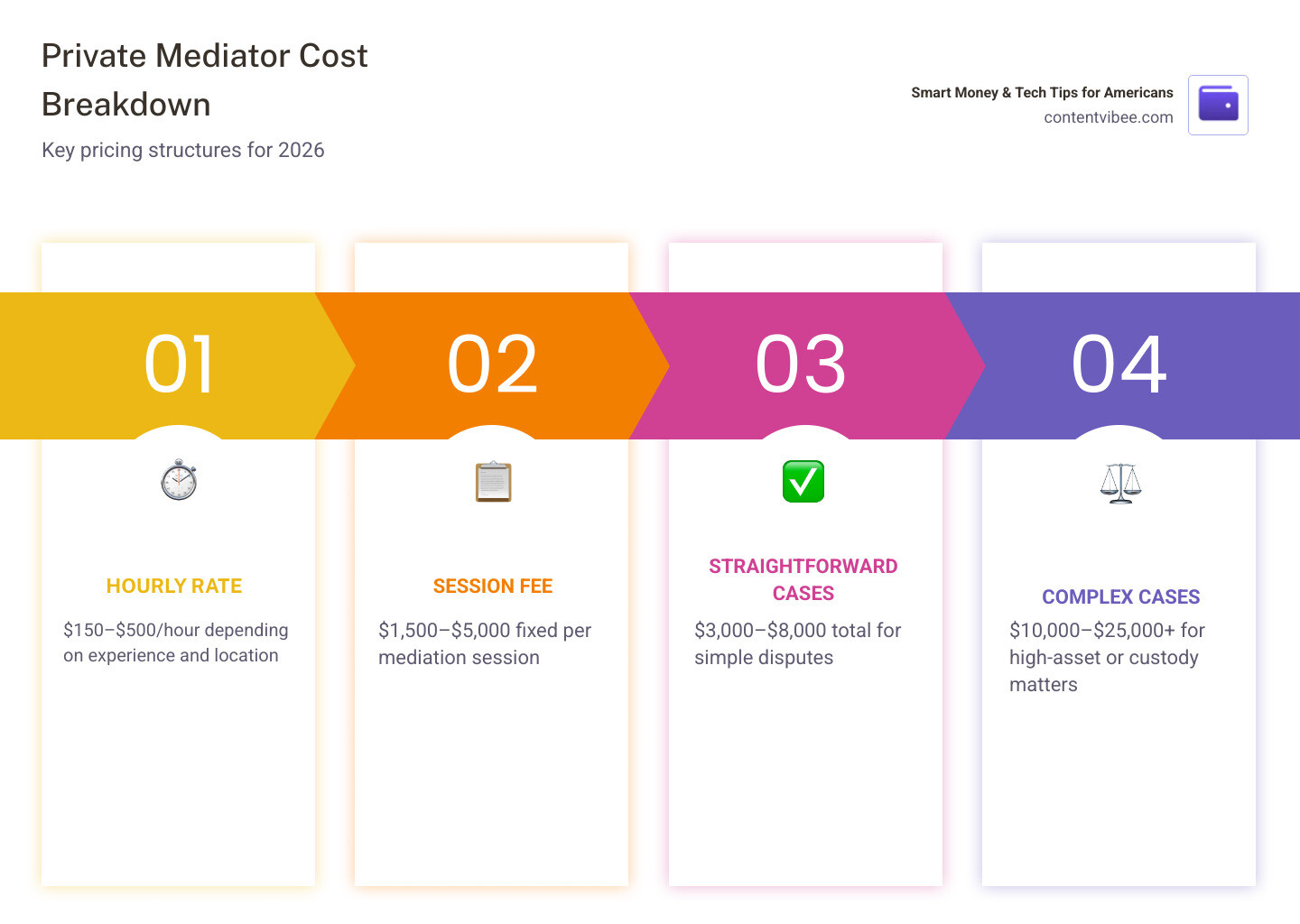
If you’re wondering how much does a private mediator cost, here’s the short answer:
| Cost Type | Typical Range |
|---|---|
| Hourly rate | $150 – $500/hour |
| Per session (fixed fee) | $1,500 – $5,000 |
| Total for straightforward cases | $3,000 – $8,000 |
| Complex or high-asset cases | $10,000 – $25,000+ |
Most people going through a divorce or legal dispute are already stretched thin — emotionally and financially. The last thing you need is a surprise bill.
Private mediation is often far cheaper than going to court. Litigation can easily run $15,000 to $100,000 or more. Mediation, by comparison, usually wraps up in a handful of sessions at a fraction of that cost.
But “private mediator” isn’t one price. It depends on who you hire, where you live, and how complicated your situation is. A straightforward divorce with no major assets looks very different from a high-net-worth dispute involving property, retirement accounts, and custody arrangements.
This guide breaks down exactly what drives those costs — so you can plan your budget with confidence.
How much does a private mediator cost in 2026?
As we navigate the legal landscape of May 2026, the financial reality of dispute resolution has shifted toward efficiency. If you are looking to settle a matter outside of a crowded courtroom, the primary question is usually about the bottom line.
In the current market, the typical hourly rate for a private mediator sits between $150 and $500. However, for elite specialists or those in high-demand California metros, those rates can climb as high as $1,000 per hour. When you look at the total spend for a standard mediation process, most parties find themselves paying between $3,000 and $8,000 for a full resolution.
This is a significant investment, but it is one that often covers the entire “workflow” of the dispute, from the initial intake to the final signed agreement. To understand why these rates vary, we have to look at the professional background of the person sitting at the head of the table. For instance, navigating the financial maze of family law costs often requires deciding between a legal expert and a financial one.
| Mediator Type | Typical Hourly Rate | Best For |
|---|---|---|
| Non-Attorney / CDFA | $150 – $350 | Financial heavy disputes, asset division |
| Attorney-Mediator | $250 – $500 | Legal complexity, enforceable contracts |
| Retired Judge | $500 – $1,000+ | High-stakes litigation, complex civil cases |
How much does a private mediator cost for complex family disputes?
When a case involves more than just “who gets the car,” the price tag naturally increases. High-net-worth individuals or families with complex business interests often find that a standard mediation isn’t enough. In these scenarios, the total cost can exceed $25,000.
Why the jump? Complex cases often require “neutral experts.” You might need a forensic accountant to untangle commingled assets or a parenting specialist to draft a 50-page custody plan. In California, where real estate values are high and tech equity is common, the difference between a simple solution and an expensive legal war often comes down to how much “homework” and expert analysis is required. If you are dividing a multi-million dollar portfolio, paying a mediator $15,000 to save you $100,000 in trial fees is simply smart money management.
How much does a private mediator cost compared to court-appointed options?
You might wonder why anyone would pay for a private mediator when the court offers mediation services. In many California jurisdictions, court-connected mediation is available, but it comes with strings attached. Often, these programs are reserved for families below a certain income threshold—typically a combined gross income of $100,000 or less.
If you exceed these limits, you are often required to seek a private referral. While court-ordered programs might be free or cost a nominal fee (like $60 per session), they are often time-constrained. You might only get two hours with a court mediator who is juggling 20 cases that day. Private mediation, governed by the Administrative Dispute Resolution Act, offers a market-driven alternative where you pay for the mediator’s undivided attention and expertise. For many, the cost of private divorce mediation in California is worth the price for the privacy and customized schedule it provides.
Key Factors That Influence Private Mediation Pricing
The price of a mediator isn’t pulled out of thin air. Several moving parts determine whether your final bill looks like a used car or a luxury SUV.
- Geographic Location: If you’re in a major metro like Los Angeles or San Francisco, expect to pay a premium. High overhead and high demand drive rates toward the $500+ mark. In more rural areas, you might find excellent mediators for $200 an hour.
- Mediator Experience: Just like you’d pay more for a senior surgeon, a mediator with 20 years of experience and a high settlement rate will charge more. They are often faster at identifying “stuck points,” which can actually save you money by reducing the number of sessions.
- Case Complexity: Are we talking about a simple contract dispute or a child custody battle involving multiple states? The more moving parts, the more time the mediator spends on document review and preparation.
- Number of Sessions: Most straightforward cases wrap up in two to four sessions. If the parties are highly high-conflict and refuse to budge, that can easily double.
- Preparation Time: People often forget that mediators charge for the work they do between meetings. This includes reviewing your financial disclosures, reading your legal briefs, and drafting the final settlement. California mediation costs frequently include these “behind-the-scenes” billable hours.
Comparing Private Mediation Costs to Traditional Litigation
If you’re choking on the idea of paying $5,000 for mediation, take a deep breath and look at the alternative. Traditional litigation is the “nuclear option” for your bank account.
When you hire two separate trial lawyers, you aren’t just paying for their time in court. You are paying for two separate retainers, two sets of paralegals, and two competing strategies. Divorce lawyer fees can range from $15,000 to over $100,000 per side if the case goes to trial.
In mediation, you are essentially “buying a risk transfer.” Instead of rolling the dice in front of a judge who doesn’t know your family, you are paying for the “legal firepower” to reach a controlled, private agreement. This is similar to how lawyers charge for accident claims; you are paying for an expert to maximize your outcome while minimizing your risk. In mediation, the “win” is a faster finalization and a preserved relationship, all while keeping your private financial business out of the public record.
Hidden Fees and Additional Expenses to Budget For
When calculating how much does a private mediator cost, don’t just look at the hourly rate. There are several “sneaky” costs that can pad the bill if you aren’t prepared.
- Administrative Set-up Fees: Many private firms charge a one-time fee, often around $250, just to open your file and get the conflict checks out of the way.
- Filing Fees: The mediator’s fee doesn’t usually include the court’s filing fees. In California, for example, the petition fee for a divorce is roughly $435.
- Document Review: If the mediator has to spend three hours reading a complex prenuptial agreement or a forensic accounting report, you will see those hours on your invoice.
- Expert Witnesses: If you need a real estate appraiser or a tax expert to chime in, they will bill you separately from the mediator. This is a common factor in personal injury lawyer costs as well—experts aren’t cheap.
- Travel and Post-Mediation Summaries: If the mediator has to travel to a specific location or spend time drafting a detailed “Memorandum of Understanding” after the session, expect to pay for that time.
How to Manage and Reduce Your Mediation Expenses
We are all about smart money tips here, and mediation is one of the best areas to apply them. You don’t have to just sit back and watch the bill grow.
- Be the “Master of Documentation”: The fastest way to blow your budget is to show up to mediation without your financial records. If the mediator has to wait for you to find a tax return on your phone, you are paying $400 an hour for them to watch you scroll. Have everything organized in folders before the first minute starts.
- Opt for 90-Minute Sessions: Some mediators suggest “marathon” 8-hour sessions. We’ve found that many clients hit “emotional fatigue” after two hours. Shorter, 90-minute sessions are often more productive and prevent you from making expensive, tired mistakes.
- Split the Cost 50/50: This is the industry standard. Sharing the bill keeps both parties “invested” in reaching a quick resolution.
- Ask for Flat-Fee Packages: Some mediators offer a flat fee for the entire process (e.g., $5,000 for up to four sessions and the final paperwork). This provides ultimate financial predictability.
- Go Virtual: Remote mediation via Zoom or Teams eliminates travel costs and often allows for more flexible, shorter scheduling that fits your work day.
- Get it in Writing: Never start without a written fee agreement. It should clearly outline the hourly rate, the retainer amount, and how “ancillary” tasks like emails and phone calls are billed.
Frequently Asked Questions about Private Mediation Costs
Who typically pays for the private mediator’s services?
In almost all private cases, the parties split the cost 50/50. However, this is negotiable. Sometimes, if there is a significant income disparity, one party might agree to pay 70% of the cost, or pay the initial retainer deposit to get the ball rolling. This is often settled in the initial agreement or as part of the final settlement.
Are there low-cost or sliding-scale options for private mediation?
Yes! Many private mediators offer tiered pricing based on household income. If you don’t qualify for free court services but can’t afford a $500/hour attorney, look for “Community Mediation Centers.” These non-profit organizations often use highly trained volunteers or junior mediators who charge on a sliding scale, sometimes as low as $50 to $150 per session.
How many sessions are usually required to reach a settlement?
For a straightforward dispute, you can expect 4 to 6 hours of actual meeting time, usually spread over two or three sessions. Complex cases involving children and businesses might take five to ten sessions. To keep things moving, mediators often assign “homework”—tasks like getting a house appraisal or drafting a holiday schedule—that you complete between meetings to save billable time.
Conclusion
At Smart Money & Tech Tips for Americans, our mission is to help you navigate life’s toughest financial transitions with your bank account intact. Understanding how much does a private mediator cost is the first step in taking control of your legal future.
By choosing mediation over a courtroom battle, you aren’t just saving money; you are buying peace of mind and a faster path to your “new normal.” Whether you are in California or beyond, the combination of professional guidance and personal preparation is the ultimate strategy for a cost-effective resolution. Learn more about our mission to provide actionable tips for your financial and legal health.