What Every California Parent Needs to Know About Divorce and Custody
California divorce custody law can feel overwhelming — especially when you’re already stressed, stretched thin, and trying to do right by your kids.
Here’s a quick answer to what most parents want to know first:
California Child Custody at a Glance (2026)
| Question | Quick Answer |
|---|---|
| What types of custody exist? | Legal custody (decisions) and physical custody (where child lives) — each can be joint or sole |
| What standard do courts use? | Best interests of the child (Family Code § 3011) |
| Is 50/50 custody automatic? | No, but courts favor frequent contact with both parents |
| Can my child choose where to live? | At age 14+, their preference gets serious weight |
| Do we have to go to mediation? | Yes, in most California counties before any contested hearing |
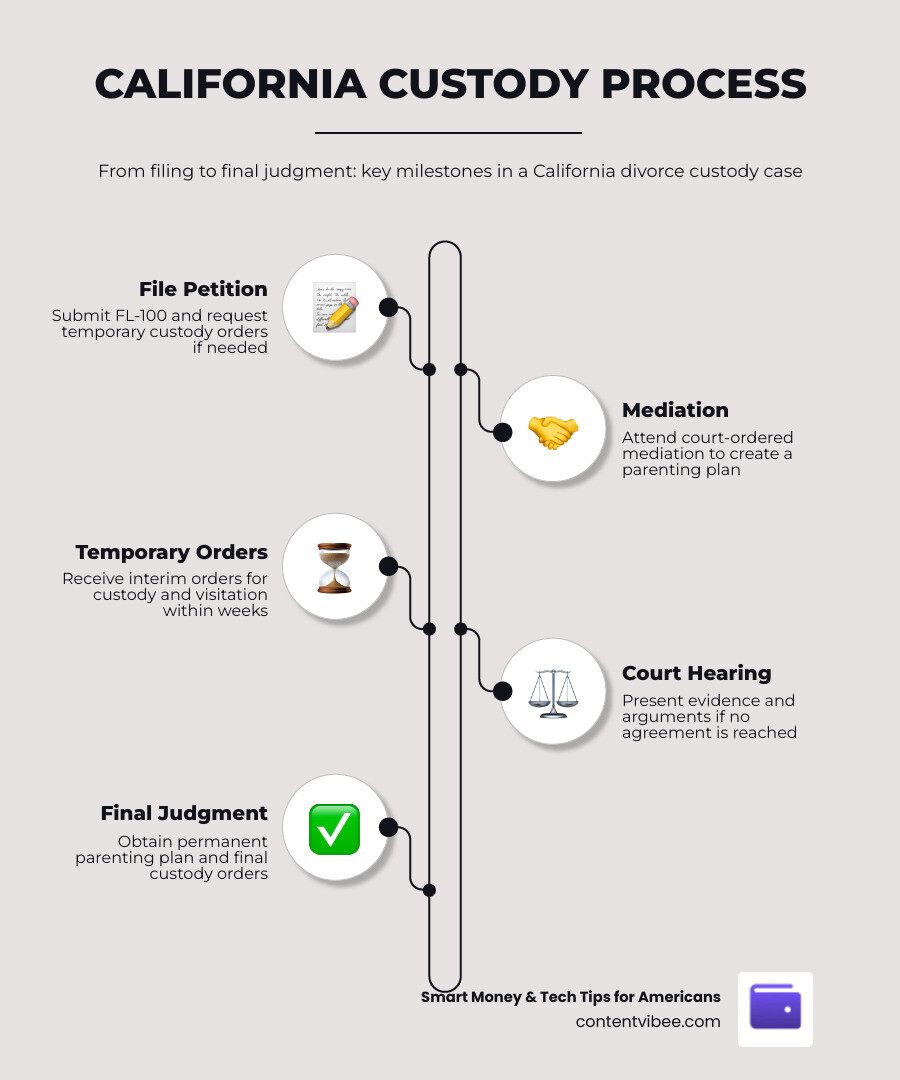
| How long does it take? | Temporary orders: 2–4 weeks; Final orders: 6–12 months in contested cases |
About 40% of California divorces involve disputes over child custody or visitation — and those disputes are among the most emotionally and financially draining parts of any split.
The good news? Most custody cases never go to trial. California law actually pushes parents toward agreement first — through mediation, parenting plans, and negotiation — saving time, money, and stress for everyone involved, especially the kids.
This guide walks you through everything: custody types, how judges decide, domestic violence protections, parenting plans, and how to modify orders when life must change.
Basic california divorce custody glossary:
Understanding the Types of California Divorce Custody

When we talk about custody in the Golden State, we aren’t just talking about where the kids sleep at night. California law splits custody into two distinct categories: Legal and Physical. Understanding the difference is the first step in building a sustainable future for your family.
You might hear people say they have “full custody,” but in the eyes of the court, that usually means a combination of sole legal and sole physical custody. Conversely, many modern families operate under “joint” arrangements. To help you stay organized during this transition, we recommend checking out The Ultimate California Divorce Checklist to ensure you haven’t missed any critical filings.
For a deep dive into the official court definitions, you can also review the Child custody and parenting time guide provided by the California Courts.
Legal Custody: Decision-Making Power
Legal custody is all about the “Big Three”: Education, Healthcare, and Religious upbringing. It grants a parent the right and the responsibility to make major decisions that shape the child’s life.
In California, there is a strong preference for Joint Legal Custody. In fact, approximately 60% of child custody cases result in joint legal custody arrangements. This means both parents must collaborate on:
- Which school the child attends.
- Whether the child receives specific medical treatments or vaccinations.
- Which religious activities the child participates in.
- Travel and extracurricular activities.
Sometimes, a judge may grant “tie-breaking authority” to one parent if the adults are constantly deadlocked. This allows one parent to make the final call on a specific issue (like braces or private school) to prevent the family from having to run back to court for every minor disagreement.
Physical Custody: Where the Child Lives
Physical custody refers to where the child actually resides and who handles the day-to-day care.
- Joint Physical Custody: This doesn’t necessarily mean a perfect 50/50 split, but it does mean the child spends significant periods of time with both parents. California law (Family Code § 3020) explicitly favors “frequent and continuing contact” with both parents unless it’s unsafe.
- Sole Physical Custody: The child lives primarily with one parent (the custodial parent), while the other (the non-custodial parent) usually has visitation rights.
Custody decisions often go hand-in-hand with financial shifts. As you navigate these changes, you’ll also need to consider how assets are split, which you can read about in our guide on Dividing the Spoils and Your 401k in a California Divorce.
How Judges Determine the Best Interests of the Child

If you and your co-parent can’t agree on a schedule, a judge will step in. But they don’t just flip a coin. California judges are bound by the “Best Interests of the Child” standard, primarily governed by Family Code Section 3011.
The court’s primary concern is the child’s health, safety, and welfare. Judges have broad discretion to make orders that are “necessary or proper,” but they must look at the specific evidence presented. For a comprehensive look at the statutory updates for this year, see California Child Custody Laws 2026.
Factors in California Divorce Custody Decisions
When evaluating what is “best,” the court looks at a variety of “Best Interest Factors”:
- Health and Safety: This is the #1 priority. Any history of abuse or neglect is scrutinized heavily.
- Emotional Ties: The judge looks at the bond between the child and each parent.
- Stability: Courts prefer to keep children in their current school, community, and routine whenever possible.
- Sibling Bonds: California law generally disfavors separating siblings unless there is a compelling reason.
- Substance Abuse: Recent or habitual use of illegal drugs or alcohol by either parent is a major factor.
- Co-parenting Ability: Interestingly, judges look at which parent is more likely to encourage the child’s relationship with the other parent. If one parent tries to “alienate” the other, it can backfire in court.
Navigating these legal hurdles can be pricey. If you’re worried about the bottom line, we’ve broken down the costs in Navigating the Financial Maze of Family Law Costs.
The Child’s Voice and Preference
In California, children aren’t just bystanders. Under Family Code Section 3042, if a child is of “sufficient age and capacity to reason,” the court must consider their wishes.
- The Age 14 Rule: Once a child reaches 14, they have a right to address the court directly about their custody preference, unless the judge decides it’s not in their best interest to do so.
- Maturity Matters: For children under 14, the judge may still listen if they seem mature enough to express an independent opinion.
- Judicial Discretion: The child’s preference is not a veto. A 15-year-old might want to live with the “fun” parent who has no rules, but the judge can still order them to live with the parent who ensures they go to school and stay healthy.
Navigating Domestic Violence and Safety Protections
Safety is the absolute floor of any california divorce custody case. If there is a history of domestic violence, the usual “joint custody” preference is thrown out the window.
New for 2026, Piqui’s Law (SB 331) has significantly changed how courts handle these cases. This law requires mandatory training for judges and court professionals on domestic violence and child safety. It also prohibits courts from ordering children into “reunification camps” that use coercive tactics.
If you are in a situation involving abuse, you should immediately review the FL-313-INFO Child Custody Information Sheet to understand how “Recommending Counseling” works when safety is a concern. You can request separate mediation sessions or bring a support person with you.
Impact of Abuse on Visitation Rights
Under California Family Code Section 3044, there is a rebuttable presumption that awarding sole or joint custody to a person who has committed domestic violence within the last five years is detrimental to the child’s best interest.
To overcome this, the abusive parent must prove they have completed batterer’s intervention programs, parenting classes, or substance abuse treatment, and that they no longer pose a risk. In many of these cases, the court will order:
- Supervised Visitation: A professional or a trusted third party must be present at all times.
- No Visitation: In extreme cases, the court may suspend all contact to protect the child.
- SB 1427 Updates: Recent 2026 updates have further strengthened the requirement for “independent corroboration” of abuse to ensure children are protected from high-risk environments.
If you’re dealing with these complex issues, consulting with specialized Child Support Attorneys can help ensure your child’s financial and physical safety are both addressed.
Creating and Modifying Your California Parenting Plan
A parenting plan is your roadmap. It’s a written agreement that details exactly when the child is with each parent and how decisions are made. If you and your ex agree, the judge will almost always sign off on it, making it a legally binding court order.
Most California counties require you to attend Mediation (also called Child Custody Recommending Counseling) before you can even see a judge. This is a chance to work out a plan with a neutral professional.
| Feature | Scheduled Visitation | Reasonable Visitation |
|---|---|---|
| Structure | Specific days, times, and locations | Open-ended (“as agreed upon”) |
| Flexibility | Lower (requires sticking to the calendar) | Higher (requires great communication) |
| Best For | High-conflict parents or busy schedules | Parents who get along and are flexible |
| Transportation | Detailed in the order (who drives when) | Usually handled on the fly |
If you can’t agree, you’ll need to file a Request for Order (FL-300). This tells the judge you need them to make the decision for you. This process can be expensive, so it’s wise to understand What Does a Custody Lawyer Actually Cost before you dive into a litigated battle.
Modifying California Divorce Custody Orders
Life happens. People move, jobs change, and kids grow up. In California, you can request a modification of your custody order, but it isn’t always easy.
- Temporary Orders: Can be changed based on the “Best Interest” standard.
- Final Orders: Under the famous case Montenegro v. Diaz, if you want to change a final custody order, you must show a “Substantial Change in Circumstances.” This means something significant has happened that makes the old order no longer work (e.g., a parent’s relocation, a shift in the child’s needs, or evidence of new abuse).
- Relocation (Move-Away) Rules: If a parent wants to move with the child, they must usually provide 45 days’ advance written notice. These are some of the most contested cases in California law, often requiring a “Best Interest” hearing to decide if the move is beneficial for the child.
If you are considering a move or a change but aren’t yet divorced, you might want to look into the Legal Separation Cost and Your Wallet as an alternative way to set boundaries.
Jurisdiction and Alternatives to Traditional Divorce
Not every marriage ends in a courtroom drama. California offers several paths, but they all require the state to have “Jurisdiction.”
The UCCJEA (Uniform Child Custody Jurisdiction and Enforcement Act): To make a custody order, California must generally be the child’s “home state.” This usually means the child has lived here for at least 6 months prior to filing. If you just moved to California last week, the court might not be able to help you with custody yet.
Alternatives to Standard Divorce:
- Summary Dissolution: A “divorce-lite” for couples married less than 5 years, with no children, and limited property. It’s faster and cheaper.
- Legal Separation: You stay technically married (often for insurance or religious reasons) but the court still decides custody and property division.
- Annulment: The court treats the marriage as if it never happened. This is rare and requires specific grounds like fraud or bigamy.
While these options can save money, Divorce Costs Why Your Ex Might Be Your Most Expensive Hobby if you don’t choose the right path early on.
Frequently Asked Questions about California Custody
When do California courts have jurisdiction to decide custody?
California courts typically have jurisdiction if California is the child’s “home state”—meaning the child has lived here with a parent for at least six consecutive months before the case was filed. There are “Emergency Jurisdiction” exceptions if the child is in the state and needs immediate protection due to abandonment or abuse.
Can a child choose which parent to live with in California?
A child cannot “choose” in the sense of making the final decision, but their voice carries weight. If the child is at least 14 years old, the judge must allow them to express their preference unless it would be harmful to them. The judge then weighs that preference against other factors like stability and safety.
What are the options for ending a marriage besides divorce?
The main options are Legal Separation (where you stay married but live separate lives with court-ordered support/custody) and Summary Dissolution (a simplified divorce for couples with no kids and few assets). Annulment is also an option but is much harder to prove.
Conclusion
Navigating california divorce custody in 2026 requires a mix of emotional resilience, legal knowledge, and smart financial planning. At Smart Money & Tech Tips for Americans, we believe that the best outcomes happen when parents stay informed and use the tools available to them.
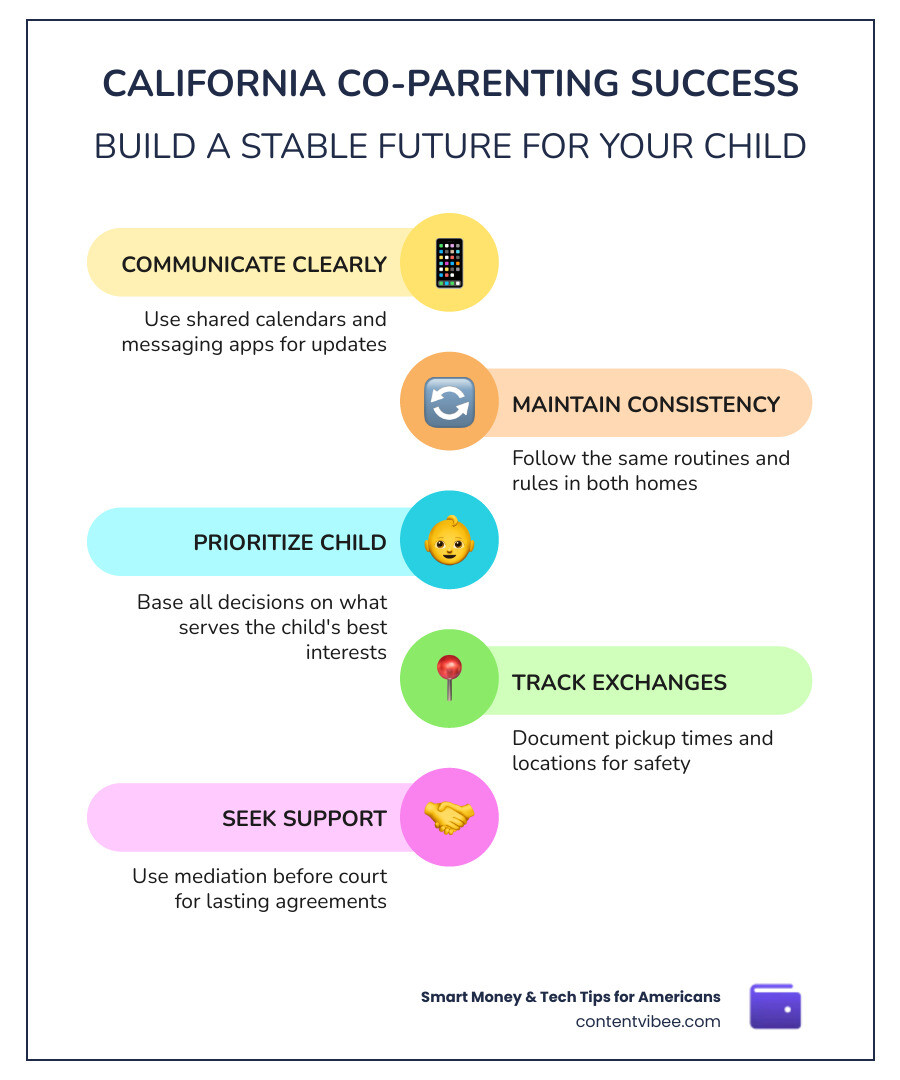
From co-parenting apps that track schedules to using mediation to avoid the high cost of a trial, technology and strategy can make this process much smoother. The “final judgment” is just the beginning of your new co-parenting relationship.
If you find yourself in a high-conflict situation where an agreement seems impossible, it may be time to call in the professionals. We recommend looking at Detailed Reviews of the Top 10 Family Law Attorneys LA to find an advocate who can help you protect your rights and your child’s future.