What the Ten Year Marriage Rule Means for Your Divorced Spousal Benefits
The ten year marriage rule is one of the most misunderstood milestones in divorce law — and it can have a massive impact on your financial future.
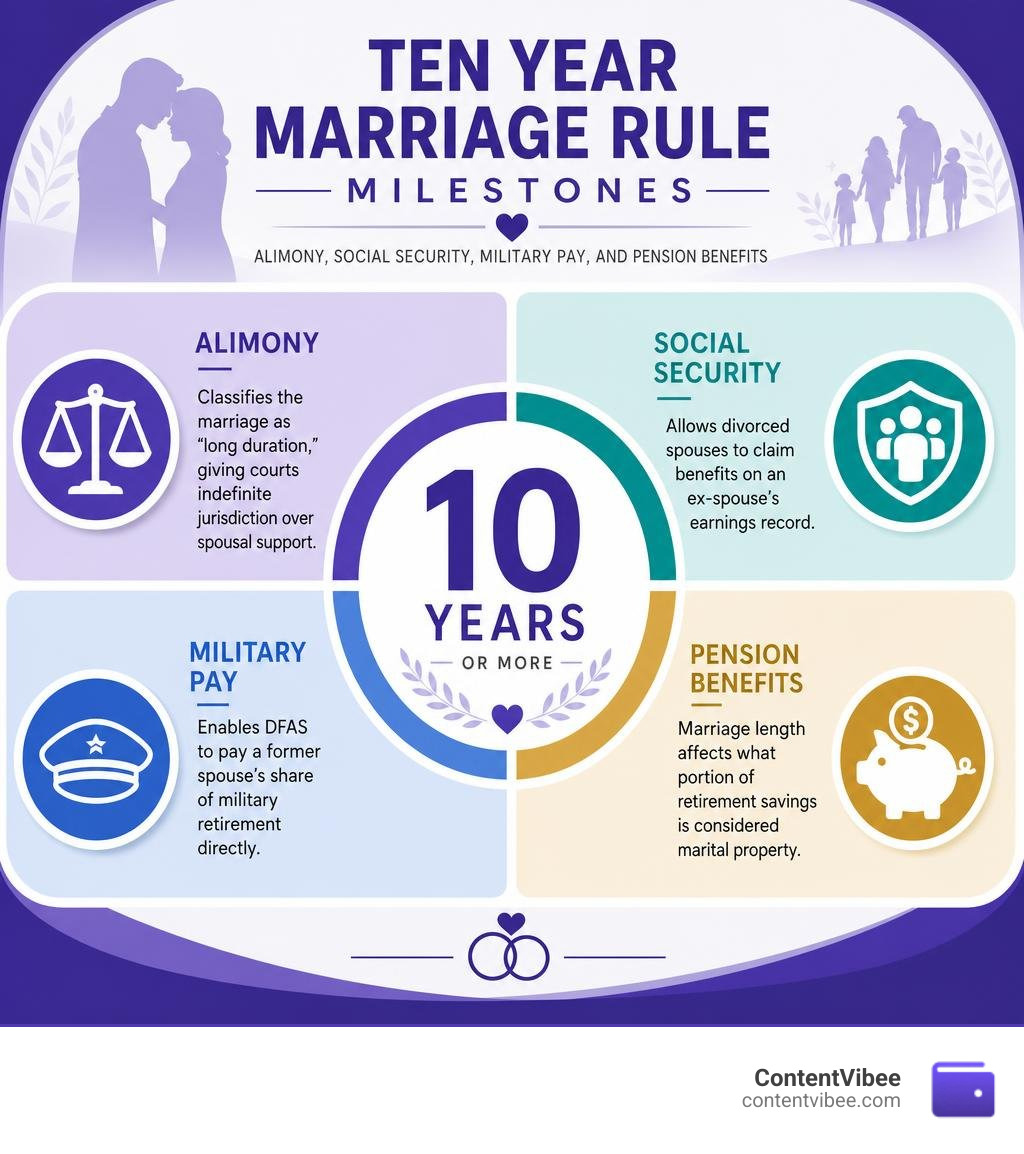
Here’s a quick breakdown of what it actually covers:
| Area | What the 10-Year Rule Does |
|---|---|
| California Spousal Support | Classifies the marriage as “long duration,” giving courts indefinite jurisdiction over alimony |
| Social Security | Allows divorced spouses to claim benefits on an ex-spouse’s earnings record |
| Military Divorce (10/10 Rule) | Enables DFAS to pay a former spouse’s share of military retirement directly |
| Private Pensions & 401(k)s | Marriage length affects what portion of retirement savings is considered marital property |
A few things to know up front:
- For marriages under 10 years, California courts typically presume spousal support lasts half the length of the marriage.
- For marriages 10 years or longer, there is no automatic end date — courts retain jurisdiction indefinitely.
- The 10-year rule does not guarantee lifetime alimony. Support can still be modified or terminated.
- In military divorce, the 10-year rule controls how you get paid, not whether you’re entitled to a share.
These distinctions matter — and confusing them can cost you significantly in a settlement.
Whether you’re approaching the 10-year mark, already past it, or trying to understand benefits you may already be entitled to, this guide explains exactly how each version of the ten-year rule works and what you need to know before making any decisions.
What Is the Ten Year Marriage Rule in California?
In California family law, the ten year marriage rule is a critical threshold defined by California Family Code Section 4336. Under this statute, any marriage that lasts ten years or more is officially classified as a marriage of “long duration.”
This classification does not automatically grant a specific dollar amount of alimony, nor does it mean payments will flow forever. Instead, its primary legal consequence is jurisdiction. For a marriage of long duration, the court retains the legal authority (jurisdiction) to order, modify, or extend spousal support indefinitely, unless the spouses agree otherwise in writing or a court order terminates it.
How do we measure this ten-year milestone? It is calculated strictly from the date of marriage to the date of separation. The date of separation is the day when at least one spouse has decided the marriage is over and takes actions consistent with that intent.
Because a few days or weeks can mean the difference between a hard cutoff on alimony and indefinite court jurisdiction, the exact date of separation is often aggressively litigated. Spouses may look at text messages, emails, bank accounts, or the date one spouse moved out to establish when the marriage truly ended. Strategic timing is common; a spouse looking to avoid indefinite jurisdiction may push to finalize separation at nine years and eleven months, while the other may try to hold out past the decade mark.
How the Ten Year Marriage Rule Impacts Alimony Duration
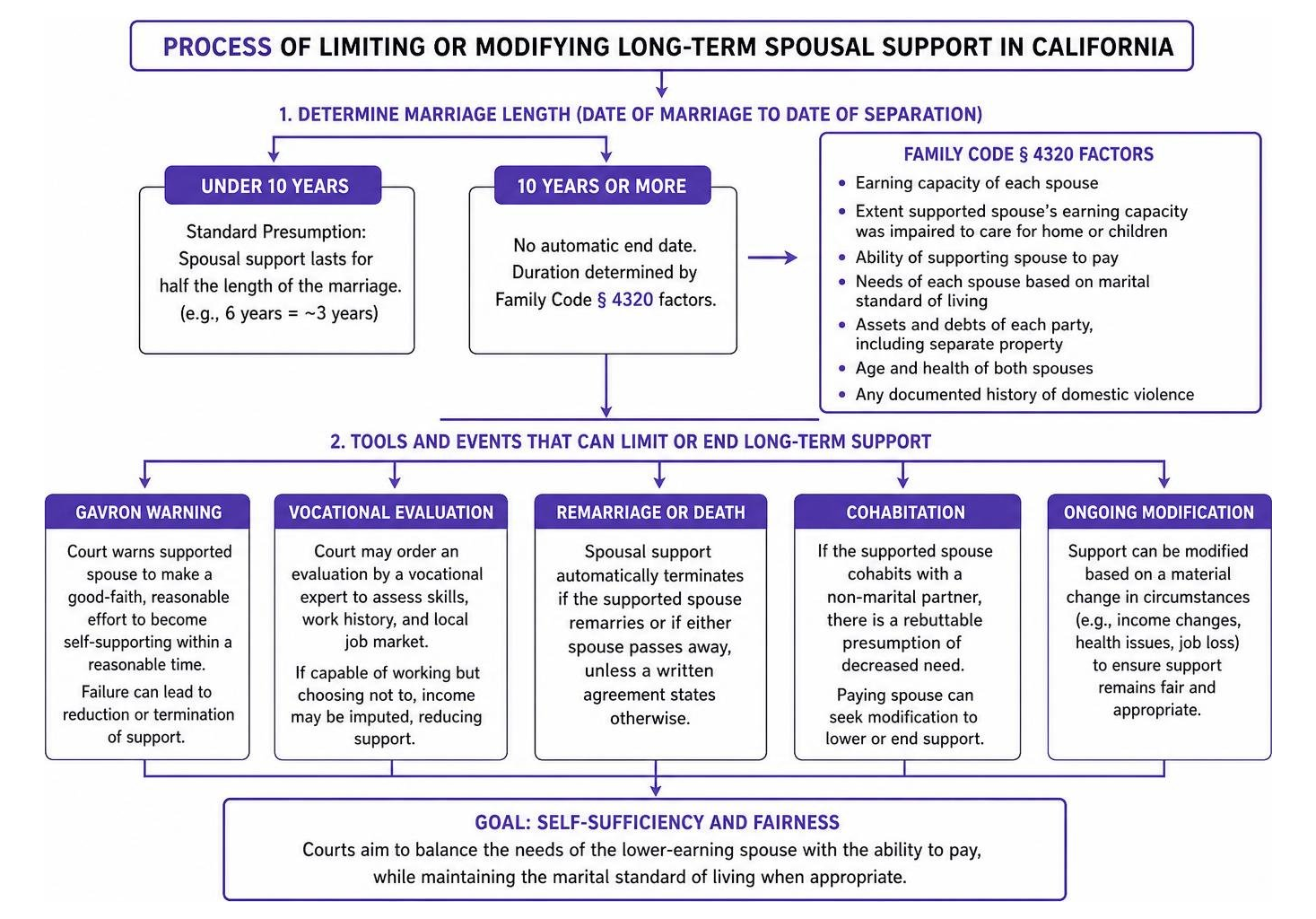
For marriages under ten years, California courts operate under a standard presumption: spousal support should generally last for half the length of the marriage. For example, if you were married for six years, you can expect alimony to last for about three years.
Once you hit the ten year marriage rule threshold, that presumption disappears. The court cannot set an arbitrary, automatic termination date for spousal support in its initial judgment. Instead, the duration of support is governed by a complex set of factors under California Family Code Section 4320.
These factors include:
- The earning capacity of each spouse.
- The extent to which the supported spouse’s present or future earning capacity was impaired by periods of unemployment during the marriage to care for the home or children.
- The ability of the supporting spouse to pay support.
- The needs of each spouse based on the standard of living established during the marriage.
- The assets and debts of each party, including separate property.
- The age and health of both spouses.
- Any documented history of domestic violence.
The court seeks to balance the financial needs of the lower-earning spouse with the higher-earning spouse’s ability to pay, while keeping the marital standard of living in mind.
Exceptions and Ways to Limit Long-Term Support
Even in a marriage that exceeds ten years, the court’s goal is for both parties to eventually become self-supporting. To prevent spousal support from becoming a lifetime pension, California courts utilize several tools:
- The Gavron Warning: This is an official notice issued by the court warning the supported spouse that they must make a good-faith, reasonable effort to become self-supporting within a reasonable period of time. Failing to do so can result in the reduction or complete termination of alimony.
- Vocational Evaluations: A court can order the supported spouse to undergo an evaluation by a vocational expert. This professional assesses the spouse’s work history, skills, and the local job market to determine their true earning capacity. If the expert finds the spouse is capable of working but choosing not to, the court can “impute” income to them, reducing the alimony obligation.
- Remarriage and Death: By law, spousal support automatically terminates if the supported spouse remarries or if either spouse passes away, unless there is a written agreement stating otherwise.
- Cohabitation: Under California law, if the supported spouse begins cohabiting with a non-marital partner, there is a rebuttable presumption of a decreased need for spousal support. The paying spouse can request a modification to lower or end payments.
How Marriage Length Affects Federal and Retirement Benefits
When we look beyond state-level alimony, the length of your marriage also plays a massive role in how federal benefits and private retirement assets are divided. Because California is a community property state, any retirement benefits or pensions accrued during the marriage are considered shared property, regardless of whether you were married for two years or twenty.
However, dividing these assets requires specific legal tools, and federal programs like Social Security have their own strict rules tied directly to the ten-year mark.
Social Security Benefits and the Ten Year Marriage Rule
One of the most valuable federal protections for divorced spouses is the ability to claim Social Security benefits based on an ex-spouse’s earnings record. To qualify for these “derivative benefits,” you must meet the following federal requirements:
- Your marriage must have lasted at least ten years before the divorce was finalized.
- You must be at least 62 years old.
- You must currently be unmarried (if you remarry, you generally lose the right to claim on your ex-spouse’s record, unless your subsequent marriage also ends).
- Your ex-spouse must be eligible for Social Security retirement or disability benefits.
- The benefit you would receive based on your own work record must be less than the benefit you would receive based on your ex-spouse’s record.
If you meet these criteria, you can receive a spousal benefit equal to up to 50 percent of your ex-spouse’s full retirement age benefit.
Crucially, claiming this benefit does not reduce your ex-spouse’s monthly payment, nor does it impact the benefits of their current spouse if they have remarried. It is a completely independent federal entitlement. If you are approaching the nine-year mark of your marriage and considering divorce, waiting until the ten-year anniversary is finalized can secure this lifetime financial safety net.
Dividing Private Pensions and 401(k) Accounts
While Social Security is a federal benefit that cannot be divided or transferred by a state court, private retirement accounts like 401(k)s, IRAs, and traditional pensions are treated as marital assets. Under the Employee Retirement Income Security Act (ERISA), dividing a private pension or employer-sponsored retirement account requires a specialized court order known as a Qualified Domestic Relations Order (QDRO).
The QDRO is drafted during the divorce process and submitted to the retirement plan administrator. It instructs the administrator on how to split the account.
To determine the marital portion of a pension, courts typically use the coverture fraction (also known as the Time Rule formula):
$$\text{Marital Share} = \frac{\text{Months of Marriage Overlapping with Service}}{\text{Total Months of Service}}$$
This fraction is then multiplied by the total pension benefit to find the community property portion, which is usually split 50/50. If you were married for less than ten years, you are still legally entitled to your share of the retirement assets earned during that time. However, the sheer cost of hiring an attorney and an actuary to draft a QDRO can sometimes outweigh the value of the asset in shorter marriages. In those cases, spouses often negotiate a “present-value setoff,” trading other assets (like home equity or cash) to keep their respective retirement accounts intact.
Military Divorce and the 10/10 Rule vs. California Law
Military divorces are governed by a unique overlap of state family law and federal statutes, specifically the Uniformed Services Former Spouses’ Protection Act (USFSPA). One of the most common points of confusion is the difference between California’s ten-year rule for alimony and the military’s 10/10 rule.
The military’s 10/10 rule is not a rule that determines whether a former spouse is entitled to a portion of a military pension. Under state law, military retirement pay is treated as community property and can be divided whether you were married for ten days, ten months, or ten years.
Instead, the 10/10 rule is purely an enforcement and payment mechanism. It dictates who sends the retirement check.
To satisfy the 10/10 rule, you must meet two overlapping criteria:
- You must have been married for at least ten years.
- The military member must have performed at least ten years of creditable military service toward retirement during that marriage.
| Rule / Feature | California 10-Year Rule | Military 10/10 Rule |
|---|---|---|
| Primary Authority | California Family Code | USFSPA (Federal Law) |
| What It Controls | Court’s jurisdiction over alimony duration | How military pension division is paid |
| Requirement | 10 years of marriage | 10 years of marriage overlapping with 10 years of service |
| If You Fail the Rule | Alimony duration is usually limited to half the marriage length | Pension is still divisible, but retiree must pay you directly |
As explained in the ROA Law Review on the 10/10 rule, if you meet the 10/10 threshold, the Defense Finance and Accounting Service (DFAS) will pay the former spouse’s share of the retirement pay directly to them each month. This direct payment is highly advantageous because it ensures guaranteed, on-time deposits, includes automatic cost-of-living adjustments (COLAs), and generates a separate Form 1099-R for tax reporting, ensuring both parties are only taxed on the income they actually receive.
If your marriage does not meet the 10/10 rule, the court can still order the military retirement to be divided. However, DFAS will not handle the payments. Instead, the retired service member must write a personal check to the former spouse every month, which can lead to collection headaches, missed payments, and complex tax reporting challenges.
The Frozen Benefit Rule and Post-2016 Divorces
The National Defense Authorization Act (NDAA) of 2017 radically changed how military pensions are divided for service members who divorce while still on active duty. This change is known as the Frozen Benefit Rule.
For divorces finalized after December 23, 2016, the former spouse’s share of the military pension is “frozen” at the time of the divorce. Rather than calculating the pension based on the service member’s rank and years of service at the time they eventually retire, the benefit is calculated as if the member retired on the date of the divorce.
The calculation uses:
- The service member’s high-36 months of basic pay at the time of divorce.
- The creditable years of service at the time of divorce.
This rule prevents former spouses from benefiting from the promotions, pay raises, and career advancements the service member achieves after the marriage ends. It makes obtaining certified military service records (such as a DD Form 214 or a certified statement of service) during the divorce process absolutely vital to lock in accurate values.
Military Benefit Thresholds: 20/20/20 vs. 20/20/15 Rules
While the 10/10 rule only governs pension payments, the military offers substantial healthcare and exchange benefits to former spouses who meet much higher marital milestones. These are known as the 20/20/20 and 20/20/15 rules.
The 20/20/20 Rule: To qualify for lifetime TRICARE healthcare coverage, commissary privileges, and military exchange access, you must meet three strict criteria:
- You were married for at least 20 years.
- The service member performed at least 20 years of service creditable for retired pay.
- There is an overlap of at least 20 years between the marriage and the military service.
These benefits remain active as long as the former spouse does not remarry and is not covered by an employer-sponsored health plan.
The 20/20/15 Rule: If you meet the 20 years of marriage and 20 years of service requirements, but the overlap between the two is only 15 years (instead of 20), you qualify for transitional TRICARE coverage for exactly one year following the divorce. After that year, coverage terminates, though you may transition to the Continued Health Care Benefit Program (CHCBP).
VA Disability, Mansell, Howell, and Indemnification
A highly complex and contentious area of military divorce involves VA disability compensation. Under federal law, military retirees who have a service-connected disability rating can waive a portion of their taxable retired pay to receive tax-free VA disability benefits instead.
Because VA disability is not considered divisible marital property under the USFSPA (as established by the Supreme Court in Mansell v. Mansell), a veteran’s election of disability benefits directly reduces the “disposable retired pay” available to be split with a former spouse.
In the past, state courts would often order veterans to “indemnify” their ex-spouses — essentially requiring them to pay the ex-spouse out-of-pocket to make up for the financial loss caused by the post-divorce disability waiver. However, in 2017, the U.S. Supreme Court decided Howell v. Howell, ruling that state courts cannot order veterans to indemnify former spouses for reductions in retirement pay caused by VA disability elections.
To protect yourself against this risk, settlements must be crafted carefully. Parties often negotiate fixed-dollar alimony payments or trade other marital assets (such as equity in the family home) rather than relying solely on a percentage of military retired pay.
Additionally, spouses should address the Survivor Benefit Plan (SBP). The SBP is an annuity that pays a designated beneficiary up to 55% of the retiree’s pension after they pass away. If the court orders “former spouse coverage” for SBP, the former spouse must submit a “deemed election” form to DFAS within one year of the divorce decree. Missing this strict federal deadline makes the SBP order completely unenforceable against DFAS.
Common Misconceptions About the 10-Year Divorce Thresholds
When navigating a divorce, relying on neighborhood rumors or internet myths can lead to disastrous financial decisions. Let’s clear up some of the most common misconceptions surrounding the 10-year rule in California:
- Myth 1: Reaching 10 years guarantees “lifetime alimony.”
Reality: There is no such thing as automatic lifetime alimony in California. The ten-year mark simply means the court retains the power to modify or extend support. If the supported spouse is young, capable of working, or has substantial assets, the court can still order support to end after a reasonable transition period. - Myth 2: If we divorce at 9 years and 11 months, the court cannot order long-term support.
Reality: The ten-year mark is a guideline, not a brick wall. Family Code Section 4336 allows a court to find that a marriage of less than ten years is still of “long duration” based on the specific circumstances of the case. - Myth 3: If we aren’t married for 10 years, I get nothing from my spouse’s military retirement or private pension.
Reality: You are legally entitled to your community property share of any pension or retirement account earned during the marriage, even if you were married for only a few years. The ten-year rule in military divorce only dictates whether DFAS pays you directly.
Frequently Asked Questions About Divorced Spousal Benefits
Can a spouse still receive a share of military retirement if the marriage lasted less than 10 years?
Yes. A former spouse is legally entitled to a division of military retirement pay under state property laws, regardless of the length of the marriage. The military’s 10/10 rule only determines whether DFAS will send the payments directly to the former spouse. If the marriage lasted less than ten years during active duty, the state court will still calculate the marital share, but the retired service member will be personally responsible for writing a check to their ex-spouse each month.
How does the date of separation affect whether a marriage qualifies as a long-duration marriage in California?
The date of separation is the absolute endpoint for measuring the length of a marriage. It is defined as the date there is a complete and final break in the marital relationship, evidenced by a spouse’s intent to end the marriage and actions consistent with that intent. If the date of separation occurs at nine years and ten months, the marriage is legally considered “short-term” (under ten years), even if the actual divorce process takes another two years to finalize in court.
What is the Gavron warning and how does it relate to long-term spousal support?
A Gavron warning is a formal court advisement telling the spouse receiving alimony that they are expected to make reasonable, diligent efforts to become self-supporting. In long-duration marriages where spousal support has no automatic end date, this warning is a critical tool used by paying spouses. If the receiving spouse fails to make a good-faith effort to find employment after receiving the warning, the court has the legal authority to reduce or completely terminate their spousal support.
Conclusion
Understanding how the ten year marriage rule affects your spousal support, Social Security, and retirement benefits is essential for protecting your financial well-being. Whether you are dealing with California’s indefinite alimony jurisdiction, federal Social Security guidelines, or the military’s complex 10/10 payment rules, the decisions you make today will shape your financial reality for decades to come.
Divorce is incredibly stressful, but you don’t have to navigate these complex financial rules alone. At ContentVibee, we are dedicated to helping you make sense of your money and secure your retirement.
Ready to take control of your financial future? Explore our comprehensive retirement planning guides today to get clear, step-by-step guidance on what you are entitled to and how to maximize your long-term security.