


Why Social Security COLA & Benefit Optimization in 2026 Could Be Worth $100,000 to Your Retirement
The single most important thing to know: The 2026 Social Security COLA is 2.8%, adding about $56/month to the average benefit. But the COLA itself is the least consequential number in your retirement picture. Your claiming age — 62, 67, or 70 — will determine tens of thousands more in lifetime income than any annual adjustment ever will.
Here’s a quick snapshot of what matters most for 2026:
| Factor | 2026 Number | Why It Matters |
|---|---|---|
| COLA increase | 2.8% | Raises every benefit by 2.8% from January 2026 |
| Average monthly benefit | ~$2,071 | After COLA; up ~$56 from 2025 |
| Max benefit at FRA (67) | $4,152/month | Only if you earned at or above the wage base for 35 years |
| Benefit at 62 vs. 70 | 70% vs. 124% of PIA | A 54-percentage-point permanent gap |
| Medicare Part B premium | $202.90/month | Deducted directly — offsets part of your COLA gain |
| IRMAA threshold (single) | $109,000 MAGI | Higher earners pay more for Medicare |
| Earnings test limit (under FRA) | $24,480/year | Exceed it and SSA withholds benefits temporarily |
| Taxable wage base | $184,500 | Up from $176,100 in 2025 |
Most people treat the annual COLA announcement as the big retirement news story. It isn’t.
The 2.8% bump is real — but if you claim at the wrong age, you could permanently reduce your monthly check by 30%. That’s a hole no COLA ever fills.
Here’s the harder truth: close to half of all beneficiaries aged 65 and over rely on Social Security as their primary income source, yet the average monthly benefit of roughly $2,071 barely covers typical housing costs alone — before healthcare, utilities, or food. Getting the optimization decisions right isn’t a nice-to-have. It’s essential.
This guide walks you through exactly what to do — and when — to get the most out of your benefits in 2026.
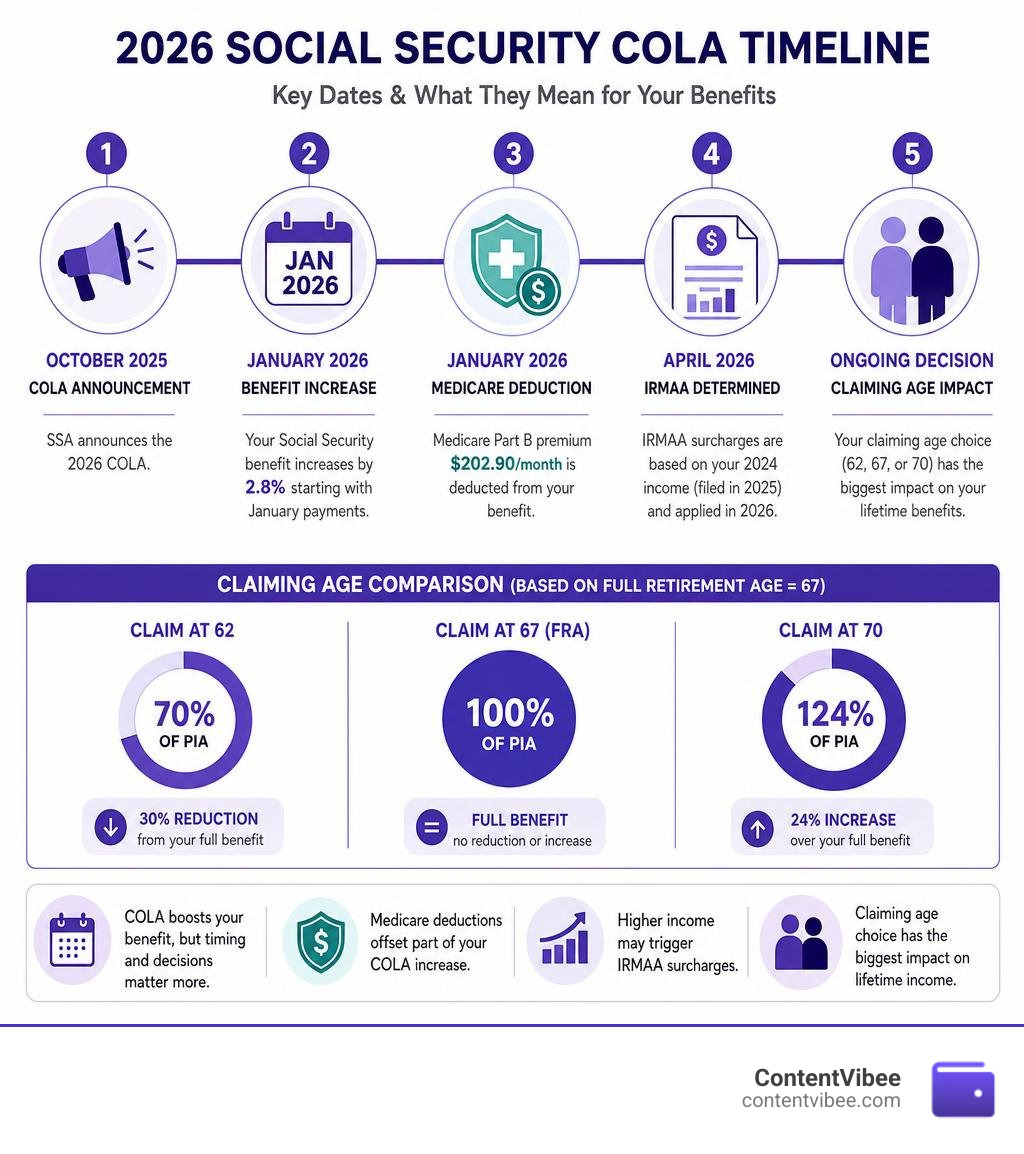
The 2026 COLA Landscape: Numbers, Math, and the CPI-W Debate
For the year 2026, the Social Security Administration announced a 2.8% Cost-of-Living Adjustment (COLA). While this is a step up from the 2.5% adjustment we saw in 2025, it remains well below the historical average of 3.7% recorded over the past several decades.
For the typical retiree, this 2.8% boost translates into an average monthly increase of approximately $56, bumping the average retired worker’s benefit from roughly $2,015 to $2,071. While an extra $56 a month is certainly welcome, it is hardly life-altering in an economy where basic necessities remain stubbornly expensive.
How the Math Works Behind the Scenes
To understand why the COLA lands where it does, we have to look at the formula. The annual adjustment is calculated using the Consumer Price Index for Urban Wage Earners and Clerical Workers (CPI-W). The Social Security Administration compares the average CPI-W data from the third quarter (July, August, and September) of the current year against the third quarter of the prior year. If you want to dive into the technical details, you can view the Official SSA COLA Announcement.
While this math is highly systematic, many senior advocates and economists argue that the formula itself is fundamentally flawed.
The Senior Spending Mismatch
The core issue with using the CPI-W is that it tracks the spending habits of working-class, urban households—people who spend heavily on technology, transportation, and education. It does not accurately reflect how retirees actually spend their money.
Older Americans spend a disproportionate amount of their income on:
- Healthcare and Prescription Drugs: Out-of-pocket medical costs consistently rise faster than general inflation.
- Housing and Rent: Rent and property taxes have surged, hitting fixed-income seniors especially hard.
- Home Energy and Utilities: Heating and cooling costs represent a larger slice of a senior’s household budget.
Because of this mismatch, organization leaders at the National Council on Aging (NCOA) have pointed out that a 4% adjustment would far better reflect the actual cost increases seniors are experiencing. According to research, nearly 45% of older-adult households (roughly 19 million families) lack the income to cover basic daily living costs. Furthermore, 80% of senior households simply cannot weather a major financial shock, such as an unexpected medical emergency or major home repair.
This economic reality is even more pronounced along demographic lines, with 43% of Black adults and 44% of Hispanic adults aged 65 and over living with incomes below 200% of the federal poverty line. When the annual COLA fails to keep pace with real-world senior expenses, it quietly erodes the purchasing power of those who rely on it most.
Claiming at 62, 67, or 70: Social Security COLA & Benefit Optimization 2026
When it comes to Social Security COLA & Benefit Optimization 2026, the absolute most powerful lever you control is your claiming age.
With the final transition of the Full Retirement Age (FRA) now fully phased in, anyone born in 1960 or later has an FRA of 67. If you choose to claim your benefits before this milestone, you face steep, permanent penalties. If you delay past this milestone, you are rewarded with guaranteed, compounding growth.
The Claiming Age Trade-Offs at a Glance
Let’s look at how your choice of claiming age permanently reshapes your Primary Insurance Amount (PIA)—the base benefit you are entitled to at your Full Retirement Age:
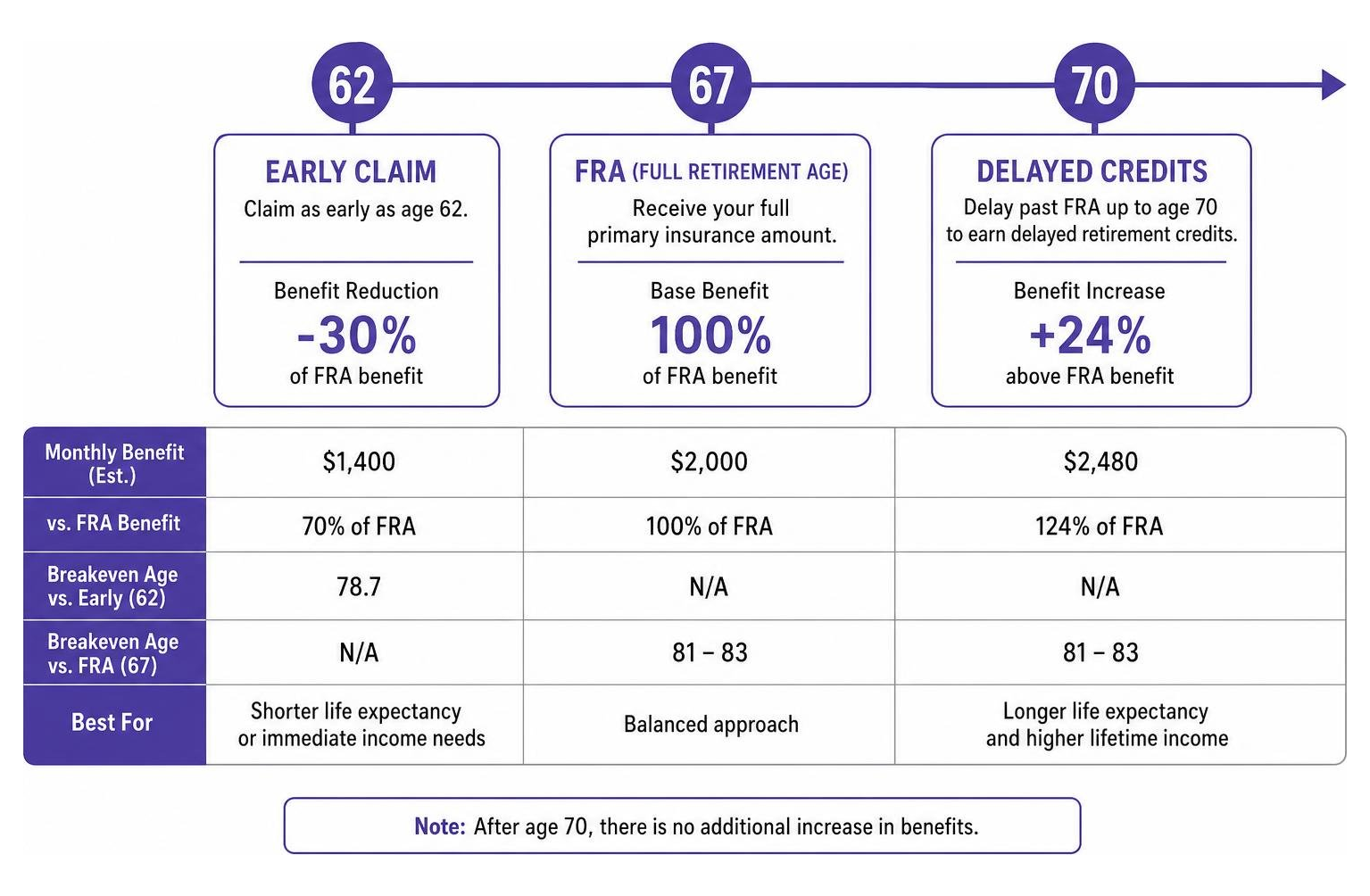
- Claiming at Age 62: If your FRA is 67 and you file as early as possible at age 62, your monthly check is permanently slashed by 30%. You get more checks over your lifetime, but each one is significantly smaller.
- Claiming at Full Retirement Age (67): You receive exactly 100% of your earned benefit.
- Claiming at Age 70: By waiting past your FRA, you earn Delayed Retirement Credits (DRCs) worth 8% per year (compounded monthly) up to age 70. This results in a permanent 24% increase above your base benefit. There is no benefit to waiting past age 70.
The Compounding COLA Multiplier Effect
Many people do not realize that the annual COLA is applied to your benefit even if you haven’t claimed yet. Once you turn 62, your future benefit is adjusted for inflation each year.
However, when you delay claiming, the annual COLA percentage is applied to a much larger base. A 2.8% COLA on a $1,500 early-retirement benefit adds $42 a month. That same 2.8% COLA applied to a delayed $2,600 benefit adds nearly $73 a month. Over a 20-to-30-year retirement, this compounding effect creates a massive wealth gap.
The table below illustrates the math for an individual with a base PIA of $2,000 at an FRA of 67, comparing cumulative payouts as they age:
| Age | Monthly Benefit (Est.) | Cumulative Payout by Age 75 | Cumulative Payout by Age 85 | Cumulative Payout by Age 90 |
|---|---|---|---|---|
| 62 (Early) | $1,400 | $218,400 | $386,400 | $470,400 |
| 67 (FRA) | $2,000 | $192,000 | $432,000 | $552,000 |
| 70 (Delayed) | $2,480 | $148,800 | $446,400 | $595,200 |
Note: For simplicity, this illustrative table uses fixed 2026 benefit baselines without factoring in future annual COLA compounding, which would widen the gap in favor of delaying even further.
Running the Breakeven Analysis
The math shows that the “breakeven age”—the point at which the total lifetime benefits of delaying surpass the total benefits of claiming early—typically lands between ages 78 and 82.
- If you claim at 62 instead of 67, your breakeven age is roughly 78.7. If you live past this age, claiming at 62 was the financially suboptimal choice.
- If you compare claiming at 67 versus delaying to 70, the breakeven point is roughly 81 to 83.
Given that the average American woman reaching age 62 is projected to live to approximately 86, and the average man to 84, the odds are statistically in favor of delaying your claim if your health and financial circumstances allow.
Strategic Playbook: Maximizing Payouts Before and After Claiming
Optimizing your retirement income requires a coordinated strategy. It is not just about picking an age on a calendar; it is about looking at your household’s entire financial picture.
Pre-Claiming Strategies for Social Security COLA & Benefit Optimization 2026
Before you submit your application to the Social Security Administration, implement these high-impact optimization tactics:
1. Audit and Maximize Your 35-Year Earnings History
Your Social Security benefit is calculated using your highest 35 years of inflation-adjusted indexed earnings. If you work fewer than 35 years, the SSA averages in “zero” years, which severely drags down your monthly benefit. If you are near retirement and have several low-earning years on your record, working just a few more years can replace those low-earning or zero-earning years, boosting your base benefit.
2. Coordinate Spousal Benefits
Under Social Security rules, a lower-earning spouse can claim a spousal benefit worth up to 50% of the higher-earning spouse’s PIA (if claimed at their own FRA). The lower-earning spouse can claim their own retirement benefit early, allowing the higher-earning spouse’s benefit to delay and grow at 8% per year up to age 70.
Note: Spousal benefits do not earn Delayed Retirement Credits past FRA, so there is no advantage to waiting past FRA to claim a spousal benefit.
3. Prioritize Survivor Benefit Protection
This is the most frequently overlooked aspect of retirement planning. When one member of a married couple passes away, the smaller of the two monthly Social Security checks disappears, and the surviving spouse inherits the larger check.
For couples, the higher-earning spouse has a nearly unambiguous mandate to delay claiming until age 70. By doing so, they maximize the permanent survivor benefit floor, protecting the surviving spouse from a severe drop in household income later in life.
4. Leverage Divorced Spouse Rules
If you were married for at least 10 years, have been divorced for at least 2 consecutive years, and are currently unmarried, you may be eligible to claim benefits based on your ex-spouse’s earnings record. Your ex-spouse must be at least 62, but they do not need to have claimed their own benefit yet for you to file. Best of all, claiming a divorced spouse benefit has absolutely zero impact on your ex-spouse’s benefit or their current spouse’s benefits.
To accurately model these options, avoid using basic online “quick calculators.” Instead, utilize advanced household-level optimization tools that model joint life expectancies and spousal coordination.
Post-Claiming Adjustments and Social Security COLA & Benefit Optimization 2026
If you have already claimed your benefits, or if you must claim early due to immediate cash flow needs, you still have strategic moves available:
1. Navigating the Earnings Test Limits
If you claim early and continue to work, your benefits may be temporarily withheld if your earnings exceed annual thresholds. For 2026, the limits are:
- Under Full Retirement Age: The limit is $24,480. For every $2 you earn above this limit, the SSA will withhold $1 in benefits.
- Reaching FRA in 2026: The limit is $65,160 for the months leading up to your birthday. For every $3 you earn above this limit, the SSA will withhold $1.
- Once You Reach FRA: The earnings test disappears entirely. There is no limit on how much you can earn, and no benefits are withheld.
It is vital to know that withheld benefits are not permanently lost. Once you reach your Full Retirement Age, the SSA automatically recalculates your monthly benefit upward to account for the months benefits were withheld, allowing you to recover those funds over time.
2. The 12-Month “Do-Over” Window (Form SSA-521)
If you claimed your benefits early and regret the decision, you have a one-time opportunity to hit the reset button. Within 12 months of your initial claiming date, you can file Form SSA-521 to withdraw your application. You must repay every dollar you (and your family members) received in benefits. Once completed, your benefit will continue to grow as if you had never filed, allowing you to claim a much higher, optimized payout later.
High-Net-Worth Strategies: Wage Base, Taxes, and Medicare Integration
For high-net-worth (HNW) individuals, Social Security optimization is less about monthly cash flow and more about tax diversification, Medicare premium management, and portfolio longevity.

The Rising Wage Base and Maximum Benefit
In 2026, the maximum taxable earnings limit—the Social Security wage base—rises to $184,500 (up from $176,100 in 2025). High earners will pay 6.2% in FICA taxes up to this cap, representing an additional maximum tax of $520.80 per employee ($1,041.60 for the self-employed).
Consequently, the maximum projected Social Security benefit at Full Retirement Age in 2026 rises to $4,152 per month. To secure this maximum check, you must have earned at or above the taxable maximum wage base for at least 35 years of your working career.
The Medicare Premium and IRMAA Trap
Your net Social Security check is directly impacted by Medicare Part B premiums, which are deducted automatically. For 2026, the standard Part B premium rises to $202.90 per month.
However, high-income retirees face the Income-Related Monthly Adjustment Amount (IRMAA) surcharges. These surcharges are based on your Modified Adjusted Gross Income (MAGI) from two years prior (meaning your 2026 premiums are determined by your 2024 tax return).
The 2026 IRMAA brackets start at:
- Single Filers: $109,000 MAGI
- Married Filing Jointly: $218,000 MAGI
If your income crosses these thresholds by even a single dollar, your monthly Medicare Part B premium can skyrocket, easily swallowing up your entire 2.8% COLA increase.
Strategic Tax Planning: Roth Conversions and the OBBBA Deduction
To protect your Social Security benefits from being heavily taxed and to avoid IRMAA surcharges, HNW individuals should employ active tax-bracket management:
- Execute Strategic Roth Conversions: By converting traditional tax-deferred IRA assets to a Roth IRA during the “gap years” between retirement and age 73 (when Required Minimum Distributions begin), you can generate tax-free income streams for the future. Because Roth withdrawals do not count toward your MAGI, they help keep you below IRMAA thresholds and reduce the “provisional income” that triggers federal taxation on up to 85% of your Social Security benefits.
- Utilize the OBBBA Deduction: In 2026, eligible taxpayers can leverage the temporary $6,000 individual ($12,000 joint) deduction to strategically lower their adjusted gross income, keeping them safely under key tax and Medicare premium thresholds.
Long-Term Solvency and Planning for Future COLA Uncertainty
No discussion of Social Security is complete without addressing the elephant in the room: the program’s long-term solvency.
According to the latest trustees’ reports, Social Security’s Old-Age and Survivors Insurance (OASI) Trust Fund is projected to deplete its reserves in 2032. If Congress fails to act before then, incoming payroll tax revenues will only be sufficient to pay 83% of scheduled benefits, eventually declining to 64% by the year 2100.
Potential Legislative Reforms on the Horizon
To close the actuarial deficit, lawmakers are actively debating several reform packages, which may include:
- Gradually raising the Full Retirement Age past 67.
- Increasing the payroll tax rate or raising the taxable wage base cap.
- Modifying the COLA formula (for example, switching to the “Chained CPI,” which generally yields lower annual increases).
- Reducing benefits for ultra-high-net-worth retirees through means-testing.
How to Plan Around Trust Fund Uncertainty
While these headlines can cause anxiety, they should not drive you to claim benefits early out of fear. Even in a worst-case scenario where benefits are cut by 20% in the 2030s, delaying your claim to age 70 to secure a 124% benefit baseline still yields a far higher lifetime payout than locking in a permanently reduced 70% benefit at age 62.
The smartest approach is to treat Social Security as a guaranteed, inflation-adjusted baseline for your fixed costs, while maintaining a diversified personal portfolio—including equities, real estate, and inflation-hedged assets—to absorb any future policy shifts.
Frequently Asked Questions About 2026 Social Security Rules
How does the 2026 earnings test affect my benefits if I work part-time?
If you are under your Full Retirement Age for the entirety of 2026, you can earn up to $24,480 without penalty. If your earnings exceed this limit, the SSA will withhold $1 for every $2 earned above the threshold. If you reach your FRA in 2026, the limit rises to $65,160, with a withholding rate of $1 for every $3 earned above the limit. Once you hit your FRA birthday, the earnings test no longer applies, and your monthly benefit will be recalculated upward to credit you for any withheld payments.
Does delaying past age 70 continue to increase my monthly payout?
No. Delayed Retirement Credits stop accumulating once you reach your 70th birthday. There is absolutely no financial benefit to delaying your claim past age 70. If you wait past 70, you are simply leaving money on the table.
How do Medicare Part B premiums impact my net 2026 COLA increase?
Because Medicare Part B premiums are deducted directly from your monthly Social Security check, any premium increase directly offsets your COLA raise. In 2026, the standard Part B premium rises to $202.90 per month. For a retiree receiving the average $56 monthly COLA increase, a portion of that raise will go directly toward paying the higher Medicare premium, reducing the net amount of extra cash in their pocket.
Conclusion
Maximizing your retirement income is not about reacting to short-term headlines or annual COLA percentages. It requires a disciplined, step-by-step approach tailored to your household’s unique needs. At ContentVibee, we believe in delivering clear, actionable step-by-step financial advice to help you build lasting financial security.
Before you make your final claiming decision, run through this quick optimization checklist:
- [ ] Log into your “my Social Security” account to verify your 35-year earnings record.
- [ ] Calculate your personal breakeven ages based on your health and family longevity history.
- [ ] Coordinate with your spouse to maximize survivor and spousal benefit protections.
- [ ] Map out a tax-efficient withdrawal strategy, coordinating your Social Security timeline with Roth conversions and Medicare IRMAA thresholds.
Ready to take control of your financial future? Optimize your retirement strategy with ContentVibee’s comprehensive guide and build a retirement income stream that you can never outlive.


