


Is There a Strict 401k Rollover Deadline After Leaving Your Job?
The 401k rollover deadline is one of the most misunderstood rules in retirement planning — and getting it wrong can cost you thousands in taxes and penalties.
Here’s the quick answer most people need:
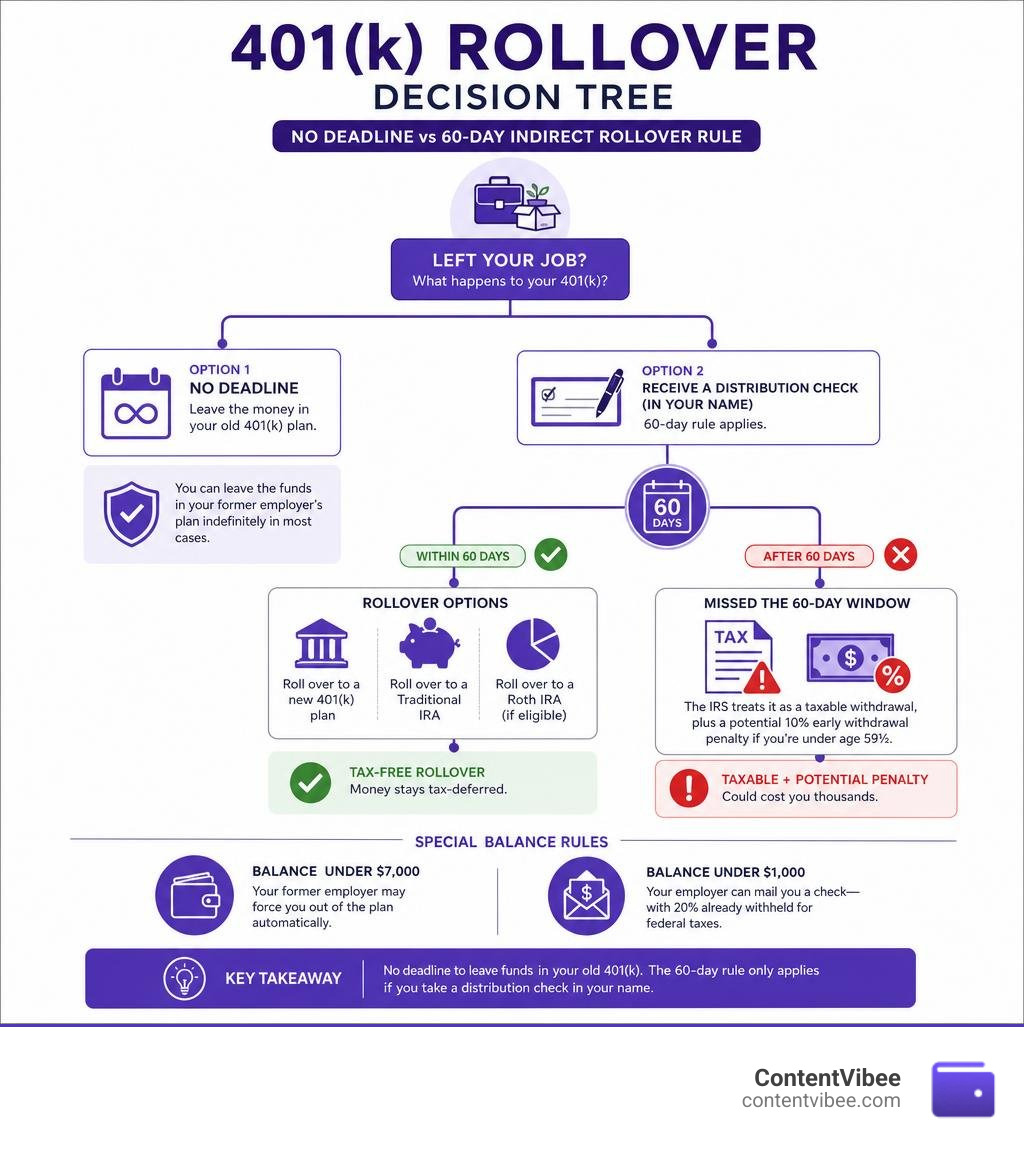
- There is no strict deadline to roll over a 401(k) after leaving a job — you can leave funds in your old plan indefinitely in most cases.
- The 60-day rule applies only if you receive a distribution check directly in your name (an indirect rollover).
- If your balance is under $7,000, your former employer may force you out of the plan automatically.
- If your balance is under $1,000, your employer can mail you a check — with 20% already withheld for federal taxes.
- Miss the 60-day window on an indirect rollover and the IRS treats it as a taxable withdrawal, plus a potential 10% early withdrawal penalty if you’re under age 59½.
The stakes are real. Over 29 million 401(k) accounts have been left behind or forgotten by workers — and many of those account holders had no idea what their options were or how the timing rules worked.
Whether you just quit, got laid off, or are simply finally dealing with an old account from years ago, understanding these rules now can protect your retirement savings from an unnecessary tax hit.
When you pack up your desk and say goodbye to an employer, you might feel a sudden rush of panic about your retirement account. Do you have to move the money immediately? Will your account be locked?
The good news is that, from a strictly regulatory perspective, there is no IRS-mandated deadline to roll over a 401(k) after leaving a job. As long as your account balance is large enough, you can generally leave your retirement nest egg sitting in your former employer’s plan for years, or even decades, without facing tax consequences.
However, “no IRS deadline” does not mean “no rules at all.” Your former employer’s plan administrator has their own set of guidelines, and federal law allows them to take action if your account balance is relatively small.
Thanks to the SECURE 2.0 Act, the rules around these “force-out distributions” became more flexible for employers, but more urgent for savers. Under current rules, the force-out thresholds work as follows:
- Balances over $7,000: If your vested 401(k) balance is $7,000 or more, your former employer cannot force you out of the plan. You can leave the money exactly where it is indefinitely.
- Balances between $1,000 and $7,000: If your balance falls into this range, your former employer has the right to automatically remove you from the plan. However, they cannot simply cash you out. Instead, they must automatically roll your funds into an Individual Retirement Account (IRA) established on your behalf.
- Balances under $1,000: For very small balances, the employer can choose to close the account and write you a check directly. This is treated as a taxable distribution, and the plan will automatically withhold 20% for federal taxes.
For more details on how the IRS views these plan distributions, you can review the official guidance on Topic no. 413, Rollovers from retirement plans | Internal Revenue Service.

The 60-Day 401k Rollover Deadline: Direct vs. Indirect Transfers
While you don’t face a ticking clock while your money remains safely inside your old 401(k) plan, a very strict clock starts the moment those funds leave the plan. This is where many retirement savers accidentally trigger massive tax bills.
The IRS distinguishes between two primary ways of moving your retirement funds: a direct rollover and an indirect rollover.
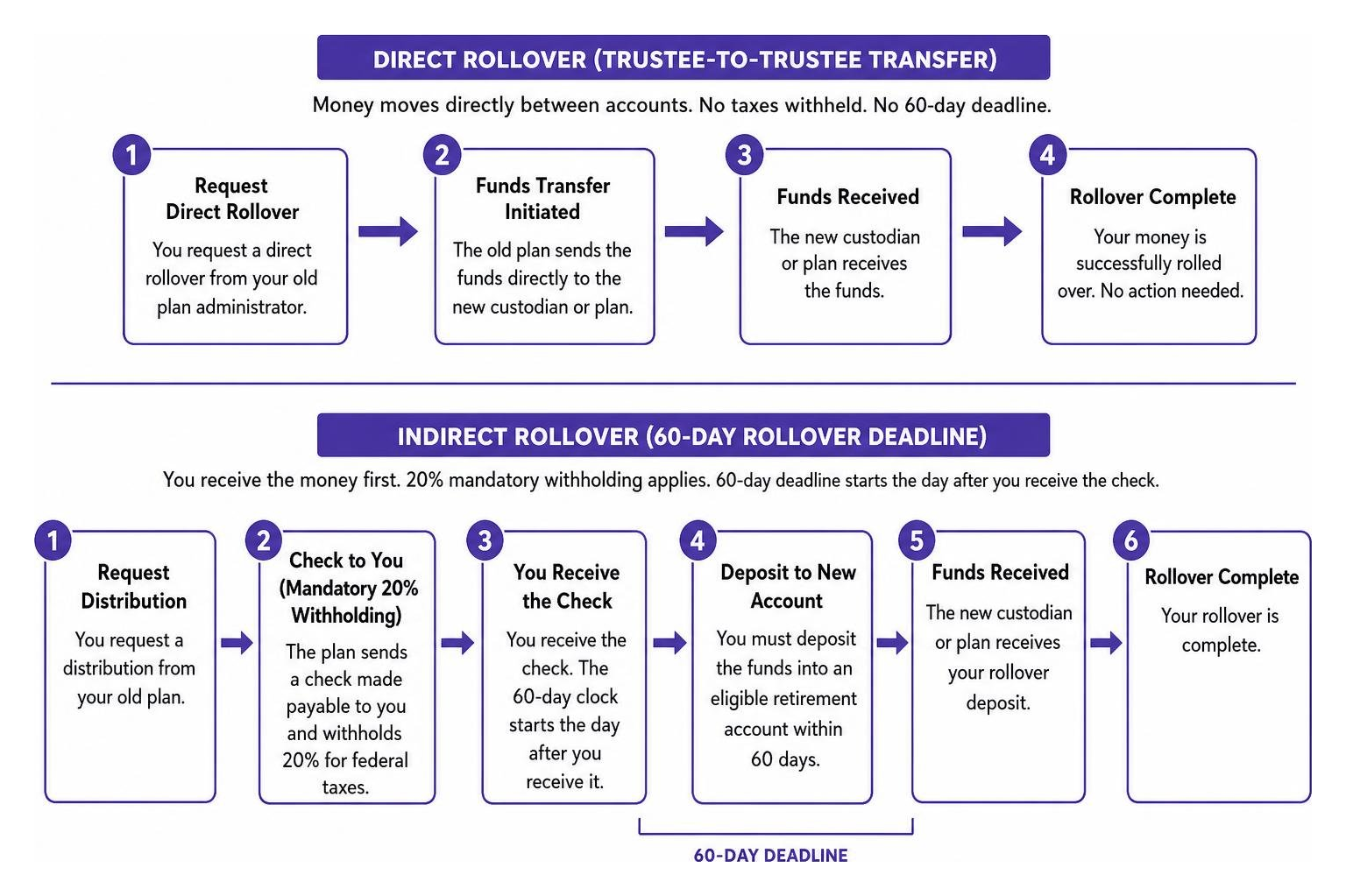
A direct rollover (often called a trustee-to-trustee transfer) occurs when your money moves directly from your old 401(k) provider to your new IRA custodian or your new employer’s 401(k) plan. The money never touches your personal bank account.
An indirect rollover, on the other hand, occurs when the old plan administrator writes a check made out directly to you. You cash or deposit the check, and then you must manually deposit those funds into another qualified retirement account.
The moment you receive that check, the 60-day rollover deadline begins.

According to the IRS, you have exactly 60 days from the date you receive an IRA or retirement plan distribution to roll it over to another plan or IRA. The 60-day clock starts the day after you receive the check, not the date the check was mailed.
Furthermore, you are generally limited to only one indirect rollover per 12-month period across all of your IRAs. This is known as the one-rollover-per-year rule, and violating it can result in heavy tax penalties.
To understand the full scope of these timing rules, you can refer to the official IRS breakdown of Rollovers of retirement plan and IRA distributions | Internal Revenue Service.
How the 401k Rollover Deadline Applies to Indirect Rollovers
If you choose or are forced into an indirect rollover, you must navigate the IRS’s mandatory tax withholding rules. This is where things get mathematically tricky.
When a workplace retirement plan distributes funds directly to you, the plan administrator is legally required to perform a mandatory withholding of 20% for federal income taxes, even if you tell them you intend to roll the money over later.
Let’s look at a real-world example to see how this works:
Suppose you have $50,000 in an old 401(k) and request an indirect rollover. The plan administrator will automatically withhold 20% ($10,000) for federal taxes and mail you a check for $40,000.
To complete a tax-free rollover and avoid penalties, you must deposit the full pre-withheld amount of $50,000 into your new retirement account within 60 days.
This means you must come up with $10,000 of your own out-of-pocket money to make up for the withheld taxes. When you file your federal tax return for the year, the $10,000 withheld will be credited back to you as taxes paid, but you must have the liquidity to cover that gap within the 60-day window.
If you only deposit the $40,000 check you received:
- The IRS will treat the $40,000 as a successful rollover (no taxes or penalties on this portion).
- The remaining $10,000 will be treated as a permanent, taxable distribution.
- You will owe ordinary income taxes on that $10,000.
- If you are under age 59½, you will also owe a 10% early withdrawal penalty ($1,000) on that portion.
Avoiding the 401k Rollover Deadline with Direct Transfers
If the indirect rollover process sounds like a high-wire act, that’s because it is. Fortunately, you can bypass the 60-day clock, the 20% tax withholding, and the one-rollover-per-year limit entirely by opting for a direct rollover.
In a direct rollover, you instruct your old plan administrator to send the funds directly to your new IRA custodian or new 401(k) provider.
Even if the old provider insists on mailing a physical check, they will make it payable directly to the new custodian for your benefit (for example: “Fidelity FBO [Your Name]” or “Vanguard FBO [Your Name]”). Because the check is not made payable to you personally, it does not count as a distribution to you.
With a direct transfer:
- There is zero tax withholding (100% of your balance moves to the new account).
- There is no 60-day deadline pressure (though you should still deposit the check promptly to get your money back into the market).
- There is no penalty risk.
- There is no annual limit on how many direct transfers you can perform.
What Happens If You Miss the 60-Day Rollover Window?
Life happens. Sometimes checks get lost in the mail, family emergencies strike, or you simply lose track of the calendar. But if you miss the 60-day rollover deadline on an indirect distribution, the consequences are swift and expensive.
The moment the 60th day passes without the funds being deposited into a qualified retirement account, the transaction is officially classified as a taxable distribution.
Here is what happens next:
- Ordinary Income Tax: The entire pre-tax amount of the distribution will be added to your taxable income for the year. Depending on your tax bracket, this could push you into a much higher tax tier.
- The 10% Early Withdrawal Penalty: If you are under the age of 59½, the IRS will assess an additional 10% penalty on the taxable portion of the distribution.
- State Income Taxes: In addition to federal taxes, your state may also tax the distribution and levy its own early withdrawal penalties.
- Tax Reporting Hassles: Your old plan administrator will issue a Form 1099-R in January of the following year, reporting the distribution to the IRS. You will have to report this on your Form 1040, and if you cannot prove the rollover was completed on time, you will have to pay the taxes and penalties due.
IRS Waivers and Exceptions for a Missed Rollover Deadline
If you have already missed the 60-day deadline, do not despair just yet. The IRS recognizes that circumstances beyond your control can interfere with financial transactions. There are three primary ways to secure a waiver of the 60-day rollover requirement:
1. The Automatic Waiver
You may qualify for an automatic waiver if a financial institution makes an error. To qualify:
- The funds must have been delivered to the financial institution within the 60-day window.
- You must have followed all of the institution’s procedures for depositing the funds into a retirement account.
- The delay must be entirely due to the institution’s error (e.g., they deposited the money into a regular brokerage account instead of an IRA).
- The error must be corrected within one year from the start of the 60-day period.
2. Self-Certification
Under Revenue Procedure 2016-47 and 2020-46, the IRS allows you to self-certify that you qualify for a waiver if your delay was caused by specific, qualifying events. You can submit a written self-certification letter (the IRS provides a Model Letter for this purpose) to your new financial institution when you deposit the late funds.
Qualifying reasons for self-certification include:
- An error committed by the distributing or receiving financial institution.
- A misplaced check that was never cashed.
- Severe damage to your primary residence.
- A death or serious illness in your immediate family.
- Incarceration or severe postal delays.
- Restrictions imposed by a foreign country.
You must deposit the funds into the new retirement account as soon as practicable after the issue is resolved (usually within 30 days). That while self-certification allows the bank to accept the late deposit, the IRS can still audit your return and deny the waiver if they find your claim was invalid.
3. Private Letter Ruling (PLR)
If you do not meet the strict requirements for an automatic waiver or self-certification, your final option is to apply directly to the IRS for a Private Letter Ruling.
Be warned: this is a formal, highly technical legal request. The IRS charges a non-refundable user fee of $10,000 just to review your application, and you will likely need to hire a tax professional to write the request. This option only makes financial sense for very large account balances.
For more information on these processes, consult the Retirement plans FAQs relating to waivers of the 60-day rollover requirement | Internal Revenue Service.
Four Options for Your Old 401(k) Account
When you leave an employer, you have four main paths to choose from. Each has distinct advantages and disadvantages depending on your financial goals, age, and investment preferences.
| Option | Pros | Cons | Best For |
|---|---|---|---|
| 1. Leave it in your old plan | • Strong federal ERISA creditor protection • No immediate action required • Access to unique institutional funds | • Subject to plan fees and limited investment options • Risk of forgetting the account • No new contributions allowed | Savers with low-fee, high-performing plans who want to take their time deciding on a long-term strategy. |
| 2. Roll to an IRA (Traditional or Roth) | • Maximum investment flexibility • Ability to consolidate multiple accounts • Easier to convert to Roth over time | • Weaker creditor protection in some states compared to ERISA • Cannot use the “Rule of 55” penalty exception | Savers looking for lower fees, better investment selection, and simplified account management. |
| 3. Roll to a new employer 401(k) | • Keeps retirement funds consolidated in one place • Preserves ERISA creditor protection • May allow for 401(k) loans | • Subject to the new plan’s fees and investment limits • Not all employer plans accept incoming rollovers | Active workers who want to simplify their accounts and maintain strong asset protection. |
| 4. Cash out (Take a distribution) | • Immediate access to cash | • Subject to ordinary income taxes • 10% early withdrawal penalty if under age 59½ • Steals from your future self | Only for extreme, unavoidable financial emergencies. |
Key Considerations for Your Decision:
- The Rule of 55: If you leave your job in or after the year you turn 55, the IRS allows you to take penalty-free withdrawals from that specific employer’s 401(k) plan. If you roll those funds into an IRA, you lose this privilege and must wait until age 59½ to access the money penalty-free.
- Creditor Protection: 401(k) plans are protected by federal ERISA laws, which shield your assets from bankruptcy, lawsuits, and creditors. IRAs are protected up to certain limits in bankruptcy, but general creditor protection varies widely by state.
- Investment Fees: Always compare the expense ratios of the mutual funds in your workplace plan against those available in a self-directed IRA. High administrative fees can quietly eat away at your returns over time.
Frequently Asked Questions About 401(k) Rollovers
What types of distributions are ineligible for a 401(k) rollover?
Not all money coming out of a retirement plan can be rolled over. The IRS explicitly prohibits you from rolling over:
- Required Minimum Distributions (RMDs): Once you reach age 73, you must take annual RMDs, and these funds cannot be rolled over to avoid taxes.
- Hardship Withdrawals: Distributions taken to cover immediate, heavy financial needs are ineligible for rollover.
- Corrective Distributions: Refunds of excess contributions made to pass non-discrimination testing cannot be rolled over.
- 401(k) Loans: If you default on an outstanding loan after leaving your job, the unpaid balance is treated as a taxable distribution, not an eligible rollover amount.
Does the one-rollover-per-year rule apply to 401(k) to IRA transfers?
No. The one-rollover-per-year limit applies strictly to indirect, IRA-to-IRA rollovers. It does not apply to:
- Workplace plan-to-IRA rollovers (such as moving a 401(k) to a traditional IRA).
- Workplace plan-to-plan transfers.
- Direct trustee-to-trustee transfers of any kind.
- Roth conversions.
How long does the actual 401(k) rollover process take?
The entire sequential timeline typically takes between 7 and 21 business days from start to finish.
- Decide and Open Account (Days 1–3): You select your new custodian and open the receiving account.
- Submit Request (Days 3–5): You contact your old plan administrator to initiate the transfer.
- Processing (Days 5–15): The administrator processes the request, liquidates your holdings, and issues a wire transfer or mails a physical check.
- Posting and Investing (Days 15–21): The new custodian receives the funds, posts them to your account, and you manually select your new investments.
Conclusion
Navigating your 401k rollover deadline doesn’t have to be a stressful experience. As long as you understand the difference between a direct and indirect transfer, you can easily protect your hard-earned savings from unnecessary taxes and early withdrawal penalties.
The safest, simplest, and most stress-free route is almost always a direct rollover. By moving your funds directly from custodian to custodian, you bypass the 60-day clock entirely and keep your retirement strategy on solid ground.
At ContentVibee, we believe that clear, step-by-step financial education is the key to building a secure financial future. Keeping a close eye on retirement timelines ensures you never lose a cent of what you’ve earned.
Take control of your old retirement accounts today, choose the path that fits your long-term goals, and keep your money growing for the years to come.