


What You Need to Know About SSDI Spousal Benefits
SSDI spousal benefits allow the husband or wife of a disabled worker to receive monthly Social Security payments — even if they never worked a day in their life.
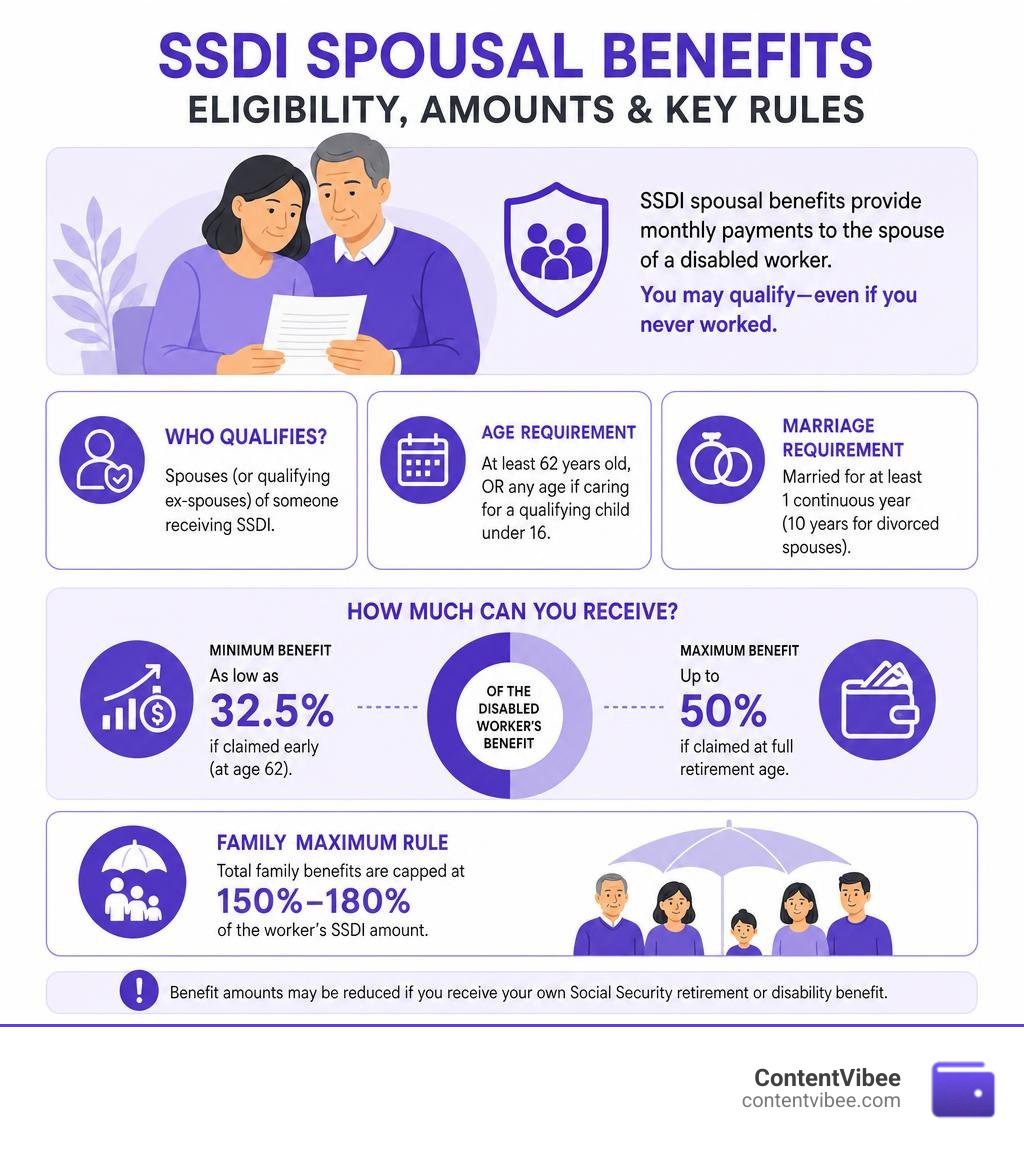
Here’s a quick summary of who qualifies and what they can get:
- Who qualifies: Spouses (or qualifying ex-spouses) of someone receiving Social Security Disability Insurance (SSDI)
- Age requirement: At least 62 years old, OR any age if caring for a qualifying child under 16
- Marriage requirement: Married for at least 1 continuous year (10 years for divorced spouses)
- Maximum benefit: Up to 50% of the disabled worker’s benefit if claimed at full retirement age
- Minimum benefit: As low as 32.5% if claimed early (at age 62)
- Family maximum: Total family benefits are capped at 150%–180% of the worker’s SSDI amount
Many spouses don’t realize this benefit exists. Others assume they don’t qualify because they have their own work history. But even if you’ve worked your whole life, you may still be entitled to a spousal top-up payment.
This guide walks you through exactly how to qualify, how much you can expect, and how to apply — step by step.
Glossary for ssdi spousal benefits:
Understanding SSDI Spousal Benefits and Basic Eligibility

When a worker qualifies for Social Security Disability Insurance (SSDI), the financial impact of their disability ripples through the entire household. Fortunately, the Social Security Administration (SSA) recognizes this and provides financial support for family members too.
According to the official SSA definitions and requirements, the spouse of an entitled disabled worker (often called the “number holder” or NH in legal terms) can receive monthly benefits based on that worker’s earnings record. These are known as ssdi spousal benefits.
To qualify as a spouse under SSA rules, you must meet one of the following criteria:
- You are legally married to the disabled worker under the laws of the state where the worker lives.
- You have the same rights as a husband or wife to inherit the worker’s intestate personal property (personal property if they died without a will).
- You are considered a “deemed spouse,” meaning you entered into a marriage ceremony in good faith that would have been valid if a legal impediment (like an administrative error in a previous divorce) hadn’t existed.
Understanding how Social Security spousal benefits work for married couples is the first step toward securing this essential piece of your family’s financial puzzle.
Age and Marriage Duration Requirements
To collect ssdi spousal benefits as a current spouse, you must meet specific age and marriage duration milestones:
- The One-Year Marriage Rule: You must generally be married to the disabled worker for at least one continuous year before filing your application. However, this requirement can be waived if you are the natural parent of the worker’s child, or if you were eligible for certain other Social Security benefits (like survivor or parent benefits) in the month before you married.
- The Age 62 Threshold: You must be at least 62 years old to claim these benefits. If you claim before your Full Retirement Age (FRA), your monthly payment will be permanently reduced.
- The Child-in-Care Exception: If you are caring for a qualifying child of the disabled worker, the age 62 requirement is completely waived. A qualifying child is one who is under the age of 16 or who has a disability that began before age 22. In this scenario, you can receive unreduced spousal benefits at any age until the child turns 16 or their disability status changes.
If you are wondering about the perfect age to file, check out our guide on at what age can I claim my spouse’s Social Security to understand how your age impacts your long-term payout.
Divorced Spouses and the 10-Year Rule
Can you claim benefits if you are no longer married? Yes! Divorced spouses are often eligible to receive ssdi spousal benefits on their ex-partner’s record. This is a crucial safety net for individuals who spent years supporting a partner and may have sacrificed their own career progression.
To qualify as a divorced spouse, you must meet the following strict criteria:
- The 10-Year Marriage Rule: Your marriage to the disabled worker must have lasted for at least 10 consecutive years before the divorce was finalized.
- The Remarriage Rule: You must currently be unmarried. If you remarry, you generally lose eligibility for benefits on your ex-spouse’s record (unless your subsequent marriage ends in death, divorce, or annulment).
- Age Requirement: You must be at least 62 years old.
- Independence of Claim: Your ex-spouse must be entitled to SSDI benefits. However, unlike a current spouse, an independently entitled divorced spouse can claim benefits even if the disabled worker has not yet filed for their own benefits, provided the divorce has been final for at least two consecutive years.
For a deep dive into how these rules play out, read about how the ten year marriage rule affects your divorced spousal benefits. Rest assured, claiming these benefits will not impact your ex-spouse’s monthly payment or any benefits their current spouse might receive. For more detail, read our article: can you claim your ex’s Social Security.
How Spousal Benefit Amounts Are Calculated
The maximum amount a spouse can receive is 50% of the disabled worker’s Primary Insurance Amount (PIA). The PIA is the base monthly benefit the disabled worker is entitled to receive before any adjustments are made.
However, actually getting that full 50% depends heavily on your age when you claim. If you choose to claim early (starting at age 62), the SSA permanently reduces your monthly payment.
Below is a breakdown of how claiming age affects the percentage of the worker’s PIA you will receive:
| Claiming Age | Percentage of Worker’s SSDI Benefit | Reduction Details |
|---|---|---|
| Full Retirement Age (67) | 50.0% | No reduction; maximum possible benefit |
| 66 Years Old | ~45.8% | Slight reduction for early claiming |
| 65 Years Old | ~41.7% | Moderate reduction |
| 64 Years Old | ~37.5% | Significant reduction |
| 63 Years Old | ~35.0% | Heavy reduction |
| 62 Years Old | 32.5% | Maximum reduction; lowest possible benefit |
For more help figuring out your potential monthly income, you can read our guide on determining your spousal Social Security benefit amount.
How to Calculate Your SSDI Spousal Benefits Amount
To calculate the exact amount, we start with the disabled worker’s PIA. According to the SSA spousal benefit payment rules, if you claim at your Full Retirement Age, your base benefit is exactly half of that PIA.
Let’s look at an example:
- Disabled Worker’s PIA: $2,000 per month.
- Spouse’s Full Retirement Age: 67.
- Scenario A (Claiming at age 67): The spouse receives 50% of $2,000, which is $1,000 per month.
- Scenario B (Claiming at age 62): The spouse claims early. The benefit is reduced by a specific formula: 25/36 of 1% for each of the first 36 months before FRA, plus 5/12 of 1% for any additional months. At age 62 in 2026, the benefit is reduced to 32.5% of the PIA. The spouse receives $650 per month instead of $1,000.
This permanent reduction shows why Social Security spousal benefits timing is everything. Waiting even a few years can make a massive difference in your household’s monthly cash flow.
What Can Reduce Your SSDI Spousal Benefits?
Aside from claiming early, there are other factors that can reduce your monthly ssdi spousal benefits:
- The Earnings Test: If you claim spousal benefits before your Full Retirement Age and continue to work, your benefits may be temporarily reduced if your earnings exceed the annual limit set by the SSA.
- Government Pension Offset (GPO): If you receive a pension from a federal, state, or local government job where you did not pay Social Security taxes, your spousal benefit may be reduced by two-thirds of the amount of your government pension.
- Family Maximum Caps: If multiple family members (like children) are claiming benefits on the same worker’s record, the total family payout might exceed the allowed limit, forcing a reduction in individual payments.
To make sure you aren’t leaving money on the table, review our strategies on maximizing spousal benefits without leaving money on the table. You can also read the SSA’s official blog post to see if you qualify for Social Security spouse’s benefits.
Dual Entitlement and the Family Maximum Limit

When managing a household budget on disability income, you must understand how different Social Security benefits interact. The SSA has strict rules to prevent “double-dipping,” but they also have protections in place to ensure you get the maximum amount you are legally entitled to.
Navigating these rules requires a clear strategy. For a comprehensive overview of managing these benefits together, see the smart couples guide to Social Security strategies.
The Dual Entitlement Rule for Spouses
Many spouses have worked and earned their own Social Security retirement or disability benefits. If this applies to you, you are subject to the Dual Entitlement Rule.
The SSA does not allow you to combine your own retirement benefit and your spousal benefit to receive a double payment. Instead, they apply the higher benefit rule:
- The SSA first calculates and pays your own retirement or disability benefit.
- If your spousal benefit is higher than your own benefit, they will pay you an additional “top-up” amount to make up the difference.
- The total amount you receive will equal the higher of the two benefits.
This process is handled automatically through “deemed filing.” When you apply for either retirement or spousal benefits, you are deemed to be filing for both simultaneously. For a fun and clear breakdown of how this works, read our article double the fun understanding your spousal Social Security benefits.
How the Family Maximum Affects Monthly Payments
While spousal benefits are highly supportive, the SSA caps the total amount of money that can be paid out on a single worker’s record. This cap is known as the Family Maximum Benefit.
For families of disabled workers, the family maximum is typically restricted to a range of 150% to 180% of the worker’s primary disability benefit.
If the combined benefits of the disabled worker, their spouse, and any dependent children exceed this limit, the individual benefits of the family members will be reduced proportionally until the total falls under the cap.
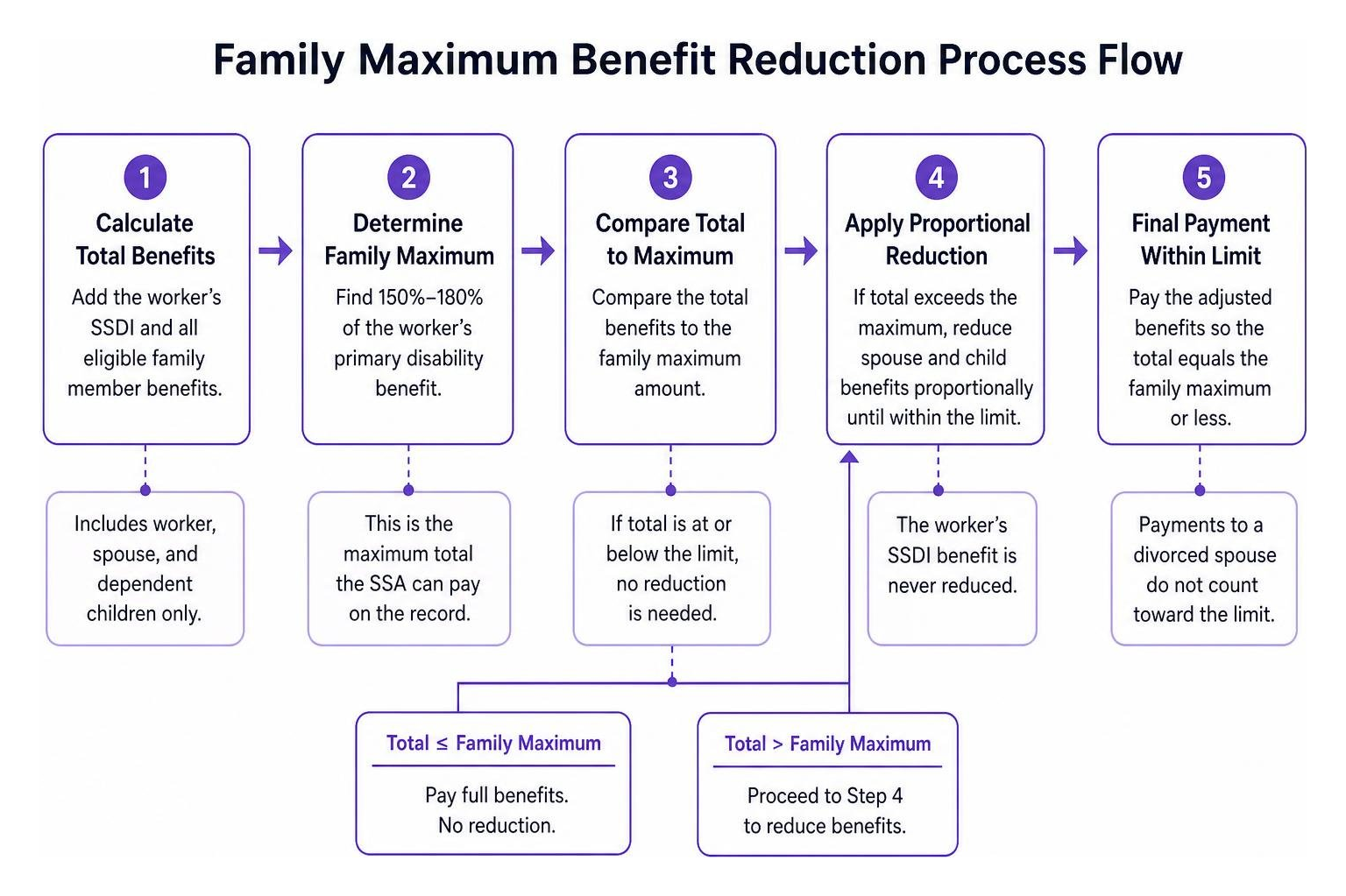
Importantly, the disabled worker’s personal SSDI payment is never reduced. Only the payments to the dependents (spouse and children) are adjusted. Also, benefits paid to a divorced spouse do not count toward the family maximum.
For more details on how to manage these caps as a family, explore double the fun a guide to Social Security spousal benefits for couples.
How to Apply for Spousal Benefits on a Partner’s Record
Applying for ssdi spousal benefits is a straightforward process, but it requires preparation. You can apply:
- Online: Visit the official SSA website (if you are at least 61 years and 9 months old and not currently receiving benefits on your own record).
- By Phone: Call the SSA national toll-free number at 1-800-772-1213.
- In Person: Schedule an appointment at your local Social Security office.
To ensure your application goes smoothly, it helps to understand how to understand spousal benefit eligibility before you initiate the process.
Required Documentation and Evidence
The SSA requires official proof to verify your relationship and eligibility. According to the SSA evidence and forms requirements, you should prepare the following documents:
- Proof of Age: A birth certificate or other official religious or school record.
- Proof of Marriage: An official marriage certificate.
- Proof of Divorce: If you are claiming as a divorced spouse, you must provide your final divorce decree to verify the marriage lasted at least 10 years.
- Children’s Records: If you are claiming under the child-in-care exception, you must provide birth certificates or disability records for the child.
- Financial Records: Recent tax returns or W-2 forms if you worked recently.
Having these documents ready beforehand will prevent processing delays and ensure your family receives support as quickly as possible.
When to File and What to Expect
Knowing when to file can save you from missing out on retroactive payments. The SSA has automated systems, such as the KP Diary outlined in the SSA KP diary detection rules, to identify spouses who may be eligible for Title II spousal benefits when they reach age 62.
Generally, you should apply as soon as your spouse is approved for SSDI and you meet the age or child-in-care requirements. Spousal benefits can sometimes be paid retroactively for up to 12 months before the application date, but they cannot begin before your spouse’s disability entitlement starts.
For a detailed look at the timeline and filing strategies, read our detailed guide to spousal benefits eligibility.
Frequently Asked Questions About Disability Spousal Benefits
Can I receive spousal benefits if I am also disabled?
Yes, but you cannot collect the full amount of both benefits. Under the dual entitlement rules, the SSA will pay your own disability benefit first. If the spousal benefit is higher, you will receive a supplemental payment to bring your total monthly deposit up to the spousal benefit amount.
Does my spousal benefit reduce my partner’s SSDI payment?
No. Your spousal benefit is paid on top of your partner’s benefit. It does not reduce their monthly SSDI payment in any way.
What happens to my spousal benefits if we get divorced?
If you divorce, your spousal benefits will end unless you were married for at least 10 consecutive years, are at least 62 years old, and remain unmarried. To understand your options after a separation, check out our guide on divorced spouse benefits what you need to know after the split.
Conclusion
Securing your family’s financial future while dealing with a disability can feel overwhelming, but you don’t have to navigate it alone. Understanding how ssdi spousal benefits work is a critical component of successful U.S. retirement planning and household money management.
At ContentVibee, we are dedicated to delivering clear, actionable, step-by-step financial advice to help you make informed decisions. By understanding the rules, preparing your documentation, and choosing the right time to file, you can maximize your household income and enjoy greater peace of mind.
Ready to see how much you could receive? Use our interactive tool to calculate spouse retirement benefits and take control of your financial planning today!