


If you’re looking for how to increase credit limit on your card, here’s the quick answer:
- Check your eligibility — account should be at least 6 months old, in good standing
- Gather your documents — annual income, employment status, monthly housing costs
- Choose your method — online portal, mobile app, or phone call
- Submit your request — be ready for either a soft or hard credit inquiry
- Wait for a decision — can be instant or take up to 30 days
Your credit limit is the maximum amount your card issuer will let you spend before you need to pay down your balance. It can range from a few hundred dollars to tens of thousands.
But here’s the thing — it’s not fixed.
With the right approach, you can request a higher limit and unlock real financial benefits. A higher limit means more spending flexibility. It also makes it much easier to keep your credit utilization ratio low, which accounts for roughly 30% of your FICO® Score.
In May 2026, with many households managing tighter budgets and larger planned expenses, knowing how to work your credit card to your advantage matters more than ever.
The good news? The process is simpler than most people think.
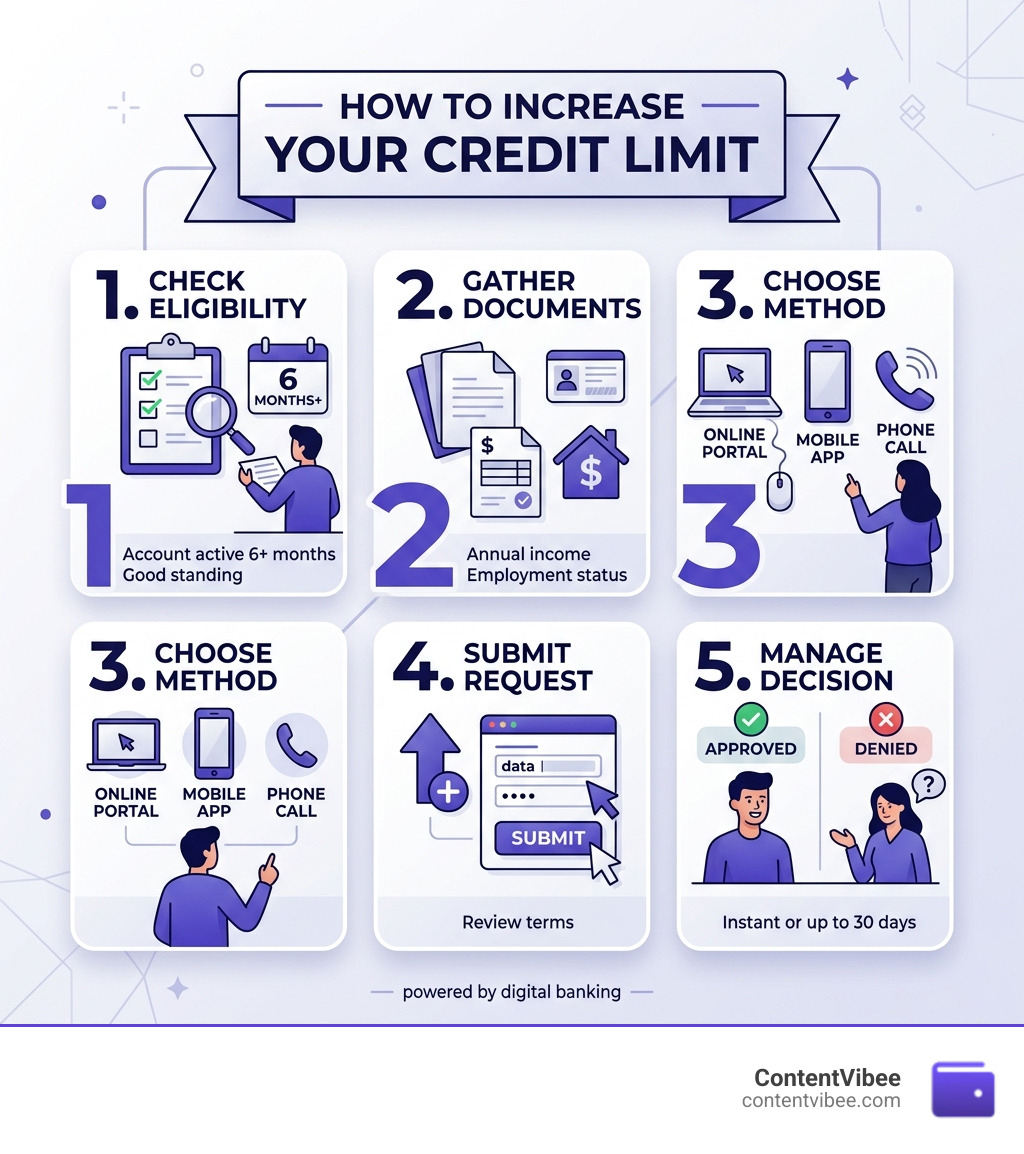
How to Increase Credit Limit: The 5-Step Process
When we think about credit limits, we often view them as a “set it and forget it” number assigned by a bank. In reality, a credit limit is more like a conversation between you and your lender. It’s a reflection of the “small amount of trust” they extended to you when you first opened the account. As that trust grows through responsible habits, so should your spending power.

The most important concept to master before hitting that “request” button is credit utilization. This is the percentage of your total available credit that you’re actually using. For example, if you have a $5,000 limit and a $2,500 balance, your utilization is 50%. Most financial experts recommend keeping this number under 30% to maintain a healthy FICO score. By increasing your limit while keeping your spending the same, you instantly lower that ratio and give your credit score a nice “high-five.”
Only the primary cardholder can request an increase. If you are an authorized user or a secondary cardholder, you typically won’t have the authority to make this change. Your account must also be in good standing, meaning no recent late payments or over-limit fees.
Step 1: Evaluate Your Eligibility and Timing
Timing is everything in comedy and credit. If you just opened your card yesterday, the bank likely won’t give you more money today. A common industry rule of thumb is the 6-month rule. Most card issuers require your account to be open for at least six months — and sometimes up to a year — before they will consider an increase.
We recommend checking your credit health first. If your score has recently dipped because of a new loan or a few missed payments, it’s probably not the best time to ask for more. On the flip side, if you’ve recently received a raise or your credit score has climbed into the “good” range (typically 670 and up), you’re in a prime position.
If you’re starting from scratch or have a “thin” credit file, you might want to look into specialized options. For instance, you can find More info about credit building cards to help establish the history needed for future increases.
Step 2: Gather Your Financial Documentation
Before you start the request, have your “financial ducks” in a row. The bank is going to ask questions, and “I think I make enough” isn’t a great answer. You’ll need to provide:
- Total Annual Income: This includes your salary, but don’t forget you can often include a spouse’s income, bonuses, or even alimony if you have reasonable access to it.
- Employment Status: Are you full-time, part-time, or self-employed?
- Monthly Housing Costs: Whether it’s a mortgage or rent, they want to see how much of your income is already spoken for.
Lenders use this data to calculate your debt-to-income (DTI) ratio. If too much of your monthly pay goes toward debt, they might see a higher credit limit as a risk rather than a reward. For a deeper dive into what lenders look for, check out Credit Limit Increases: What to Know | Equifax® .
Step 3: Select Your Preferred Request Method
In May 2026, we have more ways to communicate with our banks than ever before. You generally have three paths:
- Online Portal: Most major issuers have a “Request Credit Limit Increase” button tucked away under “Account Services” or “Manage Card.” This is usually the fastest method.
- Mobile App: If you’re on the go, the app is your best friend. It’s often a simple form where you update your income and hit submit.
- Customer Service (Phone): Sometimes, the human touch is better. If you have a long history with the bank, calling the number on the back of your card allows you to explain why you want the increase. You can highlight your loyalty and perfect payment record.
While you’re managing your account, it’s also a good time to ensure your payment systems are streamlined. You can find More info about managing card payments to ensure you never miss a due date, which is crucial for staying eligible for future increases.
Step 4: Submit Your Request on How to Increase Credit Limit
Now comes the moment of truth. When you submit your request for how to increase credit limit, the issuer will perform a credit check. It’s vital to know if this will be a soft inquiry or a hard inquiry.
- Soft Inquiry: This is like a “sneak peek” at your credit. It does not affect your credit score. Many modern issuers (like Capital One or Discover) often use soft pulls for limit increases.
- Hard Inquiry: This is a formal look at your credit report. According to FICO®, a single hard inquiry typically lowers your score by only a few points, but it stays on your report for two years.
If you’re planning a major financial move soon, like buying a home, you might want to avoid hard inquiries. For those in the middle of home-buying, you might also be looking at More info about refinancing costs or More info about closing costs in Virginia. In these cases, a small dip in your score could affect your interest rate, so always ask the card issuer about their inquiry policy first. You can also read How to increase your credit limit | U.S. Bank for more on how different banks handle these requests.
Step 5: Manage the Decision and Next Steps
Once you hit submit, one of three things will happen:
- Instant Approval: Congratulations! Your new limit is often available immediately or within 2 business days.
- The “Wait and See”: Sometimes the system needs a human to review the request. This can take anywhere from 7 to 30 days.
- The Denial: If you’re denied, don’t panic. The law requires the lender to send you an adverse action letter (usually within 7-10 business days) explaining exactly why. Use this as a roadmap. If they say your “income is too low” or “utilization is too high,” you know exactly what to work on before trying again in six months.
Interestingly, you might not even have to ask. Many issuers automatically assess accounts for increases every 6 to 12 months. Keeping your income information updated in your profile is a great way to trigger these “unsolicited” raises.
Conclusion: Mastering Your Financial Flexibility
At ContentVibee, we believe that credit is a tool, not a trap. Knowing how to increase credit limit is a key part of financial literacy. It’s not just about having the ability to buy a fancy new sofa (though that’s a nice perk); it’s about building a robust financial profile that gives you lower interest rates and more options in the long run.
By following these five steps, you’re taking control of your financial narrative. Just remember: with great power comes great responsibility. A higher limit only helps your score if you keep your spending habits the same. If a higher limit leads to higher debt, it can quickly become a burden.
Key Takeaways for Your Credit Journey:
- Wait at least 6 months between requests.
- Keep your total credit utilization under 30%.
- Update your income regularly to prompt automatic increases.
- Always ask if the request involves a hard or soft credit pull.
- If denied, read the adverse action letter and improve the specific areas mentioned.
Ready to dive deeper into managing your money? Check out More info about finance services for more tips on staying ahead of the curve.
The Strategic Benefits of Knowing How to Increase Credit Limit
Why go through all this trouble? Beyond just a higher number on your statement, there are strategic advantages. A higher limit acts as an emergency cushion for unexpected car repairs or medical bills. It also increases your rewards potential; if you can funnel more of your regular monthly spending through a rewards card (and pay it off in full!), you’ll rack up points or cashback much faster.
To help you decide when to pull the trigger, here is a quick comparison of what to expect during the inquiry process:
| Inquiry Type | Impact on Credit Score | Duration on Report | Visibility to Other Lenders |
|---|---|---|---|
| Soft Inquiry | None | Not visible to others | Does not affect future loans |
| Hard Inquiry | Small dip (usually <5 points) | 2 years | Visible to other lenders |
By mastering these steps, you aren’t just asking for more money; you’re proving to the financial world that you are a savvy, responsible manager of your own wealth. Happy spending (and saving)!


