


Why Most Americans Are Leaving Money on the Table in Retirement
Retirement tax savings strategies can make the difference between a comfortable retirement and one where taxes quietly drain your income year after year.
Here are the most effective strategies at a glance:
- Build a tax-diversified portfolio across pre-tax, Roth, and taxable accounts
- Use smart withdrawal sequencing to avoid unnecessary tax spikes
- Execute Roth conversions during low-income years before RMDs begin
- Manage Required Minimum Distributions (RMDs) to avoid the 50% penalty and reduce taxable income
- Control provisional income to minimize taxes on Social Security benefits
- Maximize HSAs for triple tax benefits on medical expenses
- Use Qualified Charitable Distributions (QCDs) to give tax-free directly from your IRA
Here’s a surprising fact: 64% of Americans aren’t sure how their taxes in retirement will compare to their current situation. That uncertainty is costly. Without a plan, you could end up paying taxes on up to 85% of your Social Security benefits, face oversized Required Minimum Distributions that push you into a higher bracket, or lose Medicare subsidies to IRMAA surcharges — all without realizing it until the damage is done.
The core problem isn’t just how much you’ve saved. It’s where you’ve saved it and how you draw it down.
A retiree pulling from the wrong account at the wrong time can pay tens of thousands more in lifetime taxes than someone with the exact same savings but a smarter strategy. Research shows that simply switching from a sequential withdrawal approach to a proportional one can cut lifetime taxes by over 45%.
The good news? You don’t need to be a tax expert to get this right. You just need a clear framework — and that’s exactly what this guide provides.
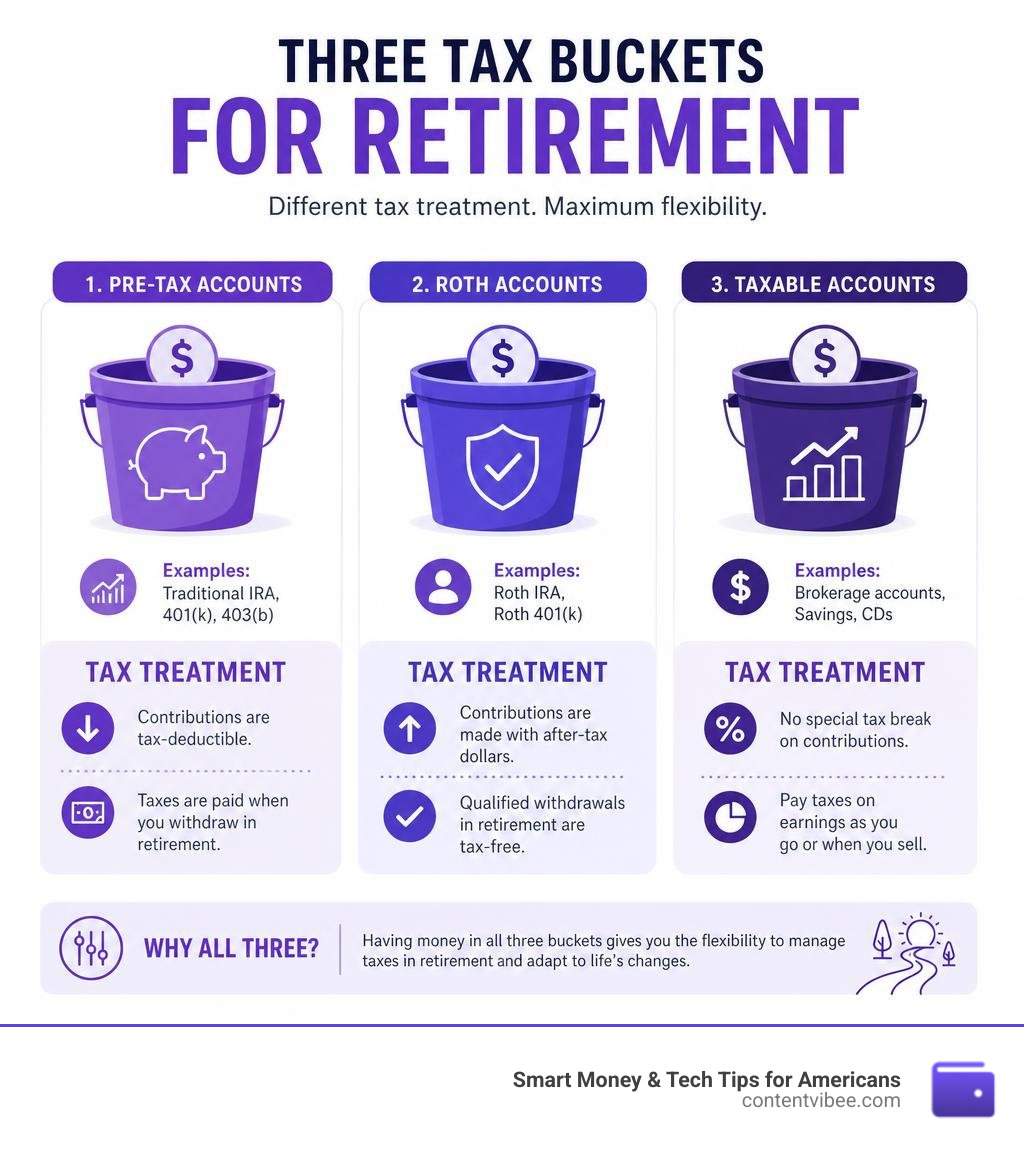
1. Build a Tax-Diversified Portfolio Across Three Key Buckets
To build a truly bulletproof retirement plan, we must first understand how our savings are categorized. We like to think of retirement savings in three distinct “tax buckets.” Each bucket has its own set of rules, and having money in all three gives us the flexibility to control our taxable income in any given year.
If all your money is locked up in a single bucket (usually a traditional pre-tax 401(k)), you have very little control. Every dollar you withdraw is taxed as ordinary income. By diversifying across different account types, we can manage our tax risk and keep our lifetime tax bill as low as possible.
Here is how the three buckets compare:
| Tax Bucket | Account Types | Tax Treatment on Contributions | Tax Treatment on Withdrawals |
|---|---|---|---|
| Pre-Tax (Tax-Deferred) | Traditional IRA, Traditional 401(k), 403(b) | Tax-deductible now (reduces current taxable income) | Taxed as ordinary income |
| Tax-Free (Roth) | Roth IRA, Roth 401(k) | Made with after-tax dollars (no immediate tax break) | 100% tax-free (contributions and earnings) |
| Taxable | Brokerage accounts, Savings, CDs | Made with after-tax dollars | Capital gains tax rates (0%, 15%, or 20%) on growth |
Many savers overlook the power of the Roth and taxable buckets during their peak earning years. However, utilizing After-Tax Contributions: How to Maximize Your Retirement Nest Egg can help you build up these alternative buckets even if you have already maxed out your standard pre-tax contributions.
Implementing Retirement Tax Savings Strategies Through Asset Location
Once you have established these three buckets, you shouldn’t just buy the exact same investments in every account. That is a common mistake that quietly leaves money on the table. Instead, we use a strategy called asset location—placing specific assets into the account type that taxes them most lightly.
To optimize your asset location, we recommend following these general guidelines:
- Put your highest-growth assets in Roth accounts: Because Roth withdrawals are entirely tax-free, you want your investments with the highest growth potential (like emerging markets, technology stocks, or broad equity index funds) to compound inside this bucket.
- Put high-yield and ordinary-income assets in pre-tax accounts: Assets that generate high levels of taxable interest, such as corporate bonds, REITs, and high-yield funds, should be shielded inside your traditional IRA or 401(k) so you don’t pay high ordinary income tax rates on their annual payouts.
- Put tax-efficient investments in taxable brokerage accounts: Broad-market index funds with low turnover are highly tax-efficient. They generate minimal capital gains distributions, and when you do sell them, you will qualify for preferential long-term capital gains tax rates.
2. Master Tax-Efficient Withdrawal Sequences to Avoid the “Tax Bump”
For decades, the standard “rule of thumb” was simple: spend your taxable brokerage accounts first, let your tax-deferred pre-tax accounts grow, and touch your tax-free Roth accounts last.
While this sounds logical, it is actually a trap for many retirees.
If you completely drain your taxable accounts first, your traditional 401(k) and IRA balances will compound untouched. By the time you reach age 73, these pre-tax accounts will have ballooned, triggering massive Required Minimum Distributions (RMDs). This sudden surge in taxable income creates a mid-retirement “tax bump,” pushing you into higher tax brackets, triggering taxes on your Social Security benefits, and increasing your Medicare premiums.

Instead of this rigid, sequential approach, we often advocate for proportional withdrawals. This means withdrawing from all three buckets simultaneously based on their percentage of your overall savings.
According to research, a proportional withdrawal strategy can cut your lifetime retirement taxes by over 45% and extend your portfolio’s longevity. This strategy keeps your taxable income level, allowing you to stay in lower tax brackets throughout your golden years.
Another major benefit of this approach is the ability to leverage the 0% long-term capital gains tax rate. For the 2026 tax year, single filers with taxable income up to $49,450 (and married couples filing jointly up to $98,900) qualify for a 0% federal tax rate on qualified dividends and long-term capital gains. By carefully blending withdrawals, you can keep your ordinary income low enough to pay absolutely nothing in federal taxes on your investment gains.
To learn more about structuring your distributions, read about Tax-savvy withdrawals in retirement.
Optimizing Your Withdrawal Order with Retirement Tax Savings Strategies
To implement these retirement tax savings strategies effectively, we must look at a method called the bracket-fill strategy.
Instead of waiting for RMDs to dictate your tax bracket, you intentionally withdraw enough money from your pre-tax accounts each year to “fill” the lowest tax brackets.
For example, under 2026 rules, the 12% federal income tax bracket for married couples filing jointly extends up to $100,800, with a standard deduction of $32,900. This means a married couple can have up to $133,700 in gross income before they hit the 22% tax bracket.
If your lifestyle only requires $80,000, you can still withdraw extra money from your traditional 401(k) up to the top of that 12% bracket limit. You can use the excess cash to fund your lifestyle, pay off low-interest debt, or reinvest it in a taxable account. This keeps your traditional account balances in check, lowering your future RMD liabilities.
For those who are transitioning from a career to retirement, check out our guide on Pension vs 401k Tax Strategies for Working Retirees to see how your pension income fits into this bracket-filling puzzle.
3. Execute Strategic Roth Conversions in Low-Income Gap Years
One of the most powerful retirement tax savings strategies available is the Roth conversion. This is the process of moving money from a pre-tax traditional IRA or 401(k) into a tax-free Roth IRA. You must pay ordinary income tax on the converted amount in the year of the conversion, but once the money is in the Roth IRA, it grows 100% tax-free, and future withdrawals are completely tax-free.

The absolute best time to do this is during your gap years—the sweet spot between the day you retire and the day you start taking Social Security benefits and RMDs (typically between ages 60 and 73).
During these gap years, your taxable income is often at an all-time low. This gives you a golden opportunity to convert large sums of pre-tax money to a Roth IRA at historically low tax rates.
By executing strategic Roth conversions during these years, you achieve three critical goals:
- Reduce future RMDs: By shrinking your pre-tax balance, you reduce the size of the mandatory withdrawals you must take later in life.
- Hedge against future tax rate risk: If you believe federal tax rates will rise in the future, paying the tax now at today’s known rates is a highly effective hedge.
- Leave a tax-free legacy: Unlike traditional IRAs, which your heirs must fully liquidate and pay taxes on within 10 years, inherited Roth IRAs are passed down completely tax-free.
4. Defuse the RMD Time Bomb and Leverage QCDs
Once you reach age 73, the IRS requires you to begin taking annual withdrawals from your traditional IRAs and workplace retirement plans. These are called Required Minimum Distributions (RMDs).
The IRS does not let you keep your money tax-deferred forever. If you fail to make the necessary RMD withdrawals, the penalty is incredibly steep: the IRS can assess a penalty against you of 50% of the amount that you should have taken out.
Fortunately, there are ways to defuse this tax bomb. If you are charitable-minded and over age 70½, you can utilize a Qualified Charitable Distribution (QCD).
A QCD allows you to transfer up to $100,000 per year directly from your traditional IRA to a qualified 501(c)(3) charity.
The beauty of a QCD is twofold:
- The distributed amount is excluded from your adjusted gross income (AGI), meaning you pay $0 in taxes on the withdrawal.
- The transfer counts directly toward satisfying your annual RMD requirement.
This is an incredibly tax-efficient way to give. Because it reduces your AGI, it can also prevent you from crossing key income thresholds that trigger taxes on your Social Security benefits or raise your Medicare premiums.
For more tips on navigating post-retirement rules, read Taxes in Retirement: 7 Tax Tips for After You Retire – TurboTax .
5. Minimize Taxes on Social Security Benefits and Avoid the IRMAA Cliff
Many retirees are shocked to discover that their Social Security benefits can be taxed. The IRS determines this using a metric called provisional income (also known as combined income).
Your provisional income is calculated as: $$\text{Provisional Income} = \text{Adjusted Gross Income (AGI)} + \text{Tax-Exempt Interest} + 50\% \text{ of your Social Security Benefits}$$
If this sum exceeds certain thresholds, you will have to pay taxes on a portion of your benefits:
- For Single Filers:
- Between $25,000 and $34,000: Up to 50% of your benefits are taxable.
- Over $34,000: Up to 85% of your benefits are taxable.
- For Married Joint Filers:
- Between $32,000 and $44,000: Up to 50% of your benefits are taxable.
- Over $44,000: Up to 85% of your benefits are taxable.
To keep your provisional income below these thresholds, we recommend pulling income from your Roth IRA or taxable brokerage accounts, as these distributions do not count toward the provisional income formula. For a deeper dive into this calculation, read our Social Security Taxable Income Guide 2026 and explore Taxing Your Golden Years: A Guide to Social Security Tax on Benefits.
Another major hurdle is the IRMAA (Income-Related Monthly Adjustment Amount) cliff. IRMAA is a surcharge added to your Medicare Part B and Part D premiums if your modified adjusted gross income (MAGI) exceeds certain limits ($106,000 for single filers and $212,000 for married couples in 2026).
Unlike progressive tax brackets, IRMAA is a cliff. If you go over the limit by even $1, you will face hundreds or thousands of dollars in additional Medicare premiums per year.
Furthermore, we must plan for the surviving spouse tax impact. When one spouse passes away, the survivor’s filing status changes from Married Filing Jointly to Single. This cuts their tax brackets and standard deductions nearly in half, but their income (from pensions, RMDs, and Social Security) often remains relatively high, pushing them into a much higher tax bracket overnight.
6. Maximize HSAs and Utilize Net Unrealized Appreciation (NUA)
If you have access to a Health Savings Account (HSA), you hold the keys to the ultimate retirement tax shelter. HSAs offer an unparalleled triple tax benefit:
- Contributions are 100% tax-deductible (pre-tax).
- The balance grows and compounds 100% tax-free.
- Withdrawals are 100% tax-free when used for qualified medical expenses.
In retirement, healthcare is often one of the largest expenses. Using an HSA to pay for these costs tax-free is a brilliant way to preserve your other retirement accounts.
Additionally, if you hold highly appreciated employer stock inside a workplace retirement plan like a 401(k), you should look into Net Unrealized Appreciation (NUA).
Normally, when you withdraw money from a traditional 401(k), the entire amount is taxed as ordinary income. However, under NUA rules, you can transfer the employer stock to a taxable brokerage account.
You will pay ordinary income tax only on the original cost basis (what the stock was worth when it was purchased). The growth (the net unrealized appreciation) is taxed at much lower long-term capital gains rates when you eventually sell the stock.
This strategy can save you hundreds of thousands of dollars in taxes if you have a significant amount of company stock.
For more advanced strategies like this, review 6 Tax Strategies Your Clients Can Use in Retirement .
Frequently Asked Questions About Retirement Tax Savings Strategies
How does the 10-year rule affect inherited retirement accounts?
Under the SECURE Act, most non-spouse beneficiaries who inherit a traditional IRA or 401(k) must fully liquidate the account by the end of the 10th year following the owner’s death. Because these withdrawals are taxed as ordinary income, inheriting a large pre-tax account can push your children or heirs into their peak tax brackets, triggering a massive tax bill.
To manage this, proactive beneficiary planning is key. You can consider splitting beneficiaries, converting assets to Roth IRAs during your lifetime, or utilizing trust structures to spread out the tax impact over time.
What is the standard deduction for retirees over age 65?
The IRS provides an extra tax break for seniors. If you are 65 or older, you qualify for a higher standard deduction.
When filing Single, the 2024 Standard Deduction for those 65 and older is $1,950 higher than for those under 65. For tax year 2024, if you are filing jointly with a spouse who is also 65 or older, you will file a return and pay taxes only if your joint income exceeds $32,300 ($30,750 if your spouse isn’t 65 yet).
How do catch-up contributions help boost retirement savings?
If you are age 50 or older, the IRS allows you to make “catch-up contributions” to accelerate your savings. Workers who are 50 or older can contribute an extra $1,000 to an IRA in 2024, on top of the standard contribution limits. Workplace plans like 401(k)s and 403(b)s also offer substantial catch-up opportunities, allowing you to defer more income and lower your current tax liability during your highest-earning years.
Conclusion
Navigating taxes in retirement can feel like walking through a minefield, but with the right retirement tax savings strategies, you can keep more of your hard-earned money. From tax diversification and asset location to Roth conversions and QCDs, the choices you make today will directly shape your financial freedom tomorrow.
Because everyone’s financial situation is unique, we highly recommend consulting a qualified tax advisor or financial professional. They can help you build a personalized tax-efficient withdrawal plan that accounts for your specific income sources, tax brackets, and retirement goals.
At ContentVibee, we are dedicated to helping you make smart money decisions. To continue optimizing your retirement, read our guide on Uncle Sam’s Cut: Understanding Taxes on Social Security.