


What an Auto Loan Calculator with Trade In and Payoff Actually Shows You
Using an auto loan calculator with trade in and payoff is the fastest way to know your real monthly payment before you set foot in a dealership. Most people only see the sticker price — but your actual loan amount depends on several moving parts working together.
Here’s how to calculate your auto loan payment with a trade-in and payoff in 5 steps:
- Start with the negotiated vehicle price — not the sticker price
- Subtract your down payment from that price
- Subtract your trade-in value — or add the amount you still owe if it’s more than the car is worth
- Add sales tax and dealer fees (doc fee, title, registration)
- Apply your interest rate and loan term to get your monthly payment
Example: You’re buying a $35,000 car. You put $3,000 down. Your trade-in is worth $8,000 but you still owe $10,000 on it — meaning you have $2,000 in negative equity. That $2,000 gets added to your loan, not subtracted. Your real financed amount could easily hit $28,000 or more once taxes and fees are included.
This matters more than most people realize. According to data from Q2 2025, 31% of new-vehicle trade-ins carried negative equity, averaging $6,754 owed beyond the car’s value. At a typical used-car rate, that $6,754 can cost you roughly $9,200 by the time the loan is done.
A standard calculator won’t show you any of that.
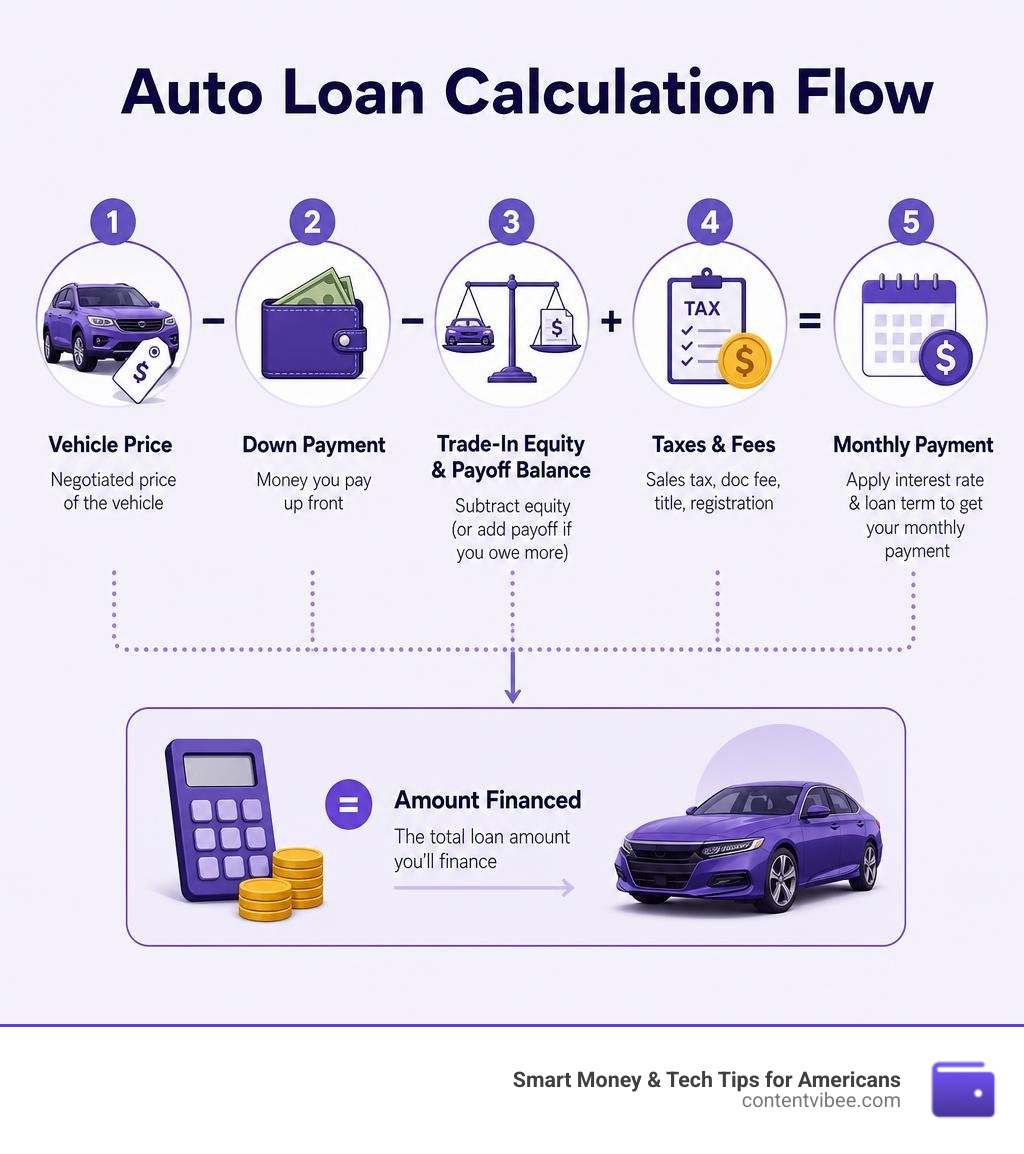
Auto loan calculator with trade in and payoff basics:
Why You Need an Auto Loan Calculator with Trade In and Payoff

When we go car shopping, we tend to focus on the negotiated price of the new ride. But if we are trading in our old car, that transaction is actually a dual-deal. We are selling a car to the dealer and buying a new one from them at the same time.
If we still have an outstanding loan on our current vehicle, the dealer has to pay off that loan to get the title. A standard loan calculator simply cannot handle this math. To understand how your trade-in value, outstanding loan balance, and new car price interact, you need an auto loan calculator with trade in and payoff.
By using a specialized tool, we can visually separate our trade-in equity from our down payment. We can see exactly how much interest we will save by lowering our loan balance, or how much extra we will pay if we have to roll negative equity into our new loan. If you want to understand how your APR affects these numbers overall, check out The Ultimate Guide to Using a Car Loan Rates Calculator.
Standard Calculators vs. an Auto Loan Calculator with Trade In and Payoff
A standard car payment calculator is straightforward: you input the purchase price, down payment, interest rate, and term. It assumes you are starting with a clean slate.
An auto loan calculator with trade in and payoff adds two critical fields:
- Trade-In Value: What the dealer is willing to pay for your old car.
- Payoff Balance (Amount Owed): Exactly what you still owe your current lender to clear the title.
The calculator automatically subtracts the payoff balance from the trade-in value to find your net trade-in equity. That net figure is what actually alters your new loan amount.
How to Estimate Your Net Trade-In Equity
Your net trade-in equity will fall into one of two categories:
- Positive Equity: Your car is worth more than you owe. If your car is appraised at $15,000 and your payoff balance is $10,000, you have $5,000 in positive equity. This acts just like a cash down payment, reducing your new loan balance. You can estimate your vehicle’s worth using reputable online valuation guides.
- Negative Equity (Being “Upside Down”): You owe more than the car is worth. If your car is appraised at $10,000 but your payoff balance is $15,000, you have $5,000 in negative equity. This amount must be paid in cash at the dealership or rolled into your new loan, which increases your monthly payment.
To get an accurate payoff number, do not guess based on your last monthly statement. Call your lender and ask for a written 10-day payoff quote. This includes the exact principal and interest accrued up to the day the dealer’s check will arrive.
Key Inputs for an Accurate Payment Calculation

To get the most out of your calculator, you need to feed it accurate, real-world data. Garbage in means garbage out, and a dealer’s finance office will quickly spot any unrealistic numbers you used. If you want to see how these inputs fit into a tight budget, take a look at How to Drive Away with a 15k Car Loan Without Wrecking Your Budget.
Essential Inputs for an Auto Loan Calculator with Trade In and Payoff
Before you start typing numbers, gather these key figures:
- Negotiated Price: This is the actual selling price of the new car, not the MSRP sticker price. Always negotiate the vehicle price first before talking about trade-ins or monthly payments.
- Down Payment: The physical cash you plan to hand over.
- Trade-In Value: Be realistic here. Use wholesale or trade-in values from reputable vehicle valuation sources rather than private-party retail values. Dealers must recondition and profit from your trade-in, so they will offer less than a private buyer would.
- Amount Owed on Trade-In: Your official 10-day payoff amount.
- Interest Rate (APR): Your APR depends heavily on your credit score. As of July 2026, Experian data shows new-car prime-credit APRs average around 6.37%, while used-car rates hover around 11.26%. That interest rates make a massive difference; on a $35,000 loan over 60 months, a mere 1.5% rate difference translates to about $1,600 in total interest saved or spent.
- Loan Term: The length of the loan, usually ranging from 36 to 84 months.
Factoring in Dealer Fees and Registration Costs
Many buyers forget that the vehicle price isn’t the “out-the-door” price. Dealers add several fees that are often financed directly into the loan:
- Documentation Fee (Doc Fee): This is what the dealer charges to process the paperwork. It ranges from $200 to $700 depending on your state (some states cap this fee, while others do not).
- Title and Registration Fees: The cost to register the car with your state’s DMV.
- GAP Insurance: If you have negative equity or are making a very small down payment, GAP (Guaranteed Asset Protection) insurance is highly recommended. It covers the “gap” between what the car is worth and what you owe if the car is totaled. This typically adds $400 to $800 to your loan.
How State Sales Tax Rules Impact Your Trade-In Value
One of the biggest hidden benefits of trading in a vehicle is the sales tax credit. However, how this credit is calculated depends entirely on where you live and register the vehicle.
| Tax Rule Type | How It Works | Example Scenario |
|---|---|---|
| Difference Tax (Most States) | Sales tax is only charged on the net difference between the new car price and trade-in value. | Buying a $30,000 car with a $10,000 trade-in means you only pay sales tax on $20,000. |
| Full-Price Tax (7 Jurisdictions) | Sales tax is charged on the full purchase price of the new car, regardless of trade-in. | Buying a $30,000 car with a $10,000 trade-in means you still pay sales tax on the full $30,000. |
Full-Price Tax vs. Difference Tax States
In a “difference tax” state like Texas, trading in your vehicle provides a massive tax shield. If you buy a $30,000 car and trade in your old car for $10,000, your taxable amount is reduced to $20,000. At a 6.25% tax rate, you pay $1,250 in tax instead of $1,875 — saving you a clean $625.
In “full-price tax” states — which include California, Maryland, Virginia, Kentucky, Hawaii, District of Columbia, and Michigan (within certain caps) — you do not get this break. If you buy that same $30,000 car in California, you will pay sales tax on the full $30,000, even if your trade-in is worth $15,000.
To see how these different rules affect your final numbers, you can model your state’s rules using an online auto loan calculator that accounts for local sales tax regulations.
Cross-State Purchases and No-Tax States
If you live in a state with no sales tax (Alaska, Delaware, Montana, New Hampshire, and Oregon), you won’t have to worry about these calculations. However, if you live in a taxed state and buy a car across state lines, be prepared: you will pay the sales tax rate of the state where you register the vehicle, not where you bought it.
The Real Cost of Rolling Negative Equity into a New Loan
If you are “upside down” on your current car loan, trading it in can feel like an easy escape. The dealer will happily offer to “wipe out” your old loan by rolling the negative equity into your new loan. But make no mistake: that debt does not disappear. It is simply added to your new principal balance.
The Danger of Rolling Negative Equity
When you roll negative equity forward, you are borrowing money for a car you no longer own. This inflates your loan-to-value (LTV) ratio, often pushing it past 100%. Lenders view high LTV loans as high-risk, which can result in a higher interest rate.
The compounding interest on rolled debt is brutal. Let’s look at the numbers:
- The Debt: You roll $6,700 of negative equity (the Q2 2025 average) into a new loan.
- The Rate: Because it’s rolled debt, it often gets calculated at used-car interest rates, which averaged 11.26% in late 2025.
- The Cost: Over a 72-month term, that $6,700 in negative equity will cost you roughly $2,500 in extra interest alone. You end up paying back $9,200 for a car you already traded away.
You can run your own “what-if” negative equity scenarios using an online auto loan calculator that allows you to input both trade-in value and payoff amount.
Estimating Your Months Until Positive Equity
When you roll negative equity into a new car, you start your new ownership journey deep underwater. Because new cars depreciate rapidly — typically losing 15% to 20% of their value in the first year — your loan balance will remain higher than the car’s actual value for a very long time.
An advanced auto loan calculator with trade in and payoff can estimate your months until positive equity. It does this by mapping a standard vehicle depreciation curve against your loan amortization schedule. If you roll negative equity into a 72-month or 84-month loan, you might not see positive equity until month 48 or 60. If you need to trade that car in early due to life changes, you’ll be trapped in an even deeper negative equity cycle.
Comparing Loan Terms and the 20/4/10 Affordability Rule
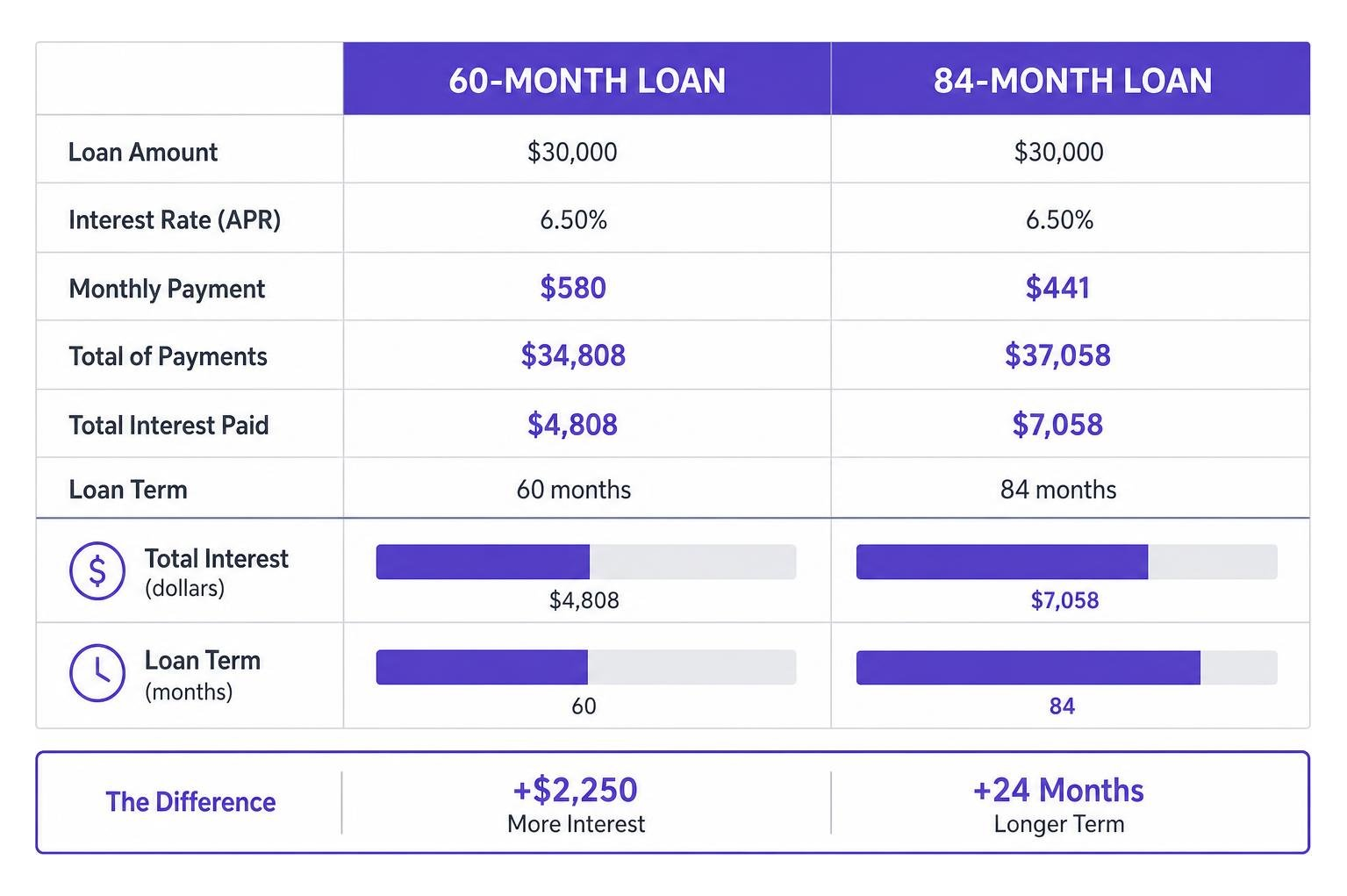
To make monthly payments look affordable, dealerships love to stretch loan terms out. While 60-month terms used to be the standard, 84-month (7-year) loans have skyrocketed, growing from 7.3% of new-car sales in 2019 to 12.8% by March 2026. For a deeper look at managing these timelines, explore The 5-Year Car Loan Roadmap: Navigating 15k, 30k and 50k Auto Loans.
Shorter vs. Longer Loan Terms
Stretching your loan term lowers your monthly payment, but it drastically increases the total interest you pay over the life of the loan.
Let’s look at a $32,000 loan at 6.5% APR:
- 60-Month Term: Your monthly payment is $558, and you pay $5,260 in total interest.
- 84-Month Term: Your monthly payment drops to $435, but your total interest jumps to $7,750.
By stretching the loan to 84 months, you save $123 a month but throw away an extra $2,490 in pure interest. If you want to see how making extra payments early can counteract this, use a car loan prepayment calculator.
Applying the 20/4/10 Rule to Your Budget
To keep yourself financially secure, we recommend using the 20/4/10 rule as a sanity check before signing any paperwork:
- 20% Down: Put at least 20% down on the vehicle (this can be a combination of cash and positive trade-in equity). This protects you from immediate depreciation.
- 4-Year Term: Limit your financing term to 48 months (4 years).
- 10% of Income: Keep your total transportation costs — including your car payment, insurance, fuel, and maintenance — under 10% of your take-home pay.
If your calculator results show that your desired car doesn’t fit the 20/4/10 rule, it is a clear sign to look for a more affordable vehicle, save a larger down payment, or wait until you have more positive equity in your trade-in.
Frequently Asked Questions about Auto Financing
Can I trade in a car if I still owe money on it?
Yes! You can trade in a car with an outstanding balance. The dealership will contact your current lender to get the 10-day payoff amount. They will pay off your old loan directly and obtain the title. If you have positive equity, it will be applied as a down payment toward your new car. If you have negative equity, you must either pay the difference in cash or roll it into your new auto loan.
Is it better to lease or finance a new vehicle?
It depends on your driving habits and financial goals. Financing leads to ownership, allowing you to eventually live payment-free and build equity. Leasing offers lower monthly payments and lets you drive a new car every few years, but you will always have a car payment and must adhere to strict mileage limits. For a complete breakdown, read Everything You Need to Know About Lease vs Finance.
How does my credit score affect my auto loan interest rate?
Your credit score is the single biggest factor determining your APR. Buyers with excellent credit (750+ FICO) qualify for prime rates, which averaged around 6.37% for new cars in late 2025. Buyers with subprime credit (below 620) may face APRs of 15% or higher.
To find the best rates, we recommend shopping around at local credit unions or checking direct lenders like the Auto Loan Calculator & Car Payment Tool at Bank of America.
Conclusion
At ContentVibee, we believe that making smart money decisions starts with preparation. Walking into a dealership without running the numbers first is like grocery shopping on an empty stomach — you are highly likely to walk out with a deal that leaves you financially hurting.
Using an auto loan calculator with trade in and payoff gives you the upper hand. You will know exactly how much your trade-in is worth, how your payoff balance affects your bottom line, and what your state’s tax laws mean for your wallet.
Armed with this data, you can secure pre-approval from a bank or credit union before you visit the dealer, giving you a powerful benchmark to negotiate the best possible financing. Ready to start modeling your next upgrade? Head over to our ContentVibee Finance Calculator to run your numbers and take complete control of your auto purchase today.


